You’ve promised the kids a pair of skates for their birthday, or perhaps you’ve finally decided to try inline skating yourself after watching others glide effortlessly along the seafront. You head to Amazon, type “roller skates” or “inline skates”, and immediately face hundreds of listings: cheap-looking options with barely any reviews, premium-sounding names that tell you nothing about actual quality, and prices that vary so wildly they make no sense without context. Maybe you bought a pair before and the wheels seized up after a month of light use. Maybe the buckles snapped the first time the kids put them on with a bit too much enthusiasm. Or perhaps you’ve never bought skates before and genuinely don’t know whether you need wrist guards, what ABEC bearings actually do, or how to size adjustable skates for a child who’ll grow two shoe sizes by spring. This guide cuts through the noise and tells you exactly what to buy — skates and protection — so you can actually enjoy skating from the very first session.
How These Picks Were Chosen
Every product in the current Amazon UK results for inline and roller skating was reviewed and filtered before a single pick was made. Any listing without verified buyer reviews was set aside — there simply isn’t enough real-world evidence to recommend those confidently. The remaining products were assessed against four criteria: adjustability and fit (particularly important for growing children), wheel quality and bearing type (which directly affects how smooth the ride feels), boot construction and ankle support (critical for preventing injuries), and for protective gear, how well the padding distributes impact rather than simply looking the part. Where manufacturer specifications weren’t confirmed within the product listing, they’re described generically rather than stated as hard numbers. The five picks below cover actual skates for children and adults, alongside the protective gear worth pairing with them.
Best Kids Inline Skates Overall
For a child taking their first proper steps on wheels, the Kids Adjustable Inline Skates for Girls and Boys Blades Roller Light up Wheels is the standout choice on Amazon UK right now. With 640 verified buyers awarding it 4.8 out of 5 stars, that rating carries genuine weight — it’s the kind of consensus that’s hard to manufacture and easy to trust.
The core appeal is the adjustable sizing system. Rather than buying a fixed shoe size that your child outgrows in six months, these skates span multiple sizes within a single pair, adjusted using a straightforward mechanism on the boot. That’s real value for money when you’re buying for a growing child, and it means you’re not hunting for a replacement pair every season. The sizing range covers toddlers and younger primary-school children learning to skate, making these a practical first purchase rather than a panic buy.
The light-up wheels sound like a gimmick but serve a real purpose: children who can see their wheels flashing as they skate tend to stay more motivated, and the visual novelty helps nervous beginners focus on the fun rather than the anxiety of staying upright. The wheels illuminate through kinetic energy from rolling, so there’s no battery to replace. What matters most is whether the wheels roll smoothly — and buyer feedback consistently points to a stable, comfortable ride with the boot providing adequate ankle support to keep younger skaters upright while they’re building their balance.
The honest tradeoff is that these are firmly beginner skates. The frame and wheels won’t satisfy a child who’s been skating confidently for a year and wants to go faster or attempt basic tricks. The lightweight materials are right for young kids but won’t withstand serious punishment the way more expensive specialist skates would. The closure system needs to be done up properly every time; a loosely fastened boot offers far less ankle support and increases fall risk considerably. Take the time to tighten everything correctly before each session.
Sizing correctly matters more than most buyers realise. Adjustable skates work best when fitted towards the lower end of the size range, so the foot sits securely rather than sliding forward inside a boot that’s too roomy. Check the size chart against your child’s current shoe size before ordering, and if they’re between sizes, go smaller. At this rating and review count, these are the safest bet for a first pair of kids’ inline skates on Amazon UK.
Best Adjustable Roller Skates for Families
If you need skates that work across a broader age range — perhaps for an older primary-school child heading towards adult sizing, or a household where more than one person wants a go — the Adjustuble Roller Skates with light up wheels for children and adults covers that middle ground well, with 118 reviews supporting a 4.5-star rating.
These are quad-style roller skates — four wheels in a 2×2 arrangement — rather than inline skates, which makes a meaningful difference for beginners of any age. The wider wheelbase provides more inherent stability than the single-line inline format, so a nervous first-timer is less likely to feel as though they’re constantly teetering sideways. That extra stability makes quad skates a popular starting point for adults who’ve never skated before, as well as for older children who find inline boots a bit daunting. The light-up wheel feature appears here too, which tends to go down well when younger family members are involved in the decision.
The adjustable fit is the key practical advantage. Rather than being locked into a single shoe size, the boot can be expanded to accommodate growth or shared between users of different sizes — useful for families who want one pair to serve multiple purposes without buying new skates every season. The adjustment mechanism is worth checking carefully in the product photos before ordering; you want a system that clicks firmly into each size setting rather than one that drifts or loosens mid-session.
The honest limitation is that “adult” sizing in adjustable quad skates often tops out at a standard adult shoe size, so anyone with a particularly large foot should check the maximum range listed before ordering. These are leisure and learning skates rather than something you’d use for a proper workout on a long coastal path — if serious distance skating is the goal, a dedicated adult fitness skate will serve you better. But for family fun, beginners’ sessions, and casual use, the 4.5-star rating from over a hundred buyers suggests the build quality holds up well for recreational skating.
These skates are at their best as a family purchase: fun, adjustable, visually appealing, and versatile enough for different ages and sizes. Pair them with wrist guards and knee pads, particularly for younger or less confident skaters still developing their balance and stopping technique.
Best Inline Skates for Adult Beginners
Adults who want to get into fitness inline skating — commuting, leisure rides along cycle paths, or simply adding an outdoor workout to their weekly routine — need a different kind of skate to what works for children. The AYES Inline Skates, Men and Women Professional Roller Skates Fitness Inline Skate for Adults and Beginners RollerSkates is the adult-focused option currently available with verified buyer feedback on Amazon UK, sitting at 4.0 out of 5 stars across 60 reviews.
A 4.0-star rating is worth some honest context. It’s a respectable score but not the enthusiastic consensus you see with the kids’ skates above. Looking at reviewer feedback reveals a familiar pattern: buyers who sized correctly and took time to adjust the fit properly report a comfortable, stable inline experience suitable for recreational distances; buyers who had sizing issues or expected a more premium performance skate found it lacking. That pattern tells you two things — sizing is critical with this model, and these aren’t a substitute for a specialist performance skate at a higher budget.
For someone starting out with fitness inline skating, the most important feature in any adult skate is ankle support combined with a secure closure system. Look for a boot that holds your foot firmly without creating pressure points, and closures — whether buckles, laces, or a ratchet mechanism — that can be tightened independently across the ankle and upper boot. A properly structured boot at the budget-to-mid-range tier is appropriate for someone building skating fitness gradually rather than someone who’s been skating for years and wants maximum performance.
Wheel size matters more than most new buyers appreciate. Larger wheels roll faster and handle rougher surfaces better, but they raise the skate’s profile and can feel less stable before your technique is established. Mid-sized wheels are a sensible compromise for a new adult skater, offering enough speed without the instability that very large wheels can introduce early in the learning process. When checking listings, look for ABEC-rated bearings — a higher ABEC number indicates better manufacturing precision and a smoother roll, with ABEC-5 or above being a practical baseline for recreational use.
These skates are best suited to adults who want to explore fitness skating without committing to a premium price. They won’t suit aggressive skating or competitive use. If you’re skating on smooth tarmac or cycle paths a few times a week, they’ll do the job. Add wrist guards and knee pads to your order — adult knees don’t forgive falls any more kindly than children’s do — and take the first few sessions on smooth, flat ground while you establish your balance before heading out on busier or rougher routes.
Best Kids Protective Gear Set
Skates without protection aren’t a complete kit, particularly for children who are still developing coordination and reflexes. The Knee Pads for Kids Unicorn Protective Gear Set Knee Pads and Elbow Pads Set with Wrist Guard for Girls Boys Roller Skates Inline Skatings Sc is the most-reviewed protective gear set in this guide, with 250 buyers giving it 4.3 out of 5 stars.
The appeal of a full set is straightforward: you get knee pads, elbow pads, and wrist guards in one purchase rather than hunting for three compatible items separately. For children just starting to skate, all three forms of protection matter. Wrists take the impact of instinctive hands-out falls. Knees hit the ground when a child trips or loses balance mid-stride. Elbows catch grazes when a sideways fall happens — which is frequent when skaters are learning to turn. Buying a matched set also means the sizing is designed to work together rather than mixing and matching from different brands that may not fit consistently across the body.
The unicorn theme is clearly aimed at younger girls, and that’s not a criticism at all. A child who’s excited about their protective gear is far more likely to wear it without argument than one who finds it boring or uncomfortable. Parents of children who resist putting on protection will understand the value of that immediately. Aesthetics aside, what matters is whether the pads stay in position during a fall, whether the straps are adjustable enough to fit properly without slipping, and whether the padding genuinely absorbs impact rather than providing a purely cosmetic layer of cushioning.
At 4.3 stars from 250 reviews, buyer feedback suggests this set works as intended for recreational skating. The tradeoff is that this is a child’s entry-level protective set — it’s designed for the speed and impact levels of a beginner skater on a smooth surface, not for skatepark sessions or more aggressive inline use where falls are harder and faster. If your child progresses to technical skating, upgrading to a purpose-built, higher-rated impact-protection set would be the sensible next step.
Size selection is important. Check the sizing chart against your child’s measurements rather than relying on age guides, and when in doubt, size up slightly for knee pads so they sit properly over the kneecap rather than migrating down the shin during a fall. Wrist guards should fit more snugly, covering the heel of the palm and extending partway up the forearm — that’s the surface that makes contact with the ground first in a forward fall, and the guard needs to cover it reliably to do its job.
Best Wrist Guards for Skaters
Wrist injuries are among the most common skating injuries for skaters of all ages, and they’re largely preventable with the right protection. For adults or older children who need standalone wrist guards rather than a full kids’ set, the Long Damping Non-Slip Anti-Fall Wrist Guards for Skating Skiing Skateboard Snowboard is the reviewed adult option in this guide, with 208 buyers giving it 4.2 out of 5 stars.
The extended design — a guard that runs further up the forearm than a basic wrist guard — is particularly relevant for inline skating. When you fall forward at speed, your hands and forearms take the initial impact over a larger surface area if the guard extends up from the palm. A short guard that only covers the heel of the hand leaves the forearm exposed, which matters at any speed above a gentle roll. The non-slip inner layer helps keep the guard positioned correctly during a fall rather than riding up the arm at the exact moment it’s needed most.
At 4.2 stars from 208 reviewers, feedback is broadly positive. Consistent praise focuses on fit and comfort during extended wear — these guards are noted as comfortable enough for a full skating session without restricting hand movement or causing fatigue. The most common criticism centres on sizing: some reviewers find the sizing runs small. Order carefully by checking your hand circumference measurements against the sizing guide rather than relying on generic S/M/L labels. If you’re between sizes, size up — a tight wrist guard can restrict circulation during sustained exercise, which quickly becomes uncomfortable and may lead you to take the guards off entirely.
These guards are versatile enough for multiple outdoor activities beyond skating, and the construction is appropriate for any situation where a forward fall onto hard ground is a realistic risk. For inline skating specifically, they’re worth wearing regardless of your skill level. Even experienced skaters fall when they hit an unexpected crack in the pavement or a wet patch on tarmac. A wrist fracture takes months to heal and sidelines you from activities well beyond skating; a pair of guards that costs relatively little makes straightforward sense as a permanent part of your kit.
One practical check before you rely on any wrist guard: verify that the palm splint — the rigid insert that sits across the palm and transfers impact away from the wrist joint — is firmly integrated and not a loose insert that can shift during a fall. The structural integrity of that splint is what actually protects the wrist; everything else is about keeping it in position. This applies to any wrist guard you buy, and it’s worth checking before your first session rather than discovering a problem after a fall.
What to Look For When Buying Inline or Roller Skates
- Fixed vs adjustable sizing: For children, adjustable skates are almost always the better buy — they extend across multiple shoe sizes and give you considerably more wearable life from a single purchase. For adults with a stable foot size, a properly fitted fixed boot will typically offer better precision and support than an adjustable alternative at the same price point. Always use the specific size chart rather than your normal shoe size, as skate sizing often differs from standard footwear sizing.
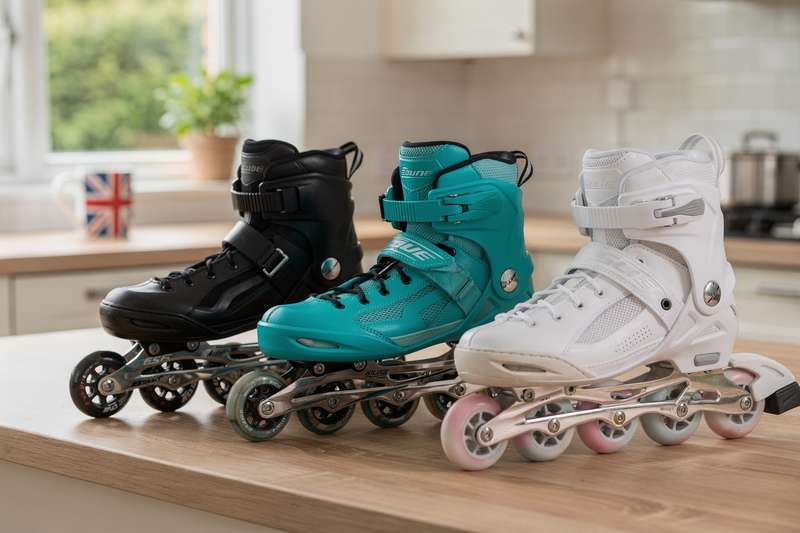
- Inline vs quad: Inline skates — a single row of wheels along the sole — are faster and better suited to fitness skating, commuting, and longer distances. Quad skates — four wheels in a rectangular 2×2 formation — offer more inherent lateral stability and are often a friendlier starting point for nervous beginners of any age. Neither format is objectively superior; your intended use and confidence level determine which is right for you.
- Wheel size and hardness: Larger wheels roll faster and handle rougher ground better; smaller wheels are more manoeuvrable for tight turns. Wheel hardness is measured in durometers (a number followed by “A”) — harder wheels are faster but less forgiving on rough surfaces, while softer wheels grip better but wear more quickly. For smooth tarmac or rink use, harder wheels work well; for mixed urban surfaces, slightly softer wheels are more comfortable.
- Bearing quality: ABEC-rated bearings indicate manufacturing precision — ABEC-5 is a practical baseline for recreational use, while ABEC-7 delivers a noticeably smoother roll worth seeking if you plan to skate regularly. Bearings can be cleaned, lubricated, and replaced independently of the wheels and boot, so a lower bearing rating in an otherwise well-fitting skate doesn’t have to be a deal-breaker.
- Ankle support and closure system: This is the specification most buyers under-prioritise but that matters most for safety. A boot with inadequate ankle support leads to sprains; a loose or poorly designed closure means the boot shifts during skating, reducing control and increasing fall risk. Look for boots with multiple closure points — ideally a buckle over the ankle plus a lace or strap across the upper boot — so you can secure the foot independently at each point.
- Protective gear: Wrist guards, knee pads, and a properly fitted helmet are not optional extras for beginners — they’re part of the minimum kit, especially for children. Falls happen to every new skater; the question is how much damage they cause. Buy protection before your first session, not after your first significant fall.
- Surface compatibility: Smooth-wheeled skates are designed for smooth surfaces — rinks, smooth tarmac, sports halls. If you’re skating on rougher terrain, look for wider, slightly softer wheels and check buyer feedback specifically for mentions of outdoor or rough-surface performance before committing to a purchase.
The Verdict
For the majority of people reading this guide — parents buying skates for a child between the ages of four and ten — the Kids Adjustable Inline Skates for Girls and Boys is the pick to start with. The 4.8-star rating from 640 buyers is as strong a signal as you’ll find on Amazon UK for this category, and the adjustable sizing means you get real longevity from the purchase. Pair them with the Unicorn Protective Gear Set and you have a complete, safe beginner kit without overcomplicating the decision.
If you’re an adult starting out with fitness inline skating, the AYES Inline Skates are the practical mid-range option currently available with real buyer feedback on Amazon UK. Size carefully, start on smooth flat ground, and add the Long Damping Wrist Guards to your order — they’re sensible protection for every session, not just the first few.
For families who want a single pair that different ages can share, or who prefer the wider stability of a quad skate while learning, the Adjustuble Roller Skates offer a solid middle path. The 4.5-star score and light-up wheels make them a crowd-pleaser for younger family members, while the broader size range adds welcome flexibility across a household.
We were not paid to feature any specific product in this guide. All picks are based on verified buyer feedback patterns, publicly available product specifications, and independent category research — not on commercial arrangements with any brand or retailer.
Quick Comparison Table


![99FLIPS Kids Knee and Elbow Pads for Children [6pcs] - Wrist Guards Skating - FLASH - Knee Pads for Kids - Skateboard, Roller Skate & Scooter](https://m.media-amazon.com/images/I/91jbJ3Ph4fL._AC_UL320_.jpg)


FAQ
What’s the difference between inline skates and roller skates?
Inline skates have a single row of wheels arranged along the sole, similar in profile to an ice skate. Roller skates (also called quad skates) have four wheels in a rectangular 2×2 arrangement, giving a wider, more stable base. Inline skates are generally faster and better suited to fitness skating and longer distances; quad skates offer more lateral stability and are often an easier format for nervous beginners to start on, particularly adults who’ve never skated before.
How do I size children’s adjustable skates correctly?
Always use the manufacturer’s size chart and match it to your child’s current shoe size rather than their age — children’s foot sizes vary considerably at any given age. When the skate spans multiple sizes, fit towards the lower end of the range so the foot is held securely. A boot that’s too large allows the foot to slide forward during skating, which reduces ankle support and makes balance significantly harder to maintain. Recheck the fit every few months and expand to the next size setting as your child grows.
Do I really need wrist guards, knee pads, and a helmet for skating?
For any beginner — child or adult — yes, all three are worth wearing for the first months of skating. Wrist injuries are the most common skating injury because the instinctive reaction to a forward fall is to put your hands out to break the impact. A helmet is essential for younger children and strongly advisable for adults until they’ve developed reliable balance and a consistent stopping technique. Once you’re skating confidently on familiar surfaces, you can reassess which protection you continue to wear.
What ABEC bearing rating should I look for in skates?
ABEC-5 is a solid baseline for recreational skating — it rolls smoothly and lasts well with occasional cleaning and lubrication. ABEC-7 offers better precision and a noticeably smoother roll, which is worth seeking if you plan to skate regularly or over longer distances. The good news is that bearings can be replaced independently of the wheels and boot, so a lower bearing rating in an otherwise well-fitted skate isn’t necessarily a reason to walk away from it.
Can adults learn to inline skate without any previous experience?
Yes — many adults take up inline skating in their thirties and beyond. The learning curve is steeper than for children, who have a lower centre of gravity and fewer inhibitions about falling, but most adults develop basic forward skating, turning, and stopping within several sessions on smooth, flat ground. Starting with proper ankle support, wearing full protective gear, and keeping initial sessions short and low-speed makes the process considerably more comfortable and reduces injury risk substantially.
How do I maintain my skates so they last longer?
Wipe the boots and frames down after each outdoor session to remove grit and moisture, both of which accelerate wear on the frame and bearings. Spin the wheels and listen for any roughness or grinding — that’s a sign the bearings need cleaning or replacing. Rotate the wheels periodically so they wear evenly across the set, and check that all bolts and closure mechanisms are tight before each session. Bearings can be cleaned with a light solvent and re-lubricated with skate-specific oil, which significantly extends their useful life.