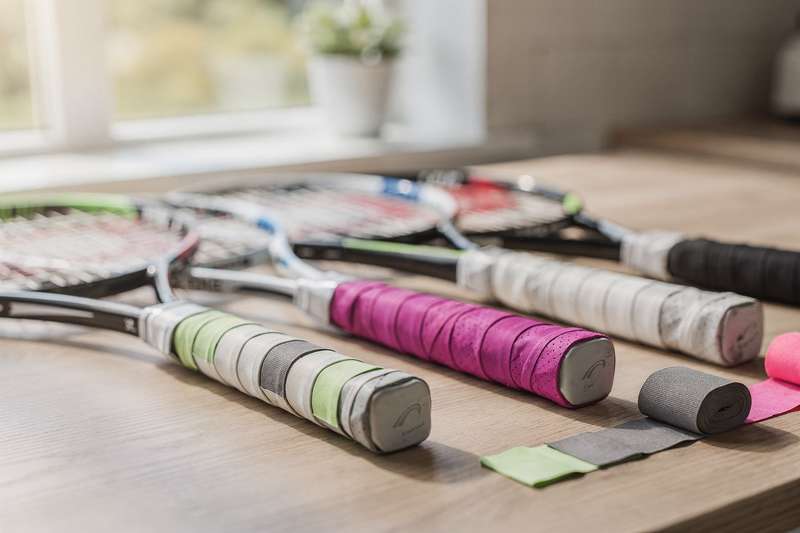
Picture this: it’s a warm Saturday afternoon at your local club, midway through the second set, and your forehand — which normally feels natural — has started going slightly awry. The racquet shifts fractionally in your fingers on contact. You grip harder to compensate. Your arm tightens. Then a routine cross-court sails long. You look down at the handle and realise what’s happened: the overgrip you’ve been meaning to replace for three weeks is smooth, compacted, and almost polished from your palm. It stopped doing its job some time ago. You only noticed when it started costing you points.
The fix should be simple — a fresh overgrip takes two minutes to apply and costs next to nothing. But choosing the right one from the dozens of packs available on Amazon is less straightforward than it appears. Tacky or absorbent? Thin or thickened? Three-pack or six-pack? Tennis-specific or multi-sport? Get it wrong and you’re back to slipping hands or a grip that goes dead after a handful of sessions. Overgrips matter more than most players give them credit for: the right one lets you hold the racquet with less force, which improves touch, reduces arm tension, and stops you white-knuckling every return when the pressure builds.
This guide cuts through the noise. Below you’ll find seven specific picks sourced from current UK Amazon listings, covering different playing styles, moisture levels, racquet sports, and budgets — with straight talk on what each one actually does and who it is best suited to.
How These Picks Were Chosen
The evaluation covered several factors that matter in practice: tack type and how well it holds across a session, sweat-absorption performance under real-world conditions, thickness and what that means for grip size, pack value, durability across multiple hits, and multi-sport compatibility. Where products had substantial verified buyer review data — three products in this guide have several hundred reviews each — recurring feedback patterns were examined, noting what players repeatedly praised and where gripes clustered. For products with more limited published buyer feedback at the time of research (four of the seven picks are newer or lower-volume listings with limited review counts), assessment drew on published specifications, brand positioning within the overgrip category, and how each product’s stated features map to real player needs. That methodological difference is flagged honestly within each section.
Best Overall Overgrip
The YONEX Overgrip Super GRAP 3 Pack is the recommendation for most players who want a dependable, high-quality overgrip from a brand with real racquet-sport credentials. It holds a 4.8-star average across 239 verified buyers — the highest rating in this guide — and that consistency across a solid review sample is a meaningful quality signal. Players who know their sport do not tend to give inflated ratings, and Yonex users are typically knowledgeable about their equipment.
The Super GRAP sits firmly in the tacky camp rather than the purely absorbent camp, offering a positive, sticky feel in your fingers rather than simply wicking moisture away. For most recreational and club-level players, this is the right call: a tacky grip lets you hold the racquet with less force (reducing forearm tension and improving touch), and the tack stays effective even when your hand picks up mild moisture during play. Where it begins to struggle is under heavy palm perspiration in hot conditions — if your hands pour with sweat, a dedicated absorbent grip will serve you better. For moderate moisture, though, the Super GRAP holds up well across a full session.
The thickness sits at approximately 0.6mm, consistent with the standard Super GRAP specification, adding a modest amount of bulk to the handle without meaningfully increasing your measured grip size for most players. The wrap applies cleanly — the grip sits flat at the starting edge, the adhesive tail holds reliably, and there is no embossed logo breaking up the surface texture, giving you a consistent feel throughout. Those sound like small details, but they are exactly what separates a grip that performs from one that frustrates during application.
The product is listed for tennis, badminton, and squash, and Yonex’s deep roots across all three sports — they are particularly dominant in badminton — give that claim real weight rather than making it feel like marketing stretch. A choice of colours within the listing makes it easy to colour-code racquets by sport or simply to track wear visually. The honest caveat is price: the Super GRAP sits at the higher end of the overgrip market compared to budget multipacks. For players who change grips every one to two weeks, the cost adds up. For those who change every two to four weeks and want consistent quality every time, the per-grip cost is easy to justify. This is the benchmark everything else in this guide gets measured against.
Best Value 5-Pack
The Raquex Evolve Racket Overgrip Tape arrives as a multicoloured 5-pack and has accumulated 704 verified reviews at a 4.4-star average — the most-reviewed product in this guide and a reliable marker of genuine, sustained popularity among UK players. At over 700 reviews, this is not a product coasting on early enthusiasm; it has broad, consistent appeal from players who have had time to form real opinions.
Raquex is a UK-based brand, which matters in a practical way: their products are developed with British court conditions and club-level expectations in mind, and their customer support operates in the same time zone if anything goes wrong. The Evolve is described as durable, soft, and anti-slip, placing it closer to the tacky-comfort end of the spectrum than the purely absorbent end. The multicoloured 5-pack format is more than cosmetic: if you are managing racquets across tennis, badminton, squash, and padel (all listed as compatible sports), colour-coding by racquet or by sport simplifies your equipment bag in a way you will actually use.
From a value-per-grip perspective, a 5-pack positions this well for regular players who change grips every two to four weeks. You are covered for a solid stretch without needing to reorder constantly, and the per-grip cost across the set is competitive relative to premium single-sport packs from established tour brands. For players who are not yet sure how quickly they cycle through grips, the 5-pack is also a useful calibration exercise — you will know exactly how many sessions you get per grip before committing to a larger bulk order.
The honest tradeoff: a proportion of reviewers note that the tack fades faster than they would prefer under heavy sweat. If you are playing hard indoors in summer or on a warm outdoor court where your palms get properly wet, you may find you are replacing grips more frequently than the 5-pack implies, which erodes the value proposition. For typical UK club sessions — moderate temperatures, moderate duration — the longevity is solid. The Raquex Evolve is a well-supported, sensibly priced option that has earned its following from real players in real conditions.
Best Budget Pick
The Senston 3/6 Pack Racquet Grips Super Absorbent Anti Slip is the pick for players whose palms get genuinely wet during play and who want maximum moisture control without spending a significant amount per grip. With 453 verified reviews and a 4.3-star average, it has a substantial base of real-world feedback, and the pattern in those reviews reflects precisely what the product name promises: consistent praise for sweat-wicking performance, particularly under intense or prolonged sessions.
Senston occupies the budget tier of the racquet accessories market, and that is not a negative here — the overgrip category does not inherently require expensive materials to function well. A grip that wicks sweat reliably at a lower cost per unit is practical for anyone who goes through grips frequently. The option to buy as a 3-pack or 6-pack (both available under this listing) gives useful flexibility. Heavy sweaters who use a fresh grip every single session will find the 6-pack option worth considering, as it avoids the frustration of reordering before you have had a proper chance to evaluate the product.
The super absorbent anti-slip positioning puts this firmly in the dry-grip category rather than the tacky-grip category — and that distinction matters more than many players realise. Absorbent grips work by drawing moisture away from your palm, keeping the surface drier. Tacky grips work by providing a sticky feel that helps your hand hold the racquet even with some moisture present. If your hands perspire heavily, an absorbent grip is almost always the better fit: a tacky grip overwhelmed by heavy moisture can become unpredictably slippery, whereas a dry grip simply becomes gradually wetter over time until it needs changing. The Senston handles the latter scenario well.
The tradeoff is texture and feel. Absorbent grips often feel slightly rougher or more fabric-like compared to the smooth, slightly waxy feel of a good tacky grip. Some players find this perfectly comfortable; others — particularly those used to the positive, connected feeling of a tacky surface — find absorbent grips slightly abrasive or imprecise. There is also a durability consideration: highly absorbent materials can compact and lose their loft more quickly than tacky alternatives under frequent, sweaty use. If you are changing every session regardless, that matters less. For what it does and what it costs, it is a sound, honest choice in its category.
Best for Tour-Level Tack
The HEAD Prime Tour Overgrip 3 Pack is HEAD’s performance-tier overgrip, aimed at players who want the kind of tacky, connected feel that high-level club and competitive players depend on. HEAD is one of the most established names in tennis equipment, with racquets and accessories used at the top of the professional game, and the Prime Tour label within their overgrip lineup signals the top of their range.
At the time of research, this listing showed a 4.6-star rating but with limited published buyer review volume on Amazon UK. The assessment here draws primarily on product positioning, HEAD’s track record in the overgrip category, and how the Prime Tour’s stated specifications map to actual player needs rather than on a large body of aggregated buyer data. If you prefer to buy only products with extensive verified reviews, the YONEX Super GRAP or Raquex Evolve are safer bets on that criterion. If you are a HEAD brand user and want to stay within a lineup you trust, or if you are after a tour-level tack feel from a respected manufacturer, this is worth testing.
What a premium-tier tacky overgrip offers over a mid-range one is primarily longevity of tack. The feel on day one of a budget tacky grip and a premium one can be similar. The difference becomes apparent at week two: a better-formulated grip maintains its stickiness with a flatter degradation curve. For players who change grips infrequently or who are particularly sensitive to feel changes as a grip ages, that longevity matters practically — it means fewer sessions spent tolerating a grip that is past its prime but not bad enough to force an immediate replacement.
The 3-pack format is standard across HEAD’s overgrip range. The branding and description are tennis-focused, reflecting HEAD’s core market. The grip will physically fit a squash or badminton handle, but if cross-sport compatibility is your priority, the Yonex Super GRAP — explicitly designed for all three sports by a brand dominant in each — is the more targeted choice. The HEAD Prime Tour is for the committed tennis player who wants a consistent, high-quality tacky feel and is comfortable choosing a product on brand reputation and specification rather than a large review sample.
Best for Cushioned Comfort
The HEAD XtremeSoft Overgrip takes a different approach from the Prime Tour: the emphasis here, as the name makes clear, is on softness and cushioning rather than maximum tack or moisture control. It comes in a pack of three and, like the other HEAD entries in this guide, carries a listing rating with limited buyer review volume at the time of research — so evaluation leans on product specification and brand positioning rather than large-scale verified feedback.
The XtremeSoft is particularly relevant for players who experience arm fatigue after longer sessions, or those with a history of tennis elbow or general arm sensitivity. A softer, more cushioned overgrip slightly reduces the vibration transmitted through the handle on impact — not dramatically, and not as effectively as a string dampener or a softer racquet frame, but the cumulative effect across an hour or two of play is real. Adding a soft overgrip is a low-cost first step for anyone looking to soften handle feedback before investing in replacement grips, vibration dampeners, or a different racquet entirely.
The honest tradeoff of cushioning is reduced tactile precision. A very soft grip absorbs some of the feedback between your hand and the racquet, making the connection feel slightly more muted. For casual and recreational players, this is rarely a problem — comfort outweighs hyper-precise racquet feel for most club players hitting twice a week. But if you rely on strong tactile feedback to adjust grip pressure between shot types — switching from a flat drive to a slice to a serve — you may find the XtremeSoft a touch less precise than a firmer tacky option like the Super GRAP or Prime Tour.
For newer players, the XtremeSoft also makes sense as an introductory grip. A softer feel in the hand is more forgiving on the wrist and arm while technique and hand strength develop. Juniors or adults returning to the sport after a gap tend to appreciate that extra give, and the gentle feedback does not penalise imperfect grip pressure during the learning phase. A solid pick for a specific use case, even if it will not be every player’s permanent go-to.
Best for Durability
The HEAD Xtreme Track Overwrap Tennis Racket Grip is explicitly tennis-focused in both name and description, which sets it apart from the multi-sport options elsewhere in this guide. The Track element in the name points toward surface traction and handle contact rather than cushioning or moisture absorption — this is a grip designed to hold firm and maintain its surface character across repeated sessions of aggressive play.
Like the other HEAD products in this guide, this listing carried a 4.4-star rating at the time of research with limited published buyer review count on Amazon UK, so evaluation draws primarily on product specification, the Track positioning within HEAD’s range, and general category knowledge. Treat the rating as a positive early signal rather than a statistically robust verdict.
The appeal of a durability-first grip is straightforward: if you change your overgrip only once a month or less, you want it still performing reasonably at week three, not just on day one. Most overgrips have a useful life somewhere between one session (heavy sweat, hot conditions) and four to six weeks (cooler conditions, drier hands). A traction-focused, durable grip is designed to sit toward the longer end of that range by using materials that resist surface degradation and compaction better than softer alternatives.
The tennis-specific positioning is worth taking seriously. If you need a grip for a badminton racquet or padel bat, the multi-sport listings — the Raquex Evolve and the Yonex Super GRAP — are more naturally suited. The HEAD Xtreme Track is the pick for the tennis player specifically who burns through grips quickly and wants something that holds up under repeated hard-court sessions. One practical note: traction-focused grips sometimes use a slightly structured surface with subtle texture rather than the completely smooth finish of softer grips. This can feel unfamiliar at first, but many players find the additional surface contact particularly useful on serve and overhead shots where the racquet can shift in the hand on impact.
Best for Multi-Sport Players and Beginners
The Senston Racquet Grip 3 Pack is a thickened, flexible overgrip covering tennis, badminton, and squash — making it a natural fit for players who maintain racquets across more than one sport, or for those who are new to overgrips and have not yet worked out exactly what they need. The product description emphasises durable construction and sweat-wicking flexibility, aiming to cover multiple bases rather than maximise any single characteristic.
Transparency first: this listing had limited published buyer review data at the time of research, so this pick is based on how the product’s stated features fit a specific and underserved player type rather than on aggregated buyer evidence. If you prefer products with a large review base, the three reviewed options in this guide — the YONEX Super GRAP, the Raquex Evolve, and the Senston Super Absorbent Anti Slip — are the safer choices on that criterion.
For the right player, though, the Senston 3 Pack makes practical sense. The thickened construction adds more bulk to the handle than thinner alternatives, which suits players with larger hands or those who want a more substantial feel in the palm. Beginners often prefer a slightly chunkier grip while developing technique, as it reduces the fine adjustment required and gives the hand more handle contact to work with. The multi-sport compatibility means you can wrap a badminton racquet and a tennis racquet from the same pack without any compatibility concerns.
The realistic expectation: this is a starting point rather than a permanent destination for most players. Once you have used a 3-pack and developed a clear sense of what you prefer — tacky versus absorbent, thin versus thick — you will likely want to move on to something more specifically suited. The Yonex Super GRAP for tack, the Senston Super Absorbent Anti Slip option covered earlier in this guide for moisture control, or the Raquex Evolve for multi-sport variety with colour choice are the natural next steps once your preference is clear. Think of this Senston 3 Pack as the grip that helps you figure out what you are actually looking for.
What to Look For in a Racquet Overgrip
- Tack versus absorbency: This is the single most important choice. Tacky grips provide a sticky, connected feel and suit most players in moderate-sweat conditions. Absorbent (dry) grips wick moisture away from the palm and are better suited to players whose hands perspire heavily during play. A tacky grip overwhelmed by heavy moisture becomes unpredictably slippery; a dry grip simply becomes gradually wetter until it needs replacing. Know which type suits your hands before looking at anything else.
- Thickness: Overgrips typically range from around 0.5mm to 0.75mm. Thinner grips preserve your grip size more accurately; thicker grips add cushion and substance to the handle. If you have been fitted for a specific grip size and are near the upper limit of what feels comfortable, opt for a thinner overgrip. If you want more padding or have larger hands, a thicker option is worth trying.
- Durability across sessions: Premium tacky grips hold their stickiness longer; absorbent grips may compact faster under heavy use. Think about how frequently you are willing to change and buy pack sizes accordingly. Nursing a dead grip because you do not have a fresh one to hand is a false economy — the grip is cheap, the match is not.
- Multi-sport compatibility: Most overgrips physically fit both tennis and badminton handles; squash handles can vary more in diameter. If you play multiple sports, a product explicitly listed for multi-sport use from a brand with genuine experience across those sports is a more reliably matched choice than one simply claiming compatibility without the track record behind it.
- Pack size and cost per grip: Larger packs almost always represent better value per grip. For regular players, a 5 or 6-pack purchased every couple of months is more practical than repeatedly buying 3-packs. Budget packs are fine for casual players; anyone playing two or more times a week should prioritise quality per grip rather than cost per pack.
- Application quality: How a grip behaves during application affects how it performs once it is on. Look for grips with a reliable adhesive tail end, material that does not tear during wrapping, and consistent width that sits flat from base to tip. Brands with deep category experience tend to produce grips that apply more cleanly than cheaper alternatives — a small but real time saver before every session.
- Colour choice: Cosmetic, but useful in practice. Colour-coding racquets by sport or by player in a shared household is genuinely practical. Light-coloured grips also show wear and dirt more visibly, which acts as a natural prompt to change before the grip has quietly stopped performing.
Verdict
For the majority of UK club players — whether you play tennis, badminton, or squash — the YONEX Overgrip Super GRAP 3 Pack is the recommendation to start with. A 4.8-star average from 239 buyers tells a consistent story, and Yonex’s long-standing presence across all three racquet sports means the product has been properly optimised for real players rather than broadly marketed at everyone. The tack is reliable, the application is clean, and the feel holds up across multiple sessions before needing replacement. It is not the cheapest option in this guide, but the quality-per-grip justifies the step up from the budget tier for anyone who plays regularly.
If you sweat heavily from the palms and tack alone will not cut it, the Senston 3/6 Pack Racquet Grips Super Absorbent Anti Slip is the practical alternative — 453 reviews back up its moisture-control claims, and the accessible pricing makes replacing grips frequently a sustainable habit rather than a reluctant one. For players who want variety and value in a single purchase, and who play padel or badminton as well as tennis, the Raquex Evolve 5-Pack is the well-reviewed, UK-brand option with the largest buyer base in this guide.
Tennis players chasing a precise, tour-level tacky feel should look at the HEAD Prime Tour Overgrip — bearing in mind the limited review data at this stage. For anyone dealing with arm sensitivity or returning to the game after a layoff, the HEAD XtremeSoft’s comfort-first approach is worth a try. Start with the Yonex. Once you know what you prefer in an overgrip, you will know exactly where to go next.
We were not paid to feature any specific product in this guide. All opinions are independent and based on publicly available specifications, verified buyer feedback patterns, and category research.
Quick Comparison Table



FAQ
What is the difference between an overgrip and a replacement grip?
A replacement grip sits directly on the racquet handle and replaces the original base grip when it wears out — it is typically thicker, more cushioned, and adhesive-backed. An overgrip is a thinner, tape-like wrap applied on top of the base grip to add tack, absorb sweat, or slightly increase grip thickness. Most players use an overgrip on top of a base grip that is still in reasonable condition, changing the overgrip frequently and the base grip far less often.
How often should I change my overgrip?
There is no fixed rule — it depends on how much you sweat, how often you play, and how sensitive you are to feel changes. A player who sweats heavily and plays three times a week may need to change after every one or two sessions. A recreational player who sweats lightly and hits once a week might get three to four weeks from a single grip. A practical prompt: when the surface no longer feels tacky or textured and has started to look compacted and smooth, change it — a grip that is nearly done is already costing you security in the hand.
Are tacky or absorbent overgrips better?
Neither is universally better — it depends on your hands and conditions. Tacky grips offer a sticky, connected feel and suit most players in temperate, moderate-sweat conditions. Absorbent (dry) grips wick moisture away from the palm and are better for players whose hands perspire heavily, since a tacky grip overwhelmed by sweat becomes unpredictably slippery. If you are unsure which suits you, start with a tacky grip: the majority of recreational and club players find them more comfortable and intuitive.
Can I use the same overgrip on a tennis racquet and a badminton racquet?
In most cases, yes. Standard overgrips are long enough to wrap a tennis handle and will also cover a badminton grip without any cutting required. Squash handles can sometimes be slightly narrower than tennis handles, but standard overgrips generally fit those too. If you are buying specifically for one sport, look for a product with an explicit multi-sport listing — it confirms the manufacturer has verified compatibility across handle dimensions rather than simply assuming it.
Does adding an overgrip change my grip size?
Yes, slightly. A standard overgrip at around 0.6mm adds a measurable amount of bulk to the handle — roughly half a grip size if you stack two overgrips, or a smaller increase with one. If you are already at the upper limit of what feels comfortable for your hand, adding an overgrip could push it past your preferred size. Opt for a thinner overgrip (around 0.5mm) if preserving grip size is a priority, or deliberately choose a thicker one if the handle feels too slim without extra bulk.
How do I apply an overgrip correctly?
Start at the butt end of the handle, positioning the tapered end of the grip at roughly 30 to 45 degrees, and use the adhesive strip to anchor the starting point. Wrap diagonally up the handle with a slight overlap on each revolution — typically around 3 to 5mm. Keep the tension consistent throughout; too tight and the grip compacts and loses cushion, too loose and it bunches. When you reach the top of the grip area, trim any excess and secure the tail with the finishing tape included in most packs. The whole process takes two to three minutes once you have done it a few times.