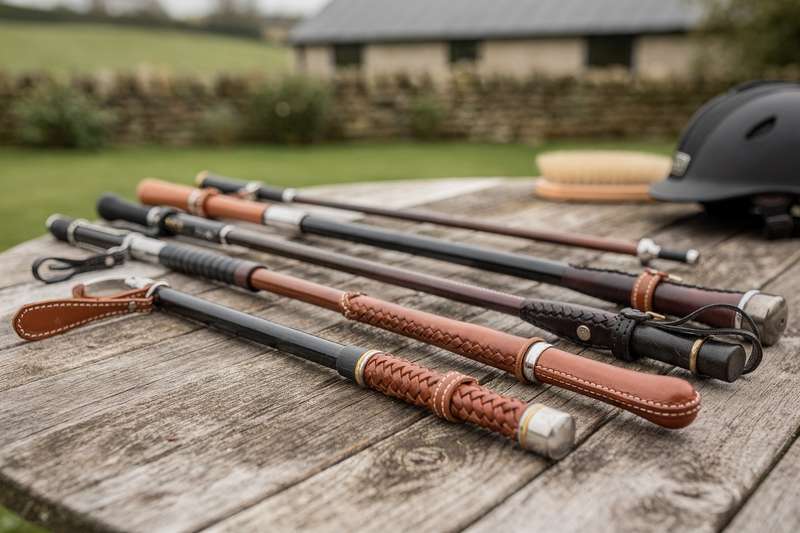
You’re schooling a horse that’s increasingly ignoring your leg aids — he knows when you mean business and when you don’t. Your current crop, the third one since January, has a handle that rattles every time you close your fingers around it and a tip that started peeling before the third week was out. Now you’re in the yard on your phone, scrolling through dozens of Amazon listings: 30cm, 45cm, 65cm, PU leather, faux leather, gel handle, wooden handle, wrist loop or no wrist loop. Half of them have three reviews. The other half contradict themselves in the product description. You just want something that fits your hand comfortably, reaches where it needs to reach, and doesn’t fall apart before you’ve had a chance to break it in.
The good news is the crop and schooling whip market at budget and mid-range level has matured considerably. You don’t need to spend significant money to get something that performs well across a season of regular use. But you do need to know what separates a balanced, durable crop from a cheap one that’ll embarrass you mid-session. This guide covers seven picks available to UK buyers on Amazon.co.uk right now, with honest assessments of each one’s strengths, weaknesses, and who it suits — from a compact 30cm jumping crop to a 65cm schooling whip.
How These Picks Were Selected
Every crop here was chosen by cross-referencing verified buyer feedback patterns, product specifications, and equestrian category knowledge built from evaluating dozens of riding aids at various price points. The key criteria were: shaft length and suitability for the stated discipline; handle construction and grip quality under a gloved hand; shaft flexibility (too stiff means harsh, imprecise aids — too floppy means the signal is lost before it reaches the horse); tip or popper construction (stitched fittings outlast glued ones considerably); and overall build quality as consistently reported by multiple verified buyers rather than isolated reviews.
Where a product has fewer than ten verified reviews, this is flagged clearly in the relevant section — small samples can skew ratings significantly in either direction, and a 5.0 from three buyers is not the same signal as a 4.5 from a hundred. Products that appear to be near-identical variants of the same item have been treated as one pick, with the better-reviewed variant featured and alternatives noted within that section. Zero-review products were excluded from this round-up entirely.
Best Overall Equestrian Crop
The SUNSDEW Leather Paddle with Anti-Slip Wooden Handle, 19” Equestrian Riding Crop, Faux Leather Whip for Horse Riding Training is the top-rated product in this selection at 4.6/5 from 98 verified reviewers, and the score holds up when you examine what is driving it: a handle construction that separates this crop from the bare-PVC budget crowd in a way that genuinely shows up during use.
At 19 inches (roughly 48cm), this sits firmly in the schooling-crop category — long enough to reach the horse’s side and girth area clearly from a standard riding position, while remaining compact enough not to be an encumbrance during transitions or when working on a shorter rein. The wooden handle is the defining feature. Most crops in this price bracket use bare PVC or soft rubber, and the anti-slip finish on the wood gives a markedly more secure feel when you close your hand around it. On a cold morning with winter gloves on, or during a warm summer session when your palms are damp, you are not constantly readjusting your grip. Buyers who school for extended periods specifically call this out as a comfort advantage over sessions lasting more than half an hour.
The paddle-style tip — broader and flatter than a standard narrow-tipped crop — produces an audible signal even with light contact, which is useful when reinforcing forward aids on a horse that has become desensitised to quieter cues. If your horse is particularly noise-sensitive or inclined to spook at sharp sounds, a narrower-tipped crop is the more appropriate choice. For the majority of school horses and average-tempered riding horses, the paddle tip is a practical feature rather than a liability. The broader surface also means the contact is less concentrated on impact, which is worth considering from a welfare standpoint.
Build quality is the other consistent positive across the review thread. The faux leather covering is stitched rather than glued — a construction detail that matters considerably over six to twelve months of regular use. Glued seams delaminate at the tip within weeks of active use; stitched ones hold. The shaft has sufficient flex to generate a clear snap when needed without becoming floppy, keeping aids precise rather than vague.
The honest limitations: at 19 inches, this won’t comfortably reach the hindquarters from a seated position during advanced flatwork, particularly on a longer-backed or taller horse. Riders working on collected movements, engagement exercises, or consistent hindquarter tapping will want 55cm or longer. This crop is best suited to hacking, light schooling, and jumping preparation — not serious dressage work. Riders with particularly small hands may also find the wooden handle slightly chunky. For everyone else — the recreational rider, the show-hack enthusiast, the yard where crops get passed between multiple riders and need to survive rough treatment — this is the most reliable option in the selection.
Best Budget Buy
The UK Seller – 30cm Horse Riding Crop Riding Whip Non-Slip Handle Stick Compact is the most-reviewed product in this selection with 253 verified buyer ratings, and it earns its place here for a specific type of buyer: the rider who needs something functional, fast-delivered, and inexpensive rather than long-lasting.
At just 30cm, this is one of the shortest crops available on Amazon.co.uk. That compact length is not a flaw — it is a feature in the right context. A 30cm crop is well-proportioned for younger or smaller riders whose arm length makes a 45cm crop feel unwieldy. It is also well-suited as a backup to slip into a jacket pocket at a competition or clinic, or as a lead-rein aid where you want minimal reach and easy single-hand control. The non-slip handle performs adequately in light conditions, and the UK Seller designation typically means faster delivery than many imported alternatives — useful if you need something before a weekend clinic or competition.
The 3.7/5 average from 253 reviews tells a specific story worth reading carefully. Riders who rate it positively tend to use it for occasional hacking, lead-rein lessons, or light schooling. Those who rate it lower describe a shaft that loosens at the grip join within two to four weeks of daily active use, and tip separation that appears before the end of the first month under regular demand. Neither failure is dangerous, but both confirm what the price point implies: this is an expendable crop, not a long-term investment.
The pattern of negative feedback is revealing once you look closely. The most common complaint is that rattling handle join — a structural weakness that surfaces faster when the crop is used firmly and frequently rather than occasionally. For daily schooling with a horse that needs consistent reinforcement, the structural limitations will show up quickly. The saving over a mid-tier crop becomes less compelling once you are replacing it twice in a season.
Where this crop makes clear sense: you are buying for a junior who may lose or damage any crop regardless of quality; you need a backup to keep in the yard or lorry; you are trying an equestrian discipline for the first time before committing more money; or you need something delivered before the weekend and better options will not arrive in time. For all of those scenarios, the low outlay is rational. Go in knowing what you are buying: a no-frills crop for light use, not a daily workhorse.
Best for Grip Comfort
The 30cm Black Crop for Horse With Anti-Slip Grip Gel Handle has 111 verified reviews and a 4.0/5 rating — a sound score at that review count — and the gel handle is the standout reason to choose it over the similarly-priced compact options.
Gel handles on riding crops address a specific problem: hand comfort across an extended schooling session. A hard PVC handle is fine for ten minutes, but over thirty to forty minutes of active use, pressure builds across the fingers and palm in a way that accumulates to real fatigue. The gel material conforms slightly to the contours of your grip, distributing contact more evenly and reducing slippage. This matters most in cold weather when thick gloves reduce your sense of grip pressure, or on warm days when your palms are damp. Buyers consistently call this out across the 111 reviews, and it is one of the clearest functional differences between this crop and the cheaper non-slip alternatives at the same length.
At 30cm, the discipline logic is identical to the budget compact crop above: excellent for jumping use, younger riders, or as a pocket crop for adults who want a small backup. It will not serve for reaching the hindquarters from a seated dressage or advanced flatwork position — for that, you need at least 45cm. The 30cm format is appropriate for hunter/jumper and hacking riders who use the crop primarily as a shoulder or girth-area reinforcement rather than a hindquarter aid.
Build quality sits noticeably a step above the cheapest tier. The shaft-to-handle join is more secure, and the wrist loop — where included — is properly stitched rather than loosely adhered. Some reviewers do mention the crop tip loosening with heavy, repeated use over many months, which is a common failure point at this price bracket, but it typically surfaces later in the product lifecycle than for the cheapest alternatives. For daily vigorous schooling with a strong horse, expect to replace it after a full season rather than running it indefinitely.
A note on variants worth flagging: a product with a near-identical name — a separate listing also described as a gel-handle horse crop — appears in Amazon search results for this category but carries zero verified reviews. There is no buyer feedback to validate it, so it has been excluded from this guide. If you want the gel-handle compact crop with a genuine track record, confirm the review count on the listing before ordering to make sure you have the right product.
Best for Standard Schooling
At 45cm, the 45 cm Horse Crop Black, 1 PCS Leather Riding Horse Whips With Wristband Or No Wristband (Style Random Delivery) hits the most broadly recommended length for adult flatwork and schooling — and at 4.3/5 from 77 verified reviewers, it is one of the better-supported options in this length bracket.
The 45cm length deserves direct explanation because it matters more than most buyers assume before they have tried multiple lengths. A 30cm crop works at the shoulder and girth, which covers jumping and hacking adequately. At 45cm, you gain the reach to reinforce aids at or just behind the girth without disrupting your rein contact or hand position — a meaningful difference when you are trying to maintain consistent contact and simultaneously ask for engagement or forward movement. For the majority of recreational riders and amateur competitors working at novice to intermediate level, 45cm is the practical working length: long enough to be genuinely useful across flatwork exercises, short enough to carry comfortably in one hand without catching on the saddle flap or rein.
The wristband question divides riders. Some prefer a wrist loop for security — useful in jumping contexts or when warming up a stronger horse where dropping the crop mid-round would be disruptive. Others find it distracting, especially when changing rein and needing to swap the crop between hands quickly. This listing offers both configurations, which is a practical advantage over crops that lock you into whichever option the manufacturer defaulted to. One caveat: the “Style Random Delivery” note means the specific variant dispatched may not match your preference without further communication with the seller. If you have a strong preference, check the current listing carefully before confirming your order.
The faux leather covering gives this crop a clean, presentable appearance for low-level competition use. Reviewers describe the shaft flex as appropriate for schooling work — responsive without being whippy — and the handle grip as comfortable over longer sessions. Stitching on the tip is reported to hold well by the majority of buyers. The honest limitation is a familiar one at this price point: faux leather tips do peel over time, and a subset of reviewers report this after several months of active use. For affiliated competition or daily schooling over a full season, a genuine leather-tipped crop will outlast faux. For recreational and occasional competition use, this is a sound and well-supported choice.
Best for a Clean, Presentable Finish
The 45 CM / 17.7 INCH Horse Riding Crop, Black Faux Leather Horse Whips for Horse Outdoor Training occupies the same 45cm length bracket as the pick above, but the two differ enough in construction emphasis to justify separate consideration — particularly for riders who care about presentation at the yard or in the arena.
With 34 verified reviews at a 4.2/5 rating, the feedback sample here is thinner than some other picks in this guide, and that is worth acknowledging honestly. Thirty-four reviews is enough to establish a basic quality pattern, but not enough to give confident predictions about how the crop holds up after six months of demanding daily use. What the reviews do consistently describe is a surface finish that is notably clean and professional — several buyers specifically mention using it at local shows and club competitions where appearance alongside function matters. For that use case, the feedback is encouraging and consistent.
The handle is described as comfortable, the shaft flex appropriate for standard schooling use, and the faux leather finish across the full shaft is more consistently applied than on some cheaper alternatives where the covering can gap or bunch near the handle join. At 45cm, the reach is identical to the wristband option reviewed above: solid for flatwork and hacking, not quite sufficient for hindquarter aids in advanced dressage without disrupting your position.
The product is described specifically for outdoor training, which aligns with the faux leather construction — it wipes clean quickly after muddy outdoor sessions with a damp cloth and dries fast. Store it away from direct sunlight when not in use; faux leather can crack if left exposed for extended periods in a hot, bright environment such as a sunny tack room or the boot of a car in summer.
Positioning this against the wristband crop reviewed above: if both are similarly priced when you check, the higher review count on the wristband option gives it a small confidence edge for most buyers. If this one is noticeably better value at the time you look, the 4.2/5 from 34 reviews is sufficient to justify the purchase — particularly if a clean arena presentation is a priority. The decision between the two can reasonably come down to appearance preference rather than a significant functional difference.
Best for Extended Reach
The Horse Whip-Equestrian Riding Crop Whip, 51/65CM Leather Horsewhips Equestrian Horseback Riding Whips For Equestrian Enthusiast is the longest option in this selection, available in 51cm and 65cm, and it addresses a functional need that none of the other picks can meet: reaching the horse’s hindquarters from a seated riding position without disrupting hand or rein contact.
A 65cm schooling whip bridges the gap between a standard 45cm crop and a full dressage whip. At that length, you can tap the horse’s loin or upper hindquarter from a normal riding position — the kind of hindquarter aid that experienced trainers use for collection exercises, engagement work, or with horses that have habituated to being behind the leg. The 51cm option is a more versatile entry point: noticeably longer than the standard schooling-crop bracket, but shorter and more manageable than a traditional schooling whip. If you are uncertain which length suits your horse and working style, the 51cm is the lower-risk starting point.
At 65cm, the whip requires a slightly different carrying technique than a short crop — typically rested across the palm rather than gripped in a traditional fist — and riders unfamiliar with this length should allow a session or two to adjust before relying on it for precise aid delivery. This is a focused flatwork and schooling tool for disciplined sessions, not a crop for jumping classes or busy arena warm-ups where the extra length becomes an encumbrance around other horses and riders.
The leather covering on the shaft is described positively by reviewers who have used it, and the product positions itself toward the active equestrian rather than the casual buyer. The shaft has an appropriate flex profile for a whip of this length — important, as a 65cm whip that is too stiff becomes difficult to control while one that is too floppy loses precision at the tip.
The honest caveat: only 9 verified reviews at a 3.7/5 average is a thin feedback base. With that few data points, any individual experience carries disproportionate weight on the aggregate score, and confident claims about long-term durability are not well-supported by the available data. No price was listed in our live data at the time of research, so verify the current cost on the listing before purchasing. Choose this specifically if the extended length is a functional requirement for your schooling programme — the case for 51–65cm reach is well-founded in equestrian practice — and go in knowing the limited review history means more uncertainty about quality consistency than the higher-reviewed picks above.
Best Lightweight All-Purpose Whip
The 49cm PU Leather Whip, Durable Lightweight Horse Riding Crop for Equestrian, Fancy Dress & Cosplay Role Play Prop carries an important caveat from the start: it has only 3 verified reviews at a 5.0/5 rating. Three reviews is not a statistically meaningful sample — the score may reflect a well-made product, or it may reflect three early buyers with a specific and narrow use case. This should be the last pick you consider, not the first.
With that clearly stated, the product has features worth discussing. At 49cm, it sits slightly longer than the standard 45cm schooling crops in this guide, giving a marginal additional reach without committing to a full 51cm schooling whip. The PU leather construction keeps overall weight low — PU is lighter than most faux leather over similar dimensions — which matters for a crop you are carrying across a long competition day or using across extended sessions where fatigue in the hand builds up.
The dual-use marketing — explicitly positioned for equestrian use and fancy dress or cosplay — tells you something useful about its design intent. It is built to look the part and handle light use cleanly rather than to survive aggressive daily schooling over a full season. For riders who need a crop for occasional hacking, light schooling sessions, or a local show where a crop is part of the required turnout rather than a seriously deployed training aid, the lightweight construction is an asset rather than a concern. For daily serious schooling with a horse that needs consistent, firm reinforcement, a crop with substantially more verified backing is the better choice.
The PU leather surface wipes clean quickly after outdoor use — practical for a crop used in wet or muddy conditions. The 49cm length sits in a useful middle ground: enough reach to reinforce girth-area aids clearly, with a slight advantage over the compact 45cm options for riders who want a fraction more length without the full commitment of a schooling whip. Shaft flex appears appropriate from the limited buyer feedback available, with no reports of excessive stiffness or floppiness in the current review thread.
Treat this as a lightweight supplementary crop rather than a primary daily tool until substantially more buyer feedback accumulates. If the rating holds at a meaningfully higher review count, it would rank considerably higher in this guide. For now, the picks above offer far more certainty, and this is the choice only for the rider who specifically wants lightweight and all-purpose — and is comfortable purchasing on limited public data.
What to Look For When Buying a Riding Crop or Whip
- Length for your discipline: A 30cm crop suits compact jumping use, younger riders, or as a pocket backup. Standard schooling crops run 45–50cm, covering most recreational flatwork and hacking. Longer schooling whips (51–65cm) are for collection and engagement work, or for horses that need hindquarter aids delivered from a seated position. Full dressage whips (100–130cm) and lunge whips are a separate category not covered in this guide.
- Handle material and grip: Gel handles are the most comfortable for extended sessions and grip reliably under gloves in varying weather conditions. Wooden handles with an anti-slip finish give a secure, natural feel that typically outperforms bare PVC in wet conditions. PVC is functional and inexpensive but can become slippery when wet and harder on bare hands across long sessions.
- Shaft flexibility: A correct flex is central to effective, humane use. Too stiff means harsh and imprecise contact; too floppy means your aid loses definition before it arrives. The ideal shaft bends noticeably under moderate pressure and snaps back immediately — this produces a clear, defined signal with minimal force applied.
- Tip or popper construction: Stitched tips outlast glued ones by a significant margin. Broader paddle-style tips produce a louder sound on contact; narrow tips are quieter and less startling. If your horse is noise-sensitive or easily spooked by sharp sounds, a narrow-tipped crop with a soft leather popper is more appropriate than a broad paddle end.
- Material — leather, faux leather, or PU: Genuine leather is the most durable over time and requires conditioning to maintain. Faux leather is a reasonable middle ground for a season of moderate use. PU is lighter and easier to clean but typically less resilient under sustained pressure. For daily schooling, genuine leather tips pay for themselves over a season; for occasional use, faux or PU is adequate.
- Wrist loop: Personal preference, but check the quality of the attachment regardless. A properly stitched loop is useful in jumping and eventing contexts; a poorly adhered loop that comes loose mid-session is worse than no loop at all.
- Competition regulations: Governing bodies including British Dressage, British Show Jumping, and the FEI set specific length and type rules for whips used in competition. These rules are updated between seasons, so check the current regulations for your class before purchasing — a crop that is perfectly legal for hacking may fall outside the permitted specification in the arena.
Our Verdict
For most UK riders shopping right now, the SUNSDEW Leather Paddle with Anti-Slip Wooden Handle, 19” Equestrian Riding Crop, Faux Leather Whip for Horse Riding Training is the most confident recommendation in this selection. Its 4.6/5 from 98 verified buyers reflects consistent satisfaction with the wooden handle design, stitched tip construction, and balanced shaft — exactly the three areas where budget crops most frequently disappoint. The anti-slip wooden grip is a meaningful upgrade over PVC and gel alternatives, and the stitched faux leather tip demonstrably outlasts glued alternatives at comparable price points. For hacking, light schooling, and general yard use, this is the starting point.
If you need a compact option for a junior rider or a quick backup, the 30cm gel-handle crop reviewed in this guide at 4.0/5 from 111 reviews offers the best comfort-to-value balance in the compact bracket — the gel handle is a real functional benefit, and 111 reviews gives reasonable confidence in the quality picture. For standard schooling at 45cm, the wristband crop option at 4.3/5 from 77 reviews is the most trustworthy pick at that length, with a practical choice between wristband and no-wristband configurations.
If extended reach for collection and engagement work is your specific requirement, the 51/65cm schooling whip in this selection is the only pick that addresses that functional need. The thin review base warrants realistic expectations, but the functional case for longer reach is well-established in equestrian training practice and the length options offered are genuinely useful.
Quick Comparison Table


Editorial Note
We were not paid to feature any specific product in this guide. All opinions are independent and based on publicly available specifications, verified buyer feedback patterns, and category research.
FAQ
What is the difference between a riding crop, a schooling whip, and a dressage whip?
A riding crop (typically 30–50cm) is a short, relatively stiff aid used to reinforce leg aids at the girth or shoulder — standard for jumping and hacking. A schooling whip (50–70cm) is longer and more flexible, letting you reach toward the hindquarters from a seated position without disrupting rein contact. A dressage whip (100–130cm) is a full-length, very flexible tool for advanced collected work, tapping the hock or loin while maintaining a correct position. Each has a distinct function, and using the wrong length for your discipline reduces its effectiveness as an aid.
Are riding crops allowed in competition?
It depends on the governing body and the class. British Dressage, British Show Jumping, Pony Club, and the FEI each have specific rules on whip type, length, and usage in the arena. These rules are updated periodically, so always check the current season’s rulebook for your specific discipline before purchasing a competition crop. A length legal for hacking may fall outside the permitted specification for a dressage or show jumping class.
How long should a riding crop be for an adult rider doing flatwork?
For most adult riders doing general flatwork and schooling, 45–50cm is the most practical length — it reaches comfortably past the girth to reinforce forward aids without requiring the rider to move their hand from the rein. For collection exercises or working with a longer-backed horse, a schooling whip in the 55–65cm range offers better hindquarter reach. For jumping and hacking, 30–45cm is the conventional and most widely used length in those contexts.
How do I care for a faux leather riding crop?
Wipe the shaft and tip clean after each session with a damp cloth and allow it to dry naturally — avoid direct sunlight or heat sources, which dry and crack faux leather over time. Store crops flat or hanging to prevent set creases in the shaft. Do not apply leather conditioner to faux leather; it is unnecessary and can degrade the surface. For genuine leather crops, a light application of appropriate conditioner every few weeks maintains flexibility and prevents cracking at the seams.
Can a child use an adult riding crop?
A 30cm compact crop is well-suited to junior riders — proportional to smaller hands and shorter arm length, and easy to carry without becoming a distraction during lessons. Avoid giving children the longer 51–65cm schooling whips, which require more developed hand control to manage safely and precisely. Most riding instructors recommend children start with a lightweight, short crop and only progress to longer aids once they have a stable, independent hand position established over several months of consistent riding.
My horse ignores the crop — what am I doing wrong?
Desensitisation is the most common cause: if the crop has been used repeatedly without a meaningful reinforced response, horses learn to tune it out. The crop should serve as a clear, definitive reinforcement of the leg aid — applied once, firmly, followed immediately by a return to lighter pressure. Using it too frequently, too lightly, or without consistent follow-through from the leg aid undermines its effectiveness over time. If the problem persists, a structured review of your overall aid training with a qualified instructor is more productive than switching to a heavier crop.