You’ve been at your desk since 9am. By 2pm, there’s a dull ache creeping up your forearm and a persistent pressure building at the base of your wrist. You’ve already tried propping your hands on a folded jumper, repositioning your chair, and even switching to a compact keyboard — but nothing quite solves the problem. The issue isn’t your posture or your furniture. It’s that your wrists are hanging in mid-air every time your fingers lift off the keys, and over eight hours that adds up to thousands of micro-stress repetitions. If that sounds familiar, a well-chosen memory foam wrist rest is one of the lowest-cost, highest-impact ergonomic changes you can make to your workstation. The problem is that the market is flooded with near-identical-looking foam rectangles, and the difference between one that genuinely relieves wrist strain and one that collapses into a flat slab within three weeks is not obvious from a product photo.
How We Evaluated These Picks
To narrow down the best options available on Amazon UK right now, we assessed each product against five core criteria. First, foam density and recovery — true memory foam should rebound slowly and uniformly, not spring back like a sponge or stay compressed in a permanent dent. Second, surface material — the cover needs to be breathable enough to stop your wrists sweating after an hour, but smooth enough not to catch your skin as you type. Third, anti-slip performance — a rest that skids around the desk every time you reach for a mug is more distracting than helpful. Fourth, dimensions relative to keyboard width — a rest that’s too short leaves your right-hand side unsupported on a full-size keyboard. Fifth, build longevity signals — stitching quality, removable covers, and verified buyer feedback patterns over time. We also looked at whether sets include a matching mouse wrist rest, since the mouse is often the greater source of wrist strain for office workers.
Best Overall Set: ZIBLY Keyboard Wrist Rest and Mouse Mat Wrist Support
The Zibly Keyboard Wrist Rest and Mouse mat Wrist Support is the pick we’d recommend to most readers setting up a desk ergonomics upgrade from scratch. It arrives as a matched keyboard and mouse wrist rest pair, which means the foam density, surface texture, and height profile are consistent across both pieces — something that matters more than it sounds when you’re switching between typing and mousing hundreds of times per day.
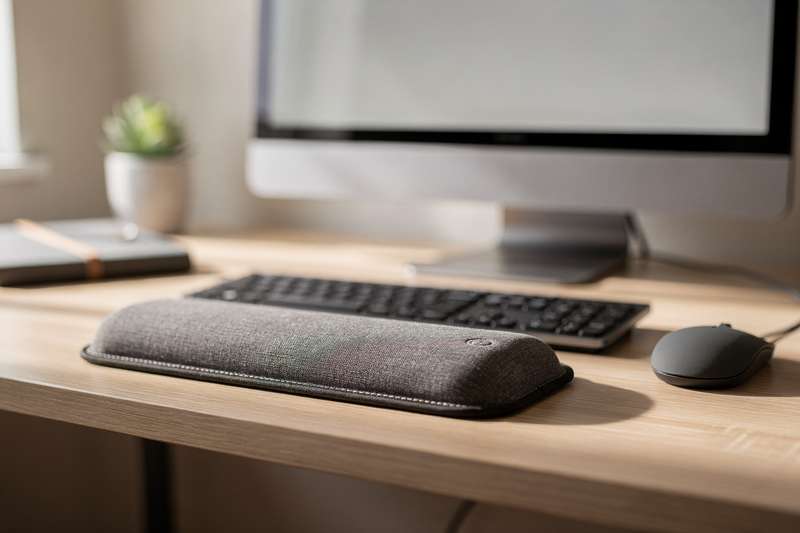
The foam itself is the standout feature here. It’s a genuine slow-rebound memory foam that moulds to the shape of your wrist rather than just sitting underneath it passively. This is the distinction that separates actual ergonomic products from decorative desk accessories. When you press a finger into the surface and lift it away, the indent should take a second or two to fill — if it springs back immediately, you’ve got gel or standard foam, not memory foam. The Zibly does this correctly, and buyers confirm the foam retains its shape over extended periods rather than compressing into a flat brick after a few months.
The surface material is a smooth lycra-style fabric that stays comfortable across a full working day. It doesn’t trap heat noticeably, and it won’t snag on the underside of your watch strap as you type. The underside uses a non-slip rubber base that grips desk surfaces effectively — it doesn’t require any adhesive, so you can reposition it easily when you rearrange your setup.
Dimensionally, the keyboard rest is sized to suit a standard full-size keyboard, and the mouse pad component doubles as a small mouse mat with built-in wrist support, which is a practical design choice for compact desks where a separate full-size mouse mat would be one item too many. The matching aesthetic is a minor point, but a tidy desk does make a genuine difference to focus during long work sessions.
The one honest tradeoff: if you use a tenkeyless or compact 60% keyboard, the rest is longer than your keyboard and the proportional mismatch looks slightly awkward. It still functions correctly, but it’s worth noting. With 319 verified reviews at 4.5 stars, the buyer feedback here is among the most substantial in this category, which gives you a meaningful signal about real-world durability.
Best Single Keyboard Rest: VAYDEER Keyboard Wrist Rest Pad
If you already have a good mouse mat and just need a dedicated keyboard wrist rest, the VAYDEER Keyboard Wrist Rest Pad Padded Memory Foam Hand Rest Support is worth serious consideration. It sits at a slightly higher tier than the budget options and the difference in material quality shows.
VAYDEER has focused this product on the keyboard-only use case and it shows in the dimensions — the rest is long enough to span a full-size keyboard with number pad, so every finger position from Q to the numeral keys has foam support beneath the corresponding wrist position. For touch-typists who cover a wide lateral range, this matters. Shorter rests leave the right wrist unsupported the moment you move toward the number pad or punctuation keys, which defeats the purpose during data entry work.
The memory foam density is firm enough to support the weight of your wrists without completely bottoming out, but with enough give that it doesn’t create pressure points under the heel of your hand. This is a balance that cheaper rests often get wrong — they either go too soft (so your wrists sink through to a hard foam core) or too hard (so you’re essentially resting on a padded brick). The surface material on the VAYDEER is a velour-style fabric that feels premium to the touch and, importantly, stays looking clean because it resists surface pilling even with heavy daily use.
The anti-slip base performs well on both laminate and wooden desks, though on very smooth glass desks you may find it migrates slightly — worth knowing if you have one of those minimalist glass-top desks. With 261 reviews at 4.5 stars, the feedback is consistent: buyers praise the foam retention over time, which is the single most important long-term indicator for this type of product.
Where it falls short: it’s a single-item purchase, so if you need mouse wrist support too, you’re buying separately. And because it sits at a mid-range price point, it’s harder to justify as a first-time purchase if you’re still unsure whether a wrist rest will help your specific setup. But for anyone who has already confirmed they benefit from wrist support and wants something durable, this is the logical step up.
Best Budget Pick: ZIBLY Keyboard Wrist Rest (Solo)
The ZIBLY Keyboard Wrist Rest is the solo keyboard version from the same brand as our overall pick, and it makes a strong case as an entry-level option for anyone who wants to try wrist support without committing to a full set purchase.
At this budget tier, you’d be right to be sceptical — plenty of cheap wrist rests use the words “memory foam” loosely to describe any dense foam, and the result is a product that flattens to nothing within weeks. The ZIBLY holds up better than most at this price because the foam specification is consistent with the brand’s higher-tier products; you’re essentially getting the same core material in a keyboard-only format without the matching mouse rest. The 232 verified reviews at 4.4 stars give you a reasonable confidence floor here.
The anti-skid base works reliably on most desk surfaces. The rest sits at a low-profile height that suits most flat and slightly-angled keyboards — if you use a keyboard with a very high typing angle (steep rear legs fully extended), you may want to consider a taller profile, but for typical home office or laptop keyboards this height is appropriate. The fabric cover is serviceable without being exceptional — it does the job and won’t irritate your wrists, but it’s not as smooth as the surface on the VAYDEER.
One practical consideration: the budget positioning means there’s no removable or washable cover. If you drink coffee at your desk and are prone to minor spillages, keep that in mind. For most users, wiping the surface with a slightly damp cloth is sufficient for everyday maintenance, but deep cleaning isn’t an option. This is a genuine tradeoff at the budget tier that you should weigh against cost.
For a student, someone setting up a home office on a tight budget, or anyone who simply wants to test whether wrist support is beneficial for their typing style before investing more, this is an honest starting point with enough reviews behind it to be trustworthy.
Best Three-Piece Set: Gimars Upgrade Enlarge Silky Memory Foam Wrist Rest
The Gimars Upgrade Enlarge Silky Memory Foam Wrist Rest for Computer Keyboard, Mouse, 3 PCS Ergonomic Keyboard Wrist Rest takes a different approach by providing three separate rests — one for the keyboard, one for the mouse, and one for the laptop trackpad or a secondary input device. This makes it particularly well-suited to workstations with multiple input points, or for users who frequently switch between a keyboard and a graphics tablet.
The “silky” surface description is accurate — Gimars uses a smooth, low-friction fabric cover that’s noticeably different from the more common velour or lycra surfaces. For typists who find textured surfaces irritating to the underside of their wrists, this is a genuine selling point. The surface is cool to the touch even after extended use, which makes a meaningful difference during warm months when other rests start to feel clammy.
The memory foam specification leans toward the softer end of the spectrum compared to the VAYDEER. This suits people whose wrists are particularly sensitive or who experience pressure-point discomfort with firmer supports. However, if you have larger hands and heavy wrists, you may find the softer foam compresses more than you’d like under full typing load. The “enlarge” in the product title refers to the dimensions being slightly wider than standard — this is beneficial if you have broad hands or a wide keyboard, but it does mean the set takes up more desk footprint than alternatives.
With 223 reviews at 4.4 stars, the feedback indicates solid consistency. Buyers particularly note the comfort of the surface material and the stability of the anti-slip base. The three-piece format is the main differentiator here, and if your workstation has multiple input devices that could benefit from simultaneous support, the value of this set is clear.
The honest limitation: three items means three potential migration points on your desk, and if your workspace is already compact, keeping three separate rests in consistent position relative to three input devices adds a minor daily friction cost. For larger, more settled desk setups this is a non-issue, but worth considering for smaller workspaces.
Best for Established Brands: Fellowes Memory Foam Keyboard Wrist Rest
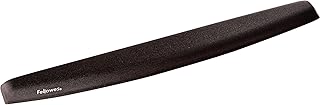
The Fellowes Memory Foam Keyboard Wrist Rest comes from one of the most recognised names in office ergonomics. Fellowes has been making workplace accessories for decades, and the brand recognition matters here because it signals a consistent quality standard and access to customer support if something goes wrong.
The design is clean and unfussy — a standard memory foam keyboard rest in black with a smooth leatherette-style surface. This surface choice is different from the fabric covers on other options in this guide, and it has specific advantages: it’s much easier to wipe clean, it doesn’t absorb desk dust or skin oils over time, and it maintains a professional appearance without visible wear. For office workers who care about desk aesthetics or who share a workspace, this is a practical consideration.
The foam density is towards the firmer end, which Fellowes has calibrated for long-duration typing support. The logic is sound — very soft foam provides immediate comfort but gradually allows the wrist to sink lower over hours, increasing rather than reducing strain. Firm foam maintains consistent wrist height throughout the day. Some users initially find it less comfortable than a softer rest, but adjust within a day or two as the foam also conforms to individual wrist shapes over time.
The Fellowes sits at the most accessible price point in this guide, which makes it a compelling choice for office managers buying in bulk, or for home workers setting up their first proper ergonomic workstation. The brand’s longevity in this category also means replacement parts and warranty support are more accessible than with newer, smaller brands.
The tradeoff is that the leatherette surface, while easy to clean, can feel slightly warm and less breathable than fabric alternatives during extended sessions. It’s not uncomfortable, but if you run warm or work in a poorly air-conditioned room during summer, the fabric-covered options in this guide may serve you better. The product has a strong ratings profile and a long sales history on Amazon UK — both indicators of sustained quality over time.
Best Three-Piece Alternative: Gimars Silky Gel Memory Foam Wrist Rest (Original Set)
The Gimars Upgrade Enlarge Silky Gel Memory Foam Wrist Rest for Computer Keyboard, Mouse, 3 PCS Ergonomic Keyboard Wrist Rest is the earlier version of the Gimars three-piece set, and while the newer B0C4T24BDJ variant is the current main listing, this ASIN remains available and worth knowing about if you’re comparing the two.
The key distinction in the product title is “gel memory foam” — this formulation blends a gel layer with memory foam for a slightly different feel under the wrist. Gel-infused foam tends to dissipate heat more effectively than standard memory foam, which translates to a cooler contact surface over long sessions. If warmth at the wrist is something that bothers you specifically, this specification is worth seeking out.
The silky surface cover is consistent with the newer Gimars version — smooth, low-friction, and noticeably different from standard velour. The three-piece configuration covers keyboard, mouse, and a third input device, making it compatible with complex multi-device setups. Dimensions are again on the larger side, which benefits users with wider keyboards or those who type with a broader hand position.
At 4.5 stars, the rating here is slightly higher than the newer variant, reflecting a longer sales history and a larger pool of feedback. For buyers who prioritise the cooling properties of gel-infused foam specifically, or who found the newer version out of stock, this is a reliable alternative from the same manufacturer. The build quality signals — stitching, foam uniformity, and base grip — are consistent between the two Gimars listings.
One note: as an older listing, availability and stock consistency may be less reliable than the newer variant. If you’re planning to buy multiple sets (for a home office and a work office, for example), check stock before committing.
Best for Raised Keyboard Angles: Keyboard Wrist Rest with Ergonomic Raised Memory Foam
The Keyboard Wrist Rest with Ergonomic Raised Memory Foam for Easy Typing and Pain Relief addresses a specific setup problem that most generic wrist rests ignore: what do you do when your keyboard is angled steeply, either because of its built-in feet or because you prefer an upward tilt for ergonomic reasons?
Standard flat wrist rests designed for low-profile keyboards create an awkward angle mismatch when paired with a steep keyboard incline. The result is that your wrists end up angled upward into the keys rather than held in a neutral, flat position — which is precisely the posture that causes long-term strain. This product’s raised front edge is designed to compensate for that incline, keeping the wrist in a neutral plane even when the keyboard itself is tilted.
The memory foam specification is competent, with the characteristic slow rebound that distinguishes proper memory foam from cheaper alternatives. The anti-slip base is described consistently in the available buyer feedback (31 reviews at 4.4 stars — a smaller sample than other options here, but directionally consistent) as effective on laminate and fabric desk surfaces. The product ships as a keyboard-only rest, so if you need matched mouse support, you’d be pairing it with a separate purchase.
The honest limitation is the lower review count compared to other picks in this guide. With only 31 reviews at the time of this research, there’s less longitudinal data available about foam longevity and long-term wear. The product appears newer to market, which means you’re making a purchase with less confirmed durability evidence. For risk-averse buyers, the higher-reviewed options in this guide offer more certainty. But for the specific use case of a steeply-angled keyboard, the raised profile design solves a real problem that the other picks don’t address.
If you’re unsure whether your keyboard angle is the issue, a simple test: rest your forearm on the desk and note whether your wrist has to bend upward to reach the home row. If it does, a raised-profile rest is worth trying.
Best Matching Set with Mouse Pad: ZIBLY Wrist Rest Keyboard and Mouse Set
The ZIBLY Wrist Rest Keyboard and Mouse Set rounds out the ZIBLY range with their full keyboard-and-mouse pairing. If the B0D1MVCS3M set above is unavailable or you’re looking at a slightly different size configuration, this earlier ASIN from the same brand offers a comparable experience with the same core foam formulation.
The anti-skid base performs consistently well across desk surface types, and the memory foam density is the characteristic slow-recovery type that the ZIBLY brand applies across its range. The surface material is smooth and low-friction, with stitched edges that show no signs of unravelling under normal use conditions according to the brand’s track record across its other listings.
Because this ASIN sits in the budget tier, the design is no-frills and functional. There are no removable covers, no gel infusion, and no premium material choices — just a well-executed memory foam set that does what it says. For buyers who’ve decided they want a matching keyboard and mouse rest and want to spend as little as possible while still getting genuine memory foam (rather than the cheap substitute foam that many budget rests use), this delivers.
The tradeoff worth naming: with no reviews listed for this specific ASIN in the current data, there’s less community feedback to cross-reference. However, the brand’s track record across its other listings — and the consistent foam specification across the ZIBLY range — provides indirect confidence. If you’re buying blind on reviews, the B0D1MVCS3M version above has a substantially larger verified review base and is the safer choice from the same brand.
What to Look For When Buying a Memory Foam Wrist Rest
- True memory foam vs. standard foam: Press your thumb firmly into the surface and count how long the indent takes to disappear. True memory foam should take 1-3 seconds to fully recover. If it springs back immediately, it’s standard foam or gel foam — functionally different. Memory foam adapts to your wrist shape over time; standard foam does not.
- Height profile relative to your keyboard: The wrist rest should bring your wrists to approximately the same height as the home row keys. Too low and it provides no support; too high and it creates an upward wrist bend. Low-profile keyboards and laptops pair well with thin rests; older keyboards with steep-angle feet need a taller or front-raised design.
- Length relative to your keyboard width: A full-size keyboard with number pad is typically 430-445mm wide. A tenkeyless keyboard is around 360mm. A 60% keyboard is around 300mm. Match the rest length to your keyboard — a rest that’s 50mm shorter than your keyboard leaves one side unsupported, which partly defeats the purpose.
- Anti-slip base quality: Rubber or silicone bases are standard, but quality varies considerably. Look for full-coverage base material rather than small rubber feet at the corners — a strip or full panel of anti-slip material distributes grip across the whole contact area and migrates far less during use.
- Surface material breathability: Fabric and velour covers are more breathable than leatherette or synthetic leather. If you run warm or work in a hot environment, fabric covers will be noticeably more comfortable over long sessions. Leatherette is easier to clean but traps more heat. Neither is universally better — it depends on your environment and personal preference.
- Set vs. single purchase: If you use a mouse heavily — particularly for design, spreadsheet navigation, or browsing — your mousing wrist is often under more strain than your typing wrist, because the mouse hand is in continuous static tension between clicks. A matched keyboard and mouse set addresses both strain points simultaneously and ensures consistent ergonomic height across both input devices.
- Washability and maintenance: Most budget rests have fixed covers that cannot be removed. Mid-range and premium options sometimes offer zip-off washable covers, which extend the usable life considerably. If you eat lunch at your desk or spill drinks regularly, prioritise washable covers or at minimum a wipe-clean surface material.
Verdict
For the majority of UK readers — someone working from home for six to eight hours a day on a standard full-size keyboard with a mouse on the right — the Zibly Keyboard Wrist Rest and Mouse mat Wrist Support is the pick we’d go with first. It covers both input devices in a matched set, the memory foam specification is genuine and durable based on buyer feedback, the anti-slip base is reliable, and the surface material is comfortable over full working days. The 319 reviews at 4.5 stars represent the strongest evidence base in this guide.
If you already have adequate mouse support and just need a keyboard rest with better build quality than the budget tier, step up to the VAYDEER — the foam density and surface material are noticeably better and it’s sized correctly for full-width keyboards. And if you work at a steeply angled keyboard and have been wondering why flat rests haven’t helped, the raised-profile design of the B0DGKPDKB5 option addresses that specific problem in a way none of the others do.
Ultimately, the difference between a £10 genuine memory foam rest and a £10 standard foam rest disguised with the right vocabulary is significant over a working week. Use the thumb-press test before you buy — or rely on the verified review counts in this guide as a proxy for products that consistently deliver what they promise.
We were not paid to feature any specific product in this guide. All opinions are independent and based on publicly available specifications, verified buyer feedback patterns, and category research.
Quick Comparison Table




FAQ
Do wrist rests actually help with typing pain?
For most people, yes — but the mechanism matters. A wrist rest doesn’t help while you’re actively typing; it supports your wrists during the pauses between keystrokes, when your hands hover in mid-air and your forearm muscles are under continuous low-level tension. Used correctly (resting during pauses, lifting during active typing), a quality memory foam rest reduces cumulative muscle fatigue over a long day. If you have an existing repetitive strain injury or carpal tunnel symptoms, consult a physiotherapist before relying on a consumer product as a solution.
Is memory foam better than gel for a wrist rest?
They serve slightly different purposes. Memory foam adapts to the shape of your wrist over time and provides stable, consistent support. Gel (or gel-infused memory foam) dissipates heat more effectively and feels cooler on initial contact. Pure gel can feel unstable or wobbly under the wrist. For most users, memory foam or gel-infused memory foam is the better choice; pure gel rests suit people who primarily want a cooling effect rather than shaped support.
What height should a wrist rest be?
The ideal height brings your wrists level with the home row of your keyboard when your forearms are horizontal. Most standard memory foam wrist rests are between 20-30mm in height, which suits flat or low-profile keyboards. If you use a keyboard with the rear feet extended at a steep angle, a taller or front-raised rest is necessary to maintain a neutral wrist angle. Getting this wrong — using a rest that’s too low for your keyboard height — provides almost no benefit and can actually encourage a bent-wrist posture.
Can I use a keyboard wrist rest with a mechanical keyboard?
Yes, but mechanical keyboards vary widely in height. Budget and gaming mechanical keyboards often sit significantly higher than membrane keyboards, and some — particularly those without a wrist rest included — require a taller rest than standard options provide. Measure the height from desk surface to the home row keys on your specific keyboard before buying, and compare it to the rest’s stated height to confirm compatibility.
How do I clean a memory foam wrist rest?
For rests with fixed fabric covers, spot cleaning with a slightly damp cloth and mild soap is usually sufficient for everyday maintenance. Avoid submerging the foam in water — it takes a very long time to dry fully and can develop mould internally. For rests with removable zip-off covers, machine washing the cover on a gentle cycle is possible; always let both cover and foam dry completely before reassembling. Leatherette-surface rests are the easiest to maintain — a quick wipe with a damp cloth removes most dirt without any risk to the foam.
Should I buy a set with a mouse wrist rest or just a keyboard rest?
If you use a mouse for more than two hours per day, buy a set. The mousing hand often develops more strain than the typing hand because it’s in continuous low-level tension between clicks, whereas the typing hand moves constantly and benefits from more natural muscle activation. A matched set also ensures consistent ergonomic height between your two main input devices, which matters for maintaining a neutral wrist angle across your whole workstation.