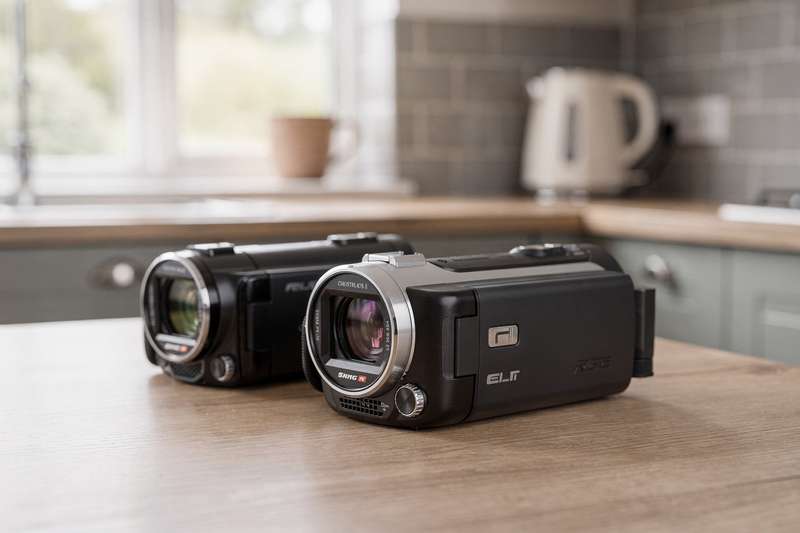
Picture this: a family event is underway — a birthday, a school play, perhaps a weekend away in the Lakes — and your phone footage looks shakier than you expected, the zoom is terrible, and you’re running out of storage mid-way through. You’ve tried the phone, tried borrowing a camera, and you’re still not happy with the results. What you actually want is something purpose-built for video: a dedicated camcorder that handles all the fiddly bits — zoom, stabilisation, autofocus on moving subjects — without requiring you to carry a bag full of lenses or wrestle with complicated settings.
The good news is that the camcorder market in 2026 is genuinely good value. Whether you’re shooting family holidays, YouTube content, school events or something more ambitious, there’s a purpose-built video camera that suits your situation. The bad news is that the market is also cluttered with similar-looking products that differ significantly in actual performance — sensor quality, zoom type (optical vs digital), stabilisation, audio options, and how footage holds up once you start editing it on a proper screen.
This guide works through the live options available on Amazon UK right now, separating the useful from the underwhelming, so you can spend your money on something you’ll actually keep using past the first weekend.
How We Evaluated These Picks
The camcorders in this guide were assessed against a consistent set of criteria: resolution and sensor quality (since megapixel counts alone can mislead), zoom capability with an emphasis on optical rather than digital zoom, screen usability for self-recording and run-and-gun situations, stabilisation quality, included accessories, battery arrangement, and connectivity options like Wi-Fi, webcam mode and memory card inclusion. Buyer review patterns — specifically what owners praise and what they flag as disappointing after extended use — were weighted heavily, since first impressions don’t always survive contact with real-world shooting conditions. Where a product has meaningful review volume, that data is reflected in the discussion. Where volume is low, we’re more conservative about claims.
We’ve focused on the current Amazon UK listings with the strongest ratings and most useful feature sets across different use cases, ensuring each recommended product addresses a genuinely different buyer scenario.
Best Budget Entry-Level Pick
The Sunscien Video Camera Camcorder Full HD 1080P Digital YouTube Vlogging Camera is the most accessible starting point in this guide, and with 780 reviews and a 4.3-star rating, it has earned that position from a genuinely large sample of buyers. This is a Full HD 1080P unit with a 3.0-inch 270-degree rotatable LCD screen, designed for everyday use rather than professional output.
If you’re new to dedicated video cameras and just want something that reliably captures better footage than a smartphone in auto mode — without spending a lot — this is a sensible place to start. The rotating screen makes self-recording straightforward, which matters for anyone doing family vlogs, travel diaries, or keeping a visual record of children growing up. You point it at yourself, frame up with the flipped screen, and record without guesswork.
At Full HD rather than 4K, the resolution ceiling is lower than other picks in this guide. That won’t bother casual users who are sharing on WhatsApp or YouTube at standard quality, but if you’re planning to edit footage on a large monitor or future-proof your archive for 4K TVs, you’ll want to step up. The 30FPS capture rate is standard for smooth motion in everyday conditions; it’s not a slow-motion camera, and fast action — sports days, pets running around — may show some blur in challenging light.
Where the Sunscien performs well is in its simplicity. The interface is approachable, the form factor is compact, and the rotating screen design is genuinely practical rather than just a spec on a box. Buyer feedback consistently highlights ease of use and good image quality for the price tier, though some reviewers note that low-light performance drops off noticeably in dim indoor environments — a limitation typical of smaller sensors at this level. If you’re shooting mostly outdoors or in well-lit rooms, it holds up well. If you’re planning a lot of evening events indoors without supplementary lighting, you’ll want to look at picks with better sensors further down this guide.
This is a solid first camcorder for a parent, a hobbyist or someone wanting to try video content creation before committing to a higher-end setup. It won’t challenge a dedicated filmmaker’s workflow, but for its intended audience, it does exactly what it promises.
Best for YouTube Vlogging
If YouTube content creation is your primary use case, the Camcorder Video Camera 4K 64MP Vlogging Camera for YouTube covers the bases you actually need: 4K resolution, an 18x digital zoom, a 270-degree rotating 3.0-inch screen, a built-in LED fill light, and a webcam function that lets you use it as a live camera for streaming directly from a computer. It carries a 4.5-star rating from 65 reviewers — a smaller sample than the Sunscien, but the feedback pattern is positive.
The LED fill light is worth singling out because it’s genuinely useful for indoor self-recording situations. Rather than setting up a separate ring light, you have a basic fill built into the camera body — handy for quick content creation without a full studio setup. It won’t replace a proper lighting rig for serious productions, but for a bedroom vlogger or someone recording product reviews and tutorials, it takes one variable off the checklist.
The 64MP still image capture is higher than you’d typically need for video work, but it’s useful if you also want to pull high-quality thumbnails or stills from shoots rather than using a separate camera. The webcam mode adds practical value if you’re streaming on platforms like YouTube Live or Twitch, turning the camcorder into a higher-quality alternative to a basic webcam without needing additional software in most setups.
One thing to understand about the zoom: the 18x figure is digital zoom, not optical. Digital zoom works by cropping and enlarging the image, which at higher zoom levels can reduce image sharpness noticeably — particularly in 4K, where you’re working the sensor harder. For typical vlogging distances (talking to camera, filming at events from a few metres away), this isn’t a problem. If you’re trying to zoom into distant subjects — wildlife, sports, distant stage performances — you’ll find the quality degrades more than an optical zoom system would. Keep that expectation calibrated and this camera works well within its intended context.
For someone building a YouTube channel who wants a single device that handles filming, self-recording, live streaming, and decent stills for thumbnails, this covers a lot of ground at a mid-range price point.
Best Value for 2.7K Resolution
The 2.7K 56MP Camcorder Video Camera 16X Digital Zoom Vlogging Camera with LED Fill Light for YouTube sits in an interesting middle ground: it records at 2.7K — sharper than Full HD but less demanding on storage than 4K — and combines this with a 56MP still camera, an LED fill light, and a 270-degree rotating 2.8-inch LCD screen. With a 4.6-star rating from 79 reviews, it currently sits among the better-rated options in this guide.
The 2.7K resolution sweet spot is underrated for everyday video use. The jump from Full HD to 2.7K is clearly visible when footage is played back on a quality screen, but the file sizes stay more manageable than 4K, which matters if you’re working with limited SD card space or editing on a laptop without a fast processor. For YouTube, 2.7K exports well to the platform’s 1440p stream option, which looks noticeably sharper than standard 1080p playback.
At 16x digital zoom, you’re getting slightly less range than the 18x options elsewhere in this guide — but the difference in practice is small for most shooting situations. The LED fill light follows the same pattern as the previous pick: useful for indoor self-recording and quick setups, not a substitute for dedicated lighting on anything serious. The 2.8-inch rotating screen is slightly smaller than the 3.0-inch screens on some competitors, which is a minor ergonomic trade-off but worth noting if you find yourself squinting at small displays.
Where this camera stands out is in the combination of a strong rating, a reasonable review count, and a feature set that doesn’t require you to compromise heavily in any single area. It’s not the cheapest option here, but it’s also not trying to be — it’s aimed at buyers who want a step up from entry-level without jumping to premium pricing. If you shoot a mix of family events, travel content and occasional YouTube videos and you don’t want to think too hard about which camera to grab, this is a reliable all-rounder.
The 56MP still capture is high for a camera in this class and gives you flexibility to pull quality stills alongside video. Build quality feedback from buyers is generally positive, with the rotating screen mechanism and button layout drawing praise for day-to-day handling. A sensible, honest mid-tier option.
Best Premium Consumer Pick
The Camcorder Video Camera 5K 56MP Youtube Vlogging Camera with 3-inch 270° Rotatable Touchscreen WiFi is the most fully featured consumer-grade option in this guide, and at a 4.7-star rating from 39 reviewers it’s well-regarded — though the review count is lower than some competitors, so take that with appropriate caution. The headline feature here is 5K video resolution, Wi-Fi connectivity, a 3-inch touchscreen, and night vision capability alongside a 16x digital zoom.
5K recording is the highest resolution in this category and gives you meaningful headroom in post-production: you can crop, reframe or stabilise footage in editing software without losing 4K quality in the final export. For YouTube creators who want to deliver sharp 4K content while maintaining flexibility in the edit, shooting at 5K is a legitimate workflow advantage. On a compatible 4K or 5K monitor, the footage difference is visible, particularly in fine detail — fabric textures, foliage, text on signs.
The touchscreen interface is a practical quality-of-life improvement over button-only navigation. Tapping to set focus or adjust settings mid-shoot is faster than cycling through menus with physical controls, especially when you’re operating alone. The Wi-Fi function allows wireless transfer of footage to a phone or computer, which speeds up the process of getting content from camera to edit suite or social media. Night vision extends usefulness into low-light situations — not a replacement for proper lighting, but useful for outdoor evening events or situations where you can’t control the light.
The tradeoff at this resolution level is file size and battery drain. 5K footage generates large files that fill memory cards faster and require more processing power to edit smoothly. If you’re working on an older laptop, you may find playback stutters until you proxy-edit or export to a lower resolution for editing. Battery life also tends to be shorter when shooting at peak resolution — something to factor in if you’re planning long shooting days without access to charging.
For a buyer who wants the best consumer-grade specs available in this format, is comfortable with slightly more demanding editing requirements, and values Wi-Fi and a touchscreen for a smoother workflow, this is the pick to consider. It’s a genuine step up from the mid-range options rather than a marginal improvement.
Best Compact All-Rounder with Included Card
The Camcorder Video Camera 2.7K for YouTube 48MP 18X Digital Zoom Video Recorder with 3.0-inch 270° Rotation Screen Battery 32GB SD Card makes an immediately practical case for itself: it ships with a 32GB SD card and a battery included in the box, which removes one of the most common friction points when unboxing a new camera — discovering you need to buy accessories before you can actually record anything. The 4.6-star rating from 54 reviews is consistent with the better performers in this guide.
Recording at 2.7K with 48MP still capture and an 18x digital zoom, the feature set is competitive with the other mid-range picks in this guide. What differentiates it is the out-of-the-box readiness. A 32GB SD card gives you a meaningful amount of recording time at 2.7K before you need to think about managing storage — enough for a full day trip or a multi-day event without constantly offloading footage. The included battery means you can charge and shoot on day one without a separate purchase.
The 3.0-inch rotating screen is the largest in the mid-range category and makes self-recording comfortable, particularly for longer takes where you’re reading from notes or presenting directly to camera. The 18x digital zoom provides the same range as the 4K 64MP pick reviewed earlier, which is adequate for capturing subjects at a moderate distance — a speaker at the front of a room, action across a sports pitch — without the camera having to work too hard.
Like all the digital-zoom options in this guide, quality at the extreme end of the zoom range will degrade compared to optical zoom systems found in premium camcorders. But for casual use, event coverage, and content creation within typical shooting distances, it’s more than adequate. The 2.7K resolution strikes a practical balance between quality and file management, and buyer feedback highlights good build quality and ease of setup as consistent positives.
If you want to open the box and start shooting the same day without a shopping list of additional items, this is the most practical pick in the guide. It’s particularly well-suited to gift purchases, first-time camcorder buyers, and anyone who finds the peripheral costs of setting up new tech genuinely annoying.
Best for Night Vision and Low-Light Conditions
The ORDRO B320 1080P Camcorder with 16GB Card, 18X Digital Zoom, Night Vision, 270° Rotatable Screen, Full HD 1080P 30MP Camera, 2 Batteries (Gold) is the most specialist option in this guide, positioning itself around its night vision capability and dual-battery included package. It holds a 3.9-star rating from 104 reviews — the highest review volume of any single product in this guide, but also the lowest average rating, which is a combination worth taking seriously.
The night vision mode is the headline differentiator. It uses infrared illumination to capture footage in very low or zero ambient light — useful for wildlife observation, security-adjacent recording, or outdoor evening events where you genuinely cannot add light to the scene. In standard daylight or well-lit conditions, it operates as a conventional 1080P camcorder with 18x digital zoom and a rotating screen. The two included batteries are a practical inclusion that extends your shooting time between charges, similar to the accessory advantage of the 2.7K pick above.
However, the 3.9-star average rating deserves honest attention. Across 104 reviews, a pattern emerges that includes complaints about build quality consistency, battery life falling short of stated figures, and footage quality in standard (non-night-vision) conditions being less impressive than competitors at a similar price point. These are not universal complaints — many buyers are satisfied — but the frequency is higher than the 4.3–4.7 star products in this guide, and that gap is real.
The honest assessment: if infrared night vision capability is specifically what you need and no other product in this guide offers it, the ORDRO B320 serves that niche. For outdoor events in genuinely dark conditions, nature watching, or novelty recording scenarios, it does something the other picks don’t. But if night vision isn’t a priority and you’re choosing between this and the other mid-range options, the higher-rated alternatives offer more reliable everyday performance. This is a specialist tool rather than a general recommendation.
The Full HD 1080P resolution ceiling is also lower than the 2.7K and 4K options in the guide, which matters if you’re planning to share footage on large screens or edit with cropping in mind. Factor that into your decision alongside the night vision requirement.
Best for 4K with High Review Confidence
The 4K Video Camera Camcorder 42MP Vlogging Camera for YouTube, 18X Digital Zoom Camcorder with 3.0-inch 270° Rotating Screen, Webcam Function, 32GB SD Card carries the highest average rating in this guide at 4.8 stars — though from only 14 reviews, which is the smallest sample here. That caveat matters: a 4.8-star rating from 14 people is encouraging but not statistically robust. It’s the kind of early signal that suggests a product is off to a good start, not a guarantee of consistent quality at scale.
On paper, the feature set is strong: true 4K recording, 42MP stills, an 18x digital zoom, a 3.0-inch 270-degree rotating screen, webcam functionality, and a 32GB SD card included. That’s a competitive package that covers the key bases for YouTube content creation and everyday video use. The webcam mode — shared with the 4K 64MP pick earlier — is increasingly useful as content creators look to consolidate their hardware rather than running separate devices for filming and streaming.
The 4K resolution puts it in the premium tier of this guide, giving you sharper footage with more editing flexibility than 1080P or 2.7K alternatives. The 42MP still capture is slightly lower than the 56MP and 64MP options elsewhere, but the difference in practical output quality is minimal for most uses — both produce images that are more than detailed enough for web, social, and print use at standard sizes.
Where this pick earns a genuine recommendation is for buyers who want a 4K capable camcorder with a bundled SD card, a webcam option, and a rotating screen — and who are comfortable being among the earlier adopters of a product that hasn’t yet accumulated a large review base. If you’re risk-averse and prefer buying something with hundreds of confirmed experiences behind it, the Sunscien or the 2.7K picks are safer choices. But if you’re comfortable with a newer listing and the current 4.8-star signal, this is a well-specified 4K option worth considering.
Battery life and build quality at this price point are worth testing carefully in the return window — as with any lower-volume product, there’s less buyer data to predict how it performs over extended use. Shoot a range of content in the first few days and verify the quality holds up before committing long-term.
What to Look For When Buying a Camcorder
- Optical zoom vs digital zoom: All the products in this guide use digital zoom, which crops and enlarges the image digitally and can reduce sharpness at higher magnifications. Optical zoom, found in more expensive camcorders, uses the lens to magnify without quality loss. If zooming into distant subjects cleanly is important — sport, wildlife, performances — optical zoom is worth seeking out in a higher-budget option. For typical vlogging and event distances, digital zoom at 16–18x is adequate.
- Resolution: 1080P, 2.7K, 4K or 5K: Higher resolution gives you sharper footage and more flexibility to crop in editing. But it also means larger file sizes and more demanding editing software requirements. Full HD (1080P) is fine for casual sharing and smaller screens. 2.7K and 4K are worth the step up if you have a 4K TV or monitor, plan to edit footage seriously, or want future-proofing. 5K is currently overkill for most buyers but useful if you want editing headroom.
- Screen size and rotation: A 270-degree or fully rotating LCD screen is essential for self-recording — without it, you’re guessing at your framing when speaking to camera. Screens in the 2.8–3.0 inch range are standard here; the larger the better for ease of use in direct sunlight or when reviewing footage in the field.
- Included accessories: Some camcorders include an SD card and spare battery in the box; others require you to source these separately. If a 32GB card and a second battery are included, that’s real added value — factor it into your comparison rather than looking purely at the camera price.
- Battery life and charging: Video is power-hungry. Check whether the camera supports USB-C charging (faster, more universal) or uses a proprietary charger. Dual-battery options extend shooting time meaningfully for events or travel days. Look for claimed battery life in minutes of continuous recording, then assume real-world use will be somewhat shorter.
- Connectivity: Wi-Fi and webcam mode: Wi-Fi allows wireless transfer of footage to a phone or computer without cables — useful for quick sharing and social posting. Webcam mode turns the camcorder into a higher-quality camera for live streaming or video calls, reducing the need for separate hardware. Both features add practical value for content creators.
- Low-light performance: Sensor size and quality determine how well a camcorder handles dim conditions. Larger sensors typically perform better in low light. Built-in LED fill lights help for close-range self-recording but don’t reach far. If you regularly shoot indoors in challenging light — evening events, dim venues — prioritise cameras with better sensor specs or night vision capability, and consider supplementary lighting.
Verdict
For the majority of UK buyers in 2026 — someone wanting to record family events, travel, school activities or YouTube content without diving into professional filmmaking territory — the Camcorder Video Camera 2.7K for YouTube 48MP 18X Digital Zoom Video Recorder is the most practically complete choice. It combines a strong 4.6-star rating from over 50 buyers, a 32GB SD card and battery included in the box, a 3.0-inch rotating screen, and 2.7K resolution that comfortably exceeds Full HD without the file management overhead of 4K. You can open the box and start shooting the same day, which genuinely matters.
If your priority is maximum resolution and you’re comfortable with a smaller review base, the 5K Wi-Fi touchscreen model is the most fully featured consumer option here and earns its 4.7-star early rating. For pure YouTube vlogging with integrated LED fill light and webcam mode, the 4K 64MP pick covers that workflow specifically. And if night vision capability is a hard requirement, the ORDRO B320 is the only option in this guide that delivers it — just go in with calibrated expectations around its 3.9-star rating relative to the rest of the field.
Whichever you choose, a dedicated camcorder — even at the consumer end — will consistently outperform a phone for video in terms of sustained autofocus, optical ergonomics, and long-take battery stamina. For most buyers reading this guide, it’s a worthwhile upgrade.
We were not paid to feature any specific product in this guide. All opinions are independent and based on publicly available specifications, verified buyer feedback patterns, and category research.
Quick Comparison Table


FAQ
What is the difference between optical zoom and digital zoom on a camcorder?
Optical zoom uses the physical lens to magnify a subject, maintaining full image quality at any zoom level. Digital zoom works by cropping and enlarging the existing image digitally, which can reduce sharpness at higher magnifications. All the camcorders in this guide use digital zoom; optical zoom is typically found on more expensive, higher-specification models. For typical shooting distances in vlogging and event recording, digital zoom at 16–18x is adequate, but it will show quality degradation if you push it to its extreme range.
Is 4K worth it on a consumer camcorder, or is Full HD enough?
It depends on how you plan to use the footage. If you’re sharing clips on WhatsApp or uploading to YouTube at standard quality and watching on a smaller screen, Full HD is entirely sufficient. If you have a 4K TV, plan to edit footage with cropping or reframing in mind, or want to future-proof your recordings, 4K is genuinely worth the step up. The main trade-off is larger file sizes and slightly higher demands on your editing computer or phone.
Do I need a separate microphone for a consumer camcorder?
Built-in microphones on consumer camcorders are designed for casual use and work adequately in quiet, controlled environments. If you’re recording speech directly — vlogs, tutorials, presentations — you’ll get noticeably cleaner audio from a clip-on lavalier microphone or a directional mic mounted on the camera’s hotshoe, if one is available. For filming events, sports or travel where audio isn’t the primary concern, the built-in mic is usually sufficient. Check whether the model you’re considering has a 3.5mm microphone input if external audio quality matters to you.
How much SD card storage do I need for video recording?
A rough guide: Full HD footage at standard bitrates uses around 2–3GB per hour, while 2.7K uses approximately 4–6GB per hour and 4K can use 6–12GB or more depending on the compression format. A 32GB card is a practical starting point that gives you several hours of shooting before you need to offload footage. If you’re shooting a full day event or a multi-day trip without reliable laptop access, a 64GB or 128GB card is worth having as a backup.
Can I use a consumer camcorder for YouTube and live streaming?
Yes — several models in this guide include a webcam mode that lets you connect directly to a computer via USB and use the camcorder as a higher-quality video source for streaming platforms like YouTube Live, Twitch or Zoom. Wi-Fi-enabled models also let you transfer footage wirelessly for faster upload. The main limitation compared to a dedicated webcam or broadcast setup is that camcorders generate more heat during long streaming sessions, so monitor the device temperature if you’re running multi-hour streams.
What battery life should I expect from a consumer camcorder?
Most consumer camcorders at this level will deliver between 60 and 120 minutes of continuous recording on a single charge under typical conditions, though real-world performance often falls toward the lower end of the stated range — particularly when the LCD screen is fully active, you’re using Wi-Fi, or you’re recording at higher resolutions. Models that include two batteries in the box are a practical advantage for full-day shoots. USB-C charging is preferable to proprietary connectors because you can top up from a power bank or the same charger you use for other devices.