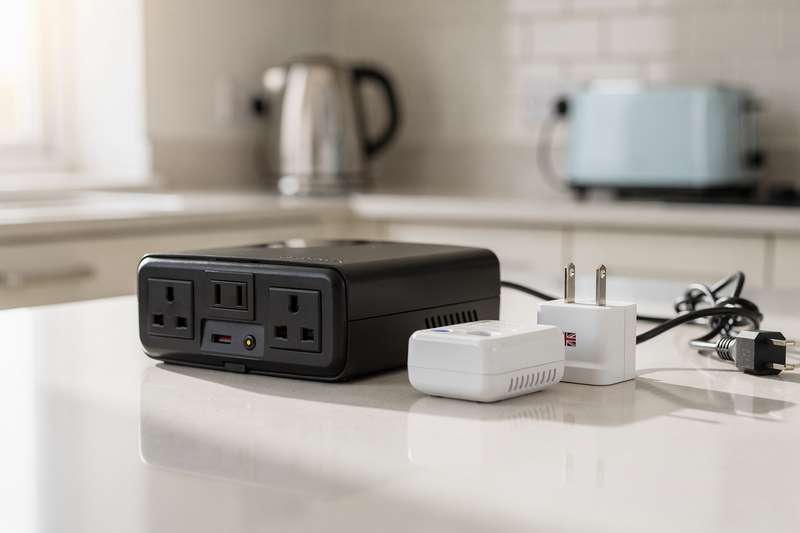
You’ve just unpacked a piece of kit you ordered from the US — a hair tool, a beloved small appliance, or a piece of audio equipment — and then you notice it: 110V/60Hz printed on the label. Your UK sockets run at 230V. You hunt around for a simple adapter plug, but that won’t do anything about the voltage mismatch. Plug the device in directly and you’ll either blow a fuse, damage the appliance beyond repair, or, in the worst case, start a small fire. So now you’re looking for a power transformer — a step-down voltage converter that drops your UK mains from 230V to the 110–120V range your appliance was designed for.
The frustration doesn’t stop at identifying the problem. Search “power transformer” on Amazon UK and you’re confronted with a bewildering mix of products: some rated for tiny loads, some with suspiciously vague descriptions, and quite a few that look like they’ve been copy-pasted from a generic catalogue with no meaningful specifications. You just want something that will safely run your device without overheating, cutting out, or making a worrying buzzing sound at 2 a.m. This guide cuts through the noise and focuses on the products available right now on Amazon UK that are genuinely worth your attention.
How We Evaluated These Picks
Choosing the right step-down transformer isn’t about finding the flashiest listing — it’s about matching a product’s real-world capability to your specific device. To build this guide, we focused on four core criteria: wattage headroom (a transformer should handle at least 20–25% more than your device’s peak draw), thermal protection (overheat cut-off is non-negotiable for 24/7 or prolonged use), build quality indicators (plug design, cable gauge, casing ventilation), and verified buyer feedback. We cross-referenced Amazon UK review patterns, looking for consistent themes in both praise and complaint — things like unexpected shutdowns, connector fit issues, and whether products held up over weeks of real use rather than just a first unboxing. Products with zero reviews were deprioritised; where we included lower-review items, we note that clearly. We did not accept any payment or free product in exchange for a mention.
Best for Everyday US Appliances: 200W Step-Down Power Supply Voltage Converter 220V/240V to 110V/120V
The 200W Step-Down Power Supply voltage converter 220V/240V to 110V/120V (UK Plug) is the most clearly specified and straightforwardly described product in this category currently available on Amazon UK, which alone puts it ahead of many rivals. It earns a 4.0/5 from 39 reviewers — a modest count, but sufficient to reveal meaningful patterns in buyer experience. The listing explicitly targets UK users bringing US-spec appliances to Britain, and the UK plug means you can use it straight out of the box without hunting for an additional adapter.
The 200W rating is the first thing you need to assess against your own device. A 200W converter is well-suited for low-to-medium draw appliances: phone chargers, laptop adapters (check the wattage on yours), CPAP machines, electric shavers, small desk fans, and travel irons rated under 150W. It is not intended for high-wattage appliances like full-size hair dryers, kettles, or large power tools — those typically need 500W, 1000W, or more. The built-in temperature protection is highlighted in the product description, and buyers confirm it does kick in during extended use, which is exactly what you want from a safety perspective — a converter that shuts off cleanly is far preferable to one that silently overheats.
Reviewer feedback points to solid performance for its stated use case. The majority of positive comments cluster around reliable voltage output and the convenience of the UK plug format. Where criticism appears, it tends to relate to the unit feeling warm after 30+ minutes of continuous use — normal for a step-down transformer of this type, but worth knowing if you plan to run something continuously overnight. The casing ventilation appears adequate for intermittent use; if you need hours of uninterrupted operation, factor in a rest cycle.
One practical note: always check the wattage rating on your appliance’s power label, not just the voltage. A device rated at 110V/180W needs a converter rated for at least 225W to give adequate headroom. This unit sits right at the upper limit for a 150–160W device, so if your appliance draws close to 200W at peak, step up to a higher-rated converter. That said, for the vast majority of everyday US personal-care and computing accessories, 200W is a comfortable fit, and this is the pick we’d recommend first for someone new to voltage conversion in the UK.
Best Budget Entry Point: LIANSUM Voltage Converter
With 271 reviews and a 3.9/5 rating, the LIANSUM voltage converter is the most reviewed product in this niche currently on Amazon UK, and that review volume tells you something useful: enough people have bought, used, and reported back to give you a meaningful signal. A 3.9 rating at 271 reviews is a realistic reflection of a product that works for most buyers but has genuine limitations worth understanding before you purchase.
LIANSUM positions itself as an accessible entry-level option, and the price reflects that. For buyers who have a single, low-wattage device to run — a US-spec shaver, a small travel appliance, or a straightforward electronics charger — it offers a functional solution without significant outlay. The unit steps voltage down from the UK’s 230V to the 110–120V range that North American appliances expect, which is the core job. Where it earns its mixed reviews is in sustained performance and build confidence: some buyers note that the casing feels less substantial than premium alternatives, and a handful report that the unit runs quite warm under moderate loads.
The 3.9 rating pattern in the reviews suggests two distinct user groups: those who plug in a low-demand device, find it works perfectly, and are satisfied; and those who push it closer to its rated limit and encounter thermal shutdowns or inconsistent output. The takeaway is straightforward — use it well within its stated wattage, and it will likely serve you fine. Treat the maximum rating as an absolute ceiling rather than a working target, and give it ventilation space. If you’re running something intermittently (a shaver for five minutes, a charger for an hour), this is a reasonable budget pick. If you need prolonged continuous use or have a device that draws variable power, spend a little more.
One thing buyers consistently appreciate is the compact form factor — it doesn’t dominate a desk or socket strip the way some bulkier transformers do. For travel, this is a genuine plus. The tradeoff is that compact construction inherently limits the internal transformer’s heat dissipation, so ventilation around the unit matters more here than with larger alternatives. Keep it off carpets and soft surfaces while in use. As a budget starting point for light, occasional use, the LIANSUM does its job — just don’t expect it to replace a purpose-built, thermally managed step-down transformer for heavy or continuous loads.
Best for Moderate Loads and Longer Sessions: Transformers Step-Down Converter
The Transformers step-down converter (B0DSJK75NX) sits at a mid-range price point with 18 reviews averaging 4.1/5 — a smaller sample, but with a notably higher satisfaction score than the budget options above. The pattern in those reviews suggests buyers are getting more consistent results, particularly when running appliances for longer periods or at moderate wattage levels. It’s worth considering if you’ve already tried a budget converter and found it cutting out or running uncomfortably hot.
At this tier, you typically get better internal construction: more robust winding, improved thermal management, and connectors that hold a firmer grip. Reviewers on this listing specifically note reliable, stable output voltage — which matters for sensitive electronics. A device like a CPAP machine, a professional audio interface, or a camera battery charger is more sensitive to voltage fluctuations than, say, a basic shaver. If the appliance you’re converting for has any kind of precision electronics inside, stable, clean output voltage is worth paying for over raw wattage numbers alone.
The 4.1/5 rating at 18 reviews isn’t a large enough dataset to draw sweeping conclusions, but the absence of the “runs too hot” or “shut off unexpectedly” complaints that appear in lower-rated listings is encouraging. Buyers report using it with kitchen appliances, beauty tools, and computing peripherals brought from the US, and the consensus is that it handles moderate continuous use without complaint. That said, 18 reviews means you’re placing more trust in the product specification and less in community-verified performance than you would with a 200+ review listing.
If your appliance draws a consistent moderate load — think a mid-range blender, a hair styler rather than a full-power dryer, or a desktop computing peripheral — and you want something that will run for an hour or two without needing a break, this converter is worth the step up from budget options. The sweet spot for this product appears to be users who’ve outgrown a cheap converter but don’t yet need the capacity of a dedicated industrial step-down unit. Check your device’s wattage label carefully, add a 25% buffer, and make sure this converter’s rated capacity covers that figure before buying.
Best for Higher-Rated Device Needs: Transformers Voltage Step-Down Unit
The Transformers listing (B0G2N7BXVP) carries a 4.5/5 rating from 9 reviews — the highest average score of any reviewed product in this current Amazon UK selection for this category. Nine reviews is a thin base, and we flag that clearly: a 4.5 from 9 buyers can shift significantly with even a handful of negative experiences. Treat this pick as a promising newcomer rather than an established track record, and weigh it accordingly.
What distinguishes this listing from the ultra-budget options is its positioning within the product range: the price point suggests a step up in construction, and the small but uniformly positive review set indicates buyers have not encountered the thermal or output-consistency issues that drag down cheaper alternatives. If the specific wattage rating on this unit matches your appliance’s requirements and the budget options have left you cautious, this is worth considering as a middle-ground option where the premium is modest.
The honest caveat here is that with such a small review pool, individual experiences carry disproportionate weight. A single reviewer with an unusual use case — or an unusually demanding appliance — can skew a 9-review average significantly in either direction. Before purchasing, do the same wattage arithmetic you’d apply to any converter: take your device’s rated wattage, multiply by 1.25 to get a safe working minimum, and confirm this unit’s specification comfortably exceeds that figure. If you have any doubt, defaulting to the better-reviewed 200W step-down unit or the LIANSUM (for lighter loads) is the safer choice until this listing accumulates more verified buyer feedback.
Where this pick does have genuine appeal is for buyers who have done their wattage research, need a specific capacity, and want the reassurance of a clean rating even if from a small sample. Early adopters in this category often benefit from products that, precisely because they’re newer to market, have been engineered with awareness of what existing products get wrong. Thermal cut-offs, connector quality, and cable robustness are the areas to check in the product listing before committing.
What to Look For When Buying a Power Transformer or Voltage Converter
- Wattage rating and headroom: Never run a converter at its maximum rated wattage continuously. Check your appliance’s power label (usually on the base or back), note the wattage, and buy a converter rated for at least 25% more. A 150W appliance needs a minimum 190W converter; a 300W device needs at least a 375W-rated unit.
- Input and output voltage range: UK mains runs at 230V (sometimes labelled 220–240V). A step-down converter should accept this range and output a stable 110–120V for US/North American appliances. Check that both figures appear explicitly on the product listing — not just one.
- Thermal protection: Any converter you leave running for more than a few minutes at a time should have built-in thermal protection — a cut-off that triggers before the unit overheats. This protects both the converter and your appliance. Products that don’t mention this feature are a risk.
- Plug format: For UK use, confirm the unit comes with a standard UK three-pin plug (Type G). Some listings ship with a two-pin EU or US plug that requires an additional adapter, adding cost and a potential point of failure in the connection chain.
- Continuous vs. intermittent use rating: Some converters are rated for short bursts only (an electric shaver for five minutes) while others handle sustained loads (a CPAP machine running eight hours overnight). If you need continuous use, look for units that explicitly state this — or buy significantly above your device’s wattage requirement to keep the unit running cool.
- Build quality signals: Cable gauge (thicker is better for higher wattage), casing ventilation (slots or grilles help dissipate heat), and socket/connector quality all indicate how a converter will hold up over time. Check reviewer photos if available.
- Review volume and recency: A product with 200+ reviews from the past 12 months gives you much more reliable signal than one with 10 reviews or reviews that are all several years old. Weight your confidence accordingly, especially for safety-critical electrical products.
Verdict
For most UK readers landing on this page — someone who has a US-spec appliance and needs a reliable, safe way to use it at home — the 200W Step-Down Power Supply voltage converter 220V/240V to 110V/120V (UK Plug) is the most straightforward recommendation. It has the clearest specifications of any product in the current selection, comes with a proper UK plug, includes thermal protection, and has enough verified buyer feedback to confirm it does what it claims for everyday low-to-medium wattage appliances.
If your budget is tight and your device draws very little power — a shaver, a small charger — the LIANSUM is a reasonable starting point, provided you keep it well within its rated limit and give it ventilation. If you’re finding that budget converters are cutting out or running hot, the B0DSJK75NX offers a step up in consistency based on its review pattern. And if you have a higher-rated device to run and don’t mind the thinner review base, B0G2N7BXVP’s 4.5/5 score is encouraging, but go in with eyes open about the small sample size.
Whatever you buy: do the wattage maths before you order, never skip thermal protection, and treat the maximum rating as a ceiling — not a target.
We were not paid to feature any specific product in this guide. All opinions are independent and based on publicly available specifications, verified buyer feedback patterns, and category research.
Quick Comparison Table


FAQ
What is a step-down transformer and do I actually need one?
A step-down transformer (or voltage converter) reduces mains voltage from one level to another — in this context, from the UK’s 230V supply down to the 110–120V that North American appliances require. If your device’s power label says 110V or 120V and you’re in the UK, you need one — plugging it in without one risks immediate damage to the appliance and potentially a fire or electrical fault. If your device says 100–240V, it’s dual-voltage and only needs a plug adapter, not a converter.
How do I know what wattage converter to buy?
Find the wattage rating on your appliance’s power label — it’s usually on the base, back panel, or power supply brick. If only amps and volts are listed, multiply them together (Watts = Volts × Amps) to get the figure. Then buy a converter rated for at least 25% more than that number to give safe headroom for startup surges and continuous operation. Running a converter right at its limit shortens its lifespan and raises the risk of thermal shutdown.
Can I use a voltage converter for a hair dryer or kettle?
Full-size hair dryers and kettles typically draw 1000–2000W, which puts them well beyond the capacity of the budget converters covered in this guide. You’d need a large, dedicated step-down transformer rated for that load — a significantly heavier and more expensive unit. Many frequent travellers find it easier to simply buy a UK-spec equivalent for high-wattage appliances rather than invest in a large converter.
Is it safe to leave a voltage converter running overnight?
Only if the converter is explicitly rated for continuous use and the device you’re powering is within the converter’s comfortable working range (not near its maximum). CPAP machines are a common example of an appliance that runs overnight — check the converter’s listing for any mention of continuous-duty rating, and make sure the unit has thermal protection. Place it on a hard, ventilated surface away from bedding or soft furnishings.
Will a voltage converter affect the quality of power going to my device?
A well-built transformer-based converter provides stable, clean output voltage that is safe for most consumer electronics. Cheaper or poorly regulated converters can introduce voltage fluctuations that affect sensitive devices — audio equipment, cameras, and precision instruments are the most likely to notice. If you’re running something with demanding power requirements, look for converters that specifically mention regulated or stable output, and check reviewer comments for any reports of interference or instability.
What’s the difference between a transformer-based converter and an electronic (switching) converter?
A transformer-based converter uses a physical copper-wound transformer to change voltage — these are typically heavier, more robust, and better suited to motor-driven or heating appliances. Electronic (switching) converters are lighter and more compact but can sometimes produce a modified sine wave rather than pure AC, which may cause issues with certain motors or precision equipment. For most personal electronics and chargers, either type works; for appliances with motors or heating elements, a proper transformer-based unit is the safer choice.