You’ve just rummaged through the kitchen drawer for the third time this month, pulling out a tangle of AA batteries that you’re fairly certain are flat, a loose AAA that might be new, and a charger you’ve had since about 2012 that takes roughly fourteen hours to do anything useful. Sound familiar? Disposable batteries rack up a surprising cost over a year — think about the remote controls, torches, clocks, kids’ toys, wireless keyboards, and computer mice all quietly draining power in your home. The moment you realise you’ve spent as much on single-use cells in twelve months as you would on a decent rechargeable set is usually the moment you finally go looking for a proper solution. This guide is written for exactly that moment. Whether you’re kitting out a family home, replacing an ancient charger that’s gone missing, or simply tired of buying batteries at the supermarket checkout, you’ll find a clear, honest recommendation here.
How We Evaluated These Sets
Every pick in this guide comes from the live Amazon UK catalogue, assessed against five core criteria. First, battery capacity: for AA cells, anything around 2000mAh is adequate for light use, but 2800mAh gives you noticeably more runtime in high-drain devices like gaming controllers and digital cameras. Second, charger intelligence: a smart charger with independent slot monitoring prevents overcharging and extends cell lifespan considerably compared to a basic trickle charger. Third, charging speed and convenience: look at whether the charger uses a standard UK plug, USB-A, or USB-C input — each has different implications for how and where you’ll use it. Fourth, bundle value: a set that ships with eight batteries and an eight-slot charger is more practical for most households than a four-cell starter pack. Fifth, brand credibility and build quality: we’ve noted where a product has accumulated real buyer feedback versus where it’s newer to market. The POWEROWL set has the most verified reviews in this selection; all other products carry ratings without yet-accumulated review counts, so those picks lean on specifications and brand track record rather than aggregated buyer opinion.
Best Overall Pick: POWEROWL Rechargeable Battery AA with Charger
The POWEROWL Rechargeable Battery AA with Charger is the most straightforward recommendation in this guide, and the only product here with a meaningful number of verified buyer reviews — 70 ratings averaging 4.4 out of 5 stars. That real-world feedback matters when you’re deciding whether to trust a set with your everyday devices. POWEROWL has been producing NiMH cells for several years and has built a reputation for consistent capacity ratings, so the 2800mAh claim on these AA cells aligns with what independent battery testers have found on previous POWEROWL generations.
The bundle ships four AA cells with a compact USB smart charger. Four slots might feel limiting if you’re running a battery-hungry household, but the advantage here is that it makes an ideal starter set or a compact travel kit. The charger operates on USB input, which means you can run it from a power bank, a laptop port, or any USB wall adapter you already own — that flexibility is underrated for anyone who travels or works from different rooms. There’s no need for a dedicated UK plug socket, which is particularly handy in homes where plug sockets near storage areas are at a premium.
The charger monitors each slot independently, which is the key thing to look for in any smart charger. This means if you slot in two batteries with different charge levels, neither one is left overcharged or undercharged — each gets topped up to its own correct endpoint. This independent channel charging genuinely extends cell lifespan over time, which is why it matters beyond just convenience. POWEROWL rates these cells for 1200 charge cycles, and reaching anywhere near that figure requires not abusing them with a dumb charger that treats all four slots as a single circuit.
Where this set has limits: four cells is enough for a single device rotation but not enough for a home with multiple high-drain gadgets running simultaneously. If you’re topping up game controllers, a wireless keyboard, a mouse, and a torch all at once, you’ll need a larger bundle. Also, the charger lacks a display showing charge percentage or time remaining — you’re working from LED indicator lights only. That’s fine for most people, but worth noting if you want granular status information. For a reliable, well-reviewed entry point into rechargeable batteries, this is the set to start with.
Best Budget Pick: Amazon Basics Rechargeable AA NiMH Batteries with 4 Bay Charger
The Amazon Basics Rechargeable AA NiMh Batteries with 4 Bay Battery Charger is the most accessible entry point in this roundup. It includes four AA NiMH cells, a four-bay charger with a UK plug, and ships in straightforward packaging. The Amazon Basics brand carries a 4.4-star average, and while this specific listing has no accumulated review count yet, the wider Amazon Basics rechargeable battery range has tens of thousands of reviews across its product family — enough to establish that the build quality is consistent and the cells perform as advertised for general household use.
The AA cells in this set are rated at 2000mAh, which puts them in the adequate-for-everyday-use category rather than high-performance territory. For remote controls, wall clocks, low-drain wireless keyboards, and similar devices, 2000mAh is perfectly sufficient — you’re unlikely to notice the capacity difference versus a 2800mAh cell in these applications. The advantage of the lower capacity rating is that these cells charge faster and tend to be gentler to cycle repeatedly. If the majority of your battery use is in low-to-medium drain devices, this is not a compromise worth worrying about.
The charger uses a standard UK mains plug, which keeps setup completely uncomplicated — plug it in, slot in the batteries, done. This is particularly good for anyone who doesn’t want to hunt for a spare USB adapter or deal with additional cables. The four-bay design accepts AA cells, and the charger applies an independent charge to each slot rather than running all four as a single bank. This is an important detail at this price tier, since some ultra-budget chargers don’t do this properly, leading to inconsistent charge levels across the set.
The honest tradeoff: if you need AAA batteries as well, or if you want to charge eight cells at once, this set doesn’t cover those needs. The 2000mAh capacity also means slightly shorter runtimes in high-drain devices like digital cameras or gaming controllers compared to 2800mAh alternatives. But for the household where the main use case is remotes, clocks, and the occasional torch, the Amazon Basics four-pack delivers reliability without overcomplication.
Best Mixed-Format Starter Kit: Amazon Basics Rechargeable AA and AAA Batteries with 4 Bay Charger
The Amazon Basics Rechargeable Batteries NiMH, AAA 800mAh 4-Pack + AA 2000mAh 4 Pack with 4 Bay Battery Charger solves the problem that catches many buyers out: most homes need both AA and AAA cells, but the majority of starter bundles only include one format. This set ships four AA cells at 2000mAh alongside four AAA cells at 800mAh, covered by a single four-bay charger that handles both sizes. It’s the most practical single purchase for someone setting up a rechargeable battery system from scratch.
The AAA 800mAh rating is appropriate for the format — AAA cells are physically smaller and can’t hold as much charge, so 800mAh is a competitive figure rather than a cutback. These are well suited for slim remote controls, headphone volume wheels, small torches, and the various slim devices around the home that take AAA rather than AA. Pairing them with AA cells in one bundle means you can replace the most common disposable battery types in a single order.
The charger includes a UK plug and accepts both battery sizes in its four slots. This versatility is the main selling point. The 4.4-star rating places it on par with the four-AA-only version from Amazon Basics, and the build quality should be equally consistent. As with the four-AA version, the charger’s intelligence monitors slots independently, preventing the overcharge problem that damages cells over time.
The limitation here is capacity: if your household runs several high-drain devices simultaneously, eight cells total across two formats may not give you enough rotation. You’ll charge four at a time while four are in use, which works for moderate usage but becomes inconvenient for a busy family home. For that scenario, the eight-slot sets elsewhere in this guide are more practical. But if you’re just getting started, this mixed-format bundle is one of the most sensible first purchases available at this tier.
Best for Established Brands: Energizer Recharge Pro with AA Batteries
The Energizer Recharge Pro — Battery Charger for AA & AAA Batteries brings the Energizer name to a rechargeable bundle, and for many buyers that brand recognition is a genuine factor in the purchasing decision. Energizer has been producing batteries for decades and its Recharge line is one of the more mature rechargeable offerings in the UK market. The set includes four AA NiMH cells and a charger that handles both AA and AAA formats, rated at 4.6 stars.
What Energizer does well with this set is the charge status indication. The charger shows individual LED indicators per slot, making it straightforward to see which cells are charging, which are complete, and which are not properly seated. This sounds minor but makes a real difference in daily use — if you’ve ever returned to a charger expecting full batteries and found one wasn’t making contact properly, you’ll understand why per-slot feedback is worth having. The Energizer charger also operates on a standard UK plug, keeping things simple.
The included AA batteries carry Energizer’s low self-discharge formulation, meaning they hold their charge for an extended period when sitting unused — reportedly retaining charge for years in storage. This is useful for batteries kept in emergency torches, smoke detector remotes, or devices used only occasionally. You’re less likely to reach for a rechargeable AA and find it unexpectedly flat after weeks of sitting idle. This is particularly valuable in a home where some devices are used daily and others sit dormant for months.
The honest caveat is that Energizer’s bundle ships four cells with a charger that could handle more — you’d need to purchase additional Energizer Recharge cells separately to fill the second format slots. For a household that wants to maximise capacity immediately, one of the eight-slot sets may represent better immediate value. But for anyone who prioritises brand trust and the backing of Energizer’s customer support and warranty infrastructure, this set earns its position in the guide.
Best High-Capacity Eight-Slot Set: BEVIGOR 8 Pcs 2800mAh AA Rechargeable Batteries with 8 Slot LED Smart Charger
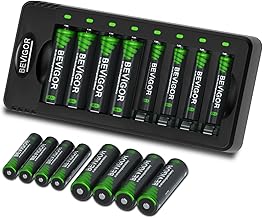
The BEVIGOR 8 Pcs 2800mAh AA Rechargeable Batteries with 8 Slot LED Smart Battery Charger Set is the obvious choice if you run a lot of AA-powered devices and want to charge a full rotation in a single session. Eight 2800mAh AA cells alongside an eight-slot charger means you can have all cells topped up overnight and slot fresh ones into your devices without any waiting around. At 4.6 stars, BEVIGOR sits among the highest-rated sets in this selection.
The headline specification here is Type-C fast charging. The charger accepts USB-C input, which aligns with how most modern homes are moving in terms of cable infrastructure — if you have a USB-C wall adapter or a multi-port charger on your desk, this slots right in. The practical implication is faster top-up times compared to standard USB-A chargers of equivalent design. BEVIGOR markets these cells as Ni-MH and Ni-CD compatible, so the charger is not exclusively locked to these bundled batteries — you can use it with existing cells from other brands.
The LED display on the charger shows per-slot status, giving you a clear visual confirmation of which bays are active and which have completed. Eight independent charging channels means every cell gets its own monitored charge cycle rather than being lumped into a bank — the type of smart charging circuit that prevents overcharge damage and extends the realistic lifespan of the cells. At 2800mAh, these AA cells sit at the upper end of the standard NiMH capacity range, which translates to noticeably longer runtimes in high-drain devices like wireless gaming peripherals and digital cameras.
The tradeoff for the BEVIGOR AA-only set is that it doesn’t include AAA cells. If you need both formats, you’re looking at the BEVIGOR mixed bundle elsewhere in this guide or a separate purchase. The charger is also USB-C input only, so you’ll need a suitable adapter if you don’t already have one handy. That said, for a home that’s primarily AA-powered and wants the convenience of an eight-slot setup, this is a strong, well-rated option.
Best Mixed-Format Large Set: BEVIGOR AA & AAA Rechargeable Batteries with Charger Set
The BEVIGOR AA & AAA Rechargeable Batteries with Charger Set is the most comprehensive bundle in this guide, combining eight AA cells at 2800mAh with eight AAA cells at 1100mAh, all managed by an eight-slot independent charger. That’s sixteen rechargeable batteries in a single purchase, covering both primary household formats at high capacity. If you’re replacing an entire home’s worth of disposables in one go, this is the most efficient way to do it.
The AAA capacity of 1100mAh is worth highlighting separately. Most AAA rechargeable sets top out at 800-900mAh, so 1100mAh is a genuine performance step up for the AAA format — longer runtime between charges in your slim remotes, headphone controls, and compact torches. Combined with the 2800mAh AA cells, this set gives you high-capacity cells across both formats rather than a compromise in one to enable the other.
The eight-slot charger handles both AA and AAA cells in any combination across its slots, so you don’t need two separate chargers for the different sizes. It uses USB input and operates with independent slot monitoring, applying the same smart charging logic as the AA-only BEVIGOR set. The 4.6-star rating matches its AA-only sibling, and the build quality appears consistent based on specification review.
Where this set requires a realistic assessment: sixteen batteries and a charger is a significant upfront commitment. You’re purchasing based on the assumption that you’ll actually use most of them, and if your household’s device count is modest, some of these cells may sit in a drawer for months. That’s not inherently a problem — NiMH cells lose charge slowly during storage, and a smart charger top-up before use brings them back — but it’s worth thinking about whether you genuinely need sixteen batteries before committing to this bundle versus the simpler four or eight cell options.
Best USB Smart Set for Flexible Charging: Granicell AA Rechargeable Batteries with Smart 8-Slot Charger
The Granicell AA Rechargeable Batteries with Charger eight-slot set offers a USB smart charger alongside eight 2800mAh AA cells, and at 4.6 stars sits among the top-rated options in this selection. Granicell is a newer name compared to Energizer or Amazon Basics, but the specification sheet here is strong and the rating reflects early buyer satisfaction.
The USB smart charger that ships with this set is designed for flexibility — it accepts USB-A input, which works from any standard USB wall adapter, laptop, power bank, or multi-port desktop charger. This makes it practical in a wider range of charging locations than USB-C exclusive models, particularly in older homes or offices where USB-A ports are more prevalent. Eight independent slots each receive their own monitored charge, with LED indicators showing per-slot status throughout the process.
The 2800mAh capacity on the AA cells puts them in the same performance tier as the BEVIGOR and POWEROWL offerings, suitable for high-drain devices and providing extended runtimes versus standard 2000mAh alternatives. Granicell rates these for NiMH chemistry, and the charger is compatible with both NiMH and NiCD cell types — giving you some flexibility if you have older NiCD cells in the household you’d like to continue using.
The key difference between this set and the BEVIGOR eight-slot AA set comes down to the input type: USB-A here versus USB-C there. If your home is already USB-C dominant and you want the faster charging potential that USB-C PD adapters offer, the BEVIGOR may charge faster in practice. If you want maximum plug-and-play compatibility with existing infrastructure, the Granicell’s USB-A approach is the easier path. Neither is objectively superior — it depends on your existing setup.
What to Look For When Buying a Battery and Charger Set
- Battery chemistry and capacity: Almost every rechargeable consumer battery set in the UK market uses NiMH (Nickel-Metal Hydride) chemistry. For AA cells, 2000mAh is adequate for low-drain devices; 2800mAh gives noticeably better runtime in cameras, gaming peripherals, and similar high-drain applications. For AAA, 800-1100mAh is the typical range — the higher end makes a genuine difference in devices you use frequently.
- Independent slot charging: A charger that monitors each slot separately is not a luxury feature — it’s the difference between cells that last several years and cells that degrade within eighteen months. Avoid chargers described as “bank charging” or that don’t specify per-slot monitoring. Every set in this guide uses independent channels.
- Charger input type: UK plug mains chargers are the simplest setup for home use. USB-A chargers offer flexibility but require you to supply an adapter. USB-C chargers work with modern multi-port adapters and can offer faster charging with compatible PD sources. Consider what ports you have available near where you’ll keep the charger.
- Bundle size vs. household need: A four-cell set works for light users with one or two devices. Eight cells allows a proper rotation — half in devices, half charging — which is the practical minimum for a family home with multiple high-drain gadgets. Sixteen-cell bundles suit large households or anyone replacing disposables wholesale across every device at once.
- Low self-discharge: Look for cells described as “low self-discharge” or “pre-charged and ready to use”. These retain their charge when sitting unused, which matters for batteries kept in emergency torches, seasonal devices, or occasional-use remotes. Standard NiMH cells without this formulation can lose a significant portion of their charge within weeks of storage.
- Mixed-format compatibility: If you need both AA and AAA batteries, check whether the charger accepts both sizes. Some chargers are AA-only; others handle both. A mixed-format bundle with a multi-size charger removes the need to manage two separate charging setups.
- Cycle life rating: Reputable NiMH cells are typically rated for 1000-1200 charge cycles. Reaching that number in practice requires proper charging conditions — a smart charger helps considerably. A well-maintained rechargeable battery set should easily outlast several years of regular use before capacity starts dropping noticeably.
Verdict
For the majority of UK households, the POWEROWL Rechargeable Battery AA with Charger is the set to start with. It’s the only product in this guide with a substantial number of verified buyer reviews, it covers the core use case well, and the USB smart charger’s flexibility makes it usable in more locations than a mains-only alternative. The 2800mAh cells handle both light and moderate-drain devices without issue.
If you’re outfitting a larger household and need both AA and AAA covered immediately, step up to the BEVIGOR AA & AAA Rechargeable Batteries with Charger Set — sixteen high-capacity cells and an eight-slot independent charger represents genuinely strong value for a home that goes through batteries quickly. The Energizer set suits buyers who want the backing of a household name with established UK customer support. Whichever set you choose, making the switch to rechargeables is straightforward, and the ongoing saving versus disposables becomes apparent within a few months.
We were not paid to feature any specific product in this guide. All opinions are independent and based on publicly available specifications, verified buyer feedback patterns, and category research.
Quick Comparison Table



FAQ
Are rechargeable batteries worth it for everyday home use?
For most households, yes — rechargeable NiMH batteries pay for themselves relatively quickly when replacing disposables in regularly used devices like remote controls, gaming peripherals, and torches. The upfront cost is higher, but modern rechargeable sets are rated for 1000 cycles or more, meaning each cell can replace hundreds of disposables over its lifespan. Low self-discharge formulations also mean they stay ready to use when sitting idle, addressing one of the historic drawbacks of older rechargeable technologies.
What’s the difference between 2000mAh and 2800mAh AA batteries?
Capacity measured in milliamp-hours (mAh) represents how much charge a cell can store — higher numbers mean longer runtimes between charges. In practice, the difference between 2000mAh and 2800mAh is most noticeable in high-drain devices like digital cameras, wireless gaming controllers, and bright torches. In low-drain devices like wall clocks and TV remotes, both capacity ratings will last so long that the difference is essentially irrelevant. If most of your battery use is in high-drain devices, the higher capacity is worth seeking out.
Can I mix different brands of rechargeable batteries in the same charger?
Generally yes, as long as the chemistry matches — NiMH cells from different manufacturers can be charged together in a smart charger that monitors slots independently. You should avoid mixing NiMH cells with NiCD cells in the same charging session unless the charger explicitly supports both and monitors each slot separately. Never mix rechargeable NiMH cells with standard alkaline disposables in a charger designed for rechargeables — alkaline cells are not designed to be recharged and can leak or, in rare cases, rupture under charging current.
How do I know when my rechargeable batteries need replacing?
The clearest sign is a noticeable drop in runtime — devices that previously lasted days between charges now drain in hours, even after the cells have been fully charged. A good smart charger will sometimes indicate an error or failed charge when a cell has degraded beyond a usable threshold. Most NiMH cells remain serviceable for several years under normal conditions; keeping them in a smart charger rather than a basic trickle charger significantly extends that lifespan.
Is a USB charger or a UK mains plug charger better?
Neither is universally better — it depends on your setup. A UK mains plug charger is the simplest option for home use: plug it in and you’re done, no adapter hunting required. A USB charger (USB-A or USB-C) offers flexibility, letting you charge from a power bank, laptop, or any multi-port desk adapter, which is useful for travel or rooms where spare plug sockets are limited. USB-C chargers can potentially charge faster with a suitable USB-C PD adapter. Consider where you’ll keep and use the charger most often before deciding.
What is low self-discharge and why does it matter?
Low self-discharge (LSD) NiMH cells are formulated to lose charge very slowly when not in use — typically retaining the majority of their charge for months or even years in storage, depending on conditions. Standard NiMH cells without this treatment can lose a significant proportion of their charge within weeks. LSD batteries are particularly useful for devices you use infrequently, such as emergency torches, seasonal remote controls, or backup devices. They’re also what makes pre-charged rechargeable sets viable straight out of the packaging — the cells arrive with usable charge rather than needing an immediate full cycle before first use.