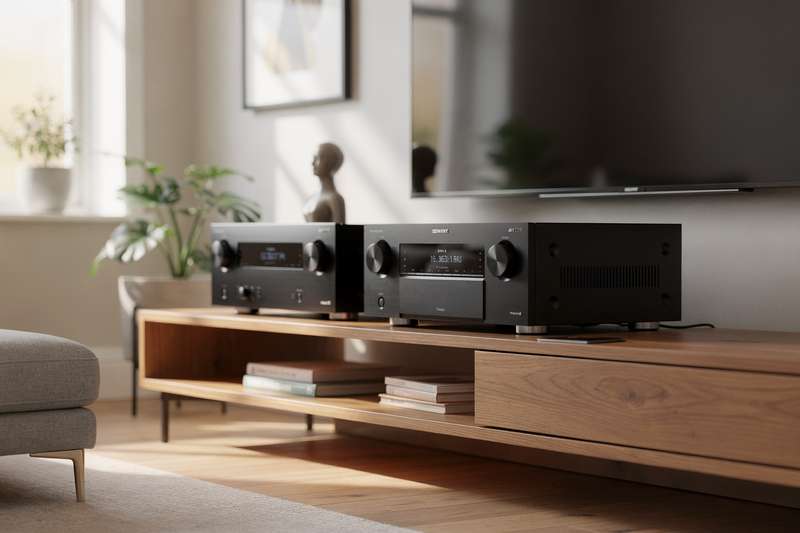
You’ve been living with a soundbar for a couple of years. At first it was a genuine improvement over the television’s built-in speakers, but now you’re watching action films and the low-end sounds thin, surround effects come from one direction instead of wrapping around you, and music never quite fills the room the way you imagined it would. You’ve started reading about passive speakers — a proper bookshelf pair, maybe a floor-stander — and then you discover you need something to power them. Welcome to the world of receivers and separates: AV receivers on one side, AV processors plus dedicated power amplifiers on the other. The jargon is dense, the spec sheets are built to impress rather than inform, and the online forums lead to rabbit holes where enthusiasts debate things that probably won’t affect your listening room at all. This guide cuts straight to what matters: what these components actually do, which pick suits which situation, and what you should look for — or avoid — before spending your money.
How We Evaluated These Picks
Products were assessed against criteria that matter in real listening rooms: channel count and power delivery, connectivity across both analogue and digital inputs, wireless streaming quality and codec support, build quality relative to price tier, and — where buyer feedback existed — consistent patterns from verified Amazon UK purchasers. One point of transparency: the Amazon catalogue for this specific niche returned a limited set of genuinely relevant products, and two of the four picks below carry no buyer reviews at time of research. Where that’s the case, we say so directly in the relevant section and supplement with published specifications and category knowledge. Tier descriptors (budget, mid-range) replace specific prices throughout — prices shift frequently and are best checked directly on Amazon.
Best Budget Multi-Channel AV Receiver
The Pyle Bluetooth Amplifier Hifi 6 Channel AV Receiver is the pick for anyone building a first proper multi-channel audio set-up without spending significantly. It delivers six channels, Bluetooth wireless streaming, a digital LCD display, a headphone output, and inputs covering USB, SD card, auxiliary, and FM radio — a connectivity breadth that’s hard to match at the budget tier. If you want one box handling music from your phone, audio from a television via RCA or AUX, and background radio without buying a separate tuner or streaming device, this unit covers all of that without demanding you read a technical manual first.
With 95 verified buyer ratings on Amazon and a 4.2 out of 5 star average, this Pyle has accumulated enough real-world feedback to give a clear picture of daily use. Buyers consistently note how quick the initial setup is — connect passive speakers to the terminals, pair a phone via Bluetooth, and you’re producing sound within minutes. FM radio reception receives solid marks, and the LCD panel is readable from across a room under normal living room lighting. Where feedback becomes more nuanced is around the karaoke-specific features: built-in microphone inputs with echo adjustment push this unit toward dual-use entertainment rather than focused critical listening, which is worth keeping in mind when you’re setting your expectations.
On power: the headline 600W figure is a peak rating across all six channels combined, not a sustained RMS output figure — which is standard practice across the budget receiver segment and not a specific failing of this unit. Drive efficient passive speakers (sensitivity ratings of 87dB or above) at moderate levels in a small to medium room and you’ll get clean, enjoyable sound. Push it in a large space with power-hungry speakers and you’ll notice dynamics compress under load. This is a room-sized product with room-sized expectations.
The six-channel layout suits a 5.1 surround configuration — front left, centre, front right, two surrounds, and a subwoofer output — though it’s more accurately described as a powered mixer-amplifier than a true home cinema AVR. There’s no HDMI switching, no eARC, no onboard Dolby Atmos decoding, and no room calibration microphone. Those are genuine limitations if a high-performance cinema room is your goal. But as a starting point for getting passive speakers working with everyday sources — or as a permanent solution for a casual living room, kitchen, or workshop — it does what it promises.
Best Entry-Level Power Amplifier for a Separates System
The POHOVE Power Amplifier Home Audio DC12V HiFi Dual Channel Stereo Receiver addresses a different buyer: someone who already has a preamp, a DAC, or a streaming device with line-level outputs, and wants to add a dedicated stereo amplification stage without significant expenditure. Running from a DC12V supply — compatible with a mains adapter, a car battery, or a portable power bank — it’s unusually flexible in deployment. That flexibility makes it relevant for a compact bedroom hi-fi, a garage or workshop audio system, or a garden set-up with passive speakers running from a battery source.
With 86 buyer ratings and a 4.1 out of 5 star average, feedback reflects what you’d expect from a genuinely entry-level class-D unit. Buyers praise its small footprint, simple connectivity, and the quality of sound it produces at low to moderate listening levels. The chassis is modest — this is not a premium-looking piece of equipment — but thermal management has been noted as adequate: it doesn’t run excessively hot under typical use, which matters with compact amplifier designs where heat build-up constrains component lifespan.
The limitations are worth stating plainly. This is a two-channel stereo amplifier, which rules it out for multi-channel surround unless you cascade multiple units. Output power is modest by home cinema standards, making it better suited to near-field desktop listening or bookshelf speakers in a small room than to filling a dedicated cinema space. There’s no digital input, no Bluetooth receiver built in, and no remote control. You’ll need to send a line-level analogue signal from a source — a DAC, a preamp, a phone headphone jack — and manage volume from that source device or your main amplifier.
Where this unit genuinely shines is in a minimalist separates chain: a quality Bluetooth receiver or DAC feeding this amplifier, which then drives a pair of compact passive bookshelf speakers. That approach gives you the separate power supply and dedicated amplification circuit that distinguishes a basic separates system from an all-in-one unit, while leaving budget for better speakers or a better source component. The DC power supply flexibility is a real practical advantage that many similarly priced units don’t offer.
Best Compact All-in-One AV Receiver
The Pyle Amplifier Hifi Bluetooth AV Receiver positions itself as a mini Hi-Fi amplifier with MP3, USB, SD, AUX, and FM radio inputs, plus Bluetooth wireless streaming. It’s aimed at buyers who want a single compact box handling multiple source types without requiring additional switching hardware or a separate streamer. The Echo Studio compatibility reference in the product title suggests it’s been optimised for use alongside Amazon smart speakers, a useful pointer if you’re already in the Alexa ecosystem.
It’s important to flag that this unit had no buyer reviews at the time of research. That’s not necessarily a sign of a poor product — newly listed items sometimes arrive on Amazon before review volumes build — but it does mean you’re working from specifications and manufacturer claims rather than verified real-world feedback. Given that, treat this as a pick to watch rather than a pick to buy immediately if you need confidence from peer reviews. If you’re comfortable with the risk profile of a zero-review purchase and the spec list matches your needs, the connectivity breadth is attractive at the price tier.
In practical application, this receiver-amplifier is best suited to modest room sizes and casual listening. The mini form factor means the power supply and amplifier stages are compact, which typically translates to moderate output power rather than the headroom you’d want for large rooms or demanding speakers. On the plus side, that compact footprint makes it genuinely easy to integrate into a living room cabinet, a kitchen shelf, or a study without the unit dominating the space. The Bluetooth input is particularly relevant if your primary music source is a smartphone or tablet — pairing is straightforward, and latency is rarely noticeable for music on modern implementations.
The FM radio is a feature that sounds dated in the streaming era but remains useful for background listening without consuming data. USB and SD card playback adds flexibility that budget receivers handle reasonably well for MP3 and similar formats. For lossless audio from local files, check which file formats the unit supports before assuming compatibility.
Best Bluetooth Audio Receiver for an Existing Hi-Fi System
The Auris BluMe HD Long Range Bluetooth 5.3 Music Receiver addresses a specific scenario: you have an existing amplifier — perhaps a vintage integrated amp or a well-regarded stereo unit — that lacks any wireless connectivity, and you want to stream from Spotify, Apple Music, or Tidal without running cables or replacing the amplifier. The BluMe HD adds Bluetooth 5.3 with LDAC and aptX HD codec support, meaning that when paired with a compatible Android phone or source device transmitting LDAC, you’re getting high-resolution wireless audio rather than the compressed standard Bluetooth quality.
Like the Pyle compact receiver above, this unit had zero buyer reviews on Amazon UK at time of research. However, the Auris BluMe product line has an established reputation in audiophile communities and has been reviewed by specialist hi-fi publications, so there’s a broader evidence base for the product family even if Amazon-specific UK buyer feedback is absent. The LDAC support — Sony’s high-quality Bluetooth codec capable of up to 990kbps transmission — is the headline feature that separates this from generic Bluetooth adapters. For high-resolution streaming services, the difference in audio quality between a basic Bluetooth adapter and an LDAC-capable receiver is audible on revealing speakers.
The output options typically include both optical digital and analogue RCA, which means you can feed either a digital input or a standard analogue line input. The audiophile DAC mentioned in the title suggests the unit handles its own digital-to-analogue conversion when using the analogue output, rather than relying on your amplifier’s own DAC — potentially beneficial if your existing amplifier is older and its DAC circuitry is less refined than modern designs. The long-range Bluetooth 5.3 capability matters for large rooms or open-plan spaces where standard Bluetooth range might be marginal.
Where this unit is less suitable: if you need multi-room audio, HDMI ARC connectivity, or any form of volume control beyond what your existing amplifier provides, you’ll need to look elsewhere. This is a single-purpose Bluetooth upgrade for an existing system, and its value is entirely dependent on the quality of the amplifier and speakers it’s connected to.
What to Look for When Buying a Receiver or Separates Component
- Power output per channel (all channels driven): Manufacturers often quote peak or two-channel power figures, not the more relevant all-channels-driven RMS figure. Look for the latter — it tells you how the unit performs under real multi-channel load. For a small to medium room with efficient speakers, 50–80W RMS per channel all-channels-driven is ample. For a larger space or less sensitive speakers, you’ll want more headroom, and that’s where separates with their dedicated power supplies start to justify their higher cost.
- Channel count and surround format support: A stereo (2.0) receiver suits music listening and simple TV audio. For surround sound, you need at minimum 5.1. Modern immersive audio formats like Dolby Atmos and DTS:X require additional height channels, typically pushing the channel count to 7.1.2, 9.1.2, or beyond. Check whether the receiver actually decodes these formats onboard or merely passes them through — decoding requires dedicated processing that cheaper units often lack.
- HDMI switching and ARC/eARC: For a home cinema set-up with a television, HDMI inputs and at least one ARC or preferably eARC output are essential. eARC supports lossless audio formats including Dolby TrueHD and DTS-HD Master Audio, which ARC cannot carry. Without HDMI, you’re relying on optical or coaxial digital connections, which have bandwidth limitations preventing lossless surround transmission.
- Room calibration system: Automated room calibration — found as Audyssey, YPAO, Dirac Live, or proprietary equivalents — makes a substantial audible difference to how speakers integrate with your room. It measures your speakers via a calibration microphone and applies digital correction filters. Budget units typically omit this feature, which means manual EQ adjustment or accepting whatever response your room imposes on the sound.
- Wireless connectivity standard and codec support: Bluetooth is near-universal, but codec support varies significantly. Basic SBC is the lowest common denominator. AptX and aptX HD offer better quality from Android and some other sources. LDAC provides the highest Bluetooth audio quality currently available. If you stream from an iPhone, aptX may not be available; if you stream from Android, LDAC compatibility is worth prioritising.
- Input and output flexibility: Count your actual sources — turntable, television, streaming device, games console, CD player — and match them to available inputs. A unit covering your current sources without additional switchers simplifies setup. Check also for preamp outputs or zone 2 outputs if you want to expand later without replacing the entire unit.
- Ventilation and warranty: Receivers generate significant heat, particularly Class AB designs with linear power supplies. Adequate ventilation clearance in a cabinet is important for component longevity. A UK-relevant warranty of at least one year, ideally two, is worth confirming before purchasing.
Verdict
For the majority of readers arriving at this guide — someone moving beyond a soundbar, building a first proper speaker system, or adding amplification to passive speakers they already own — the Pyle Bluetooth Amplifier Hifi 6 Channel AV Receiver is the most straightforwardly useful pick. It has genuine buyer feedback behind it, covers the widest range of input types, and its six channels give you a workable surround configuration from day one. Its limitations are real, but they’re expected at the budget tier and don’t prevent it from delivering enjoyable, room-filling sound with efficient speakers.
If you already own an amplifier and simply want to add wireless streaming without replacing working equipment, the Auris BluMe HD Bluetooth Receiver with LDAC and aptX HD is the most targeted solution — a clean, single-purpose upgrade that leaves your existing system intact. And if you’re curious about the separates path without committing significant budget, the POHOVE Power Amplifier is an accessible way to understand what dedicated amplification actually sounds like in practice.
We were not paid to feature any specific product in this guide. All opinions are independent and based on publicly available specifications and category research.
Quick Comparison Table


FAQ
What is the difference between an AV receiver and separates?
An AV receiver combines a preamplifier, audio processor, and power amplifiers into one enclosure, handling input switching, surround decoding, room calibration, and speaker driving in a single box. Separates split those roles: an AV processor manages decoding and control, while dedicated external power amplifiers handle amplification. Separates generally deliver higher performance at higher cost, particularly in larger rooms; receivers offer greater convenience and value at the all-in-one level.
Do I need an AV receiver for a home cinema system?
Not strictly, but you need some form of amplification to drive passive speakers. An AV receiver is the most practical all-in-one solution because it handles HDMI switching, surround decoding, room calibration, and speaker amplification together. If you’re using powered speakers with built-in amplification, you can connect them directly to a source device and skip the receiver. For a proper passive speaker set-up with surround sound, a receiver or a separates equivalent is the standard approach.
Is Bluetooth audio quality good enough for hi-fi listening?
It depends on the codec. Basic SBC Bluetooth is noticeably compressed, and the quality difference versus a wired connection is audible on transparent systems. Higher-quality codecs — aptX HD and particularly LDAC — close that gap substantially, delivering near-lossless quality when both the transmitting device and the receiver support the same codec. For critical listening sessions, a wired connection remains preferable; for everyday streaming use, LDAC Bluetooth is genuinely capable on a well-matched system.
How many channels do I need in a home cinema receiver?
A 5.1 configuration — front left, centre, front right, two surrounds, and a subwoofer — covers standard surround sound and suits most UK living rooms. Adding Dolby Atmos height channels moves you to 5.1.2 or 7.1.2 configurations. Larger dedicated cinema rooms may benefit from 9.1.4 or beyond, but for a typical-sized UK room, a 5.1 or 7.1 set-up delivers the best practical return without demanding ceiling speaker installation or complex room treatment.
What is room calibration and do I need it?
Room calibration is an automated measurement process where the receiver uses a supplied microphone to analyse your room’s acoustics and applies corrective digital filters. Systems like Audyssey, YPAO, and Dirac Live produce clearly audible improvements, particularly in rooms with hard reflective surfaces or irregular dimensions. For any system aimed beyond casual background listening, room calibration support is one of the most worthwhile features to prioritise when choosing a receiver.
Can I use a budget receiver as a stepping stone before upgrading to separates?
Yes, and this is a sensible way to approach the market. A mid-range AV receiver gives you a working multi-channel system while you learn what you want in terms of power and channel count. Many receivers include preamp outputs, so when you’re ready to add an external power amplifier for more headroom, you can connect it without replacing the entire unit — the receiver continues handling decoding while the external amp takes over speaker driving duty, giving you the key benefit of separates without starting from scratch.