You’ve repainted the living room, replaced the sofa, sorted the curtains — and then you flick on the light and the room immediately feels like a staff canteen. That builder-grade ceiling rose with its yellowed diffuser is doing all of your décor a disservice, yet somehow it keeps getting bumped down the priority list. Or maybe you’re in a bathroom that never quite feels clean because the overhead light is too dim and too warm, and you suspect the fitting isn’t even rated for a damp environment. Perhaps you’re trying to cool a bedroom in summer and heat it in winter, and you’ve realised that a decent ceiling fan with an integrated light would solve two problems at once — if only you knew which one wouldn’t wobble itself loose after a fortnight.
These are the situations that drive people to search for ceiling lighting, only to find themselves drowning in listings that all look vaguely similar and make claims that are impossible to verify from a product page alone. This guide cuts through that. It focuses specifically on the ceiling light fixtures available right now on Amazon UK, covering flush-mount panels, bathroom-rated fittings, and ceiling fans with integrated LEDs — the product types that cover the vast majority of UK domestic ceiling lighting needs.
How These Picks Were Evaluated
Each product in this guide was assessed against a consistent set of criteria: IP rating (critical for bathrooms and kitchens), lumen output and colour temperature accuracy, build quality as reported by verified buyers, ease of installation for a competent DIYer, and whether the fixture’s physical design actually suits the room types it claims to suit. Where a product had a substantial number of verified UK reviews — over a hundred — patterns in that feedback were given significant weight, particularly around long-term reliability, dimmer compatibility, and whether the colour temperature matches the box. Products with zero reviews were included only where they represent a distinct product type not otherwise covered, and that caveat is noted plainly in those sections. The goal throughout is to give you enough information to make a confident decision without having to read 400 product reviews yourself.
Best Modern Flush-Mount Panel for Living Rooms and Kitchens
The Riserva LED Square Ceiling Light 48W is the kind of fitting that does exactly what most UK households actually need from a ceiling light: clean, bright, even illumination from a slim square panel that doesn’t draw attention to itself. With 741 verified reviews and a 4.5/5 rating, this is the most battle-tested product in this guide, and the feedback consistently praises how bright and evenly lit rooms become after installation.
The fixture runs at 48W and outputs a cool white light at 6500K — important to note if you prefer a warmer, more relaxed atmosphere, because 6500K is firmly in daylight territory. It’s excellent for task-oriented spaces: kitchens where you need to see what you’re cooking, home offices, utility rooms, and garages. In living rooms, some buyers find 6500K a touch clinical for evening relaxation, so if you’re fitting this in a lounge, consider whether you’re happy with a cooler tone or whether you’d prefer a warmer colour temperature from the outset.
The IP44 rating is a genuine practical advantage. It means this fitting can legally and safely go in a bathroom zone 2 or 3, a kitchen, or a hallway — anywhere where condensation or occasional splashing might be a concern. That versatility alone makes it a strong choice for anyone fitting out multiple rooms and wanting a consistent look throughout. Installation follows a standard UK ceiling rose approach, and reviewers broadly report it as DIY-friendly, with the square profile sitting flush and tidy once mounted.
The main trade-off is the fixed colour temperature. There’s no adjustable CCT on this model, so you’re committing to 6500K when you buy. If your space already has warm-toned supplementary lighting (table lamps, wall lights), the cool overhead can complement that well — but if you want one light to do everything, the fixed output is a limitation worth acknowledging. At the budget end of the market, this is a reliable, high-volume choice that earns its strong rating through consistent real-world performance rather than marketing promises.
Best Budget Bathroom Ceiling Light
If you want a compact, waterproof ceiling light for a bathroom or cloakroom without spending much, the DoRight 33CM LED Ceiling Light 36W is worth a close look. It carries a 4.7/5 rating from 79 reviewers — a smaller sample than ideal, but the scores are consistently positive and the spec sheet is solid for the price point. At 36W drawing 3300 lumens, this is a genuinely bright fitting for a bathroom, not a dim compromise.
The IP44 waterproof rating covers it for bathroom use outside the shower zone, and the ultra-thin 2.5cm profile means it sits very flush against the ceiling — useful in rooms with low ceilings where a bulky fitting would feel oppressive. The 5000K colour temperature sits in the neutral-to-cool white range: bright enough to see clearly when applying makeup or shaving, without being as stark as some 6500K options. If you want a bathroom that feels crisp and clean rather than warm and amber, 5000K is generally the better choice over 3000K for a primary overhead light.
The square design in white is modern enough to look intentional without being so styled that it dates quickly. Buyers report installation is uncomplicated, and the fixture mounts to a standard UK backbox. At 33cm across, it works best in bathrooms, en-suites, cloakrooms, and smaller kitchens — it’s proportional in those spaces in a way that a larger 48W panel might not be.
The downside of the lower review count is that long-term durability hasn’t been as comprehensively stress-tested by the buying public as some alternatives. LED drivers in budget fixtures occasionally degrade faster than the LEDs themselves, leading to flickering after a year or two. Given the 4.7/5 score so far and the reasonable specification, this remains a strong budget pick for bathroom ceiling lighting — just keep your receipt.
Best Ceiling Fan with Light for Bedrooms
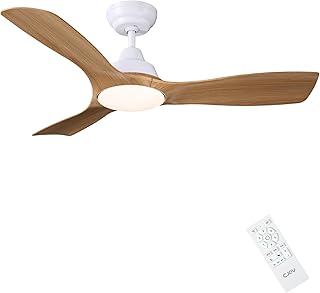
The CJOY Ceiling Fan with Lights and Remote is the most comprehensively reviewed ceiling fan in this guide, with 262 ratings averaging 4.6/5 — strong scores for a product category where buyers tend to be more critical because installation is more involved. The 42-inch three-blade design suits bedrooms and smaller living rooms, and the reversible DC motor is the detail that makes it genuinely useful year-round rather than just in summer.
Reversible DC ceiling fans work by spinning in one direction in summer to create a downdraught that cools the room, and in the opposite direction in winter to gently push warm air that has risen to the ceiling back down along the walls. The DC motor is quieter and more energy-efficient than older AC motors — relevant both for noise in a bedroom and for running costs over time. Buyers consistently mention how quiet this fan runs, which matters significantly if you’re planning to use it while sleeping.
The integrated LED offers three colour temperature settings (3 CCT) with dimming, controlled via the included remote. That means you can have warm light in the evening, neutral light for reading, and brighter cooler light if you use the room as a workspace. The memory function retains your last setting when the power cycles, so you’re not resetting preferences every time there’s a power cut or you flick the wall switch. Six speed settings give you granular control over airflow rather than the crude three-speed options on cheaper fans.
The 42-inch diameter is suitable for rooms roughly up to about 15 square metres — larger than that and you’d want a bigger blade span. Installation requires a ceiling fan-rated backbox (not all standard UK ceiling roses are rated for the dynamic load of a spinning fan), and the process takes longer than a simple light fitting. If you’re not confident with electrics, this is a job to hand to an electrician. That said, the instructions are reported as clear, and confident DIYers complete the installation without drama. The remote is functional rather than sophisticated — there’s no app control or smart home integration on this model.
Best Ceiling Fan with Light for Larger Living Rooms
The CJOY Ceiling Fan with Lights and Remote Control (5-Blade, White) is a distinct product from the three-blade model above — the five-blade configuration moves air differently, and the white finish suits living rooms and dining rooms where the fan is more visually prominent. With 511 reviews at 4.4/5, it has a larger reviewer base and the feedback pattern is similarly positive on noise levels and build quality.
Five blades on a ceiling fan create a perception of solidity and move air in a way that feels less directional and more evenly distributed than three-blade designs. In a living room where people are seated in different positions, that spread matters. The reversible DC motor carries the same practical year-round benefits as the three-blade model, and the 3 CCT dimmable LED panel means the light adapts to morning, evening, and daytime use without you needing to change anything manually beyond the remote.
The white finish is broadly neutral, but it reads as a more traditional aesthetic than the minimal look of some contemporary pendant lights. That’s not a criticism — in most UK living rooms, a white ceiling fan with a white LED panel disappears into the ceiling in the best possible way, providing function without becoming a focal point. If your room has a bold or industrial design scheme, you might want a more characterful fitting; if you want something that works without competing with your décor, this fits that bill.
As with any ceiling fan, the installation considerations are the same: fan-rated backbox, adequate ceiling height (most ceiling fans need at least 2.1m floor-to-blade clearance for comfortable use), and confidence with the wiring. The 42-inch span works in rooms up to around 20 square metres when the five blades are factored in. If you’re already sold on the CJOY ceiling fan format after reading the three-blade section but want more airflow coverage or a different aesthetic, this is the natural step up.
Best Smart Bladeless Ceiling Fan with Light
The Quite Ceiling Fans with Lights and Remote Smart Ceiling Fan takes a fundamentally different approach to ceiling fan design with its bladeless crystal aesthetic — and it has 45 reviews averaging 4.4/5, which is a reasonable early signal for a more premium-positioned product. The bladeless format eliminates the visual weight of traditional blades and creates a chandelier-like centrepiece that works well in dining rooms, hotel-aesthetic bedrooms, and open-plan living areas where the ceiling fitting is meant to be noticed.
Smart functionality on this model goes beyond a standard remote — the listing describes app and voice control compatibility, which means integration with smart home setups is possible. For a bedroom or living room where you’re already using smart speakers or a hub, the ability to set lighting scenes and fan speeds without reaching for a physical remote has genuine daily-use value. The dimmable LED is built into the crystal structure, so the light quality and the visual impact of the fitting are inseparable — when it’s lit, it looks like a decorative light fixture; when it’s off, it still looks like a design statement.
The honest trade-off with bladeless designs is airflow. A conventional bladed fan of the same diameter will typically move more air than a bladeless equivalent, because the blade geometry is optimised purely for airflow rather than aesthetics. If your primary goal is maximum cooling, a bladed fan is more efficient. If the primary goal is a striking light fitting that also provides supplementary air circulation and smart control, the bladeless format is more appropriate.
With only 45 reviews at the time of writing, the long-term reliability picture for this specific model is still developing. The 4.4/5 score is encouraging, but there’s less community feedback to draw on than with the higher-volume picks. It’s a considered buy for someone who has a specific aesthetic vision and is willing to accept a slightly less established track record in exchange for a distinctive look and smart features.
Best Small Bathroom or Cloakroom Light
The hepside Bathroom Light is one of two zero-review products in this guide, and that needs to be stated clearly upfront. There are no verified buyer experiences to draw on here, so the assessment is based entirely on the specification and how it compares to the category broadly. That said, its spec addresses a specific and genuine gap: a small, round, flat bathroom light with a selectable 3000K/4000K/6500K colour temperature and IP54 waterproof rating.
IP54 is a higher waterproofing standard than IP44 — it protects against dust ingress as well as water splashing from any direction, which makes it suitable for zones closer to the shower or bath in some bathroom configurations (always check your specific zone requirements and consult a qualified electrician if unsure). The three selectable colour temperatures — warm white, neutral, and cool daylight — mean you can choose the atmosphere of your bathroom rather than committing to a fixed tone at purchase. That flexibility is genuinely useful in bathrooms that double as spaces for relaxation (where warm light is better) and practical grooming (where cooler, more neutral light helps).
The round, flat design suits smaller rooms — en-suites, cloakrooms, and compact bathrooms where a large square panel would look oversized. The flush profile keeps things tidy in low-ceiling spaces. The budget price point makes it low-risk for someone fitting out a rental property or a room where cost per fitting is a real constraint.
The absence of reviews means you’re taking a position on spec and price rather than community-validated performance. If that feels too uncertain, the DoRight option earlier in this guide has 79 reviews and a higher rating to lean on. But if the round form factor or the IP54 rating specifically suits your project, this is worth considering — just understand the trade-off in verified confidence you’re accepting.
What to Look For When Buying Ceiling Lighting
- IP Rating for wet and damp locations: Any ceiling light in a bathroom must carry at least IP44 (protected against water splashing from any direction). For zones closer to the shower — within 60cm horizontally — IP65 or higher is required. Kitchen ceiling lights benefit from IP44 too. Always check the zone requirements before buying, and never install a non-rated fitting in a wet area regardless of how waterproof it looks.
- Colour temperature (CCT) and whether it’s adjustable: Colour temperature is measured in Kelvin. Below 3000K is warm yellow-white (relaxing, good for bedrooms and living rooms). 4000K is neutral white (versatile, good for kitchens and home offices). 5000–6500K is cool daylight (task-focused, good for garages, bathrooms, and utility rooms). Fixed CCT fittings are cheaper; adjustable CCT (sometimes called tunable white or 3CCT) cost more but let you adapt one fitting to different moods and tasks. Decide before you buy — retrofitting is expensive.
- Lumen output, not just wattage: Wattage tells you how much electricity a fitting uses; lumens tell you how much light it produces. For a typical UK living room of around 15–20 square metres, aim for at least 2500–4000 lumens from your overhead fitting. Kitchens and task areas benefit from more. Don’t rely on “watt equivalents” on packaging — check the actual lumen figure in the specification.
- Dimmer compatibility: Not all LED fittings work with all dimmer switches. If you’re installing a dimmable LED, check that the fitting lists compatible dimmer types — trailing edge (electronic) dimmers generally work better with LEDs than leading edge (triac/phase-cut) dimmers. A mismatch causes flickering, buzzing, or the light not dimming smoothly across its full range.
- Ceiling height and fan blade clearance: For ceiling fans, building regulations and general safety guidance require a minimum clearance from the blade tips to the floor — typically around 2.1 metres. Measure your ceiling height before buying. If your ceilings are lower than 2.3 metres, look for a flush-mount (hugger) fan design rather than one with a drop rod.
- Backbox rating for ceiling fans: Standard UK ceiling rose backboxes are rated for static loads (light fittings). A ceiling fan creates dynamic load through vibration and rotation. Fan manufacturers specify that a fan-rated backbox must be used — not doing so risks the fitting working loose over time. This is a specific installation requirement that catches out DIYers who aren’t expecting it.
- Build material and long-term LED driver quality: The LED chips in most modern fittings last tens of thousands of hours. What typically fails first is the driver (the electronics that convert mains voltage to the correct power for the LEDs). Budget fittings sometimes use lower-quality drivers that can flicker or fail within two to three years. Fittings with substantial verified review histories give you better insight into whether the driver holds up — look specifically for reviews mentioning long-term use or any flickering issues.
Verdict
For most UK households fitting out a kitchen, living room, or hallway, the Riserva LED Square Ceiling Light 48W is the most straightforward, reliable choice in this guide. It has the largest verified review base, strong ratings, a practical IP44 rating that covers damp rooms as well as dry ones, and a flush modern profile that works in the majority of UK home interiors. The fixed 6500K colour temperature suits task-oriented and functional rooms particularly well.
If your priority is a bedroom that stays cool in summer and comfortable year-round, the CJOY Ceiling Fan with Lights and Remote (three-blade) offers the best combination of verified performance, quiet operation, and adjustable CCT lighting in a fan format. And if your bathroom specifically needs a compact, bright, waterproofed fitting, the DoRight 33CM LED Ceiling Light delivers impressive lumens and an ultra-slim profile at a genuinely accessible price point. Match the pick to the room — and you won’t go far wrong.
We were not paid to feature any specific product in this guide. All opinions are independent and based on publicly available specifications, verified buyer feedback patterns, and category research.
Quick Comparison Table


FAQ
What ceiling light is best for a bathroom in the UK?
Any ceiling light installed in a UK bathroom must carry a minimum IP44 rating — this protects against water splashing from any direction. For areas within the shower zone, a higher rating (IP65 or above) is required. Beyond the IP rating, look for a fitting with a cool or neutral colour temperature (4000–6000K) for a bathroom, as it helps with tasks like grooming and makes the room feel bright and clean.
Do I need an electrician to fit a ceiling light in the UK?
Replacing a like-for-like ceiling light on an existing circuit is generally considered a minor electrical work that a competent homeowner can undertake under Part P of the Building Regulations in England and Wales — but you must be confident in what you’re doing and work safely. Installing a new circuit, moving a fitting to a different location, or fitting a ceiling fan (which requires a fan-rated backbox) is more involved, and many people choose to hire a qualified electrician for those jobs. Always isolate the circuit at the consumer unit before starting any work.
What does CCT mean on a ceiling light?
CCT stands for Correlated Colour Temperature, measured in Kelvin (K). It describes the colour appearance of the light: lower values (2700–3000K) produce a warm, yellowish-white similar to traditional incandescent bulbs; mid-range values (4000K) give a neutral white; and higher values (5000–6500K) produce a cool, daylight-like white. Some fittings offer adjustable CCT (often labelled 3CCT or tunable white), letting you switch between modes — useful if you want one fitting to serve different purposes at different times of day.
Are ceiling fans suitable for UK bedrooms?
Yes, and they’re increasingly popular as UK summers become warmer. A ceiling fan does not lower air temperature the way an air conditioning unit does, but it creates a wind-chill effect that makes the room feel cooler — typically by two to four degrees of perceived temperature. Reversible DC ceiling fans can also push warm air downward in winter, helping with energy efficiency. For bedrooms, look specifically for fans described as quiet or with DC motors, as these run silently enough not to disturb sleep.
How many lumens do I need for a ceiling light in a typical UK room?
A rough guideline is to aim for around 150–200 lumens per square metre for general living areas, and 300–400 lumens per square metre for task-intensive spaces like kitchens and home offices. A 15 square metre living room therefore benefits from roughly 2500–3000 lumens overhead; a 10 square metre kitchen might need 3000–4000 lumens for comfortable food preparation. Remember that lumens — not watts — measure actual light output, so always check the lumen figure in the product specification rather than relying on wattage alone.
Can I use a standard dimmer switch with an LED ceiling light?
Only if both the dimmer switch and the LED fitting are confirmed as compatible with each other. Many older leading-edge (triac) dimmer switches cause LED fittings to flicker, buzz, or fail to dim smoothly across their full range. LED-compatible trailing-edge dimmers generally work better. If you’re unsure, check the fitting’s documentation for a list of compatible dimmers, or replace your dimmer switch at the same time as the fitting — manufacturers increasingly provide a list of tested compatible switches.