You’ve just come back from a holiday and you’re scrolling through your phone photos, squinting at blurry sunsets and washed-out portraits, and thinking: there has to be something better than this. You don’t want a professional DSLR that weighs more than your carry-on bag. You don’t want to spend months learning manual settings. You just want a proper camera — something compact enough to slip into a pocket, capable enough to produce a photo you’d actually want to print or post, and simple enough that you won’t need a YouTube tutorial every time you switch it on.
That’s exactly the kind of buyer this guide is written for. Whether you’re after a travel-friendly compact, a flip-screen vlogging camera for YouTube content, a camera you can hand to a ten-year-old without anxiety, or something that punches well above its price with solid image quality, the current Amazon UK market has more options than ever — and more noise than ever too. Generic brands with near-identical spec sheets jostle for attention, listings are padded with marketing superlatives, and customer review sections are littered with fake five-star ratings. Knowing which cameras are actually worth your money takes some digging. That’s what this guide does for you.
How We Evaluated These Cameras
Every camera featured here was assessed against a consistent set of criteria. Image quality was the first filter — not just headline megapixel counts, which are easy to inflate with software interpolation, but actual sensor performance in terms of colour reproduction, sharpness, and low-light handling. Autofocus reliability mattered too, especially for anything marketed at vloggers or action shooters. We looked at build quality and portability (if a camera is supposed to be travel-friendly, it needs to actually be travel-sized), screen usability (a flip screen needs to genuinely work at arm’s length), and ease of use for the target audience.
Connectivity features like WiFi were assessed for real-world usefulness rather than checkbox marketing. Battery life and charging convenience were factored in, since a camera that dies after ninety minutes of use is a liability on a day out. We also scrutinised verified buyer reviews: only cameras with a meaningful number of confirmed purchases were included, and review patterns were checked for consistency. A product boasting a high star rating from a handful of reviews carries a very different weight from one with hundreds of verified buyers all saying the same things. Cameras with very low review counts were either excluded or flagged accordingly.
Best Budget Compact Camera
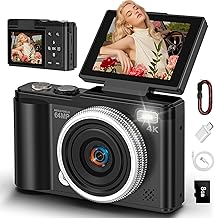
The Digital Camera 4K 64MP Compact Portable Photo Camera with 18X Digital Zoom Autofocus sits at the entry-level end of the market and, despite its modest positioning, manages to deliver a usable all-round package for casual shooters. It’s backed by 119 verified reviews and holds a 4.2 out of 5 rating — a realistic score that suggests genuine user satisfaction without the suspicious perfection of artificially boosted listings.
The headline 64MP figure deserves some context. In cameras at this price tier, high megapixel counts are often achieved through pixel-binning or software interpolation rather than a physically large sensor. That’s not a disqualifier — it just means you should manage expectations accordingly. Real-world detail at full resolution will be noticeably softer than what you’d get from a proper enthusiast camera, but for social media sharing, holiday snaps, and printing at standard sizes, the output is perfectly adequate.
The 18X digital zoom is genuinely useful for getting closer to subjects without physically moving — handy at events, in wildlife scenarios, or for photographing architecture. Be aware that digital zoom degrades image quality the further you push it, so results at 18X will be soft, but usable. The anti-shake feature helps counteract the slight camera movement that’s inevitable when zooming at longer focal lengths, and reviewers note it works reasonably well in decent light.
The 2.8-inch IPS screen is one of the better display specs at this level — IPS panels offer wider viewing angles than standard LCD, which makes framing shots in bright outdoor light easier. The inclusion of a 32GB SD card and an OTG adapter in the box is a practical touch that means you can get shooting straight out of the box, and transfer photos to a phone without needing a separate card reader.
Where this camera struggles is in low light. Smaller sensors and basic image processors mean that indoor shots or evening photography can look noisy and lack definition. Autofocus is functional in good light but can hunt in dimmer conditions. If you’re primarily shooting outdoors in daytime — holidays, days out, family events — it does the job well. If low-light capability is a priority, step up to one of the 4K WiFi options reviewed below.
Best for Image Quality in a Compact
The Kodak PIXPRO FZ55 16MP 5x Zoom Compact Camera takes a different approach from most of the cameras in this guide. Where the generic-brand alternatives stack their spec sheets with high megapixel counts and digital zoom figures, Kodak’s compact keeps things modest on paper — 16MP, 5x optical zoom — and instead invests in the fundamentals that actually make a difference to image quality.
The key word there is optical zoom. A 5x optical zoom uses actual glass to magnify the subject without any digital processing, which means you retain full image quality at every zoom level up to 5x. That’s a meaningful advantage over cameras that rely on digital zoom alone, where quality degrades noticeably. For everyday photography — portraits, travel, family gatherings — 5x optical zoom covers most scenarios well. You won’t be photographing distant wildlife with it, but for general-purpose use, it’s more than sufficient.
Kodak’s image processing pipeline is a known quantity in a way that generic brands simply aren’t. The PIXPRO FZ55 produces consistent, well-exposed JPEGs with natural colours and reliable white balance. It’s not a technical powerhouse, but it’s predictable — and for someone who doesn’t want to spend time post-processing every shot, that consistency is genuinely valuable. The camera handles well, with a sensible button layout and a straightforward menu system that won’t intimidate beginners.
One important note: at the time of research, this listing showed a 4.5 out of 5 star rating on Amazon. The review count associated with the listing was not populated, which makes it impossible to assess how many buyers have actually contributed to that score. A high rating without a substantial review base should be taken at face value rather than as strong social proof. That said, the Kodak PIXPRO FZ55 is a well-regarded model with a track record in the compact camera market, and its reputation in the wider photography community is solid.
If your priority is reliable, consistent image quality from a recognisable brand — and you’re not bothered about WiFi, flip screens, or 4K video — the FZ55 is a strong choice. It’s the camera for the photographer who wants good stills without complication.
Best Compact for Vlogging and Travel
The 4K Digital Camera with WiFi 64MP Autofocus Vlogging Camera is one of the better-reviewed options in this guide, with 150 verified buyers and a 4.6 out of 5 rating — high enough to be encouraging, realistic enough to be credible. It’s built squarely at the travel photographer and casual vlogger who needs versatility in a compact body.
The 180-degree flip screen is the headline feature here, and it’s the reason this camera suits vloggers particularly well. Flipping the screen around so it faces the same direction as the lens means you can see exactly what you’re recording while presenting to camera — something that sounds simple but makes a significant practical difference when you’re trying to frame a talking-head video on your own. The 3-inch display is a decent size for self-monitoring, and reviewers confirm it’s visible enough in moderate outdoor light.
4K video recording is listed, and while the quality at 4K will inevitably be limited by the sensor size and processor in a camera at this tier, it still represents a meaningful upgrade over 1080p for anyone who wants footage that holds up on a larger screen or allows some cropping room in post-production. The anti-shake feature helps smooth out the slight hand movements that are unavoidable when filming on the move, which is important for travel content.
WiFi connectivity allows you to transfer photos and video clips directly to a smartphone without cables, which streamlines the workflow for anyone posting to social media regularly. The 16X digital zoom gives you flexibility for framing shots at a distance, though as with all digital zoom, quality degrades as you push it further. The autofocus is noted by reviewers as responsive in good light — a real practical asset for run-and-gun travel photography where you don’t have time to manually focus.
The flash is a useful addition for indoor shots and low-light fill, though it’s a basic unit rather than a powerful strobe. Battery life is adequate for a day’s casual shooting if you’re disciplined about switching the camera off between uses. The USB charging capability means you can top up from a power bank or laptop on the road — a practical touch for travellers.
Best WiFi Camera for YouTube and Social Media
If you’re creating content for YouTube or want seamless social media integration, the Digital Camera with WiFi, 4K 64MP Autofocus Vlogging Camera for YouTube has the highest review count in this guide at 327 verified buyers, with a 4.4 out of 5 star rating. That combination of volume and quality gives genuine confidence — this is a camera that a significant number of people have actually bought and used, and the majority are satisfied.
The 180-degree flip screen appears here too, and for YouTube content creation it’s non-negotiable. What distinguishes this model from the previous pick is the combination of WiFi connectivity with a built-in SD card slot and USB charging — a trio of features that makes the content workflow considerably smoother. Shoot your footage, transfer it wirelessly to your phone for quick edits, charge the camera overnight via USB: it’s a practical ecosystem that suits the social media creator’s day-to-day needs.
The 4K resolution at 64MP gives your footage and stills the headroom to look sharp even after cropping. Reviewers specifically highlight the autofocus as a strength — it tracks subjects reliably in well-lit conditions, which is important for solo vlogging where you’re the only person in frame and can’t rely on anyone else to adjust the camera. Anti-shake is noted as genuinely effective for handheld video, reducing the jittery quality that plagues cameras without stabilisation.
The 16X digital zoom gives you the option to compress backgrounds or frame subjects more tightly when you’re filming at a distance from your tripod — useful for certain YouTube formats where you want to vary your shots without repositioning constantly. The included SD card means you’re ready to record immediately, without needing to source storage separately.
Where this camera falls short is in genuinely challenging low light — indoor scenes with a single overhead bulb, or exterior evening filming. The sensor can’t compete with larger, more expensive cameras in those conditions. If most of your content is shot in reasonably lit indoor spaces or outdoors during the day, this won’t be a practical limitation. If you’re planning to film late-night event content or atmospheric low-light material, you’ll need to invest at a higher level.
Best Camera for Kids and Teenagers
The Digital Camera 1080P 44MP Vlogging Camera for Kids Teens has the highest rating in this guide — 4.8 out of 5 from 620 verified buyers — and that’s not a small sample. Over six hundred people have bought and rated this camera, and the overwhelming majority are happy with it. That’s meaningful social proof in a market segment where fake reviews are common.
This is a 1080P camera rather than 4K, which is the right trade-off for its intended audience. Kids and teenagers don’t need 4K footage — they need a camera that’s easy to use, produces fun results, feels responsive, and doesn’t require constant parental intervention to operate. The 44MP still resolution produces photos with plenty of detail for printing or sharing, and the 16X zoom lets younger photographers explore framing and composition without needing to physically get close to their subjects.
The 2.4-inch screen is compact but adequate — small enough that the overall camera body stays manageable for smaller hands, large enough to review shots comfortably. The anti-shake feature is particularly valuable here, because younger shooters tend to hold cameras with less stability than adults. The result is that more shots come out sharp even when the photographer is moving around or excited about what they’re capturing.
Build quality for a camera at this tier is usually adequate rather than robust — if your child is particularly rough with their belongings, this isn’t a rugged, shockproof camera. For normal use, reviewers report it holding up well. The mini form factor is genuinely compact and light enough for a child to carry around without complaint, which matters on a day out when the camera needs to actually get used rather than left in a bag.
For parents looking to encourage an interest in photography or video-making without spending a significant amount, or for a teenager who wants to start creating content, this is a practical and well-regarded entry point. The review base makes it one of the most confidently recommended options in this guide.
Best Budget 4K Camera for Beginners
The 4K Digital Camera for Photography Vlogging: 64MP Compact Cameras with Flip Screen and Anti-Shake positions itself as a gift option for beginners and teenagers — and the positioning is well-judged. It sits at the budget end of the 4K segment, carries 402 verified reviews, and holds a 4.1 out of 5 rating: a realistic score from a substantial number of buyers.
The 4.1 rating is worth contextualising. In a category where many listings inflate their scores with a handful of reviews, 402 buyers providing an average of 4.1 tells a more honest story. The camera does what it claims to do for the majority of users, but it isn’t without its limitations — and that’s reflected in the score. For a beginner who’s stepping up from a smartphone for the first time, those limitations are unlikely to cause frustration. For someone with more experience or higher expectations, they might.
The flip screen and 4K recording make this camera suitable for basic vlogging, and the 64MP resolution gives stills enough detail for online sharing and standard-size prints. Anti-shake is included and, at this price point, it performs adequately in good light. The compact body is genuinely portable — light enough for a day bag without being so fragile that you’re constantly worrying about it.
As a gift for a teenager starting out with photography or casual video content, this camera strikes a reasonable balance. It gives the recipient enough capability to learn and experiment — manual exposure options on some models in this family allow beginners to explore settings beyond full auto — without the cost of a more serious camera that might go unused if the hobby doesn’t stick. The flip screen is the feature most buyers highlight positively: it genuinely changes the vlogging experience.
The trade-offs are the same as others in its tier: low-light performance is limited, digital zoom degrades quality at higher levels, and battery life requires careful management on a full day out. Pack a spare battery or a USB power bank, and this camera will serve a beginner well.
Best Camera with Macro and Advanced Features
The 4K 64MP Digital Camera with SD Card, 180° Flip Screen Autofocus Camera with Macro Function and 16x Digital Zoom stands out from the rest of this guide for one specific reason: the macro function. At 4.9 out of 5 from 56 verified reviews, the rating is very high — the review count is moderate rather than large, so treat it as a strong early indicator rather than a definitive verdict. That said, the reviews that do exist are consistently positive.
Macro photography — capturing extreme close-up images of small subjects like flowers, insects, textures, or food — is a niche that most compact cameras handle poorly. The ability to focus at very short distances without losing sharpness requires specific optical design, and finding that capability in a compact at this tier is genuinely unusual. For photographers who want to explore macro as a creative avenue without investing in a dedicated lens system, this camera offers a legitimate entry point.
Beyond the macro function, the core spec set is competitive: 4K video, 64MP stills, a 180-degree flip screen for self-recording, autofocus, anti-shake, and 16X digital zoom. The USB charging via cable is included, and the SD card in the box means you’re ready to shoot immediately. The flip screen works as expected for vlogging or self-portraits, and the autofocus is noted by reviewers as accurate.
The combination of macro capability with a flip screen and 4K video makes this camera genuinely versatile. It works as a travel compact, a vlogging camera, and a close-up photography tool — three use cases in a single body. For someone who wants to explore photography beyond the standard ‘point it at a person or landscape’ approach, the macro function opens up a different way of seeing and shooting that can be genuinely engaging.
Given the lower review count, exercise the usual caution — but the absence of any concerning patterns in the existing reviews, combined with the distinctive macro feature set, makes this the most interesting pick in the guide for someone who wants to go slightly beyond basic photography. If close-up detail photography appeals to you, this is the one to consider.
What to Look For When Buying a Digital Camera
- Optical zoom vs digital zoom: Optical zoom uses physical glass and retains full image quality at any zoom level. Digital zoom is simply a software crop — quality degrades the further you push it. If zoom matters to you, prioritise cameras that specify optical zoom. Many budget compacts use digital zoom exclusively, which is a limitation worth knowing about before you buy.
- Sensor size and resolution: High megapixel counts don’t automatically mean better photos. A 64MP sensor in a compact camera may produce less detailed images than a 16MP sensor in a camera with better optics and a larger physical sensor. Look at verified reviewer photos and real-world samples rather than trusting headline specs. Sensor size (the physical dimensions of the image-capturing chip) matters more than pixel count for low-light performance.
- Flip screen and self-recording: A 180-degree flip screen is the single most useful feature for vloggers and solo content creators. Without it, you’re guessing at your framing every time you record yourself. If you’re buying a camera primarily for YouTube, social media, or travel diary content, a flip screen should be near the top of your checklist.
- WiFi connectivity: Built-in WiFi lets you transfer photos and video to your smartphone wirelessly, which streamlines posting to social media and backing up your content. If you’re creating content for YouTube or Instagram regularly, WiFi connectivity saves meaningful time versus using a cable or removing the SD card every time you want to share a file.
- Battery life and charging: Budget compacts typically offer battery life in the range of 200-400 shots per charge, which is adequate for casual shooting but can run short on a full day out. USB charging (especially via USB-C) is a significant practical convenience — it means you can charge from a power bank, laptop, or car charger without carrying a dedicated wall adapter. Always check what’s included in the box, since some cameras ship without a charging cable or spare battery.
- Review count and rating balance: A 4.9-star rating from fifteen reviews is not the same as a 4.4-star rating from three hundred reviews. In the compact camera segment on Amazon UK, inflated ratings from low review counts are common. Prioritise cameras with ratings above 4.2 and review counts in the hundreds, and read the critical reviews specifically — they tend to be the most informative about real-world limitations.
- Included accessories: Check exactly what comes in the box. Some cameras include an SD card (very useful), a carrying case, extra batteries, or an OTG adapter for phone connectivity. Others ship with the bare minimum. Knowing what you’ll need to source separately prevents unexpected additional costs and delays before you can actually start using the camera.
Verdict
For most UK buyers reading this guide — holiday photographers, casual family snappers, or beginners who want something better than a phone without the complexity of a mirrorless system — the Digital Camera with WiFi, 4K 64MP Autofocus Vlogging Camera for YouTube represents the best all-round choice. Its combination of 327 verified reviews, a solid 4.4 rating, 4K recording, a 180-degree flip screen, WiFi, and USB charging covers the widest range of everyday shooting scenarios. It’s the camera that does the most things well without asking you to compromise on the features that matter most in day-to-day use.
If you’re buying for a child or teenager, the Digital Camera 1080P 44MP Vlogging Camera for Kids Teens is the standout — 620 reviews at 4.8 stars is genuinely impressive and gives real confidence that it works well for its intended audience. For photographers specifically interested in close-up and macro shooting, the 4K 64MP Digital Camera with Macro Function is the most distinctive option in the guide. And if you simply want consistent, reliable image quality from a brand with a proven track record, the Kodak PIXPRO FZ55 is worth your attention.
We were not paid to feature any specific product in this guide. All opinions are independent and based on publicly available specifications, verified buyer feedback patterns, and category research.
Quick Comparison Table


FAQ
What is the best digital camera for a complete beginner in the UK?
For a complete beginner, look for a compact camera with automatic shooting modes, a flip screen for self-recording, and a straightforward menu system. The cameras in this guide with flip screens and autofocus are the most accessible starting points, since they handle most technical decisions automatically and let you focus on framing and composition. A camera with a meaningful number of positive reviews from other beginners is a reliable indicator that the learning curve isn’t too steep.
Is a higher megapixel count always better?
Not in practice. Megapixel count describes how many individual pixels the sensor uses to capture an image, but image quality also depends heavily on the physical size of the sensor, the quality of the lens, and the camera’s image processing. A 16MP camera with good optics will often produce sharper, more detailed images than a 64MP compact with a small sensor and basic lens. For everyday use and standard-size prints or online sharing, anything above 16MP is more than adequate.
Do I need a flip screen on my camera?
If you plan to vlog, record yourself, or take self-portraits regularly, a 180-degree flip screen is one of the most practically useful features you can have. It lets you see exactly what the camera is capturing while you’re in front of it, which eliminates the guesswork and ensures your framing is correct. If you only shoot outward-facing subjects — landscapes, events, other people — a flip screen is nice to have but not essential.
What does anti-shake actually do on a compact camera?
Anti-shake (also called image stabilisation) compensates for the small, involuntary movements your hands make while holding a camera. It’s most useful when shooting at slower shutter speeds, in lower light, or at higher zoom levels where movement is amplified. The technology can be optical (the lens or sensor physically moves to counteract camera shake) or digital (the camera processes the image to correct blur). Optical stabilisation is generally more effective, but digital anti-shake still provides a noticeable improvement over no stabilisation at all, particularly for video recording.
Is WiFi on a compact camera actually useful?
Yes, particularly if you create content for social media or YouTube. WiFi lets you transfer photos and videos directly from the camera to your smartphone without removing the SD card or connecting a cable — you simply connect the two devices via the camera’s companion app and download what you need. For photographers who batch-edit and back up files on a computer, WiFi is less critical. For regular online posters, it removes a step from the workflow every single time you want to share something.
How many photos can a typical compact camera store on a 32GB SD card?
At standard JPEG quality settings, a 32GB card will typically hold several thousand photos — the exact number varies depending on the resolution you’re shooting at and the level of compression applied. At maximum resolution on a 64MP camera, you can expect several hundred photos before filling the card. For video, storage is consumed more quickly: 4K footage uses significantly more space than 1080P, so a 32GB card might give you around one to two hours of 4K video depending on the bitrate. If you shoot a lot of video, a 64GB or 128GB card is worth considering.