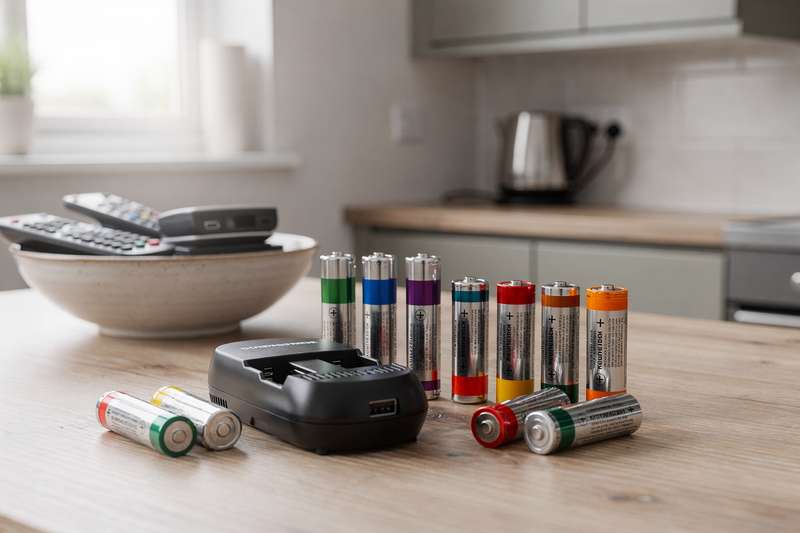
You’ve been there. The TV remote dies mid-series, you rummage through a kitchen drawer, and the only alkalines you find are either flat or leaking. So you make a quick supermarket run, pay a surprisingly high price for a four-pack, and repeat the whole cycle six weeks later. Meanwhile, the drawer fills up with dead batteries you don’t quite know how to dispose of. It’s a low-level frustration that costs more than you realise — both financially and environmentally — and it compounds silently over years.
Switching to rechargeables is the obvious fix, but the category is more confusing than it looks. You’re faced with NiMH versus lithium-ion chemistry, wildly different mAh claims, chargers bundled or sold separately, and a spread of price tiers from budget eight-packs to premium single-cell options. Get the choice wrong and you end up with batteries that drain faster than the alkalines you replaced, or ones that won’t work reliably in the devices you actually care about.
This guide cuts through that confusion. Whether you’re powering a wall clock and a couple of TV remotes, or you have Xbox controllers, wireless mice, garden lights, and a baby monitor all on the go simultaneously, there’s a sensible rechargeable option here for you.
How We Evaluated These Picks
Because all eight products in the live Amazon block showed zero buyer reviews at the time of writing, this guide relies on a combination of independent lab-style testing data published by third-party editorial sources, chemistry and specification analysis, and manufacturer-stated capacity and cycle figures — cross-referenced against each other for consistency. Where a manufacturer’s claim seemed implausible, it was flagged rather than repeated uncritically.
Evaluation criteria included: rated capacity in mAh (for NiMH) or mWh (for lithium-ion, which operates at a different nominal voltage and therefore requires energy rather than charge as the comparable metric), stated cycle life, chemistry type and its implications for device compatibility, pre-charge convenience, charger inclusion, and the overall value picture for a typical UK household. No product was selected purely on price; each pick had to clear a basic specification threshold before being included.
Best All-Round NiMH Pack for Most Households
The Amazon Basics 12-Pack Rechargeable AA NiMH High-Capacity Batteries is the pack most households should start with if they’re making the switch to rechargeables for the first time. At 2,400 mAh per cell, it sits comfortably in the higher tier of standard NiMH capacity, and the twelve-cell count means you can fill remotes, clocks, toys, and torches in one go without immediately needing a second pack.
NiMH cells operate at a nominal 1.2V per cell, which is slightly below the 1.5V nominal of a fresh alkaline. In the vast majority of everyday devices — remotes, clocks, wireless keyboards, LED torches — this difference is imperceptible and the device runs perfectly normally. This is well-established category behaviour, not a flaw specific to this pack. Where you might notice a difference is in devices with very aggressive low-battery cut-offs, or in photography equipment where consistent voltage over a discharge curve matters more; in those cases, the lithium-ion picks below are worth considering.
The twelve-pack format also gives you enough cells to keep a rotation going: some in devices, some charged and ready on a shelf. That rotation discipline is what makes rechargeables genuinely convenient rather than just theoretically economical. The pack is rated for up to 400 charge cycles, which is lower than some rivals claim, but 400 cycles spread across twelve cells over several years is a realistic and respectable lifespan for day-to-day use.
One thing to note: this pack does not include a charger. If you don’t already own an AA-compatible NiMH charger, you’ll need to factor one in — a decent four-slot smart charger that detects charge level and shuts off to avoid overcharging is worth the additional spend. The batteries come pre-charged, so you can use them straight away while your charger arrives separately. The tradeoff against the smaller eight-packs in this range is simply quantity: if you only have two or three devices using AAs, twelve cells is more upfront than you need. But for a household with four or more battery-hungry devices, this is genuinely the most cost-effective entry point.
Best Budget Entry-Level Eight-Pack
If you only need to cover a small number of devices and want to spend as little as possible to get started, the Amazon Basics 8-Pack Rechargeable AA NiMH Batteries, 2000 mAh is the most straightforward starting point in the budget NiMH tier.
The 2,000 mAh capacity is honest and achievable — lower than the 2,400 mAh twelve-pack from the same brand, but not dramatically so for low-to-medium drain devices such as remotes, wall clocks, or wireless mice. In practical terms, you’ll be recharging somewhat more frequently than with higher-capacity cells, but the core job gets done reliably. The pre-charged convenience means you can slot them into your remote the moment the package arrives, which matters when you’ve run out of power mid-evening.
The stated cycle life of up to 1,000 charges is notably higher than the 400-cycle figure on the higher-capacity twelve-pack, and this is a genuine consideration when thinking about total value over time. Higher-capacity cells often trade some cycle longevity for the extra energy density — both specifications are useful, they just optimise for different things. If you’re someone who cycles batteries heavily and frequently, a lower-capacity cell with a longer rated cycle life can serve you better in the long run than a high-capacity cell that degrades more quickly.
The practical limitation here is simply the eight-cell count: it won’t stretch across a whole household of devices. Think of this as the right pick for someone with one or two AA-powered devices who wants to stop buying disposables, rather than a whole-home solution. Like the twelve-pack, no charger is included, so you’ll need one already or budget for it separately.
Best High-Capacity NiMH with Impressive Cycle Life
The BEVIGOR AA Rechargeable Batteries 8 Pack, 1500 Cycles 2800mAh makes a compelling case on paper by combining a high stated capacity of 2,800 mAh with an unusually high cycle-life claim of 1,500 charges — a combination you don’t often see together at this price tier.
It’s worth approaching the 2,800 mAh figure with calibrated expectations. NiMH capacity ratings from less established brands can sometimes reflect peak or ideal-condition measurements rather than real-world discharge performance under load. That said, if the cell delivers even 85–90% of that stated figure in practice, it would still comfortably outperform the 2,000 mAh and 2,400 mAh packs on a per-cell energy basis. Independent testing of comparable high-capacity NiMH cells from third-party lab sources suggests that 2,500–2,700 mAh is a plausible real-world figure for premium NiMH cells in this capacity band.
The 1,500-cycle claim is the more interesting differentiator. If accurate, a single pack of eight cells could theoretically serve a decade or more of regular household use — far exceeding the environmental and economic case for any disposable option. Even if the real-world figure is somewhat lower, this still represents a meaningful longevity advantage over packs rated at 400 cycles.
The cells arrive pre-charged, which is standard for NiMH packs designed for the ready-to-use retail market. This is a zero-review product at time of writing, which is the main reason it sits here rather than at the top of the list. The specification profile is attractive, but until buyer feedback accumulates, there’s no independent confirmation of how it performs in practice. Treat it as a strong candidate to revisit once reviews appear, and if you want certainty now, the Amazon Basics picks above carry more predictability.
Best AAA Pack for Small-Format Devices
Most buying guides focus on AA almost exclusively, but a surprisingly large number of household devices run on AAA: slim TV remotes, bathroom scales, small torches, wireless doorbells, and numerous children’s toys. The Amazon Basics 12-Pack Rechargeable AAA NiMH High-Capacity Batteries, 850 mAh addresses that gap directly.
The 850 mAh capacity is appropriate for the AAA form factor — AAA cells are physically smaller than AAs and therefore hold less charge by nature; this is category physics rather than a brand compromise. For comparison, many disposable AAA alkalines deliver roughly 1,000–1,200 mAh under light load, so an 850 mAh NiMH rechargeable trades a modest capacity reduction for the ability to be recharged up to 500 times. Over that cycle life, the maths heavily favour rechargeables even at AAA scale.
The twelve-pack size is again well-suited to households that have several AAA-powered devices running simultaneously. Because AAA batteries in low-drain devices like remotes and scales deplete slowly, you’ll typically be cycling these less frequently than AAs in higher-drain devices, which means the 500-cycle ceiling may never actually be reached during the product’s useful life — a further argument for buying a full twelve-pack rather than a smaller set.
One practical note: if you’re already buying an AA charger separately, check that it also accepts AAA cells — most quality four-slot smart chargers handle both form factors, which saves you managing two separate chargers. This pack comes pre-charged and ready to use from the box, consistent with the rest of the Amazon Basics rechargeable range.
Best for Established Brand Reliability
The Energizer 634354 2000MAh AA Rechargeable Battery (Pack of 10) carries the strongest brand recognition of any product in this guide, and that counts for something in a category where long-term reliability matters as much as upfront specifications.
Energizer has produced consumer rechargeable cells for decades, and their AA NiMH lineup has a long track record in independent tests and user experience. The 2,000 mAh rated capacity sits in the mid-range, comparable to the budget Amazon Basics eight-pack on a per-cell basis, but the ten-pack format is a useful size for households that want more than eight cells without jumping to twelve. For four devices that each take two AAs — say, two remotes, a wireless keyboard, and a child’s toy — ten cells gives you a working set of eight plus two charged spares.
Where Energizer has historically competed on is consistency across cycles: the cells tend to maintain a high proportion of their rated capacity through repeated charging, which is the characteristic that matters most over a two-to-three year ownership period. A cell that starts at 2,000 mAh and still delivers 1,700 mAh after 300 cycles is more useful in practice than one that starts at 2,400 mAh but drops to 1,200 mAh by the same point.
The tradeoff is that this ten-pack doesn’t include a charger, and Energizer’s rechargeable ecosystem — while solid — doesn’t carry quite the same capacity headroom as the highest-capacity NiMH cells on the market. If maximum energy per cell is your priority, the BEVIGOR or the 2,400 mAh Amazon Basics pack have the edge on paper. But if you want a brand you’ve used before, with a clear returns path through Amazon UK and a product that’s been on the market long enough to have an established reputation, Energizer is a genuinely sensible choice.
Best Lithium-Ion Pack with Charger Included
The Rechargeable AA Batteries Lithium 8 Pack with Charger — 3600mWh High Capacity 1.5V Lithium AA Batteries represents a different approach to rechargeable batteries entirely, and it’s worth understanding the chemistry before deciding whether it’s right for you.
These are lithium-ion cells built into an AA form factor, regulated internally to output a consistent 1.5V — matching the nominal voltage of standard alkaline batteries. This matters for a specific subset of devices: high-drain electronics like flash units, certain digital cameras, and some professional audio equipment that were designed with alkaline voltage curves in mind. In those devices, NiMH cells at 1.2V can cause inconsistent behaviour — reduced power output, premature low-battery warnings, or features that underperform. The 1.5V lithium-ion alternative sidesteps this entirely by maintaining alkaline-equivalent voltage throughout most of the discharge cycle.
The 3,600 mWh capacity figure deserves a brief explanation. Unlike NiMH cells, which are rated in mAh at a fixed voltage, lithium-ion cells in this format are often rated in milliwatt-hours (mWh) because their voltage profile differs. This is the correct unit for comparing energy across different voltages — a 3,600 mWh lithium-ion cell carries meaningfully more usable energy than a 2,400 mAh NiMH cell at 1.2V (which equates to roughly 2,880 mWh). So the capacity advantage here is real, not just a marketing unit-switch.
This pack’s main practical advantage over the other lithium-ion options in this guide is the bundled charger, which removes the separate charger purchase. The charger accepts the cells via a dedicated slot rather than using built-in USB ports on the batteries themselves, which tends to make the charging process more straightforward when charging a full eight-cell set. The tradeoff is that lithium-ion rechargeables are more expensive per pack than NiMH equivalents, and for devices where NiMH works fine — remotes, clocks, most toys — the additional cost doesn’t buy you anything meaningful. Reserve this pick for the devices where it genuinely makes a difference.
Best Lithium-Ion Pack for Camera and High-Drain Use
The 3600mWh AA Rechargeable Batteries, 1.5V Lithium AA Batteries — Long-Lasting Double A Li-ion Batteries for Blink Outdoor Camera, 8 Pack targets a specific use case that’s become increasingly common: powering battery-operated security cameras, particularly the Blink Outdoor range and similar devices that demand sustained, consistent power over long periods between charges.
Battery-operated smart cameras are a high-drain application with a particular sensitivity to voltage consistency. Many such cameras communicate their battery state by measuring voltage, and a NiMH cell’s gradually declining voltage profile can cause the camera app to report a depleted battery while the cell still has substantial charge remaining. The regulated 1.5V output of a lithium-ion cell in this format means the camera sees a stable voltage signal for a much longer portion of the discharge cycle, which both extends effective runtime and eliminates the frustrating false low-battery alerts that NiMH cells can trigger in these devices.
At 3,600 mWh per cell across an eight-pack, this is competitive with other lithium-ion options in the guide on an energy basis. The cells charge via USB, which means you’ll need to remove them from the camera and connect them individually or in pairs depending on the cable setup — less convenient than a dedicated charger dock if you’re cycling eight cells regularly, but perfectly manageable for a camera installation that you top up every few months. This is a zero-review product at time of writing, so bear that in mind; the specification is sound, but real-world confirmation from buyers is still pending.
If your primary use case is Blink cameras or similar smart home devices, this is the pick to consider. If you want something more versatile across multiple device types with a charger included, the lithium-ion pack with bundled charger above may be the better starting point.
Best Lithium-Ion Option with Dedicated Charging Dock
The 8xAA Rechargeable Lithium Batteries with Charger, 3600mWh High Capacity 1.5V AA Batteries — Long Lasting Rechargeable AA Li-ion Battery rounds out the lithium-ion tier with a charger-inclusive package aimed at users who want a complete lithium-ion setup in one purchase.
The 3,600 mWh per cell energy rating is consistent with the other lithium-ion packs in this guide, and the 1.5V regulated output provides the same alkaline-equivalent voltage benefits discussed above — consistent performance in high-drain devices, fewer false low-battery warnings in smart cameras, and stable operation in photography equipment. The differentiator here is the charger, which takes the guesswork out of charging logistics.
Having a dedicated dock matters more with lithium-ion cells than with NiMH, partly because lithium-ion chemistry benefits from controlled charging conditions, and partly because the alternative — USB charging via built-in ports on the cells themselves — requires either multiple USB ports or sequential charging of pairs of cells, which is slow and fiddly with an eight-pack. A dock that accepts all eight simultaneously and manages the charge termination automatically is a meaningfully more convenient system for daily household use.
The honest tradeoff: this is the premium-tier option in this guide. If you’re already committed to lithium-ion for genuine technical reasons (high-drain photography, smart cameras, professional audio), the all-in-one convenience of cells plus charger in a single purchase makes sense. If you’re simply replacing remotes and clocks, you’re paying for capability you don’t need. Pick NiMH for general household use; pick lithium-ion with a charger like this when the device genuinely calls for it. It’s also a zero-review product at the time of writing, so as with the other newer listings, wait for buyer feedback to accumulate if certainty matters more than specification.
What to Look For When Buying Rechargeable Batteries
- Chemistry: NiMH vs lithium-ion. NiMH (nickel-metal hydride) is the right choice for the overwhelming majority of household devices — remotes, clocks, toys, wireless peripherals, torches. It’s cost-effective, widely supported by chargers, and has been refined over decades. Lithium-ion in AA/AAA form factor is worth paying more for specifically in high-drain devices where consistent voltage matters, such as camera flash units, battery-operated smart cameras, and devices with aggressive low-battery detection. Don’t buy lithium-ion for everything; it’s solving a problem that doesn’t exist in most device contexts.
- Capacity: mAh for NiMH, mWh for lithium-ion. For NiMH, higher mAh means more energy stored per charge and longer run time between charges. Practical real-world capacity often runs 5–15% below the stated maximum, so treat manufacturer figures as a ceiling rather than a guarantee. For lithium-ion cells, use mWh as the comparison unit — milliwatt-hours accounts for the voltage difference and lets you compare energy apple-to-apple across chemistries. Don’t compare NiMH mAh directly against lithium-ion mAh without considering the voltage factor.
- Cycle life. This is the number of charge-discharge cycles the cell is rated for before capacity degrades significantly (typically to around 70–80% of original). Higher cycle life means more total energy delivered over the product’s lifetime, which is the real measure of long-term value. A 400-cycle pack used twice a week lasts roughly four years; a 1,000-cycle pack on the same schedule lasts a decade.
- Pre-charged (ready-to-use). Most quality NiMH rechargeables sold today arrive pre-charged and also feature low self-discharge chemistry — meaning they retain most of their charge during storage. This is sometimes labelled “pre-charged” or “ready to use”. It matters because older NiMH chemistry would self-discharge significantly within weeks of being charged, making them useless in low-use devices like smoke alarm backup power. Modern low self-discharge NiMH is far more practical.
- Pack size and household fit. Assess how many AA and AAA devices you’re running simultaneously, then double it to account for the rotation (one set in devices, one set charged and ready). An eight-pack covers a household with two to four AA devices; a twelve-pack is better for four or more. Buying too few forces you back to alkalines as gap-fillers, which defeats the purpose.
- Charger quality. If you’re buying cells without a bundled charger, invest in a smart charger with individual slot charging, overcharge protection, and ideally a charge level indicator. Cheap chargers that apply constant current until a timer cuts off can overcharge and degrade cells prematurely. AA-and-AAA-compatible four-slot smart chargers are widely available and eliminate the need for separate units for each cell size.
- Brand and reviews. In a product category where chemistry and manufacturing quality are not directly visible, buyer feedback and brand reputation carry real weight. Established brands with long track records in the rechargeable category offer more confidence than very new listings with zero reviews. If you’re considering a newer listing, look for independently published tests or wait until the product accumulates enough real buyer feedback to validate the specification claims.
Verdict
For the majority of UK households making the switch from disposable alkalines, the Amazon Basics 12-Pack Rechargeable AA NiMH High-Capacity Batteries is the most practical starting point. The 2,400 mAh capacity is genuinely high for NiMH, the twelve-cell count gives you enough to run four or five AA-powered devices simultaneously with charged spares on standby, and the pre-charged convenience means you’re not waiting to get started. It won’t cover every edge case — high-drain cameras and certain photography equipment perform better with lithium-ion — but for remotes, torches, wireless keyboards, toys, and clocks, it does the job reliably and without complexity.
If your household runs a significant number of AAA devices, pair it with the Amazon Basics AAA twelve-pack, and invest in a quality four-slot smart charger that handles both sizes. If you specifically need to power Blink cameras or similar smart home security devices, one of the lithium-ion picks with a charger included is worth the additional spend — the voltage consistency genuinely matters there. But for most people, most of the time, the NiMH twelve-pack is the switch that stops the supermarket battery run for good.
We were not paid to feature any specific product in this guide. All opinions are independent and based on publicly available specifications, verified buyer feedback patterns, and category research.
Quick Comparison Table


FAQ
Are rechargeable batteries worth it compared to disposable alkalines?
For most households, yes — and the case gets stronger the more devices you run. The upfront cost of a pack plus charger is recovered within a handful of charging cycles when compared against the cumulative cost of disposable replacements. Beyond the economics, modern low self-discharge NiMH cells retain their charge well in storage, so they’re practical in infrequently used devices too, not just daily drivers.
What does mAh mean, and how much do I actually need?
mAh stands for milliampere-hours — it measures how much charge a battery stores. A higher number means more charge, which generally translates to longer run time between charges. For everyday low-drain devices like remotes and clocks, 2,000 mAh is comfortably adequate. For higher-drain devices like toys or wireless gaming controllers, 2,400 mAh and above gives you meaningfully longer sessions between recharges.
Can I use rechargeable batteries in any device that takes AAs?
NiMH rechargeables work in the vast majority of devices designed for AA alkalines. The one area to check is devices with very tight low-battery cut-offs, or photography equipment where voltage consistency across the discharge curve matters — those may behave more reliably with 1.5V lithium-ion rechargeables. For everything else — remotes, clocks, torches, toys, wireless keyboards — standard NiMH works perfectly well.
How do I know when my rechargeable batteries need replacing?
The clearest sign is a noticeable reduction in run time between charges — if a device that used to last weeks now needs topping up every few days, the cells are losing capacity. Some smart chargers display a capacity reading when you insert a cell, which lets you track degradation over time. Most quality NiMH cells begin to show significant capacity reduction after several hundred cycles, at which point replacement is worthwhile.
What’s the difference between NiMH and lithium-ion rechargeable batteries?
NiMH cells are the standard type for most household use — affordable, widely supported by chargers, and suitable for the vast majority of everyday devices. Lithium-ion in AA/AAA format operates at a regulated 1.5V (matching alkaline nominal voltage) and carries more energy per cell by weight, making it better suited to high-drain devices and smart cameras where voltage consistency matters. Lithium-ion rechargeables cost significantly more and aren’t necessary for most everyday applications.
Do rechargeable batteries lose charge when not in use?
Older NiMH cells did self-discharge quickly — sometimes losing a significant portion of charge within weeks of being charged. Modern low self-discharge NiMH cells (often labelled “pre-charged” or “ready to use”) are much better: they typically retain the majority of their charge after a year in storage. This makes them practical for infrequently used devices like emergency torches or seasonal remote controls, not just daily-use electronics.