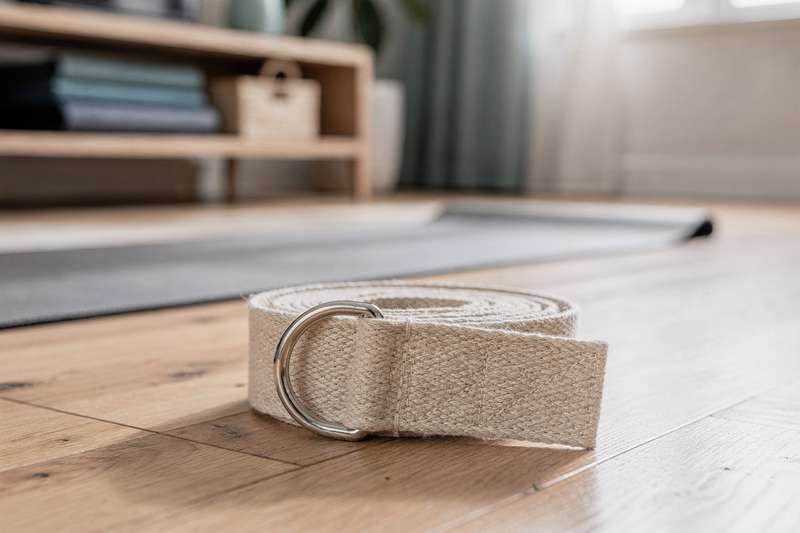
You roll out your mat, sit down on the floor, and reach for your toes. Your fingertips stop about 20 centimetres short, which is exactly where they’ve been stopping for the past three years. You’ve tried warming up longer, you’ve tried those foam roller routines on YouTube, and you’ve even attempted a few physio-guided stretches after a nagging hamstring strain that refused to fully clear up. Nothing has given you a reliable grip to hold a stretch properly — your arms tire out before your hamstrings actually lengthen, and without something to anchor your foot, the whole effort feels like a battle rather than a stretch. A yoga strap with a D-ring buckle solves this specific problem: it extends your reach, holds the load at the buckle so your hands aren’t white-knuckling a towel, and lets you adjust tension incrementally as your hamstrings relax. The catch is that the market is flooded with near-identical-looking straps, and the quality difference between them is enormous once you’re actually using them at 6 a.m. before your body has woken up properly.
How We Evaluated These Picks
To narrow down the best options available right now on Amazon UK, we assessed each strap against five core criteria. First, buckle integrity — a D-ring that slips under load is worse than useless; we paid close attention to verified buyer reports of slippage, deformation, or cracking under sustained tension. Second, material and width — cotton versus synthetic blends behave differently against bare skin, and a strap narrower than 1.5 inches tends to concentrate pressure and dig in. Third, length — for hamstring work specifically, anything under 1.8 metres limits versatility; 2.4 to 2.5 metres opens up reclined leg-raise variations and partner-assisted stretches. Fourth, loop configuration — some straps rely solely on the D-ring for adjustability, while others include fixed loops along the length for physical therapy-style progressions. Fifth, reviewer volume and rating pattern — a strap with hundreds of verified reviews gives a much clearer signal than one with a handful, particularly when negative reviews consistently flag the same structural failure point.
Best Overall D-Ring Yoga Strap
The Flintronic Yoga Belt Pilates D-Ring Buckle Yoga Strap is the strap we’d point most readers towards first, and the reason comes down to a combination of solid reviewer volume and consistent real-world feedback. With 382 verified ratings at 4.6 out of 5 stars, it has enough coverage to give you a reliable read on long-term performance — something you simply can’t say for a strap with four or five reviews.
What buyers consistently highlight is that the D-ring buckle holds its position under sustained tension, which is the single most important functional requirement for hamstring stretching. When you loop the strap around your foot, raise your leg, and gradually walk your hands up the strap to increase the stretch angle, the last thing you want is a buckle that quietly inches its way towards you and drops your leg. The Flintronic strap appears to pass this test for the vast majority of users, and critically, the complaints in negative reviews tend to centre on minor aesthetic issues (stitching colour variation, slight smell from packaging) rather than structural failures.
The strap is extra-long, which matters for taller individuals or anyone working on deep reclined hamstring stretches where a shorter strap runs out of length before you’ve created useful leverage. It’s designed for yoga, Pilates, and general fitness stretching, so it covers the typical range of uses without being over-engineered for one specific application. The adjustable buckle system means you can set the loop size for your foot, lock it, and then use the remaining tail for grip — a simple mechanic that works well in practice.
The one honest tradeoff: at this price tier, you’re not getting a premium woven cotton strap with reinforced bar-tack stitching at every stress point. If you’re doing intensive daily physical therapy work where the strap is under load for extended periods, the seam quality may show wear after several months of heavy use. For the typical yoga or home-stretching user — three to five sessions per week, moderate tension — this strap performs well above its price point and earns its place as the default recommendation.
Best Budget Pick
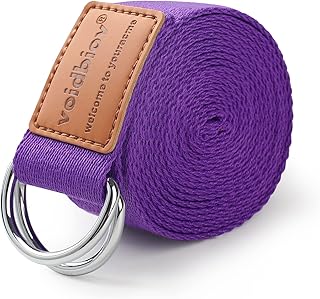
If you want to spend the absolute minimum to get a functional D-ring yoga strap into your hands, the D-Ring Buckle Yoga Strap 1.85 or 2.5M Durable Cotton Adjustable Belt is a straightforward entry point. It comes in two length options — 1.85 metres and 2.5 metres — which is a useful choice to have, because taller users or anyone who wants to use the strap for reclined poses will find the longer version far more practical.
The core promise here is simplicity: cotton construction, a metal D-ring, and a clean loop that adjusts as you thread the tail back through. There are no extra loops, no additional hardware, and no branded padding — just the fundamental tool for the job. For someone who is brand new to using a yoga strap, or who wants something to keep at the office or in a travel bag without worrying about it, this covers the basics competently.
The honest limitation is the review data. With zero verified reviews on this particular listing at the time of research, you’re relying on the product specification rather than a pattern of buyer feedback. The 4.7-star rating appears to be based on a very small or unverified base, so approach with that context. That said, the product description and construction details align with what a functional budget strap should offer, and the cotton material is appropriate for direct skin contact during barefoot stretching sessions.
Where this strap makes the most sense is as a starter purchase — buy it, test whether you’ll actually use a strap consistently, and then upgrade to a more thoroughly reviewed option once you know it suits your routine. The 2.5-metre version in particular gives you enough length to experiment with different hamstring stretch positions without feeling constrained.
Best for Multi-Loop Physical Therapy Work
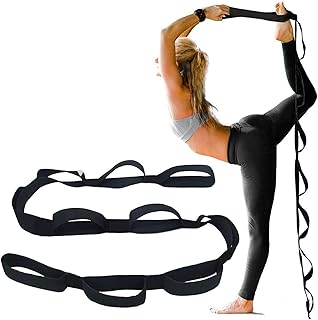
The YNR Yoga Strap for Stretching with 10 Loops Multi-Grip Pilates Hamstring Stretcher Belt takes a different approach to most straps in this category. Rather than relying purely on a D-ring buckle for all adjustability, it features ten fixed loops along the length, making it closer to a physical therapy ladder strap than a conventional yoga belt. This matters for hamstring work specifically because fixed loops let you progress a stretch methodically — grip loop three today, loop four next week — without any chance of the buckle slipping and losing your set position.
For anyone coming off a hamstring injury, or working through rehabilitation guided by a physio, this structure has a clear advantage. You can set precise, repeatable stretch depths and track genuine range-of-motion improvements over time. A D-ring strap is infinitely adjustable, which is flexible but also means you can unconsciously allow more or less tension each session. The loop system removes that variable.
The tradeoff with the YNR strap is that it currently has only four verified reviews, which gives very limited insight into real-world durability or buckle performance under sustained load. The 5-star rating sounds impressive, but with four reviews it reflects a tiny sample. The construction details suggest solid intent — the multi-grip design, the specific hamstring-stretching focus — but you’d be buying on specification rather than a well-established track record of buyer feedback. If the fixed-loop approach appeals to your rehabilitation or progressive stretching goals, this is worth considering, but go in with eyes open about the limited review base.
For yoga-class use where you need to adjust the strap quickly between poses, the ten-loop format is less convenient than a smooth D-ring adjustment. This strap is best treated as a dedicated rehabilitation and progressive-stretching tool rather than an all-purpose yoga prop.
Best for Daily Stretching Routines with Ankle Support
The Yoga Stretching Strap Ankle Ligament Stretcher Belt with Loops is the highest-reviewed product in this list by a significant margin, with 847 verified ratings at 4.2 out of 5 stars. That volume of feedback tells you a great deal: this strap is widely used, and buyers have had enough time with it across enough different use cases to give a genuinely representative picture.
Its design focus is slightly different from a pure yoga strap — it’s marketed specifically for ankle ligament stretching, plantar fasciitis management, and foot stretching, which means the loop configuration is optimised for wrapping around the foot and ankle rather than for gripping mid-strap during standing poses. For hamstring stretching in particular, this orientation works well: you loop it around your foot, lie on your back, and use the strap to guide your leg upwards through a supine hamstring stretch, which is one of the most effective and joint-friendly hamstring lengthening techniques available.
At 4.2 stars across nearly 850 reviews, the honest picture is that most buyers are satisfied, but a meaningful minority have noted that the loops can feel slightly restrictive for larger feet, and the strap width may be narrower than some users prefer for longer holds. It’s worth reading through the recent negative reviews before purchasing if you have wide feet or plan on extended hold durations above 60 seconds, where strap pressure becomes more noticeable.
What gives this strap genuine value for daily home use is the dual benefit: you get a hamstring stretching tool and a foot/ankle rehabilitation aid in one product. If you’re managing any lower-leg tightness alongside hamstring issues — a common pairing for runners and cyclists — this strap addresses both needs without requiring two separate purchases.
Best for Yoga Classes (Pack of Three)
The 3 Pcs Yoga Straps D-Ring Buckle Yoga Strap Durable Yoga Stretching Belt is the obvious pick if you teach a small yoga class, share a practice space with family members, or simply want a spare to keep in a gym bag and one at home. The set of three straps with D-ring buckles at a mid-range price tier means the per-strap cost drops considerably, and having multiple straps in different positions — one looped around a door anchor, one on your mat, one in your bag — is genuinely useful once you’ve integrated strap work into your daily routine.
With 29 verified reviews at 4.6 stars, the feedback base is modest but consistently positive. Buyers mention the buckles hold reliably and the cotton material feels comfortable against skin. The set format means these are designed to the same specification as individual budget straps but packaged to offer better value for multi-user or multi-location use. For a yoga teacher who wants to equip students during a small class, or a couple who practise together at home, this set covers the bases without over-spending.
The tradeoff with multi-packs is typically quality consistency across units — in textile products, it’s not uncommon for one strap in a set to have slightly uneven stitching or a marginally stiffer buckle than the others. With only 29 reviews, there isn’t enough data yet to say definitively whether this is an issue for this particular set. Given the 4.6-star average, the initial buyer cohort appears satisfied, but if you need a single strap with maximum confidence in individual unit quality, a higher-reviewed individual strap may be a safer first purchase.
For dance teachers, Pilates instructors, or anyone running small group sessions on a tight equipment budget, this three-pack makes strong practical sense. Each strap covers yoga, Pilates, dance stretching, and general fitness work — the versatility is reasonable for the format.
Best Wide-Strap Option for Sensitive Skin
If you find standard yoga straps dig in uncomfortably during longer holds — a genuine problem for anyone with sensitive skin, or for users holding deep hamstring stretches for 90 seconds or more — the Yoga Strap Belt with Metal D-Ring Buckle 6ft long and 1.5 inch wide Made with Durable Cotton is worth a close look. At 1.5 inches (approximately 3.8 cm) in width and 6 feet in length, its proportions are clearly stated in the title — which is more than you can say for many straps that leave you guessing about dimensions until it arrives.
The explicit 1.5-inch width is the key differentiator here. Most budget yoga straps sit closer to 1 inch or 1.25 inches, and that extra quarter-inch of contact width distributes pressure meaningfully over the arch of the foot and the back of the leg. If you’re holding a reclined hamstring stretch with your leg at 90 degrees for multiple breath cycles, the difference between a 1-inch and 1.5-inch strap is noticeable in how the load spreads across the sole of your foot.
At 35 verified reviews and a 4.1-star rating, this strap has a small but more informative review base than some alternatives here. The 4.1 average suggests it’s good but not flawless — the honest read is that it works well for its stated purpose but may have occasional buckle adjustment stiffness or minor stitching inconsistencies based on the review pattern. It’s a mid-tier purchase rather than a bargain option, and the cotton construction is appropriate for the skin-contact priority.
The 6-foot length (approximately 1.83 metres) is adequate for most hamstring stretching applications but is on the shorter end if you’re very tall or if you want significant excess strap for grip. If length is a priority alongside width, you may need to weigh up whether the width advantage justifies the shorter overall strap compared to 2.5-metre alternatives.
Best Premium Single Strap
The PATIKIL Yoga Strap for Stretching Cotton Yoga Belt with Adjustable Metal D-Ring Buckle Stretch Band sits at the higher end of this category’s pricing spectrum, and with only 16 verified reviews at 4.4 stars, it’s a newer product that hasn’t yet accumulated the review volume to give a fully confident recommendation. That said, the 4.4-star average across 16 reviews is a reasonable early signal, and the PATIKIL brand name carries some searchable history in fitness accessories.
Where this strap positions itself is in the combination of cotton construction, metal D-ring (as opposed to a plastic or mixed-material buckle), and a specification that points clearly towards quality-conscious buyers who want a strap that will last through regular daily use without the buckle degrading after six months. Metal D-rings are meaningfully more durable than plastic equivalents under repeated tension cycles, and if you’re using the strap twice daily for a consistent stretching programme, the hardware longevity matters more than it might for occasional use.
The honest tradeoff at this tier is that you’re paying more for a product that hasn’t yet proven itself over hundreds of buyer experiences. The 16-review base means outlier experiences — good or bad — can distort the average significantly. If you’re the kind of buyer who values peace of mind through volume of feedback, the Flintronic strap above is a more data-backed choice at a lower price. But if you specifically want a metal-hardware cotton strap and are comfortable being an early adopter for an emerging brand, the PATIKIL is a reasonable consideration.
This strap is best suited to buyers who already know they’ll use a yoga strap consistently and want something built to last rather than something they’re buying to test whether strap work suits them. The Pilates and fitness stretching use cases are equally well covered alongside yoga hamstring work.
Best Alternative D-Ring Strap at Longer Length
The D-Ring Buckle Yoga Strap 1.85 or 2.5M Durable Cotton Adjustable Belt for Holding Poses Improving Flexibility and Physical Therapy is essentially the sibling listing to the budget pick above, sharing the same construction description and rating but appearing as a separate ASIN. The 2.5-metre length option here deserves attention in its own right because extra length genuinely changes what you can do with the strap.
At 2.5 metres, you have enough strap to set up double-loop configurations around the foot, create a hands-free anchor point against a door frame, or use the strap for partner-assisted hamstring stretches where one person holds the tail while the other controls the foot loop. None of these applications work comfortably with a 1.85-metre strap. For anyone who has followed rehabilitation protocols involving strap-assisted nerve flossing (sciatic nerve stretches involving the strap held at the foot with the leg raised), the extra length is effectively non-negotiable.
As with its sibling ASIN, the review count is the limiting factor in making a fully confident recommendation. The 4.7-star rating without a substantial verified-review base means you’re largely trusting the product specification. The cotton construction and adjustable D-ring are the right ingredients; the question is execution. If you want a 2.5-metre cotton D-ring strap and are working to a modest budget, this listing is worth considering — but do check the reviews tab at time of purchase, as the verified review count may have grown since this guide was written.
This strap is a particularly sensible pick for taller users (above 185 cm) where standard 1.8–1.85 metre straps consistently feel short, or for anyone who has already used a shorter strap and found themselves wishing for more length during reclined leg-raise progressions.
What to Look For in a Yoga Strap with D-Ring
- Buckle material and construction: A metal D-ring will outlast a plastic one significantly under repeated tension loading. Look for a ring with a smooth inner edge — rough or sharp edges can fray the strap over time. The buckle should sit flat under load and not deform when you pull against it. Avoid straps where the D-ring is secured only by a thin fabric sleeve rather than a reinforced bar-tack stitch.
- Strap width: For hamstring stretching specifically, aim for at least 1.25 inches (3.2 cm) wide. The 1.5-inch (3.8 cm) format is more comfortable for extended holds because it distributes load across a greater surface area of the foot arch and avoids the “cutting in” sensation that narrower straps produce during 60-second-plus stretches.
- Length: For versatility, 2.4 to 2.5 metres is the sweet spot. If you’re under 5’8″ and primarily want a strap for seated and supine hamstring stretches, 1.85 metres is workable. For taller users or anyone who wants to use the strap for nerve flossing, partner work, or reclined leg-raise progressions, 2.5 metres is noticeably more useful.
- Material: Cotton is the traditional and most skin-friendly choice — it’s breathable, grips moderately well against bare skin, and softens slightly with use. Polypropylene and nylon blends are more durable and easier to wipe clean, but can feel slippery against damp hands. If you practise hot yoga or tend to have sweaty hands, a cotton-poly blend with some texture may outperform pure cotton.
- Loop configuration: A single adjustable D-ring loop works well for most users and is the fastest to adjust between poses. Multi-loop straps (also called ladder straps or physical therapy straps) are better for progressive rehabilitation work where you want to track precise incremental improvements. If your primary use is a yoga class where you need to adjust the strap quickly, stick with the adjustable D-ring format.
- Stitching at stress points: Inspect the stitching where the strap threads through or around the D-ring — this is where 90% of strap failures occur. Bar-tack stitching (the dense, short cross-stitched pattern used in belts and webbing) is a positive sign. Lightweight running stitch or overlocked edges at this specific point suggest the manufacturer has not prioritised the highest-stress area.
- Verified review volume: A strap with 300-plus verified reviews at 4.4 stars or above gives you enough data to make a confident decision. Below 30 reviews, you’re largely trusting the specification. This matters because yoga strap buckle failures tend to appear in reviews only after several months of regular use — early reviews often miss this failure mode entirely.
Verdict
For most readers coming to this guide — someone stretching three to five times a week at home, working on tight hamstrings from desk work or running, wanting something reliable without over-spending — the Flintronic Yoga Belt Pilates D-Ring Buckle Yoga Strap is the clearest recommendation. It has the best combination of review volume (382 ratings), strong average score (4.6 stars), extra length, and an adjustable D-ring design that works well for the supine and seated hamstring stretch formats most users actually rely on.
If you’re managing an injury or following a rehabilitation protocol that benefits from fixed, repeatable loop positions, the YNR multi-loop strap is worth exploring despite its limited review base. And if you consistently find that yoga straps dig into the arch of your foot, the explicitly 1.5-inch-wide cotton strap is worth the slight premium for its contact-width advantage. But for the modal reader — someone who wants a strap that works, holds under load, and won’t fall apart after three months — the Flintronic is the one to start with.
We were not paid to feature any specific product in this guide. All opinions are independent and based on publicly available specifications, verified buyer feedback patterns, and category research.
Quick Comparison Table


FAQ
What length yoga strap do I need for hamstring stretches?
For most adults, a 2.4 to 2.5 metre strap gives the most flexibility across different hamstring stretch positions — supine leg raises, seated forward folds, and reclined variations. If you’re under 5’6″ and only plan to use the strap for basic seated stretches, a 1.85-metre strap is sufficient. Taller users or those doing physiotherapy work with the strap should prioritise the longer option.
Is a D-ring buckle better than a standard loop strap for stretching?
A D-ring buckle strap is more versatile for stretching because you can adjust the loop size incrementally while holding the pose — you don’t need to stop, re-thread, and restart. For hamstring work where you want to gradually increase the stretch angle as your muscles relax, that in-pose adjustability is genuinely useful. Standard fixed loops are better for rehabilitation protocols where repeatable, measured positions matter more than flexibility.
Can I use a yoga strap for sciatic nerve stretches?
Yes — yoga straps are commonly used for sciatic nerve flossing and neural mobilisation exercises under physiotherapy guidance. The strap loops around the foot, allowing you to raise the leg and gently flex/extend the foot without the muscular effort of holding the leg unsupported. For this application, a longer strap (2.5 metres) is strongly recommended because the leg angle needs to be controlled through a greater range of motion than a standard static hamstring stretch.
How do I stop a yoga strap from slipping during a stretch?
First, check that the strap tail is threaded back through the D-ring correctly — the tail should pass over the top of the ring, not under it, to create a self-locking angle under load. Second, ensure the D-ring is positioned away from the foot loop (closer to your hands) so the load pulls the buckle against the strap rather than opening it. If the strap still slips, the buckle quality may be insufficient — a metal D-ring typically holds more reliably than a plastic one under sustained tension.
Are yoga straps useful for beginners who can’t touch their toes?
Absolutely — a yoga strap is arguably more useful for beginners than for experienced practitioners. If your hamstrings are tight enough that you can’t reach your feet in a seated forward fold, trying to force the stretch without support risks strain and makes the stretch nearly impossible to hold long enough to produce adaptation. A strap closes the gap between your hands and your feet, letting you hold an effective stretch position for the 30–90 seconds needed to create genuine flexibility improvement.
How do I clean a cotton yoga strap?
Most cotton yoga straps can be machine-washed on a cool gentle cycle (30°C) inside a mesh laundry bag to prevent the strap from tangling or the D-ring from damaging other items. Avoid tumble drying — air dry flat or hanging to prevent shrinkage and preserve the buckle attachment stitching. If the strap has a strong initial smell (common with some packaged cotton products), a single wash before first use usually resolves this.