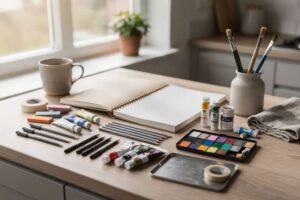
You’ve been there: you buy a sketchbook that looks the part, crack it open with your favourite ink liner, follow up with a watercolour wash — and the paper buckles into a crinkled mess. Or you try a light acrylic layer and the surface pills under your brush. You end up using a different pad for every medium, your desk disappears under a stack of half-finished books, and you never actually commit to a single surface long enough to develop a consistent practice.
Mixed media pads are supposed to solve this. The promise is a single surface that can take wet and dry media without either buckling dramatically or fighting your pencil. But not every pad that slaps “mixed media” on the cover actually delivers. Paper weight, sizing (the chemical treatment that stops paint bleeding), texture, and binding quality vary wildly — and at the budget end of the market, the gap between a genuinely versatile pad and a glorified cartridge pad is real. This guide cuts through that, focusing on pads available on Amazon UK right now that all sit comfortably in the budget-to-mid-range bracket.
How We Evaluated These Picks
Each pad here was assessed against five criteria drawn from real artist use cases. First, paper weight: anything below 200gsm tends to buckle with more than a light watercolour wash. Second, sizing and surface treatment: does the paper resist bleed-through with ink, and can it take an acrylic layer without the surface degrading? Third, binding quality: spiral bindings need to stay put; ring bindings should lie flat. Fourth, real-world user feedback — where a product had substantial verified reviews, patterns in those reviews (buckling, bleed-through, inconsistent sheet quality) were factored in. Fifth, format versatility: is the size genuinely useful for both studio work and on-the-go sessions? All eight picks sit within a realistic budget, and no product here requires you to compromise on the fundamentals of what mixed media paper should actually do.
Best Overall Pick: Winsor & Newton Mixed Media Spiral Pad, A4
The Winsor & Newton Mixed Media Spiral Pad, A4, 250gsm, 30 Sheets is the pad most artists working across multiple media should reach for first. Winsor & Newton is one of the most trusted names in artists’ materials, and this pad earns that reputation rather than just riding it. With 926 ratings averaging 4.7 out of 5, the feedback picture here is unusually consistent — that kind of volume and rating combination is rare in the art supplies category.
At 250gsm, the paper sits at the right weight for serious mixed media work. You can lay down a generous watercolour wash and the sheet won’t warp beyond usefulness. Follow that with a pen outline once it’s dry, add a layer of acrylic, come back with coloured pencil — this paper handles the sequence. The surface has enough texture to grip dry media like graphite and pastel, but it’s smooth enough that fine liner work stays crisp without the nib catching. That balance is harder to achieve than it sounds at this weight.
The spiral binding is a genuine advantage here. Sheets lie completely flat, the spiral sits at the top rather than the side (which helps when you’re painting left to right), and individual sheets can be torn out cleanly if you want to frame or scan a piece. Some users note that the white of the paper leans very slightly warm — not a problem for most work, but if you’re doing precise colour-matching exercises it’s worth knowing.
The main tradeoff is that 30 sheets goes quickly if you’re using this daily. For a practice journal or heavy-use student pad, that might feel limiting. The sheet count is reasonable for the quality level, but if volume is your priority, there are other options in this guide. Where this pad excels is versatility across the widest range of media — it genuinely earns the “mixed media” label rather than just tolerating it.
Best for Heavy Wet Media: DR Mixed Media Spiral A4 250 GM (GDAMMA4)
If your practice leans heavily into watercolour, inks, or fluid acrylics — where you’re regularly working wet-on-wet and pushing larger washes — the DR Mixed Media Spiral A4 250 GM, GDAMMA4 is a strong contender. It shares the same 250gsm weight and 4.7-star rating as the Winsor & Newton, backed by a similarly substantial review count of 896, which gives you real confidence in the consistency of the product across multiple production batches.
DR pads have a loyal following among artists who work primarily with water-based media, and the reason becomes clear when you use this paper for anything involving significant water loading. The sizing on these sheets is robust enough that water sits on the surface long enough for you to manipulate it, rather than absorbing immediately. That gives you control over blooms, diffusion, and blending in a way that cheaper mixed media papers don’t. Inks stay bright and don’t feather excessively, even when applied over a damp base layer.
The texture is slightly more pronounced than the Winsor & Newton, which some artists prefer for dry media like charcoal or soft pastel — the tooth grips the pigment more readily. However, this same texture can make very fine pen lines feel slightly rougher, and extremely smooth, flat washes of paint can show the texture of the surface more prominently than you might want. It’s a tradeoff that leans in favour of painterly, expressive work over precise technical illustration.
One thing to bear in mind: this pad is positioned more toward the mid-range budget bracket, so you’re investing a bit more per sheet than the entry-level options. For working artists who go through paper quickly, that might push you toward the A5 version (also in this guide) to manage costs. But for quality of experience with wet media specifically, it delivers consistently.
Best Value for Volume: Ohuhu A4 Mixed Media Sketchbook
The Ohuhu A4 Mixed Media Sketchbook – 200gsm 124 Pages (62 Sheets) Acid-Free Paper, Spiral Bound Artist Drawing Book for Wet & Dry Media makes a compelling case for artists who prioritise sheet count and daily practice volume over premium paper performance. Sixty-two sheets is more than double what you get with the 30-sheet pads elsewhere in this guide — and that matters if you’re journalling, doing warm-up exercises, or running an art class where you want students to experiment without worrying about wasting paper.
At 200gsm, the paper is lighter than the 250gsm options from Winsor & Newton and DR. This is the key tradeoff with this pad. For light watercolour washes, brush pen work, marker, pen and ink, and dry media combinations, 200gsm is genuinely adequate — the paper handles these without buckling badly. However, if you’re laying down very heavy, wet washes, soaking the paper repeatedly, or working into still-wet paint extensively, you’ll notice more warping than you would with a heavier sheet. It’s best thought of as a versatile practice and journalling pad rather than a showcase surface.
The acid-free specification matters here: your work won’t yellow or degrade over time, which is worth noting even at this price point. The spiral binding is solid, and the sheets sit flat when the pad is open. Ohuhu has built a reputation in the art supplies community for delivering more than the price tag suggests, and this sketchbook fits that pattern — it’s genuinely useful, not just passable.
If you’re a student building habits, an art journaller who works through pages quickly, or someone who wants a dedicated experimental pad that they don’t mind getting messy, this is an excellent choice. Just be realistic about its limits with very heavy wet media — at 200gsm, it’s working closer to its ceiling than the 250gsm options.
Best Compact Format: DR Mixed Media Spiral A5 250 GM (GDAMMA5)
For artists who work on location, carry a bag rather than a dedicated art satchel, or simply prefer a smaller format for more intimate, focused work, the DR Mixed Media Spiral A5 250 GM, GDAMMA5 delivers the same paper quality as its A4 sibling in a format that actually fits into your day. This is the same 250gsm paper with the same 4.7-star rating shared across the DR range, which tells you the consistency between formats is real rather than aspirational.
A5 mixed media pads are genuinely underrated. The smaller format encourages you to commit to a composition quickly, work with simpler arrangements, and finish pieces — habits that actually improve your practice faster than endlessly sketching in a larger book. When you’re travelling, waiting for an appointment, or working in a café, A5 is the format that actually comes out of your bag. A4 often stays in it.
The paper performance mirrors what you’d expect from the A4 version: robust enough for confident watercolour work, good ink resistance, and a texture that works with both dry and wet media. The spiral binding on the A5 sits at the top, keeping it out of your writing hand’s way — a small detail, but one that’s genuinely useful when you’re working in a limited space.
The honest tradeoff with A5 is simply scale. If your work involves broad gestural strokes or you’re planning larger compositions, you’ll feel constrained quickly. And if you primarily work in your studio rather than on the move, the step up to A4 makes sense. But as a companion pad — something you keep in your bag alongside a studio pad — or as the main pad for a dedicated location drawing practice, this one is hard to beat at this weight class.
Best for Mixed Media Beginners: Artway Studio A4 Mixed Media Pad
The Artway Studio A4 Mixed Media Pad (Multi Art Pad) – Ideal for Multimedia Applications – 240gsm Mixed Media Paper – 48 Sides/24 Sheets sits at a thoughtful middle point that makes it a strong recommendation for anyone just getting into mixed media work or teaching themselves which media they actually want to combine. At 240gsm, it’s heavier than the Ohuhu’s 200gsm but slightly lighter than the 250gsm pads — and that middle ground works well for learning.
Artway’s Studio range is positioned as a working artist’s entry point, and it delivers on that positioning. The paper handles a reasonable range of techniques: light-to-medium watercolour washes, ink, pen, graphite, and acrylic all perform acceptably on this surface. Rated at 4.5 stars from 67 reviews — a smaller pool than the DR or Winsor & Newton pads, but the feedback is consistent and there are no recurring complaints about fundamental quality issues like bleed-through or excessive buckling.
The 24-sheet count (48 sides, as the listing describes) sits between the compact 30-sheet pads and the more generous Ohuhu offering. At 240gsm, you get a bit more body under your wet media than you would with a 200gsm sheet, while keeping the pad accessible if you’re not ready to commit to a premium surface. The slightly textured surface gives grip to pencil and pastel without being so pronounced that smooth washes of watercolour are difficult to achieve.
Where this pad struggles relative to the 250gsm options is with very heavy, repeated wet applications. If you’re building up multiple layers of paint or working extensively wet-on-wet, the 240gsm paper will show more warping than you’d get from the DR or Winsor & Newton pads. For beginners experimenting with technique, that’s acceptable — but it’s worth knowing the ceiling is a bit lower here. As a pad to discover what mixed media can do, though, it’s a very sensible starting point.
Best Premium Budget Pick: Faber-Castell Creative Studio Mixed Media Pad, A4 (Spiral, Black)
The Faber-Castell Creative Studio Mixed Media Pad, A4, Spiral Bound Paper (Black), 250 GSM, 30 Sheets, All Media, Acrylic, Watercolour Paint, Pe brings Faber-Castell’s reputation for quality materials into the mixed media pad space, and it earns its 4.6-star rating from 398 verified reviews. That review count sits between the Artway and the DR/Winsor & Newton options — enough to give you real confidence in the consistency of what you’re buying.
The black spiral binding isn’t just aesthetic — it signals that Faber-Castell has thought about the presentation of this pad as a studio tool. The 250gsm paper matches the top-weight options in this guide, and the surface is treated to accept the full range of mixed media: acrylic, watercolour, ink, pen, marker, and dry media all perform well. There’s a slight texture that grips dry media without being aggressive, and watercolour washes hold their colour well with good absorption control.
Where this pad distinguishes itself from the equivalent DR or Winsor & Newton option is a slightly more refined feel to the paper surface — it has a consistent quality across the 30 sheets that artists who are particular about surface behaviour will notice. The paper white is neutral and clean, which makes colour-mixing decisions more straightforward.
The honest tradeoff is that you’re paying toward the top of the budget-friendly bracket here, and the sheet count of 30 is identical to the Winsor & Newton. If value-per-sheet is your primary concern, the Ohuhu pad offers more pages at a lower investment. But if you care about the Faber-Castell quality assurance, the refined surface, and the premium feel of a pad you’ll actually enjoy picking up every day, this is a well-justified investment within this guide’s scope.
Best for A5 Precision Work: Faber-Castell Creative Studio Mixed Media Pad, A5
The Faber-Castell Creative Studio Mixed Media Pad, A5, Spiral Bound Paper, 250 GSM, 30 Sheets, for All Media, Acrylic, Watercolour Paint and Pen delivers the same 250gsm Faber-Castell paper in an A5 format — and for artists doing detailed, precise mixed media work at a smaller scale, this is the pick. Botanical illustration, character studies, lettering projects that incorporate watercolour — these are exactly the use cases where A5 and Faber-Castell’s paper quality combine well.
At A5, the paper’s handling characteristics become even more noticeable. Smaller sheets with 250gsm paper stay flatter under wet media because the absolute surface area being wetted is smaller, so the warping forces across the sheet are lower. This is a genuine advantage for detailed work where precision matters — you’re not fighting a buckled surface when you’re trying to draw a fine pen line over a dry watercolour base.
The Faber-Castell surface texture at this format pairs particularly well with brush pen and fine liner work. The sizing means ink lines stay crisp and don’t bleed, even when you apply a watercolour wash over the top once the ink is dry — a technique that’s fundamental to many mixed media styles. The 30 sheets at A5 actually go further in terms of meaningful practice time than 30 sheets at A4, simply because smaller-format work tends to be more considered and deliberate.
The limitation is the same as with any A5 pad: you’re working small, and if your style involves gestural marks or broad areas of wash, you may feel cramped. Also worth noting that the review count on this specific variant sits lower than some other pads in this guide — the Faber-Castell brand consistency is a reassurance here, but it’s a smaller sample of verified feedback. For precision-focused mixed media artists who know they work well at A5, this is an excellent choice.
Best Structured Studio Option: Faber-Castell Creative Studio Mixed Media Pad, A4 (Ring Binder)
The Faber-Castell Creative Studio Mixed Media Pad, A4 250 gsm Pad of 30 Sheets – ing binder is the most distinctive format in this guide: a ring-bound or binder-style pad rather than a spiral. This makes it well-suited to artists who want the option to rearrange pages, insert loose reference sheets, or present their work in a more portfolio-like structure — all things a spiral pad simply can’t accommodate.
The paper specification matches the rest of the Faber-Castell Creative Studio range: 250gsm, A4, and designed for the full range of mixed media. Acrylic, watercolour, ink, pen, and dry media all work on this surface with the same quality you’d expect from Faber-Castell. If you’re already using this paper in the spiral format and like it, this binding option gives you the same surface with different structural benefits.
The practical advantage of a ring or binder binding for mixed media work is that you can rotate individual sheets to work from different angles, remove them entirely to work flat on a table without the binding getting in the way of your hand, and — perhaps most usefully — reorganise your work chronologically or by medium after the fact. For artists who treat their sketchpad as a portfolio of studies, this is genuinely useful.
The tradeoff is that ring-bound pads are slightly less convenient for on-the-go use than spiral pads — they’re a bit more structured, a bit less flexible in terms of how you hold or prop them. This is a studio pad rather than a location pad. And with a lower verified review count than some options here, you’re relying more on the Faber-Castell brand consistency than on accumulated user experience specific to this format. For studio-based artists who value flexibility in how they organise and present their work, though, it’s a thoughtful option.
What to Look For in a Mixed Media Pad
- Paper weight (gsm): This is the single most important specification. For any meaningful wet media use — watercolour washes, fluid acrylic, ink — you want a minimum of 200gsm, and 250gsm is the sweet spot for versatility. Below 200gsm, paper will buckle significantly with water. Above 250gsm, you’re typically moving into dedicated watercolour paper territory, which is heavier and less suited to dry media.
- Sizing and surface treatment: Mixed media paper needs to be sized (chemically treated) to control how liquid media absorbs into the surface. Internal sizing slows absorption and prevents bleed-through; surface sizing gives you control over how ink and paint sit on top of the sheet. Without adequate sizing, watercolour washes will absorb too fast, ink will feather, and different media won’t layer predictably.
- Surface texture: Mixed media papers typically come in a light texture (sometimes called “medium” grain) that aims to work with both dry and wet media. A very smooth surface is great for pen and ink but won’t grip pastel or charcoal. A very rough surface suits expressive painting but can make fine line work difficult. Check whether the texture is described and, where possible, look for feedback from reviewers who work in the specific media you use.
- Acid-free specification: Any paper you intend to keep work on should be acid-free. Acidic paper yellows and becomes brittle over time, which means artwork stored on it will degrade. This is a standard feature on most art-quality pads but worth confirming, especially at the budget end.
- Binding type: Spiral-bound pads lie flat and are the most practical for most artists. The spiral position (top vs side) matters — top-bound spirals are generally more comfortable for right-handed painters working across the page. Ring or binder styles offer page rearrangement flexibility but are less portable. Glued pads can feel more secure but don’t lie flat as naturally.
- Format and sheet count: A4 is the most versatile studio format for mixed media. A5 is better for portable, precise, or journalling use. Sheet count matters more than it might seem — 30 sheets at 250gsm goes quickly if you’re using the pad daily. If volume matters to you, factor in cost-per-sheet rather than just headline cost.
- Bleed-through resistance: Even with good sizing, mixed media paper should be tested for bleed-through with heavier ink applications. The best pads in this guide show no significant bleed-through with standard ink and pen work; very heavy solvent-based marker applications are the exception that almost any paper in this weight range will struggle with.
Verdict
For most UK artists working across a range of media at home or in a studio — whether you’re combining watercolour and pen, experimenting with acrylic and graphite, or building an art journal practice — the Winsor & Newton Mixed Media Spiral Pad, A4, 250gsm is the clear first choice. The 4.7-star rating from nearly a thousand verified reviewers is not an accident — this paper genuinely performs across the widest range of media combinations, the spiral binding is practical and well-made, and the Winsor & Newton quality assurance means you’re not gambling on a product that might be inconsistent from batch to batch.
If you primarily work on location or prefer a compact format, swap to the DR Mixed Media Spiral A5 250 GM, GDAMMA5 — same weight class, same portability advantage, proven paper quality. And if you’re a beginner who wants to experiment freely without the anxiety of using up premium sheets, the Ohuhu A4 Mixed Media Sketchbook with its 62 sheets gives you the freedom to make mistakes and learn quickly.
Whichever pad you choose, stick with 200gsm as your absolute minimum and prioritise pads with confirmed acid-free paper. Within this guide, all eight picks meet that baseline — the differences come down to format, weight, surface texture, and how you work.
We were not paid to feature any specific product in this guide. All opinions are independent and based on publicly available specifications, verified buyer feedback patterns, and category research.
Quick Comparison Table




FAQ
What does “mixed media” paper actually mean?
Mixed media paper is designed to accept a range of wet and dry materials on the same surface — typically watercolour, acrylic, ink, pen, pencil, and pastel. The key difference from standard sketching paper is the weight (usually 200gsm and above) and the sizing treatment, which controls how liquid media absorbs. Not every paper labelled “mixed media” performs equally across all of these, so checking the gsm and reading user feedback about specific media combinations is worthwhile.
Is 200gsm good enough for watercolour, or do I need 250gsm?
For light-to-medium watercolour washes and brush pen work, 200gsm is workable and won’t buckle dramatically if you’re not overloading the paper with water. For heavier washes, wet-on-wet techniques, or multiple layers of wet media, 250gsm is noticeably better and will stay flatter through the process. If watercolour is a significant part of your practice, the step up to 250gsm is worth it.
Can I use alcohol markers on mixed media paper?
Most mixed media paper in this guide will show some bleed-through with alcohol markers, which are solvent-based and penetrate paper differently from water-based media. For occasional alcohol marker accents used sparingly, it’s manageable — but if alcohol markers are a primary medium for you, a dedicated marker pad with a bleed-proof barrier coating is a better fit than a mixed media pad.
What’s the difference between a spiral-bound and a ring-bound mixed media pad?
Spiral-bound pads have a continuous wire or plastic coil along one edge (usually top or side), which lets the pad lie completely flat when open. Ring-bound or binder-style pads use individual rings and allow you to remove and rearrange pages, which is useful for portfolio organisation. For most practical studio and location use, spiral is more convenient; ring-bound suits artists who want more structural flexibility in how they manage their pages.
Does acid-free paper really matter for a sketchbook I’m using for practice?
If you’re using the pad purely for practice exercises and warm-ups that you’ll photograph and discard, acid-free is less critical. If there’s any chance you’ll want to keep finished pieces, show them, or store them — even temporarily — acid-free paper is worth having. Acidic paper yellows and becomes brittle over years, and the work on it degrades with it. All eight pads in this guide are acid-free, so it’s not a compromise you need to make.
How many sheets should I look for in a mixed media pad?
This depends entirely on your usage pattern. If you’re doing deliberate, finished studies on quality paper, 30 sheets is reasonable and you won’t rush through them. If you’re journalling daily, running warm-up exercises, or teaching a class, 30 sheets disappears quickly and a 60+ sheet option will serve you much better. Factor in cost-per-sheet rather than just the total pad cost, particularly if you go through paper quickly.