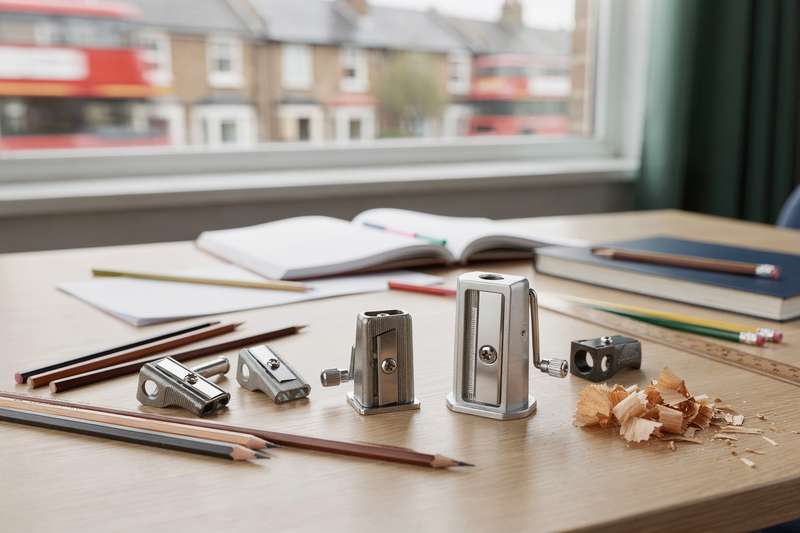
You’re mid-sketch, mid-note, or mid-lesson — and your pencil tip crumbles for the third time in ten minutes. You’ve grabbed whatever sharpener was in the drawer, wrestled with it, snapped the lead, and now you’re staring at a stubby pencil you can’t use and a pile of shavings that somehow ended up on your worksheet. Sound familiar? The frustrating truth is that most people treat pencil sharpeners as throwaway afterthoughts, grabbing whatever’s cheapest at the supermarket. But the right sharpener — matched to your pencil type, your setting, and how you actually use it — makes a genuine difference to how long your pencils last, how consistent your marks are, and how much time you waste fiddling when you should be working or creating.
This guide is for anyone who’s discovered the hard way that not all sharpeners are equal. Whether you’re a sketching enthusiast trying to protect soft graphite cores, a teacher who needs dozens of units that won’t fall apart by October, or a student wanting something compact that won’t leak shavings in your bag, there’s a genuinely useful answer for you here. We’ve focused entirely on the UK Amazon catalogue so every pick is straightforward to order.
How We Chose These Picks
Evaluating pencil sharpeners means thinking beyond the obvious. Blade material is the single biggest factor in sharpening quality — steel blades differ enormously in how cleanly they cut, how long they stay sharp, and how gently they treat fragile cores. We also considered hole diameter, because a sharpener designed for standard 8mm pencils will chew up a jumbo art pencil or coloured pencil with a wider barrel. Container design matters too: a shavings tub that locks properly or seals tightly prevents the classic rucksack disaster.
For this guide, all picks come from the live Amazon UK catalogue. Where products had verified buyer ratings we prioritised those; where we included products from well-established brands with strong category reputations (Staedtler, Faber-Castell, Derwent, Helix) we noted that context clearly. We filtered for genuine pencil sharpeners only — no accessories bundled in misleadingly, no variants of the same product counted twice. What you’ll find below are distinct products serving distinct use cases.
Best All-Round Budget Pick: STAEDTLER Eraser & Sharpener Set
The STAEDTLER Eraser & Sharpener Set – Medium Size – Latex & Phthalate-Free Rubber – Pack of 2, 526 N-S1BK is the only pick in this guide backed by verified buyer reviews — 417 ratings and a 4.7-star average — and it earns that score through sheer honest utility. This is a twin-pack that pairs a Staedtler eraser with a compact single-hole sharpener, making it the kind of desk staple that genuinely disappears into your pencil case and just works.
The sharpener itself uses a steel blade set into a compact plastic housing. It’s sized for standard pencils — your everyday HB, 2B, or coloured pencil in the usual barrel diameter. Don’t expect it to handle jumbo art pencils or the wider barrels you find on some Staedtler Lumograph or Faber-Castell GRIP editions. What it handles, it handles cleanly: a consistent taper without the ragged edges you get from cheap, factory-blunted blades.
The eraser component is latex-free and phthalate-free, which matters if you’re buying for a primary school setting where those certifications come up. Both items arrive in a straightforward pack of two, meaning you get doubles of each — handy for keeping one at home and one in a bag, or for sharing across a small class group without arguments.
Where this falls short: there’s no shavings container, so you need to sharpen over a bin or a piece of paper. It’s also not suited to artists working with wide-barrel pencils or anything softer than a mid-grade graphite. If you’re sharpening Polychromos or similar premium coloured pencils regularly, you’ll want one of the wider-hole picks below. But for everyday student or office use — especially as part of a budget stationery refresh — this set makes a lot of sense. It’s a practical starting point, not a compromise.
Best for Artists Who Need Larger Hole Clearance
The Derwent Twin Hole Pencil Sharpener with Container, Double Hole Sharpener for Artist Sketching Pencils & Colouring Pencils, Two Hole Sizes 11 is purpose-built for the kind of person who owns a range of art pencils in different barrel widths and is tired of forcing them into a single-hole sharpener. Derwent is a name with serious credibility in the art pencil world — they make the pencils themselves — so their sharpener is designed with an understanding of what soft graphite and pigment-heavy coloured cores actually need.
The twin-hole design covers two diameter ranges in a single compact unit. This means you can move between a standard sketching pencil and a wider-barrel coloured pencil without switching tools. The integrated shavings container is a real practical benefit: it holds enough debris for a reasonable working session before you need to empty it, and the lid clicks shut securely enough that you won’t find your bag dusted with graphite powder at the bottom.
The blade angle on art-focused sharpeners like this tends to produce a longer taper than you’d get from a standard office sharpener — and for artists, that matters. A longer taper gives you more exposed lead to work with, which is useful for hatching, shading, and fine line work. It’s gentler on softer cores too, reducing the snap-on-entry problem that plagues cheaper blades.
The honest caveat here is that this is a manual handheld sharpener. If you’re doing high-volume sharpening — say, running through an entire set of 72 coloured pencils in an art session — your wrist will know about it. This is better suited to focused sessions with a smaller working set. It also performs best with genuine Derwent pencils and similar quality branded pencils; very cheap, low-quality pencil wood can sometimes bind against the blade. But for the sketch artist, illustrator, or coloured pencil enthusiast wanting a reliable mid-size manual sharpener, this is a thoughtful choice.
Best Compact Single-Hole Tub Sharpener
The STAEDTLER 511 004 Single-Hole Pencil Tub Sharpener in Noris Design (Pack of 1) is the kind of sharpener that’s been a fixture in UK classrooms for decades — and for good reason. The Noris design is immediately recognisable: yellow and black, compact, with a tub-style shavings container that unscrews cleanly. It’s simple, it’s reliable, and Staedtler’s blade quality at this price tier is genuinely above average.
The single hole handles standard pencils — HBs, 2Bs, and most regular coloured pencils with a conventional barrel. The tub container is generously sized relative to the sharpener body, which means fewer interruptions to empty it during a lesson or work session. The clear plastic of the tub lets you see at a glance when it’s getting full, which is a small but genuinely useful detail in a classroom setting.
This is a straightforwardly great choice for students from primary through to secondary school, for desk use at home, or for anyone who just needs one dependable everyday sharpener without overthinking it. The Noris brand carries Staedtler’s quality assurance, and the blade stays sharp noticeably longer than the bargain-bin alternatives.
What it doesn’t do: it won’t handle jumbo pencils, art pencils with wider barrels, or the oversized diameter of some triangular GRIP-style pencils for young children. It’s also a manual unit — straightforward, no frills. If you need double-hole versatility, look at the twin-hole options in this guide. But as a single-hole desk sharpener, this is one of the most dependable options in the catalogue.
Best Double-Hole Tub Sharpener for Mixed Use
The STAEDTLER 512 001 Double-Hole Tub Sharpener for Graphite & Colour Pencils up to 10.2mm Diameter (1 x Sharpener) steps up from the single-hole Noris by adding a second, wider hole for pencils with larger barrel diameters — up to 10.2mm. That spec covers most standard and coloured pencils, including some of the wider Staedtler Ergo Soft and similar ergonomic designs that a single-hole sharpener simply can’t accept.
The tub shavings container uses the same proven unscrewing mechanism as the single-hole version, so it’s easy to empty and reassemble cleanly. The dual-blade setup — one for each hole — means both are optimised for their respective diameter range rather than trying to compromise. This matters more than it might sound: a blade calibrated for a narrow pencil will often cut too aggressively on a wider barrel, producing a rough, uneven taper.
This sharpener is particularly well suited to teachers who deal with a mixed pencil inventory — some standard HBs, some wider triangular pencils for younger children, some coloured pencils across various brands. Having one unit that handles them all without fuss reduces the need for multiple sharpeners on a shared desk. It’s also a sensible pick for home use if your household mixes standard and jumbo-barrel pencils.
The tradeoff compared to the Derwent twin-hole option is mainly about the art-specific taper angle: the Staedtler double-hole is calibrated for general use, so the point geometry is slightly more utilitarian than an art-focused sharpener. For sketching and fine art detail, the longer taper of a dedicated art sharpener may be preferable. But for everyday versatility across a range of pencil types, this Staedtler double-hole is hard to fault.
Best Aluminium Build for Durability
The Staedtler Single Hole Quality Aluminium Pencil Sharpener X 2 brings a significant materials upgrade over the plastic-bodied options: the housing is aluminium, which means it resists the cracking and warping that plastic sharpeners eventually develop with regular use. This pack of two gives you a spare or lets you place one in each location — desk and bag, or home and school.
The aluminium body also does something subtler: it provides better grip when you’re sharpening, particularly with soft or waxy coloured pencil leads that require a firmer, more controlled twist. Plastic housings can flex slightly under pressure; metal doesn’t, which translates into more consistent blade alignment and cleaner cuts over time.
These are single-hole sharpeners for standard pencil diameters, designed for everyday use rather than wide-barrel or jumbo pencils. The blade is a standard Staedtler steel fitting — replaceable in principle, which extends the useful life of the housing considerably. If you’ve ever had a perfectly good plastic sharpener become useless because the blade dulled and you couldn’t swap it, the repairability angle here is worth noting.
The honest limitation is that aluminium sharpeners without a container require sharpening over a bin or waste paper, which isn’t ideal for classroom or mobile use. These are at their best on a home desk or studio bench where you can control the sharpening environment. They’re not the pick for a primary school pencil case. But if you want a sharpener that will outlast several rounds of cheaper alternatives and maintain consistent blade performance, the aluminium build is genuinely worthwhile.
Best for Young Children or Messy Environments
The Swordfish Combo Pencil Sharpener with Mess-Free Canister and Eraser [Pack of 1] Turquoise [40294] solves a specific problem that anyone who has handed a child a pencil sharpener will recognise: the shavings go everywhere. The Swordfish Combo’s canister design seals the shavings away as you sharpen, and the built-in eraser means the whole stationery kit travels together. For parents, teachers managing individual pencil cases, or anyone who values tidy sharpening, this combination approach makes practical sense.
The turquoise colour makes it easy to spot in a crowded pencil case or on a classroom floor. The eraser is positioned accessibly without making the overall form factor awkward to hold during sharpening. This kind of thoughtful ergonomic design for younger users is exactly what differentiates a product aimed at children from one that’s just a generic sharpener in a bright colour.
Performance-wise, this is a standard single-hole sharpener for regular pencil diameters. The blade quality is functional rather than exceptional — it’s not going to please a sketching artist after a fine taper — but for school-grade pencils it produces a reliable workable point. The canister is the headline feature, and it delivers: the seal is good enough to prevent the loose-shavings-in-bag problem without being so tight that a child can’t empty it themselves.
Where this falls short: it won’t win any awards for blade longevity, and it’s not designed for wide-diameter pencils. It’s also limited to a single hole, so if your child uses a mix of standard and jumbo pencils, you’d need to supplement it. But within its intended use case — an all-in-one, mess-contained sharpening solution for younger students — it does exactly what it promises.
Best Trio Design for Multiple Pencil Sizes
The Faber-Castell Trio Pencil Sharpener Tub Box GRIP 2001 Silver takes the multi-hole concept further than the double-hole options in this guide: three holes of different diameters in one tub-container unit, designed to accommodate the full spectrum from standard pencils through to wide-barrel GRIP-style pencils and jumbo pencils for early learners. Faber-Castell’s GRIP 2001 range is specifically tailored to ergonomic triangular pencils, but the sharpener handles conventional round-barrel pencils just as well.
The tub container is a practical size — generous enough to hold a meaningful amount of shavings before you need to empty it, transparent enough to monitor fill level at a glance. The silver version has a clean, professional look that sits comfortably on an adult’s desk as well as in a classroom. It’s one of those sharpeners that manages to look considered without being fussy.
For families with children of mixed ages using different pencil sizes, this trio sharpener is genuinely useful. You buy one unit instead of two or three, it sits on the desk, and everyone can use it regardless of which pencil they’re holding. For art teachers managing a mixed media cupboard — regular graphite, jumbo charcoal pencils, wide pastel pencils — the three-diameter accommodation reduces friction considerably.
The tradeoff is that three holes means three blades to eventually dull, and replacement isn’t always straightforward on tub-style sharpeners of this type. The point geometry across all three holes is optimised for general use rather than fine art taper, so dedicated artists may still prefer a specialist dual-hole art sharpener alongside this. But as an all-household or classroom workhorse, the trio format is the most versatile manual option in this guide.
Best Desktop Sharpener for Standard and Jumbo Pencils
The Helix Metal Desktop Sharpener for Standard and Jumbo Pencils (Assorted Colours) is the most substantial manual sharpener in this selection — a desk-mount style unit with a metal body designed to stay in place rather than be carried around. The dual-hole configuration handles both standard and jumbo pencil diameters, and the metal construction means it won’t skitter across the desk when you’re applying rotational force to a fat charcoal pencil or a wide-barrel coloured pencil.
The desktop form factor suits settings where a fixed sharpening station makes sense: a home studio desk, a classroom corner station, or a shared office stationery shelf. Because it’s designed to sit rather than travel, the shavings container can be proportionally larger, which means fewer empties per day. Helix has solid brand recognition in UK schools — their geometry sets are a staple — and their sharpener quality reflects the same pragmatic, school-grade reliability.
The assorted colours mean you can’t always specify which you’ll receive, which is a minor irritation for anyone with strong desk aesthetics but genuinely irrelevant for most buyers. The metal housing is the key practical advantage: it holds up to sustained daily use in a way that lightweight plastic units don’t, and the blade seats more securely in a rigid metal chassis.
Where this is less ideal: it’s obviously not portable, and the desktop format assumes you have a stable surface to use it on. If you need a sharpener for a pencil case or on-the-go use, look at the compact options earlier in this guide. The Helix is also better suited to general-purpose pencils than to specialist art pencils requiring a very fine, long taper. Within its intended setting — a desk that sees regular pencil use — it’s a dependable, long-lasting choice.
What to Look for When Buying a Pencil Sharpener
- Hole diameter and the number of holes: Standard pencils (most HBs, 2Bs, and typical coloured pencils) have a barrel diameter of around 7–8mm. Jumbo pencils for young children and some premium art pencils run to 10–12mm or wider. A single-hole sharpener calibrated for standard pencils will damage or refuse to accept wider barrels. Check whether the sharpener explicitly states the diameter range it supports, and opt for double or triple-hole designs if your pencil collection is mixed.
- Blade material and geometry: Steel blades are the minimum you should accept. Better-quality steel holds an edge longer and cuts cleaner through pencil wood, which reduces the chance of lead snapping during sharpening. Art-focused sharpeners often use a shallower blade angle to produce a longer taper — useful for fine sketching but potentially too fragile for everyday writing use. Think about what you’re primarily sharpening for.
- Container design: Sharpeners without containers (bare-body or aluminium styles) require sharpening over a bin — fine on a studio bench, frustrating in a school bag. Tub-container sharpeners collect shavings internally; look for ones where the container is transparent (you can see when it’s full), opens and closes securely, and is easy for the intended user to empty independently. For children, screw-off lids are more secure than pull-off caps.
- Portability versus desk stability: Handheld sharpeners prioritise pocket and pencil-case portability; desk-style sharpeners with weighted or rubberised bases prioritise stability during use. For school bags, compact lightweight units are preferable. For a fixed workspace, a heavier desk unit stays put and typically has a larger shavings capacity.
- Soft-core compatibility: Soft graphite grades (4B–9B), waxy coloured pencil leads, and pastel pencils are more prone to snapping during sharpening than standard HB graphite. If this is your use case, look for sharpeners specifically designed for artists or coloured pencil users — they tend to have a gentler blade angle and wider hole tolerances. Cheap general-purpose blades can shatter soft cores entirely.
- Durability and replaceability: Plastic-bodied sharpeners are lighter and cheaper but crack under sustained use. Aluminium or metal-body options last longer and are more likely to accept replacement blades, which extends the useful life of the housing. For high-volume use — busy classrooms, prolific artists — the slightly higher upfront cost of a metal-body sharpener is usually offset by longevity.
- Pack quantity: For individual use, a single sharpener is obviously sufficient. For classroom, events, or family use, consider bulk packs or multi-packs — they typically offer better value per unit and mean you always have a spare when one goes missing, which it will.
Verdict
For the majority of readers — students, home users, and light creative users who want one reliable sharpener that handles everyday pencils cleanly and doesn’t cost much — the STAEDTLER Eraser & Sharpener Set is the most sensible starting point. It’s the only pick in this guide with a substantial base of verified buyer reviews, it’s priced at the budget end of the range, and it delivers genuine Staedtler blade quality rather than bargain-basement cutting performance. The bundled eraser makes it a complete everyday stationery unit.
If you’re an artist using a mix of standard and wide-barrel pencils, go for the Derwent Twin Hole Pencil Sharpener — the taper angle and hole range are designed around exactly the pencils artists actually use. For a classroom or family setting with mixed pencil sizes, the Faber-Castell Trio Pencil Sharpener offers the most versatility in one unit. And if durability is the priority, the Staedtler Aluminium Sharpener twin pack will outlast every plastic alternative on this list.
We were not paid to feature any specific product in this guide. All opinions are independent and based on publicly available specifications, verified buyer feedback patterns, and category research.
Quick Comparison Table


![Swordfish Combo Pencil Sharpener with Mess-Free Canister and Eraser [Pack of 1] Turquoise [40294]](https://m.media-amazon.com/images/I/71GxCMsWRrL._AC_UL320_.jpg)


FAQ
What is the difference between a single-hole and a double-hole pencil sharpener?
A single-hole sharpener accepts only one barrel diameter — typically the standard size used by most everyday pencils. A double-hole sharpener has two holes calibrated for different barrel diameters, so you can sharpen both standard pencils and wider art or jumbo pencils with one unit. If your pencil collection includes different barrel widths, the double-hole design prevents you from damaging wider pencils by forcing them into a hole that’s too small.
Are manual or electric pencil sharpeners better?
It depends on your setting and volume. Manual sharpeners are portable, require no power, and give you precise control over how much you sharpen — useful for artists who want a specific taper. Electric sharpeners sharpen faster and with less physical effort, which suits high-volume classroom use or anyone with hand mobility considerations. For the average student or occasional creative user, a quality manual sharpener is perfectly adequate and far more practical.
Why does my pencil lead keep snapping when I sharpen it?
This usually comes down to one of three issues: the blade is dull and tearing rather than cutting, the hole diameter is too small for the pencil you’re sharpening, or you’re using a soft-core pencil (like a 4B+ graphite or a waxy coloured pencil) in a sharpener not designed for soft leads. Switch to a sharpener with a sharper blade, check the hole diameter matches your pencil barrel, and consider an art-specific sharpener if you regularly use soft pencils.
How do I know when to replace my pencil sharpener blade?
The signs are consistent: the sharpener requires noticeably more turning force than before, the pencil point comes out ragged or asymmetrical, and soft leads start snapping even though they didn’t before. Some metal-body sharpeners accept replacement blades, which is more economical than replacing the whole unit. For plastic-body sharpeners without replaceable blades, the body itself is usually the cheaper item to replace.
Can I use a standard pencil sharpener for coloured pencils?
You can, with caveats. Standard single-hole sharpeners work fine for coloured pencils with a conventional barrel diameter. The issue arises with wider-diameter coloured pencils (which won’t fit a standard hole) or very waxy, soft-core coloured pencils (which snap more easily under a blade calibrated for standard graphite). Dedicated art sharpeners — like the Derwent twin-hole option in this guide — are designed with these softer, wider pencils in mind and produce cleaner results with less breakage.
Is it worth spending more on an aluminium or metal pencil sharpener?
For occasional home use, the difference is modest. But for daily use, an aluminium or metal body genuinely outlasts plastic alternatives — the housing doesn’t crack under repeated pressure, the blade seats more securely, and the overall feel is more controlled during sharpening. Metal sharpeners are also more likely to accept replacement blades, which extends their useful life considerably. If you sharpen pencils multiple times a day, the durability investment is worthwhile.