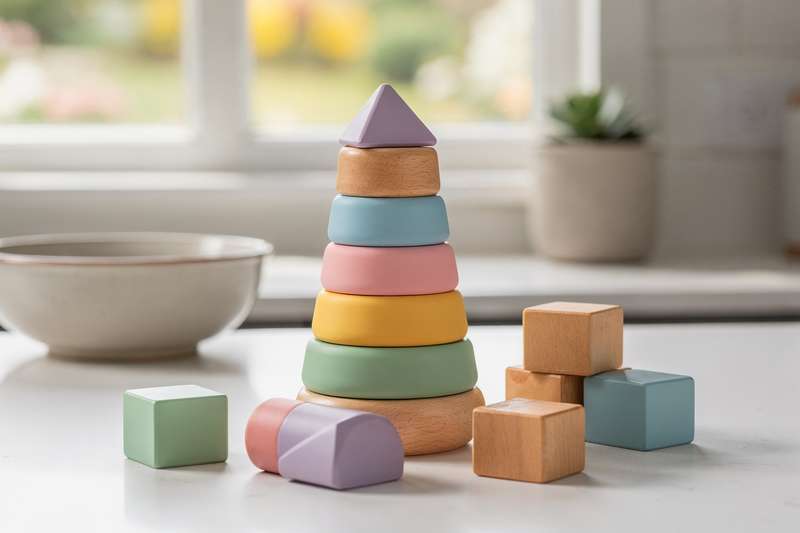
You’ve already tried the brightly coloured rattles, the play mat with the dangling animals, and that chunky plastic teether your baby ignores entirely. Now you’re staring at the toy aisle — or more likely scrolling through Amazon at 11pm — trying to work out which stacking blocks are actually worth buying. Your little one is somewhere between six and eighteen months old, and you can see them reaching for everything, knocking cups off the coffee table, and experimenting with what happens when one object sits on top of another. That’s not clumsiness — that’s cognitive development in action, and the right stacking toy can channel it brilliantly.
The problem is that the category is swamped. There are plastic sets, wooden sets, silicone sets, foam sets, sets shaped like cups, rings, eggs, and geometric cubes. Some claim to be Montessori-approved; others are just cheerfully coloured lumps of plastic that arrive with no instructions and fall apart in a fortnight. You want something safe enough to go straight in a small mouth, durable enough to survive being hurled across the room repeatedly, and genuinely engaging so that your child will actually use it for more than a week. This guide is here to cut through the noise.
How We Evaluated These Picks
Every product in this guide was assessed against a consistent set of criteria drawn from verified buyer review patterns on Amazon.co.uk, category research, and published developmental guidelines for infant and toddler play. The criteria covered safety and materials (non-toxic finishes, age-appropriate sizing, no small parts for the youngest age groups), build quality (whether pieces crack, splinter, or discolour after heavy use), developmental value (does this set genuinely support fine motor skills, colour recognition, and cause-and-effect learning?), and practical usability (ease of storage, washability, and whether the set holds a child’s interest beyond the first session).
Where a product in the live product block had verified buyer reviews, those patterns shaped the assessment directly. For products with zero reviews in the UK listing at time of writing, the evaluation draws on general category knowledge and product specifications. The final shortlist reflects a range of ages, materials, and price tiers so there is a genuinely useful recommendation regardless of your child’s stage.
Best All-Round Starter Set
The Fisher-Price Baby’s First Blocks is the set most parents reach for first, and with good reason. This ten-piece shape-sorting and stacking set is aimed at infants from six months and arrives with its own storage bucket — a detail that sounds minor until you’ve spent twenty minutes scrabbling under the sofa for scattered blocks. Each piece is a different geometric shape (circle, square, star, triangle, and so on) moulded in a different colour, so even before a baby is dropping them through the matching holes in the lid, they’re learning about colour difference and shape variety through pure sensory exploration.
The blocks themselves are chunky enough to grip easily with small, uncoordinated hands, and the plastic is smooth-edged and wipeable. Fisher-Price has a long track record in this segment and the construction reflects that — there are no sharp seams and the plastic doesn’t flex or feel hollow in a way that suggests it will crack early. The storage bucket doubles as a makeshift drum, which will either delight or exhaust you depending on the time of day.
The honest tradeoff here is that this is a functional, no-frills set. It doesn’t offer the sensory richness of silicone or fabric alternatives, and the shape-sorting challenge may feel repetitive for older toddlers who master it quickly. But as an introductory stacking and sorting toy for a baby just starting to engage with objects, it’s a dependable choice that doesn’t ask parents to spend a great deal. Note that this listing showed zero UK reviews in the live data, so treat the build-quality assessment as based on the product’s wide international reputation rather than verified UK buyer feedback.
Best Budget Pick
The Ram© Baby Kids 11 Piece Stacking Cups Stackers Pre-school Learning Toy Stacking Tower Pyramid is the kind of set that earns its place in the toy box through sheer versatility rather than prestige branding. Eleven nesting cups at a budget-friendly price point is a strong value proposition, and the basic concept — cups that stack upwards into a tower or nest downwards into a compact set — is one that children from around six months through to preschool age continue to find engaging in different ways.
At the youngest end, babies enjoy the sensory experience of mouthing and handling the cups, and the satisfying pop of nesting one inside another. As they grow, the stacking challenge becomes more deliberate, and older toddlers will start to order by size unprompted — a genuine marker of cognitive development. The cups in this set vary in size from small to quite large, giving a reasonable range for stacking towers.
The tradeoff with budget sets of this type is material quality. The plastic can feel lighter and slightly flimsier than premium alternatives, and it’s worth checking that there are no rough mould lines on the edges before handing them to a baby who will immediately try to chew them. This listing also has zero UK reviews, which means there’s no verified buyer feedback pattern to draw on — treat it as a value option if you’re happy to assess the physical product on arrival. Stacking cup sets like this are a category staple and the format itself is robust and proven.
Best Multifunctional Set for Older Toddlers
The Baby Toys 7 in-1 Montessori Sensory Toys for Toddlers is one of the more ambitious sets in this guide, and it earns its higher price point through genuine breadth. Rated 4.6 out of 5 from 248 UK reviewers, this is the most extensively reviewed product in the shortlist, and the buyer feedback patterns are positive across the board — parents particularly highlight how long their children remain engaged, which is the real test of any stacking toy.
The set includes stacking blocks, stacking rings, matching eggs, a suction cup spinner, and several other activity components, all gathered under one Montessori-influenced design philosophy. The idea is that each component isolates a different skill: the rings develop order and size discrimination; the eggs practise matching and fitting; the spinner builds cause-and-effect understanding. In practice, most toddlers will mix and match freely, which is exactly what open-ended play is supposed to encourage.
Build quality is solid — the pieces feel purposeful and the materials appear to be free of sharp edges or loose small parts. The suction cup base on the spinner component means it stays put during play, which reduces frustration for younger toddlers who haven’t yet developed the grip strength to hold a spinning toy steady. The main consideration is the price tier: this sits clearly in mid-range territory, and if your child is on the younger end of the recommended age range, a simpler set may be a more appropriate starting point. But for a child of eighteen months or older who has exhausted simpler stacking toys and needs a new challenge, this set is very well matched to their developmental stage.
Best for Sensory and Visual Play
The tickit Gem Cubes Rainbow Acrylic Building and Stacking Cubes occupies a different niche from the other picks in this guide, and that’s precisely the point. Rated 4.5 out of 5 from 81 reviewers, these ten translucent acrylic cubes in jewel colours are as much a sensory and light-play tool as they are a stacking toy. When held up to a window or placed on a light table, they create rich colour effects that genuinely capture a young child’s attention in a way that opaque plastic simply cannot replicate.
The cubes have rounded edges — tickit specifies this in the product description — which makes them safe for small hands and removes the sharp-corner concern that sometimes accompanies acrylic products. They stack well because they’re consistently shaped, and the satisfying weight and clink of acrylic blocks gives tactile and auditory feedback that plastic alternatives lack. Older toddlers and preschool-age children gravitate towards sorting by colour and building towers, while babies enjoy the visual stimulation of the translucent surfaces.
The honest caveat here is that acrylic is harder than soft plastic — these are not suitable for babies who are likely to throw them at hard surfaces or each other, and they’re better suited to supervised play with children who are past the throw-everything phase. They’re also a more specialised choice: wonderful for a child who is already interested in light and colour, and an excellent complement to a light table if you have one, but perhaps not the first stacking set you’d buy for a six-month-old. Think of this as the set you add when your child is ready for something with more visual and tactile depth.
Best Soft Stacking Blocks for Newborns and Young Babies
The Playgro Soft Stacking Blocks are designed specifically for the youngest end of the age range — from around six months — and the soft construction reflects that. A set of six fabric-covered foam blocks, each with its own pattern, texture and visual contrast, these prioritise sensory input over structural engineering. At this age, the act of stacking is less about precision and more about exploring how objects relate to one another spatially, and soft blocks make that exploration genuinely safe: there’s no risk of injury when the tower topples (which it will, repeatedly and gleefully).
Each block in this set has a different surface — some crinkle, some have contrasting patterns, some feature simple pictorial designs — giving babies multiple reasons to handle and examine them beyond just stacking. The developmental logic here is sound: multisensory engagement holds attention longer and builds more neural connections than a single-stimulus toy. The blocks are also lightweight enough for genuinely young babies to lift and handle without frustration.
The tradeoff is longevity. Soft fabric blocks have a shorter useful life with older toddlers, who will quickly find the stacking challenge insufficiently demanding and may be rough enough with them that the surfaces degrade. Playgro is a respected name in the infant toy category, but this listing showed zero UK reviews in the live data, so buyer feedback patterns aren’t available to confirm durability claims. Consider this the right choice if you need something safe and sensory-rich for a baby under twelve months, with the expectation that you’ll complement it with a more structurally varied set as they develop.
Best for Creative Open-Ended Building
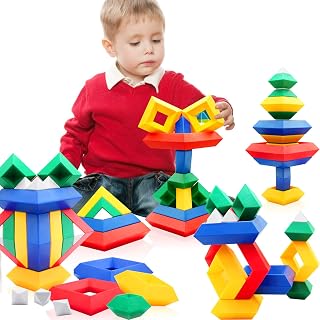
The Yeelua Stacking Toys 30Pcs Pyramid Building Blocks offers genuine quantity alongside variety. Rated 4.4 out of 5 from 82 UK reviewers, this thirty-piece set gives children a much wider canvas for building and experimenting than the smaller sets in this guide. The pyramid format — pieces of graded sizes — supports the classic stacking challenge, but thirty pieces means there’s enough material for more ambitious building projects as children grow into the preschool years.
Buyer reviews highlight the educational sensory element: pieces are colourful and varied, and the set works well for simple colour-matching and size-ordering activities that can be directed by a parent or left for free play. At the reviewed price tier, the value per piece is strong, which makes this a practical choice for families who want a set that will genuinely scale with their child’s development rather than being outgrown in a few months.
The honest tradeoff is that a thirty-piece set requires more storage discipline than a ten-piece one — pieces will scatter, and reassembling the full set after play takes a moment. Some reviewers note that the pieces benefit from a storage bag or container, which isn’t always included. Also worth noting is that the pyramid building format is somewhat more structured than fully open-ended block play, so if you’re looking specifically for a free-form creative building toy, a classic cube block set might complement this better. But for a child aged two and up who is ready for more complex stacking challenges, thirty well-made pieces at a mid-budget price is a compelling offer.
Best Wooden Montessori-Style Set
The Montessori Wooden Toddler Toys Gifts Sorting Stacking Blocks Fine Motor Skills Educational Set is aimed squarely at the two-to-four age bracket and reflects a design philosophy focused on fine motor development and independent discovery. Rated 4.6 out of 5 from 61 UK reviewers, this wooden set has attracted positive feedback from parents who appreciate the tactile quality of real wood compared to plastic alternatives, and the Montessori-influenced structure that encourages children to sort, stack, and match without prescriptive instructions.
Wooden stacking sets in this category offer a distinct sensory experience: the weight, warmth, and sound of wooden pieces is qualitatively different from plastic, and many parents find that children engage more carefully and deliberately with wooden toys — partly because they’re not bouncy or squeaky, so the play becomes more focused. The fine motor challenge of picking up, aligning, and placing wooden pieces is also well matched to the two-to-four developmental window, when pincer grip and hand-eye coordination are actively maturing.
The tradeoff is finish durability. Wooden sets can chip or splinter if the lacquer finish is thin, and it’s worth inspecting pieces on arrival to confirm the finish is smooth and intact. Sixty-one reviews is a reasonable sample, and the 4.6 rating suggests the build quality is holding up well for most buyers. This is a considered purchase rather than an impulse buy — it sits at a slightly higher price point than the plastic options — but if you’re looking for a toy that will feel at home in a Montessori or Waldorf-inspired environment, and one that a child aged two or above will genuinely use for a year or more, it’s a well-justified choice.
What to Look For When Buying Stacking Blocks
- Age appropriateness and safety: The single most important criterion. Toys for babies under twelve months must have no small parts that could become choking hazards — every piece should be large enough that it cannot be fully inserted into a young child’s mouth. UK and EU toy safety standards (the EN71 series) set the baseline here: look for products that reference compliance or are sold by established brands with a clear safety track record. Soft blocks for very young babies eliminate hard-edge risks entirely, while hard plastic or wooden sets are better suited to toddlers past the mouthing stage.
- Material quality and finish: Plastic should be smooth-seamed, BPA-free where relevant, and wipeable. Wooden pieces should have a consistent, chip-resistant finish — run a fingernail gently across a corner after purchase to check. Acrylic is durable but harder, so it’s best for supervised play with children who aren’t in a throwing phase. Silicone and fabric are the softest and most forgiving for young babies.
- Size of the set and scalability: A six-piece set is plenty for a six-month-old who is just starting to stack. A thirty-piece set gives a two-year-old room to build more complex structures. Consider where your child currently sits developmentally and where they’ll be in six months — a set that’s slightly ahead of their current ability will keep them engaged longer.
- Storage: This sounds pedestrian but matters enormously in practice. Sets that include a storage bucket, bag, or container are dramatically easier to live with. If the set doesn’t include storage, factor the cost of a container into your decision — ten cups scattered across a living room floor is a slip hazard as much as a toy.
- Developmental breadth: The best stacking sets offer more than one type of play. A set that stacks, nests, sorts by size, and sorts by colour gives a child four different activities from one purchase. Multi-component sets (rings, cups, and shaped pieces in one box) extend the useful life of the toy considerably.
- Washability: Stacking blocks will be mouthed, dropped on the kitchen floor, and handled by sticky fingers. Plastic and silicone wipe clean easily; fabric blocks can usually be sponge-cleaned but rarely tolerate a full machine wash. Wooden sets need to be kept dry — water can warp the wood and compromise the finish. Think about how much cleaning hassle you’re willing to absorb daily.
- Verified UK reviews: Before purchasing, check that the specific Amazon.co.uk listing has a meaningful number of verified reviews. A product with hundreds of reviews gives you genuine signal about real-world durability and whether the set lives up to its descriptions. A zero-review listing is a gamble — sometimes fine, but always less certain than a well-reviewed alternative.
Verdict
For most parents buying a first stacking set for a baby between six and eighteen months, the Baby Toys 7 in-1 Montessori Sensory Toys for Toddlers is the pick we’d suggest most confidently. It has the strongest verified review base of any product in this shortlist — 248 ratings at 4.6 out of 5 — and the multi-component design means it genuinely grows with a child rather than being outgrown in a couple of months. The combination of stacking blocks, rings, matching eggs, and a spinner in one set gives parents excellent value for the mid-range investment, and the Montessori-influenced design means the play is open-ended enough to sustain long-term interest.
If your child is firmly in the newborn-to-six-months window, the Playgro Soft Stacking Blocks are a safer and more age-appropriate starting point. And if you have a two-to-four-year-old who is already past basic stacking and ready for something with more visual richness, the tickit Gem Cubes offer a genuinely different and engaging experience. But as the single recommendation for the widest range of buyers, the 7-in-1 set earns the top spot on consistent positive real-world feedback and genuine developmental breadth.
We were not paid to feature any specific product in this guide. All opinions are independent and based on publicly available specifications, verified buyer feedback patterns, and category research.
Quick Comparison Table




FAQ
What age are stacking blocks suitable for?
Most stacking blocks are designed from around six months, when babies begin to develop the hand-eye coordination to grasp and place objects. Soft fabric blocks are the safest option for very young babies, while wooden and hard plastic sets are better suited to toddlers of twelve months and above who are past the heavy mouthing phase. Always check the manufacturer’s recommended age range and confirm there are no small parts that could pose a choking risk for the specific age of your child.
Are wooden stacking blocks better than plastic ones?
Neither is strictly better — they suit different priorities and ages. Wooden blocks offer a premium tactile experience, are generally more durable over the long term, and tend to suit a Montessori-style play environment well. Plastic blocks are lighter, easier to clean, more forgiving if thrown, and usually less expensive. For babies under twelve months, soft or lightweight plastic is typically more appropriate; wooden sets come into their own once a child is past the throw-and-chew stage, usually from around eighteen months onwards.
How many pieces should a stacking block set have?
For a baby just starting out, six to ten pieces is plenty — more pieces than that can be overwhelming at the earliest developmental stage. As children grow into toddlerhood (eighteen months to three years), sets of fifteen to thirty pieces give them more room to experiment and build more ambitious structures. A set that’s slightly above a child’s current ability tends to hold their interest longer than one they’ve fully mastered.
What should I look for to make sure stacking blocks are safe for my baby?
Check that all pieces are large enough to prevent choking — in practice, any single piece should be too large to pass through a standard toilet roll tube as a rough guide. For painted or finished wooden pieces, look for non-toxic, water-based finishes. For plastic, look for BPA-free materials and smooth edges with no rough mould seams. Products sold on Amazon.co.uk should comply with UK and EU EN71 toy safety standards — check the product listing or packaging for this confirmation.
Can stacking blocks be used for bath time or outdoor play?
Stacking cup sets — the type that nest together without a central rod — are often suitable for bath time, as the cups can be used for pouring and scooping water. Check the product description: some cup sets have holes in the base specifically for water play, while others don’t. Wooden blocks should be kept away from water as moisture can warp the wood and damage the finish. Hard plastic and silicone sets are generally more weather-resistant if used outdoors, but prolonged sun exposure can fade colours over time.
What is the difference between stacking blocks and nesting cups?
Stacking blocks (including ring stackers and geometric block sets) are built upwards — one piece balanced on top of another — which develops balance awareness and spatial reasoning. Nesting cups fit inside one another in a sequence from largest to smallest, which teaches size discrimination and ordering. Many sets combine both concepts: the cups stack upwards and nest downwards, giving children two complementary activities from one set. Both formats are developmentally valuable, and a combined set is often the most practical choice for a first stacking toy.