You know the feeling. Your child has just come home from a school trip to the natural history museum, eyes wide, talking non-stop about Spinosaurus and whether a T. rex could beat an Ankylosaurus in a fight. Or maybe you’re the adult in the room who always wanted a proper reference book about prehistoric life — not a slim paperback with cartoon illustrations, but something with enough depth to actually answer the harder questions. You’ve already tried the charity shop and come away with an outdated volume that calls Pluto a planet and refers to all dinosaurs as cold-blooded. You’ve trawled supermarket book sections and found nothing but thin, garish activity pads. What you need is a book that takes prehistoric life seriously — one that covers not just the famous heavyweights like T. rex and Triceratops, but also the strange, fascinating animals that filled the seas, skies, and forests for hundreds of millions of years. Pterosaurs, plesiosaurs, prehistoric mammals, Ice Age megafauna — the whole story, told well, with illustrations worth lingering over.
How We Chose These Books
Selecting books in a category this wide requires a clear set of criteria. For each title considered, the evaluation looked at scope — does the book cover a genuinely broad range of prehistoric life, or does it narrow to a handful of crowd-pleasers? Visual quality matters enormously here, because prehistoric creatures are known only through fossil evidence, so reconstruction illustrations and photography carry real educational weight. Reader age range and accessibility were assessed, since the best books meet readers where they are — a seven-year-old needs different scaffolding than a curious adult. Accuracy and editorial credibility were also key: books from established publishers with expert advisors tend to reflect current palaeontological thinking rather than decades-old misconceptions. Finally, buyer feedback patterns across verified reviews — including consistent praise or recurring complaints — shaped the shortlist. The picks below represent a spread of formats, depth levels, and intended audiences, so there’s a genuinely useful recommendation whatever your starting point.
Best Overall Pick for All Ages
Dinosaurs and Other Prehistoric Life (DK Children’s Anthologies) is the book that earns its way onto the shelf of almost any household with a curiosity about prehistoric animals. Rated 4.8 out of 5 stars across 450 reviews — easily the most widely reviewed book in this category — it covers far more than dinosaurs alone. Marine reptiles, flying reptiles, early fish, prehistoric insects, and Ice Age mammals all get proper treatment, which means the book reflects the genuine sweep of prehistoric life rather than recycling the same ten species.
The DK Children’s Anthologies format works particularly well here because it blends accessible prose with the visual richness that DK is known for. Spreads are busy in the best way — labels, fact panels, and large reconstructions appear on the same page without feeling cluttered. Children from around eight upward can navigate it independently, while adults will find the level of detail satisfying rather than condescending. Topics like the Permian extinction, the Triassic recovery, and the diversity of Cretaceous ecosystems are touched on with enough nuance to prompt real curiosity rather than just headline facts.
The honest tradeoff is that this is framed as a children’s anthology, so readers wanting post-graduate depth or detailed taxonomic breakdowns will hit a ceiling fairly quickly. Some long-term palaeontology enthusiasts report wishing the coverage of individual species went deeper. But for families, classroom collections, or adults returning to a childhood interest, the breadth and presentation are difficult to beat. This is the book you hand someone who says “I want to understand prehistoric life properly” without knowing where to start.
One thing worth noting: the hardback format holds up well to repeated use, which matters for younger readers who treat books physically. The binding quality across verified feedback is consistently praised, which gives it an edge over similarly priced softcover competitors.
Best for Serious Adult Reference
Dinosaurs and Prehistoric Life: The Definitive Visual Guide to Prehistoric Animals (DK Definitive Visual Encyclopedias) steps up the ambition considerably. With a 4.7-star rating from 139 reviewers and the words “Definitive Visual Guide” in its title doing real work, this is the volume aimed squarely at adults, serious enthusiasts, and anyone who finds that most dinosaur books run out of information before they run out of curiosity.
The DK Definitive Visual Encyclopedias series applies the same methodology here that works so well in their natural history titles: large-format pages, detailed anatomical illustrations, and structured sections that let you move from geological timelines through to specific species entries without losing the thread. Coverage extends well beyond the Mesozoic — you’ll find substantial treatment of Palaeozoic life, the bizarre Cambrian fauna, prehistoric fish lineages, and Cenozoic mammals including the woolly mammoth, saber-toothed cats, and the giant ground sloths that dominated South America. That broader sweep is what separates a genuinely useful reference from a repackaged “top ten dinosaurs” cash-in.
Where this book struggles slightly is accessibility for younger readers or casual browsers. The density of information assumes you’re coming with some background knowledge and a genuine appetite for detail. The scientific nomenclature is used properly rather than avoided, which is exactly right for the intended audience but can feel daunting if you were hoping for something more introductory. Some reviewers also note that a few of the species reconstructions reflect older interpretations — palaeontology moves fast, and even a recently published encyclopedia can lag slightly behind the latest findings on feathering or colouration.
For the reader who wants a serious shelf reference — something to reach for when a documentary raises a species you haven’t heard of — this is the right choice. It’s a premium buy that justifies its position as the most substantial option in this shortlist.
Best Illustrated Encyclopaedia for Reference
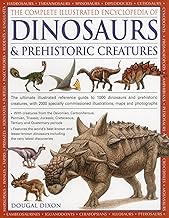
Dinosaurs and Prehistoric Creatures, the Illustrated Encyclopedia of: The ultimate reference guide featuring 1000 creatures from the Devonian to the Quaternary takes a different structural approach that many readers find genuinely useful. Rather than grouping animals by narrative theme or geological era in broad strokes, this volume commits to cataloguing 1,000 creatures in a systematic way — making it one of the most thorough single-volume references available for the scope it attempts.
Rated 4.8 stars from 91 reviewers, the feedback pattern here consistently highlights two things: the sheer number of species covered (including many that never appear in mainstream dinosaur books), and the quality of the illustrations, which lean toward detailed anatomical reconstruction rather than dramatic action scenes. If you’ve ever wanted to know what a Dunkleosteus, an Ambulocetus, or a Quetzalcoatlus actually looked like based on current fossil evidence, this is the kind of volume that delivers on that promise consistently.
The honest challenge with any book of this scale is that depth per entry is necessarily limited. A 1,000-creature encyclopedia covering everything from Devonian fish to Quaternary megafauna can’t give every species the multi-page treatment. What you gain in breadth, you give up in narrative depth. Readers looking for rich storytelling or contextual accounts of prehistoric ecosystems may find the entry-style format a little dry. It also leans toward the reference end of the spectrum — this is a book you consult rather than read cover to cover.
Where it genuinely shines is as a companion volume to other, more narrative-led books. If you already own a title that tells the story of prehistoric life in flowing prose, this encyclopaedia becomes an invaluable cross-reference — the kind of resource that answers the question “what was that species again?” immediately and reliably.
Best Bedtime Read for Young Children
The Bedtime Book of Dinosaurs and Other Prehistoric Life: Meet More Than 100 Creatures From Long Ago solves a specific and often frustrating problem: most dinosaur books for young children are either too thin to sustain interest over repeated reads, or packed with information density that makes bedtime reading feel like a biology lesson. This one finds a genuinely comfortable middle ground.
With 239 reviews and a 4.8-star rating, this is one of the most enthusiastically received books on the shortlist among parents. The format is designed explicitly for the bedtime reading ritual — entries are short enough to complete in a single sitting but interesting enough that children actually want to hear more. Crucially, coverage extends beyond the familiar classics. Yes, Velociraptor and Triceratops are here, but so are lesser-known species — prehistoric fish, early mammals, flying reptiles — which means the book rewards repeated reading rather than being exhausted in a week.
The illustrations have been widely praised in buyer feedback as warm and engaging without being cartoonish or inaccurate. The visual style sits in a sensible middle ground: child-friendly enough not to feel intimidating, accurate enough not to perpetuate the old myths (no tail-dragging, no cold-bloodedness implied). For households where a child has moved past picture books but isn’t quite ready for a heavy reference volume, this genuinely fills the gap.
The tradeoff is that the bedtime format means entries don’t go deep. Facts are curated for accessibility — a child wanting to know exactly how Spinosaurus’s sail thermoregulation worked will need to graduate to a more detailed book soon. But as an entry point and a repeated-use family read, it’s one of the most practical choices on this list.
Best Budget Pick for Young Readers
Dinosaurs: Discover fascinating facts about prehistoric creatures (All About) occupies the budget end of this shortlist without compromising on the core qualities that matter. Rated 4.8 stars from 25 reviewers, it’s the most accessible entry point price-wise, and the feedback pattern suggests it punches above its weight for younger readers — particularly those in the early primary years who are experiencing their first proper dinosaur phase.
The All About format is built around digestible fact-bites, clear labelled diagrams, and a layout designed for children who are building their reading confidence. There’s no expectation of prior knowledge, and the tone is enthusiastic without being overwhelming. Species selection prioritises the most recognisable and child-friendly dinosaurs — T. rex, Stegosaurus, Ankylosaurus, Brachiosaurus — rather than diving into the more obscure corners of palaeontology. That’s entirely appropriate for the target age range, which sits somewhere in the five-to-eight bracket.
The honest limitation here is scope. This is a book about dinosaurs in the popular sense — the Mesozoic heavyweights — rather than a broader exploration of prehistoric life. Prehistoric mammals, marine reptiles, and early life forms don’t feature. If your child has already outgrown the basics and is asking questions about Ichthyosaurs or Dimetrodon, this book won’t satisfy that curiosity. It’s also a thinner volume than others on this list, which means it won’t sustain interest through the full depth of an extended dinosaur obsession.
Where it works perfectly is as a first dinosaur book — something a younger sibling can enjoy, or a gift purchase where you know the recipient is just beginning to discover prehistoric animals. The format is robust, the content is age-appropriate, and the illustrations deliver the visual engagement that young children need to stay interested.
Best for National Geographic Fans and Fact-Hungry Kids
Little Kids First Big Book of Dinosaurs: Fact-filled fun book about prehistoric life and fossils (National Geographic Kids) brings the National Geographic Kids brand — and with it, a specific and well-earned set of expectations — to the dinosaur category. Rated 4.8 stars from 29 reviewers, the feedback highlights the photography quality in particular, which makes sense given National Geographic’s visual heritage. Where most dinosaur books rely on illustrated reconstructions, this one weaves in fossil photography and real-world imagery that gives young readers a concrete sense of what palaeontology actually looks like as a science.
The structure follows the National Geographic Kids template: large photographs, bold typography, pull-out fact boxes, and a tone that treats young readers as genuinely curious people rather than passive recipients of simplified information. Coverage includes dinosaur basics but also touches on fossils as physical objects — how they’re found, what they can tell us, and why palaeontologists still disagree about some things. That scientific process element is something few other books at this level attempt, and it gives this title a different kind of educational value.
The tradeoff is that “first big book” implies an entry-level scope. If your child already knows the difference between a theropod and a sauropod, this may feel too introductory. The species coverage is broad but not deep, and the fossil-focus angle means less page-time for detailed creature profiles than you’d find in a dedicated encyclopaedia format. Think of it as a fantastic gateway book — one that might spark a lasting interest in palaeontology as a discipline, not just dinosaurs as characters.
For families with children in the four-to-eight age range who respond well to photography over illustration, and who might be equally interested in the science behind fossils as the creatures themselves, this is the pick with the most distinctive angle on the subject.
Best Visual Guide for Younger Enthusiasts
The Ultimate Dinosaur Encyclopedia: The amazing visual guide to prehistoric creatures takes a visual-first approach that suits children who have moved past the beginner stage but aren’t quite ready for the density of a full adult encyclopaedia. Rated 4.8 stars from 15 reviewers — the smallest review base on this shortlist — it has received consistently positive feedback that highlights the balance between comprehensive content and approachable presentation.
The word “ultimate” in dinosaur book titles is used frequently enough to invite scepticism, but in this case the visual guide format does justify the claim for its intended audience. Illustrations are detailed and numerous, species entries go deeper than the typical beginner’s book, and there’s an attempt to organise content in a way that builds understanding rather than just listing creatures. Sections move through geological time in a logical sequence, which helps readers develop a mental framework for when different animals existed relative to each other — a concept many dinosaur books skip entirely.
The honest caveat is that with 15 reviews, the feedback pool is small enough that patterns are harder to confirm than with more widely reviewed titles. What’s there is positive, but a degree of caution is warranted compared to books with hundreds of reviewers confirming consistent quality. The book appears to sit in a mid-range format — more substantial than a budget activity book, less comprehensive than the DK definitive volumes — which makes it useful for readers in the middle of their dinosaur education rather than at either end of the spectrum.
If you’re buying for a child who has exhausted the beginner books and needs something with more information without the intimidating density of a full adult reference, this is worth serious consideration. The visual emphasis keeps engagement high while the content depth supports a growing understanding of prehistoric life.
What to Look For When Buying a Prehistoric Creatures Book
- Scope beyond dinosaurs: The best books cover prehistoric life as a whole — marine reptiles, pterosaurs, prehistoric fish, mammals, and Ice Age megafauna — not just the Mesozoic giants. A book that treats “dinosaurs” as the only prehistoric creatures worth knowing is missing the vast majority of evolutionary history.
- Age-appropriate depth: Match the book to the actual reader. A five-year-old needs a different entry point than a twelve-year-old, and adults deserve material written for their level of patience and curiosity. Check publisher descriptions carefully for stated age ranges, and look at sample pages where available.
- Illustration quality and accuracy: Since prehistoric creatures can’t be photographed, the quality of scientific reconstruction illustrations matters enormously. Look for books that reflect current palaeontological understanding — feathered theropods, correctly proportioned limbs, active postures — rather than outdated imagery based on older assumptions.
- Publisher credibility: Publishers with strong natural history or educational track records — and books that credit expert advisors or palaeontological consultants — are more likely to have caught errors before print. This doesn’t guarantee perfection, but it raises the baseline significantly.
- Format durability: For younger readers especially, hardback editions hold up to repeated use far better than paperback. If you’re buying for a child who treats books physically, the format decision is as important as the content decision.
- Geological context: The strongest books place creatures in their time period and ecosystem rather than presenting them as disconnected specimens. Understanding that Stegosaurus lived long before T. rex, or that the Ice Age mammals were a separate chapter from the dinosaurs, changes how the whole subject makes sense.
- Breadth of species coverage: Beyond the headline species, a genuinely useful book covers the odder, lesser-known creatures — the Therizinosaurus, the Dunkleosteus, the prehistoric sloths — that reveal how strange and varied prehistoric life actually was. If the same twelve species appear in every book you look at, keep looking.
Verdict
For most UK readers, Dinosaurs and Other Prehistoric Life (DK Children’s Anthologies) is the single best starting point. It combines the broadest coverage with the highest confidence rating from the largest number of verified reviewers, sits comfortably at a mid-range position, and works for a wider age range than any other book on this list. Children from around eight upward can use it independently; adults will find it genuinely engaging rather than condescending.
If you’re shopping for a serious adult enthusiast or building a proper shelf reference, upgrade to Dinosaurs and Prehistoric Life: The Definitive Visual Guide (DK Definitive Visual Encyclopedias) instead — the depth and visual quality justify the premium format. For young children or first-time readers, The Bedtime Book of Dinosaurs and Other Prehistoric Life remains the most practically useful choice, with a format designed to survive the bedtime routine and hold a child’s attention over months rather than weeks.
We were not paid to feature any specific product in this guide. All opinions are independent and based on publicly available specifications, verified buyer feedback patterns, and category research.
Quick Comparison Table



FAQ
What is the best dinosaur book for a six-year-old?
For a six-year-old, the two strongest options are The Bedtime Book of Dinosaurs and Other Prehistoric Life, which is built specifically for the bedtime reading ritual with short, engaging entries, and the Dinosaurs All About book, which suits early readers building their confidence. Both feature age-appropriate vocabulary and strong illustrations. Avoid dense encyclopaedias at this age — they frustrate more than they inform.
Are DK dinosaur books accurate?
DK titles in the natural history space generally credit palaeontological consultants and reflect reasonably current scientific understanding at the time of publication. No printed book can keep pace with the fastest-moving discoveries — palaeontology updates quickly — but DK editions tend to avoid the most outdated myths (tail-dragging postures, purely cold-blooded metabolism) and are updated in new editions when enough has changed to warrant it. They’re a reliable baseline, though not a substitute for following current research if that’s your goal.
What’s the difference between a dinosaur book and a prehistoric life book?
Dinosaurs are one group within the much broader story of prehistoric life. A dinosaur-only book covers the Mesozoic era (Triassic, Jurassic, Cretaceous) and the specific lineage of animals that qualify as dinosaurs. A prehistoric life book also covers marine reptiles like plesiosaurs and mosasaurs (not technically dinosaurs), pterosaurs, prehistoric fish, Palaeozoic creatures, and the Ice Age mammals that came after the dinosaur extinction. If you want the full picture, choose a book that covers prehistoric life broadly.
How do I know if a prehistoric creatures book is scientifically up to date?
Check the publication date first — anything printed before roughly 2010 may show featherless raptors, upright Tyrannosaurus postures, or other since-revised reconstructions. Look for books that credit a scientific advisor or palaeontological consultant on the imprint page. Illustrations showing active, horizontal postures for theropods and acknowledging feathers on many species are a reasonable quality signal. No book stays current indefinitely, but recent editions from credible publishers are the safest bet.
Is there a single book that covers both dinosaurs and Ice Age mammals?
Yes — several books on this list do exactly that. The DK Children’s Anthologies title and the DK Definitive Visual Encyclopedias edition both include substantive coverage of Ice Age megafauna (woolly mammoths, saber-toothed cats, giant ground sloths) alongside the Mesozoic dinosaurs. The Illustrated Encyclopedia covering 1,000 creatures from the Devonian to the Quaternary is specifically designed with this breadth in mind, making it the most thorough single-volume option for readers who want the complete prehistoric timeline.
Can adults enjoy children’s dinosaur encyclopaedias, or should they buy a separate title?
Genuinely curious adults will find that the better children’s encyclopaedias — particularly the DK Children’s Anthologies edition — deliver satisfying content up to a point, especially for breadth of species coverage and visual quality. However, adults who want real depth, taxonomic detail, or discussion of the science behind reconstructions will hit the ceiling of a children’s title fairly quickly. The DK Definitive Visual Encyclopedias edition is the right upgrade — it’s designed for an adult reading level and delivers considerably more information per species.