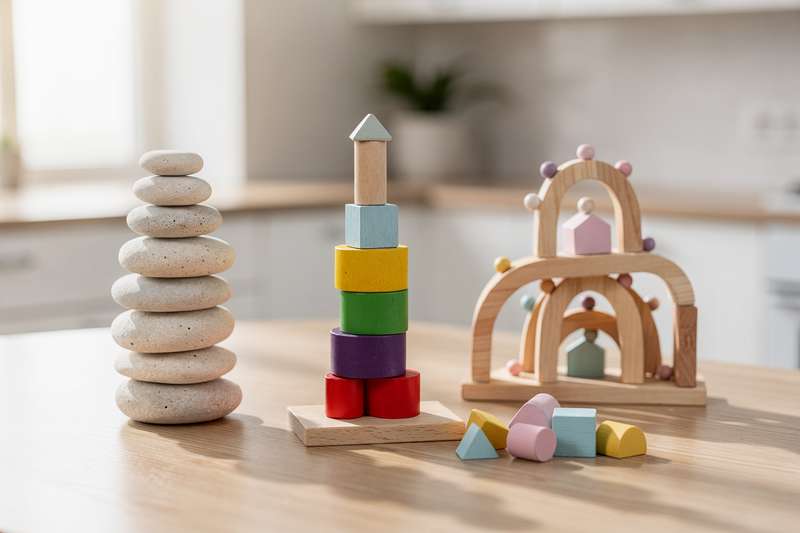
You’ve been down this road before. You buy a board game, everyone gathers round the table with good intentions, and within ten minutes the phone comes out or someone’s arguing about rules. What you actually wanted was something physical — something where the tension is visible, where the table holds its breath, and where a wobble sends everyone into genuine laughter. Stacking and balancing games deliver exactly that. But the category is broader than it looks: travel card-stackers, wooden tower classics, pendulum balancers, Montessori-style construction toys, and wobbly chair challenges all live under the same roof. Get it wrong and you end up with something too fiddly for the kids, too simple for the adults, or too fragile to survive a family game night. This guide cuts through that noise and gives you concrete picks matched to different households, age groups, and occasions — so you can spend less time second-guessing and more time watching someone’s carefully placed block slide off the edge.
How We Evaluated These Picks
The picks in this guide were assessed across five criteria: age-range suitability (does the stated minimum actually hold up in practice?), component quality and durability (wood versus plastic, piece count, storage), replayability and game-length fit (quick filler versus a proper evening game), portability and storage footprint, and real buyer feedback patterns drawn from verified Amazon reviews. Where a product had no reviews at all, that’s noted plainly in its section — and the Methodology claims are limited to what the product data actually supports. Products were also checked for topic fit: anything that is plainly not a stacking or balancing game in its core mechanic was excluded, regardless of search ranking. The goal is a shortlist you can trust rather than a padded list you have to sift through yourself.
Best Card-Stacking Game for Families and Travellers
If you want a stacking game that travels in a jacket pocket, the Big Potato Cards Vs Gravity Pro is the one to consider. It ships with a travel bag and extra cards, and it’s designed for two to eight players — a genuinely wide range that covers everything from a couple on a train to a full family gathering. The core mechanic revolves around balancing and stacking cards with increasingly daft structural challenges, which means the tension scales naturally with how many people are playing and how ambitious you get with your construction.
The Big Potato brand has a track record for party games that are easy to explain in under two minutes, and Cards Vs Gravity Pro follows that pattern. Rules overhead is minimal: you understand what you’re doing within the first round, which matters enormously when you’re playing with mixed ages or with people who don’t consider themselves “gamers”. The travel bag inclusion is not just a marketing point — it genuinely means pieces stay together between sessions, which is a real frustration with card games that ship in flimsy boxes.
The tradeoff here is that this is fundamentally a social, chaotic experience rather than a strategic one. If your household leans toward games with deeper decision trees, this will feel lightweight. It also has no buyer reviews live yet on Amazon UK, so you’re going on brand reputation and the product specification rather than aggregated owner experience — worth factoring in if you’re risk-averse. That said, the two-to-eight player range and the travel-bag inclusion make it one of the most practically versatile picks on this list for people who want stacking fun without committing to a large wooden box.
This is the pick for: anyone who wants a stacking game they can genuinely use on a train, at a café table, or at a family BBQ without needing a proper playing surface or a rulebook explanation that runs to five minutes.
Best Budget Wooden Balancing Toy for Younger Children
The Wooden Balancing Pendulum Game (42 pieces, Montessori-oriented, suitable for kids and adults) sits at the accessible end of the budget range and has 127 verified buyer reviews on Amazon UK with a 4.2/5 rating — enough of a sample to read genuine patterns. What buyers consistently praise is the quality of the wooden components relative to the price point: pieces feel solid, the pendulum mechanism works smoothly, and the set holds together well through repeated play. The 42-piece count also means there’s enough going on to hold a young child’s attention across multiple sessions, rather than exhausting the game’s possibilities in one sitting.
The Montessori framing matters here in a practical sense. This isn’t a competitive game in the traditional sense — there’s no scorekeeping or win condition baked in by default. It’s more of a physical exploration toy that can be used in loosely structured play or in more guided challenge-based sessions where an adult sets a balancing target and a child tries to match it. That flexibility is useful if you have children of different ages playing together, because the difficulty can be calibrated without changing any rules.
Where it falls short: the instructional material that ships with the set has attracted some criticism for being limited, and a few reviewers note that the pendulum base can shift on slippery surfaces. It’s not a game that creates explosive social moments in the way a toppling tower does — the satisfaction is quieter and more individual. Adults who want a proper competitive experience will find it too open-ended. But for families with children roughly aged four to eight, or for households looking for a screen-free activity that quietly builds spatial reasoning and fine motor skills, it delivers reliably and without breaking the budget.
One practical note: the 42 pieces do need somewhere to live between sessions. The set doesn’t include a bag or box with good internal organisation, so a zip-lock bag or a small container from a pound shop is worth having alongside it.
Best Classic Tumbling Tower for Adults and Older Children
The Official Hasbro Games Jenga Game with Digital Die takes the format almost everyone already knows and adds a digital die element that introduces randomised challenges or rule variations — something that meaningfully extends replayability beyond the standard “pull a block, try not to collapse it” loop. Hasbro’s Jenga is the reference point for the tumbling tower category for a reason: the block dimensions are precisely calibrated, the wood quality is consistent, and the tower behaves predictably enough that skill genuinely differentiates good players from nervous ones.
The digital die addition is more than a gimmick. Standard Jenga can feel like it runs out of steam after a few plays once you’ve learned how the tower behaves. The digital die introduces variability that keeps experienced players engaged — whether that’s pulling with one finger, using your non-dominant hand, or other physical constraints that shift the difficulty. It’s an effective way to keep the game feeling fresh at family gatherings where the core Jenga mechanics are already familiar to everyone at the table.
The honest tradeoff: this version has no buyer reviews live on Amazon UK at the time of writing, so you’re relying on the Jenga brand’s established reputation and the product specification rather than specific owner feedback for this edition. The digital die requires a battery, which means an extra dependency and a potential failure point down the line. If you want zero electronic components and pure wood-and-nerve tension, the standard Jenga format serves that need. But if you want to give a classic game meaningful new legs, the digital die variant is a sensible upgrade — particularly as a gift for someone who already owns a basic stacking tower and wants more variety.
Age-wise, Jenga is reliably engaging from about six upwards with adult supervision for setup, and the format works equally well with two players or a group of eight. It’s one of the most naturally scalable games in this category.
Best Colourful Chair-Stacking Game for Family Game Nights
The 100PCS Balancing Chairs game is the most piece-dense option in this guide, and that count is both its strength and its main logistical consideration. One hundred brightly coloured chair pieces give you an enormous number of possible stacking combinations and configurations, which means replayability is genuinely high — it’s hard to exhaust the game’s possibilities quickly. The 4.5/5 rating from 25 reviewers suggests early buyers are happy, though the review count is modest enough to treat as a promising early signal rather than a definitive verdict.
The chair stacking format — where you balance miniature chair shapes on top of each other in increasingly precarious configurations — is visually entertaining in a way that flat-block towers aren’t. Chairs have legs, which means pieces interact with each other in unpredictable ways, and the tension of watching a multi-chair stack wobble before settling is exactly the kind of shared moment that makes family game nights memorable. The format also lends itself to creative challenge variations: stack by colour, alternate piece orientations, or introduce time pressure. You don’t need a rulebook to invent interesting games with this set.
The practical challenge is storage. One hundred small pieces need a container that keeps them organised, and it’s worth checking whether the packaging is robust enough to serve as long-term storage or whether you’ll want a separate box. The pieces are made from lightweight plastic, which keeps the weight manageable but means they can scatter dramatically when a stack collapses — fine for a dining table, potentially noisy on a hard floor in the evening. The game is listed as suitable for both children and adults, and the format genuinely works across that range, though younger children (under five) may find the precise placement required frustrating.
If your household regularly hosts four or more people for game nights and you want something that creates visible drama without needing a rulebook explanation, this is a strong contender. The piece count also means multiple people can be building simultaneously if you split the set, which opens up team-based formats.
Best Geometric Tower-Building Game for Mixed-Age Groups
The Winnsell Tetra Tower Balance Game brings a different visual logic to the stacking category: tetromino-style interlocking pieces that clip together as you build upward, rather than loose blocks that rely purely on friction and gravity. The 4.0/5 rating across 61 reviews is honest — buyers appreciate the novelty of the format and the satisfying click of pieces connecting, but some note that the interlocking mechanism can make the tower more forgiving than they’d expected, reducing tension in the late game.
That characteristic — slightly more forgiving than a friction-only tower — actually makes it a better fit for mixed-age groups where younger children might otherwise feel discouraged. The pieces connect, so a slightly off-centre placement doesn’t always result in immediate collapse. This extends the game and keeps younger players competitive with adults, which is genuinely valuable if you have an age range of, say, six to sixty at your table. The geometric pieces also have an inherently satisfying tactile quality: they’re chunky, colourful, and feel robust in small hands.
Note that the Winnsell Tetra Tower appears in the Amazon catalogue under two ASINs (B0CLXM48XN and B0BNYL522D) — these represent variants of the same product line. This section covers the primary listing; the underlying game is the same. With 61 reviews shared across the line and a consistent 4.0/5 score, the pattern is reliable enough to make an informed call.
Where this game is less ideal: if your household contains competitive adults who want maximum structural tension and the genuine fear of catastrophic collapse, the interlocking format will feel too safe. For that audience, a pure friction-based tumbling tower (like the Jenga pick above) delivers more nerve-wracking stakes. But for families where inclusivity across ages matters more than pure tension, the Tetra Tower is one of the more thoughtfully designed options in the budget-to-mid range.
Best Travel-Size Tumbling Tower for Pubs and Holidays
The SOL Mini Tumble Tower has the most substantial review base of any product in this guide — 730 Amazon UK reviews at a 3.7/5 average — which tells a nuanced story worth unpacking rather than reading as a simple number. The high volume means the rating is statistically robust, and the 3.7 reflects a genuine split: buyers who wanted a travel-sized wooden tower and got exactly that tend to be satisfied, while the lower ratings cluster around buyers who expected full-size Jenga quality and found the mini format more limited.
At its core, this is a compact wooden tumbling tower that fits in a bag without taking up meaningful space. That makes it genuinely useful for pub visits, holidays, camping trips, or any situation where you want the stacking-game format without carrying a full-size box. The wooden blocks are lighter than full-size equivalents, which means the tower is more susceptible to wobble from table vibrations or nervous hands — but that’s partly the point. In a pub environment, that extra instability creates more comedy and tension, not less.
The honest limitations: the mini format means blocks are small enough to be a concern around children under the age of about six (check current guidance on Amazon), and the compact size means the game is over faster — fewer blocks means fewer turns before a collapse is inevitable. The storage tube that ships with it can be awkward to restack blocks into neatly, which is a minor but persistent annoyance that several reviewers mention. For adults who want a game they’ll genuinely take out of the house, this is the most practically portable wooden stacking game in the set. For home use with plenty of table space, you’d be better served by the full-size Jenga pick.
The 3.7 average also reflects the fact that some buyers received sets with inconsistently sized blocks, which affects gameplay. If that matters to you, the Hasbro Jenga is the more quality-controlled alternative — though it’s not a travel format. The SOL Mini earns its place here specifically for the carry-anywhere use case.
What to Look For When Buying a Stacking or Balancing Game
- Material and build quality: Wooden pieces generally feel more premium, age better, and produce a more satisfying sound on collapse. Plastic pieces are lighter, brighter in colour, and sometimes more durable against drops — but cheap plastic can feel flimsy and may warp in temperature extremes. For anything that will be used regularly with children, solid wood or thick moulded plastic is worth prioritising over thin injection-moulded pieces.
- Age-range fit: The stated minimum age on a stacking game is usually based on choking hazard guidelines as much as skill level. A four-year-old can enjoy Animal Upon Animal; a six-year-old can manage Jenga with supervision; competitive adults want something with enough structural complexity to create genuine uncertainty. Make sure the game you’re buying matches the actual players rather than the widest possible stated range.
- Player count and scalability: Some stacking games are best with exactly four players; others work equally well from two to eight. If you’re buying for a household where group size varies significantly, prioritise games that specifically state they work well across a wide player range — and check whether the game gets better or worse with more players before you commit.
- Replayability and rule variants: A game that offers multiple modes, challenge variations, or the ability to invent your own rules will outlast a one-trick format by a significant margin. Tumbling towers can feel samey after a dozen plays; games with card elements, dice, or piece variety tend to stay interesting longer. Consider how many different ways the game can be played before you’ve seen everything it has to offer.
- Portability and storage: If you want a game that travels, check not just the packed size but whether there’s a storage bag, case, or tube included — and whether the packaging is robust enough to act as long-term storage. Loose pieces in a thin cardboard box rarely survive more than a few outings intact. A dedicated bag or a hard-sided container makes a real difference to whether you’ll actually take the game out of the house.
- Piece count and setup time: Higher piece counts mean more game variety and longer play potential, but they also mean longer setup and more risk of lost pieces. For games aimed at young children, a smaller, well-defined piece set is often more practical than a hundred-piece system, even if the latter looks more impressive on paper.
- Tension and physics: The best stacking and balancing games create a physical sensation of risk — you feel the wobble, you hear the creak, you hold your breath. Before buying, consider whether the game’s mechanism (friction tower, pendulum balance, interlocking clips, card-stacking) will produce the kind of tension your household actually enjoys. Not all balancing games feel equally dramatic.
Verdict
For most UK households, the pick that delivers the best combination of broad age range, genuine tension, instant understandability, and durable components is the Official Hasbro Games Jenga Game with Digital Die. The core Jenga format needs no introduction, and the digital die adds enough structured variety to keep experienced players engaged across multiple game nights rather than getting bored of the standard tower format within a few sessions.
If your priority is younger children or a Montessori-style play experience, the Wooden Balancing Pendulum Game is the more appropriate starting point — it has the largest review base of the educational-toy picks, solid component quality, and genuine flexibility in how it’s used. For a travel companion that fits in a jacket pocket, the Big Potato Cards Vs Gravity Pro is the standout option. Choose the pick that matches where and with whom you’re actually going to play — that single consideration matters more than any other spec.
We were not paid to feature any specific product in this guide. All opinions are independent and based on publicly available specifications, verified buyer feedback patterns, and category research.
Quick Comparison Table


FAQ
What age is suitable for stacking and balancing games?
It depends heavily on the specific game. Simple wooden balancing toys with large pieces can work from age three or four with adult supervision. Tumbling tower formats like Jenga are generally a good fit from around age six upward. More complex games involving cards or multi-piece configurations work best from age eight or nine. Always check the manufacturer’s stated minimum age, which is often set based on piece size and choking hazard guidelines.
Are wooden or plastic stacking games better?
Wooden sets tend to feel more premium, produce more satisfying sound effects during play, and age well with regular use. Plastic sets are lighter, often more brightly coloured, and can be more resistant to being dropped — which matters if you’re buying for young children. For home use on a table, wood is generally the more satisfying choice; for travel or outdoor play, lighter plastic can be more practical.
Can stacking games be played solo?
Several balancing and stacking games can be played solo, particularly Montessori-style educational toys and challenge-based balancing sets where you set yourself a target configuration and try to build it. Competitive tumbling tower games are designed for groups, though some households enjoy practising or timing themselves solo. If solo play is important to you, look specifically for products that mention a solo mode or open-ended challenge play in their description.
What makes a stacking game genuinely replayable?
Replayability in stacking games comes from variability in how each session plays out. Friction-based tumbling towers have natural variability because no two towers collapse exactly the same way. Games that add dice, cards, or rule variants extend this further by changing what’s required of players on each turn. A game with only one fixed format and no randomising element will feel familiar more quickly — so if longevity matters, prioritise versions with at least one randomising mechanic.
Are stacking games a good gift for adults?
Yes, particularly formats that create genuine social tension and can accommodate a group. Tumbling tower games, card-stacking challenges, and balancing games with competitive scoring all work well for adult groups. The key is to choose a format that doesn’t feel like a children’s toy — look for games with visual appeal, a satisfying component feel, and enough game depth to be interesting for people who play regularly.
How do I choose between a tumbling tower and a balancing game?
Tumbling towers (like Jenga) are about controlled removal — the tension comes from taking pieces away without causing collapse. Balancing games are about addition — placing pieces onto an existing structure without toppling it. Tumbling towers tend to create sharper, more dramatic single moments of failure; balancing games create more sustained tension across multiple turns. Both formats work well for groups, but balancing games are often more accessible for younger children because placement (adding) is easier than extraction (removing without disturbing).