You scan your garden on a midsummer morning and the courgette flowers are open but unvisited. The borage is in bloom, the pesticides have been gone for years, and yet the pollinators are thinner on the ground than they should be. Your rose bushes carry aphid colonies that nothing seems to touch — because the lacewings and ladybirds that would normally patrol them have nowhere to shelter or overwinter in your tidied-up garden. What’s missing isn’t more flowers. It’s habitat.
Solitary bees and beneficial insects don’t need a hive. They need cavities: hollow stems to nest in, drilled timber blocks, tubes of smooth bamboo. A well-designed insect hotel provides exactly that — bamboo nesting tubes for mason bees and leafcutter bees, corrugated cardboard chambers for lacewings, bark crevices for ground beetles. A single mason bee pollinates roughly 120 times more flowers per foraging trip than a honey bee. Lacewings will work through an aphid colony without you lifting a finger. The pay-off for providing habitat is real and measurable.
The trouble is that the market is thick with products that look like insect hotels but function more like garden ornaments. Tubes drilled at the wrong angle so water pools inside and kills developing larvae. Bamboo left rough at the cut ends so bees damage their wings trying to enter. Thin softwood that splits after one winter and turns into a mould trap. This guide concentrates on options that work as habitats rather than merely decorating a fence panel.
How We Evaluated These Picks
Five criteria shaped every choice here. Material quality: untreated, responsibly sourced wood or bamboo that survives UK winters without rotting or splitting within a single season. Structural design: whether the roof overhang is sufficient to keep tubes dry, and whether tubes are oriented to prevent water pooling. Species versatility: does the hotel offer multiple chamber types to serve a range of insects beyond solitary bees alone? Installation: can it be mounted securely and quickly, and does the supplied hardware suit typical garden fences and walls? Buyer feedback patterns: I looked at verified reviewer responses across a meaningful sample, paying close attention to recurring complaints rather than headline star scores, which can be distorted by early gift purchases. Products with no verified reviews were excluded where reviewed alternatives existed, and size variants of the same product line are treated as one pick, with the strongest ASIN featured.
Best Overall: Pelle & Sol Eco-Friendly Bee House
The Pelle & Sol Eco-Friendly Bee House is the strongest all-round option in this guide. With 4.4 out of 5 stars from close to 700 verified buyers on Amazon UK, it has the largest feedback pool of any product listed here — and a review base that size gives you meaningful signal rather than the volatile scores you get from listings with fewer than 30 reviews.
The design targets bees, butterflies, and beneficial insects through a mix of bamboo nesting tubes in varying diameters. That diameter variety matters more than most listings acknowledge. Mason bees prefer tubes in roughly the 6–8mm range; leafcutter bees tend to use something slightly wider. A hotel that offers only one tube size limits which species can actually nest in it. The Pelle & Sol format addresses this with a range of sizes, and the bamboo is responsibly sourced, avoiding synthetic coatings that can deter insects or harm developing larvae.
Weather resistance is a stated feature, and bamboo handles UK conditions well in a sheltered, south-facing position. The practical limitation to be aware of: bamboo does split over time under repeated freeze-thaw cycles, particularly in wetter or more exposed locations. If your garden is in Scotland, northern England, or a coastal area, tucking the hotel under an eave or porch from December to February extends its life meaningfully. That’s a characteristic of bamboo as a material rather than a failing specific to this product.
Buyer feedback highlights one recurring point: the supplied hanging hook is adequate for a sheltered, relatively static position, but if your fence catches strong prevailing wind, adding a secondary fixing point through the frame is worth the effort. Some buyers also note the hotel is on the compact side compared to multi-chamber alternatives — which is true, but the focused design is part of why it works specifically for solitary bees.
This is the right choice for gardeners who want a product backed by a large verified review base, who want to focus specifically on supporting solitary bees, and who value responsibly sourced materials. The kid-friendly label in the product description isn’t marketing filler: children can safely handle and observe it, and positioning it at a lower height makes it accessible for younger wildlife-watchers.
For placement, the advice that applies to all insect hotels applies here: south or south-east facing, at least a metre off the ground, and close to nectar-rich plants so foraging bees have a short route between food and shelter. Some gardeners report higher occupancy rates when they cluster two or three compact hotels on the same fence panel rather than hanging a single isolated unit — worth trying if you have the space.
Best Large Multi-Chamber Hotel: ADEPTNA Wooden Garden Insect Hotel
The ADEPTNA Wooden Garden Insect Hotel — available in the large size featured here and in a more compact version for smaller fence panels — is the pick when you want one structure capable of housing a wide range of insects rather than focusing on a single species. Rated 4.6 out of 5 stars from over 600 verified buyers, it’s one of the most consistently rated multi-chamber options on Amazon UK, and that volume of feedback makes the score reliable.
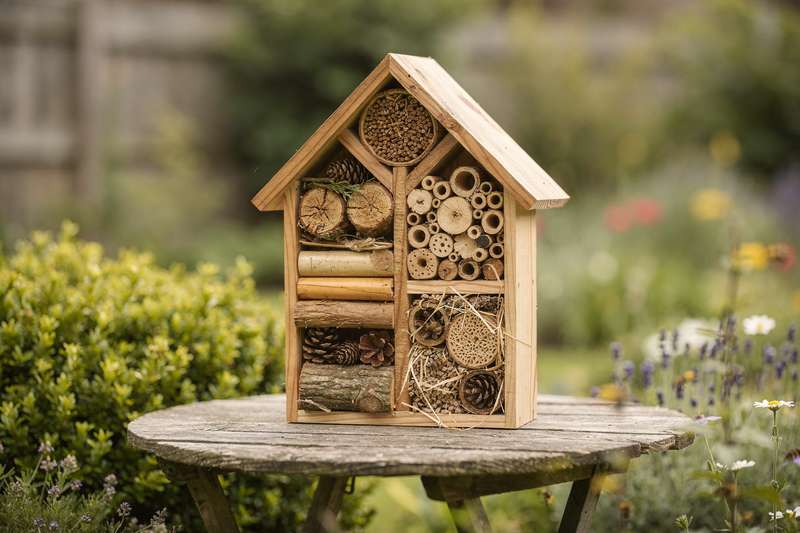
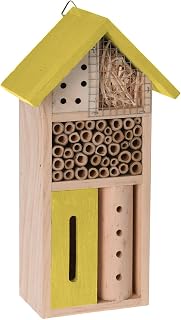
What distinguishes this from simpler bee houses is the compartment variety. The large version includes sections filled with pine cones, corrugated cardboard rolls, bamboo tubes, bark, and timber blocks with drilled holes — each targeting a different type of insect. Pine cones and bark crevices draw in ground beetles and spiders; corrugated cardboard rolls are a well-documented favourite for lacewings, which are voracious predators of aphids and scale insects; bamboo tubes and drilled timber serve solitary bees. If you’re approaching your garden holistically — not just improving pollination but reducing the conditions under which aphids and other pests thrive — this range of habitats is more useful than a single-chamber bee house.
The build quality is solid for this category. The wooden frame holds together through at least two UK winters based on buyer accounts, though a small number of reviewers note that the roof covering can lift slightly after sustained wet weather. The large size sits flat against a fence or wall and hangs securely, with functional mounting hardware included. As with any open-fronted timber hotel — and they need to be open-fronted for insects to access the compartments — check the back panels occasionally for moisture if the structure faces the direction of prevailing rain.
The smaller variant covers the same range of habitats in a reduced footprint, useful if you’re working with a narrower fence section or want to mount the hotel at eye height without it dominating the space. The design logic is identical between sizes; the choice comes down to available space and how much insect traffic you want to support.
This pick suits gardeners who think about insect support as a whole system — building a stable network of predators and prey that reduces the need for active intervention across a season. It also works well for school gardens, community allotments, and wildlife projects where demonstrating species diversity across chamber types is part of the educational value.
One practical note before hanging: the large version is heavier than single-purpose hotels. Fix it into a solid fence post with a proper wood screw rather than relying on a clip or nail through a panel — it will be more secure and will last considerably longer as a result.
Best for DIY and Educational Gardens: Fallen Fruits DIY Insect Hotel
The Fallen Fruits DIY Insect Hotel takes a different approach from every other pick in this guide: it arrives as a flat-pack wooden frame that you fill yourself using natural materials gathered from your garden or local area. Rated 4.5 out of 5 stars from 187 verified buyers, it’s a consistently well-reviewed option for a product that asks more of the buyer than simply unpacking and hanging.
The DIY format has functional advantages that pre-filled hotels genuinely can’t match. When you source and prepare the filling materials yourself — smooth-cut bamboo offcuts, pine cones, bundles of dried hollow stems, rolled corrugated cardboard — you control exactly what type of habitat each compartment provides. A dense section of smooth-drilled timber for mason bees, hollow bramble stems for solitary wasps, corrugated card tucked into a cool shaded section for lacewings. Pre-filled hotels fix those choices at the factory, which is convenient but means you inherit whatever decisions the manufacturer made about species balance. With this format, you can also refresh the contents each spring as materials degrade, rather than watching original fillings turn mouldy and become unusable.
The educational value here is more pronounced than any other pick in this guide. For families, the process of collecting materials from the garden, filling the compartments thoughtfully, and then identifying which insects move in across the season becomes an extended hands-on project rather than a passive garden feature. Schools, nature clubs, and wildlife volunteering sessions frequently use this type of structure because the activity has as much value as the outcome. The flat-pack construction is straightforward enough for older children to assemble with adult supervision.
The tradeoffs are clear. This requires more effort upfront: the hotel has no function until the compartments are filled, and sourcing appropriate materials takes time. If you want something ready to hang on a Saturday afternoon and in use within a week, one of the pre-filled options in this guide is the more practical choice. The wooden frame is also modest in scale — functional as a focused single-unit habitat but not a substitute for the broader species coverage of the ADEPTNA hotel in a larger garden.
What’s often overlooked with DIY hotels is the opportunity to refresh fillings seasonally. Prioritise smooth-cut bamboo tubes and drilled blocks in spring for nesting bees. As summer moves into autumn, add corrugated cardboard bundles in sheltered compartments to create lacewing hibernation spots. Rotating fillings also reduces the parasite load that builds up in fixed materials over time — a maintenance advantage that most pre-filled hotels make difficult or impossible.
For patient gardeners who want to actively build the habitat rather than buy a ready-made version, or for anyone running an environmental education project, this is the most engaging pick in the guide.
Best for Year-Round Weather Resistance: Wild Bee House – Insect Hotel with Metal Roof
The Wild Bee House – Insect Hotel with Metal Roof addresses the single most common failure point of wooden and bamboo insect hotels in the UK: moisture. The metal roof here is a functional upgrade rather than a cosmetic detail, and it makes a meaningful difference to how long the structure remains a viable habitat. Rated 4.5 out of 5 stars from 155 verified buyers, with feedback that specifically praises its durability across multiple UK seasons.
The structural logic is worth understanding. A timber hotel without adequate roof overhang traps rainwater in upward-facing tubes, which triggers fungal growth that kills developing bee larvae. In regions of the UK with high annual rainfall — Scotland, Wales, northern England — this isn’t an edge case; it’s the primary reason bamboo hotels fail within two seasons. The metal roof on this model creates a deep, consistent overhang that sheds rain effectively, keeping tube openings dry through prolonged autumn and winter wet. It also holds its shape better than timber roofs, which can warp and lift under repeated freeze-thaw cycles.
The bamboo tubes are arranged in a dense configuration with openings facing outward and oriented to prevent water pooling. The wooden housing is solid and the construction tighter than the basic options in this category. The hotel sits in the mid-range for hanging insect hotels by size: substantial enough to support meaningful numbers of solitary bees, compact enough that it doesn’t dominate a fence panel.
The trade-off is species scope. This is primarily a bee-focused structure rather than a multi-species habitat. There are no corrugated cardboard sections for lacewings, no pine cone or bark compartments for beetles — the design concentrates on hole-nesting insects, principally solitary bees and other small pollinators. For gardeners whose main concern is pollination rather than broad-spectrum pest management, that focus is actually an advantage: you get a well-executed single-purpose structure rather than a generalist hotel that spreads its design thinly across many compartment types.
If you’ve previously lost a bamboo hotel to winter damp, or your garden is in a high-rainfall part of the UK, or you simply want something that can stay up year-round without seasonal under-cover storage, this is the most sensible structural choice in this guide. It costs slightly more than the most basic bamboo options, but the metal roof extends service life in a way that makes it the better long-term option for exposed or high-rainfall positions.
Best Decorative Design: CKB LTD Heart Bee House Wooden Bee Hotel
The CKB LTD Heart Bee House Wooden Bee Hotel is the most visually distinctive pick on this list, and the one most likely to be chosen as a gift. It carries a 4.9 out of 5 star rating — the highest here — but that score comes from just 13 verified buyers, which is a genuine caveat to keep in mind. Early satisfaction is encouraging, but it isn’t as settled evidence as the 150-plus or 600-plus review counts backing the other picks.
The heart-shaped design is executed with care. A rustic wooden frame cut into a clear heart form and filled with clean-cut bamboo nesting tubes, finished in a natural style that reads as a considered garden feature rather than a utility box. The hanging hardware is adequate for a fence post, shed wall, or garden gate, and the construction quality — based on buyer accounts — is solid relative to the price point. Reviewers praise it specifically as a gift and as a piece that looks at home in a garden setting rather than feeling like an afterthought.
As a working habitat, it performs its function. The bamboo tubes are appropriately sized for solitary bees, and the covered frame provides reasonable shelter from light rain. It’s more compact than the multi-chamber options on this list, which means it won’t offer the species diversity of the ADEPTNA hotel or the structural weather protection of the metal-roof model. In a sheltered, south-facing spot near flowering plants, it functions as a real bee habitat rather than purely as decoration.
The clearest case for this pick is as a considered wildlife gift. If you’re buying for someone who loves their garden but isn’t a dedicated wildlife gardener — a house-warming present, a birthday gift for an allotment holder, something for a teacher who keeps a classroom window box — the heart shape makes the purchase feel intentional. A plain rectangular bamboo box often sits in a shed waiting to be hung; a heart-shaped bee house tends to go straight up on the fence.
Because of the heart shape, the internal compartment is a fixed form rather than the modular grid you get in multi-section hotels. You can’t swap out individual tube bundles or add different chamber types later. What the hotel offers from installation is what it provides throughout its life — entirely appropriate for a focused bee habitat, and worth knowing before purchase so expectations are set correctly.
If you’re optimising purely for function and the widest buyer validation, the Pelle & Sol has a substantially larger verified review base and comparable functionality. If the decorative quality is what you need — particularly for a gift — and you’re comfortable with the smaller review sample, the CKB LTD Heart Bee House is a well-made option that does what it claims.
What to Look For When Buying an Insect Hotel
- Tube and hole diameter range: Different solitary bee species prefer different aperture sizes — mason bees typically favour around 6–8mm, leafcutter bees prefer slightly wider. A hotel with only one diameter will attract fewer species. Look for a stated range across the bamboo tubes or drilled timber blocks, not just a single uniform size throughout.
- Roof overhang and drainage: The most important structural detail for UK gardens. A roof projecting at least 3–4cm beyond the tube openings sheds rain effectively and prevents the standing water that kills developing larvae. A metal roof outperforms timber under repeated freeze-thaw conditions. Avoid designs where tubes face directly upward without cover.
- Tube finish quality: The cut ends of bamboo must be smooth, not splintered or frayed. Rough-edged tubes cause bees to injure themselves on entry, which discourages use. Drilled timber blocks should have clean, sanded boreholes. Close-up product photos in the listing usually reveal whether the finish is adequate before you commit.
- Chamber variety for multi-species support: To attract lacewings — among the most effective natural aphid predators — look for corrugated cardboard roll sections in the design. Bark and pine cone compartments draw in ground beetles and spiders. Hotels consisting solely of bamboo tubes cater primarily to hole-nesting bees and little else.
- Materials and surface treatments: Use untreated wood only. Varnishes, paint, and wood preservatives deter insects and can be toxic to developing larvae. Look for responsibly sourced or FSC-certified timber in the product description — it’s typically mentioned when it applies, and worth prioritising.
- Replaceability of filling materials: Bamboo tubes accumulate parasites and fungal growth over two to three seasons and should be replaced. Hotels with removable tube bundles make this straightforward; those with glued or fixed bamboo do not. Factor long-term maintenance into the purchase decision, not just the initial outlay.
- Fixing and mounting hardware: Check that the supplied hardware suits your intended mounting point — fence panel, wall, and post all require different fixing approaches. Heavier multi-chamber hotels need a solid wood screw into a post rather than a clip through a fence panel; confirm the fixing type before purchase to avoid surprises on installation day.
Verdict
For most UK gardeners, the Pelle & Sol Eco-Friendly Bee House is where to start. Close to 700 verified buyers, responsibly sourced materials, varied bamboo tube diameters, and a design that functions as a real habitat rather than just dressing up a fence — it covers the essentials reliably and has the kind of buyer track record that lets you purchase with confidence.
If your goal is broader ecological support — attracting lacewings, beetles, and ladybirds alongside bees — the ADEPTNA Wooden Garden Insect Hotel is the more capable functional choice. The multi-chamber design serves different insect families simultaneously, which translates to more meaningful pest management across a full season rather than improved pollination alone.
For wet or exposed gardens, the Wild Bee House with Metal Roof outlasts bamboo alternatives in high-rainfall positions. For a gift or a garden feature that reads as something considered rather than purely functional, the CKB LTD Heart Bee House is the most distinctive option available. And for hands-on gardeners or educators who want to build the habitat themselves, the Fallen Fruits DIY Insect Hotel offers a level of customisation and ongoing engagement that no pre-filled structure can match.
We were not paid to feature any specific product in this guide. All opinions are independent and based on publicly available specifications, verified buyer feedback patterns, and category research.
Quick Comparison Table


FAQ
Where should I position an insect hotel?
Face the hotel south or south-east to maximise warmth — solitary bees need a sunny, sheltered aspect to trigger nesting activity. Hang it at least 1 metre above the ground, protected from prevailing wind, and within easy foraging distance of nectar-rich plants. Avoid deep shade and positions where the structure swings freely in the wind, as instability deters nesting bees.
When is the best time to put up an insect hotel?
Late February to March is optimal, as this is when the first UK solitary bee species — particularly the red mason bee — begin emerging and seek out nesting cavities. An autumn installation is equally worthwhile: lacewings and ladybirds will use the hotel for overwintering shelter from September through to spring, so the best timing depends partly on which insects you most want to support.
Do insect hotels actually attract insects?
Yes, when correctly sited and made from suitable materials. Research into solitary bee habitats consistently shows that drilled-block and bamboo-tube structures attract mason bees and leafcutter bees when placed in appropriately sunny, sheltered aspects. Hotels in deep shade, or those with poorly finished tubes, typically go unused — placement and material quality matter at least as much as which product you choose.
How do I maintain an insect hotel?
Replace bamboo tubes every two to three seasons, as they accumulate parasites and mould that harm new larvae. For drilled timber blocks, clear old mud plugs at the end of each season and check for moisture damage. Use hot water and a stiff brush rather than cleaning products, which can leave residues that deter insects. Hotels with removable tube bundles make this maintenance considerably more practical than those with fixed bamboo.
Will an insect hotel attract wasps or unwanted pests?
Solitary wasps may well use the hotel — this is a positive outcome. They are non-aggressive, rarely sting, and actively prey on caterpillars and aphids. Earwigs, woodlice, and spiders are also common occupants and beneficial in a garden context. Social wasps, the kind that build large paper nests and sting repeatedly, do not use insect hotels.
How can I tell if my insect hotel is being used?
Mason bees seal used tubes with a neat mud plug; leafcutter bees use rolled sections of leaf. Sealed tube openings appearing between April and July confirm the hotel is in active use. Tubes remaining empty after a full season almost always indicate a placement issue — try moving the hotel to a sunnier or more sheltered position before concluding it is not working.