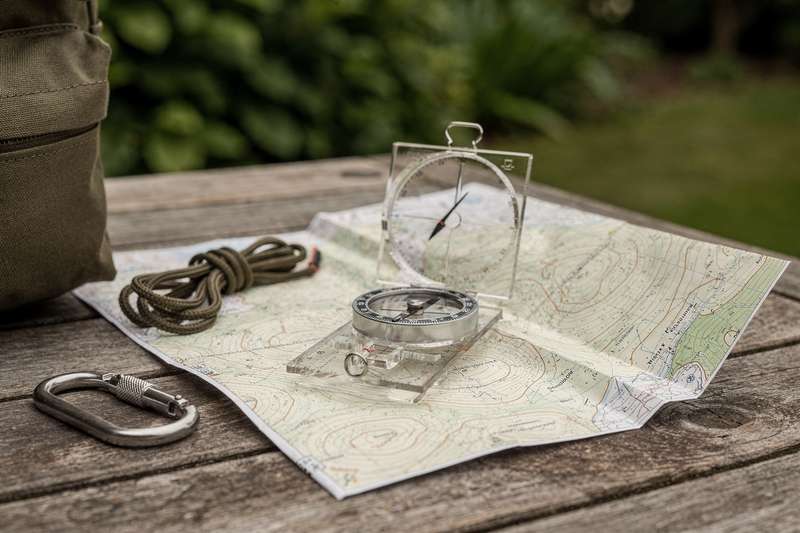
You’re somewhere on a Brecon Beacons ridge, cloud clamped down to around 200 metres, and the path you’ve been following for the past hour has dissolved into open moorland. Your phone — which was handling navigation without complaint — just flashed a “GPS signal lost” notification before the battery gave out in the cold. You’ve got a paper OS map folded in your jacket pocket. What you don’t have is anything to help you take a bearing from it.
This situation plays out across the UK’s upland areas every single weekend. It catches experienced walkers who trusted their phones too far, Duke of Edinburgh group leaders who’ve never had to navigate off a clearly waymarked path, and overnight campers who discover that navigation apps are only as reliable as battery life and mobile signal allow. A baseplate compass costs less than a decent pub meal, weighs almost nothing in a rucksack, and has zero electronics to fail in the cold or the rain. The problem is that the compass market is full of products that look identical to proper navigation tools but perform like Christmas cracker novelties — unreliable needles, unreadable markings, and baseplates that flex when you need them rigid. This guide identifies which compasses on Amazon UK are worth relying on, and which are better suited to a display shelf than a Scottish hillside.
How We Chose These Compasses
To narrow down the options available on Amazon UK, we assessed candidates against five practical criteria. Needle behaviour came first: how quickly and reliably does the needle settle on north, and does it hold its position as you move? Second, baseplate functionality — are the ruler scales, orienting lines, and map markings accurately sized for OS maps and legible in field conditions? Third, low-light readability: luminescent markings matter enormously when you’re navigating in autumn dusk, winter fog, or under heavy tree cover. Fourth, weatherproofing — a sealed, waterproof housing is a genuine functional requirement for UK use, not a marketing extra. Fifth, verified buyer feedback: we examined rating and review volume patterns to ground these picks in real-world use rather than spec sheets alone. Five products from the Amazon UK catalogue made the cut, covering ultra-budget through to the most capable sighting compass in the catalogue.
Best Overall Hiking Compass
If you want a reliable all-rounder that covers the needs of most UK hill-walkers without unnecessary complexity, the Compass Hiking Waterproof Hiking Military Navigation with Fluorescent Design Perfect for Camping Hiking and Other Outdoor Activities is where to start. It combines the two things that matter most in a field compass — a waterproof, sealed housing and clearly visible luminescent markings — with the broadest base of buyer validation in this catalogue.
With 465 reviews at 4.4 out of 5 stars, this is the best-validated option here by review volume. That kind of feedback base matters with outdoor gear: 400-plus buyers across different conditions, seasons, and terrains surface the real-world failure modes that a product page never mentions. The recurring positive theme in buyer feedback centres on two things: the needle settles quickly and holds north reliably, and the fluorescent markings are genuinely visible in low light rather than being a marketing claim that fades to invisible the moment you need it at dusk. Neither of those qualities is guaranteed at any price point, which is why consistent positive reports on both counts carry real weight.
The waterproofing deserves more than a passing mention. Rain gear helps, but a compass gets dropped, fumbled with wet hands, and occasionally dunked in a stream crossing. A liquid-filled capsule that’s properly sealed means the housing won’t fog up or let moisture into the needle chamber mid-walk. The military-style build quality suggests a housing designed to take knocks, which matters for anything that spends its life at the bottom of a rucksack alongside tent pegs and emergency bivouac kit.
What this compass doesn’t offer is a sighting mirror for precise long-distance bearings or a dedicated declination adjustment screw. For most UK hill-walkers using it alongside a 1:25,000 or 1:50,000 OS map — taking back-bearings, confirming a peak’s identity, or following a grid bearing across open ground — those omissions rarely matter in practice. If you need that level of precision, the VINTEAM pick later in this guide addresses it. But for the vast majority of recreational walking in the UK’s hills, this compass does everything needed without requiring you to learn a more complex instrument.
The fluorescent design is particularly well-suited to autumn and winter walking, where light goes earlier than expected and head torches become the primary illumination source. Being able to read a bearing without shining a torch directly at the compass — and losing your night-adapted vision in the process — is a subtle but practical advantage. If you’re buying your first serious compass, replacing a lost one, or equipping a shared group kit bag, this is the pick to start with.
Best Budget Pick
The Navigation Compass for Hiking – Portable Compass with Luminous Display & Ruler, Military Outdoor Compass for Camping, Orienteering, Survival sits at the lowest price tier in this guide, and it’s worth being upfront about what that means before recommending it.
It carries 40 verified reviews at 4.2 out of 5 stars. That’s a thinner feedback base than the other picks here — 40 reviews can confirm the basics but can’t surface every failure mode or durability edge case that a product with hundreds of reviews has already encountered. The early feedback is positive in the areas that count: needle behaviour and the luminous display are called out consistently, and there are no prominent reports of the systematic failures that would raise serious concerns. Factor in the limited sample when making your decision, particularly if you’re planning navigation in demanding conditions where instrument reliability really matters.
What you get is a compact baseplate design with a built-in ruler scale for map work, luminous markings on the dial for low-light reading, and a military-style construction suggesting it’s intended for rough handling rather than being a fragile instrument. The portability is a practical plus: a compact, lightweight compass that you’ll actually carry on every walk beats a more capable one left behind because it felt too bulky. For longer routes where every gram accumulates, that counts for something.
The tradeoffs are predictable for this price bracket. There’s no adjustable declination, which means applying a manual correction for magnetic variation when taking precise bearings — in Great Britain, the current declination is a few degrees west of grid north, manageable for casual navigation but worth accounting for on long bearings across open ground. The luminescent markings will also likely be less durable over extended use than those on higher-rated products; exactly how they hold up over hundreds of hours in the field isn’t yet known given the limited review history.
This pick makes most sense as a backup compass for a shared kit bag, a first compass for someone learning the basics of map and compass navigation, or a low-cost option for activities where a compass is useful but not the primary navigation tool — cycling, casual day-walking, or orienteering practice sessions. For anyone planning solo navigation in serious mountain country, the investment in one of the better-reviewed picks above is worth making.
Best for Map Reading and Orienteering
If your primary use is working directly with OS maps — whether that’s orienteering, detailed route planning, or precise navigation across open ground — the Navigation Compass Ruler Magnifier, Adjustable Lanyard for Explorers | Ideal for Map Reading, Orienteering & Survival Activities, Red is designed around exactly that workflow.
With 199 reviews at 4.3 out of 5 stars, it sits solidly in the middle of the pack for validation. The key feature that separates it from more basic options is the combination of a ruler scale and a magnifier built into the baseplate as a single integrated tool. Working with the fine contour lines and small text of a 1:25,000 OS map benefits from magnification, particularly when pinpointing a precise grid reference in a featureless area or reading the map in awkward lighting. The magnifier isn’t a dramatic upgrade, but it’s a useful one for the kind of detailed map work that orienteering and technical navigation require.
The adjustable lanyard is a practical detail worth valuing. A compass you can keep secured around your neck or wrist while moving is one you’re far less likely to drop on a rocky descent or leave on a gate post. When your hands are occupied — adjusting trekking poles, consulting a guidebook, hauling yourself up a scramble — having the compass within easy reach without fumbling through a pocket makes navigation more fluid. Good lanyards also serve as a flexible distance-measuring tool when looped carefully along a map’s route line.
The red colouring is more practical than purely decorative. A bright red compass is easy to spot when set down on a map or a grey rock face — compass losses to “I’m sure I put it somewhere” happen more often than most people admit. It’s a minor point, but experienced navigators tend to appreciate anything that reduces the chance of equipment loss in the field.
Where this compass has limitations is in precision bearing-taking over long distances: there’s no sighting mirror or diopter lens, so it’s a standard baseplate compass in that respect. For fell running, recreational orienteering, or hill-walking on UK terrain, that’s unlikely to be a problem. For anyone who shoots bearings across wide-open plateau to distant landmarks, look at the VINTEAM pick with its sighting lens. For DofE assessors, outdoor education instructors, orienteers, or anyone who does a lot of actual map work and wants a compass that doubles as a functional map tool, this one deserves a close look.
Best for Precision Sighting
The VINTEAM Waterproof and Shockproof Compass Hiking with Fluorescent Design, Adjustable Diopter Sighting Lens, Multi-functional Compass Navigation is the most capable instrument in this catalogue and, with 410 reviews at 4.5 out of 5 stars, the highest-rated among the well-reviewed picks.
The standout feature is the adjustable diopter sighting lens. With a standard baseplate compass, you take a bearing by visually aligning the compass with your target and reading the bezel — effective for most navigation, but inherently imprecise over longer distances. A diopter sighting lens lets you look through the compass at a specific landmark and read the bearing simultaneously, eliminating the parallax error that comes from estimating a rough visual alignment. For navigation across wide, featureless terrain — Dartmoor, the Cairngorms plateau, the Bowland Fells — where being two degrees off over several kilometres means missing a key waypoint by a significant margin, that level of precision changes outcomes in poor visibility.
The waterproof and shockproof construction is backed by consistent buyer reports. Durability is mentioned positively and repeatedly across the reviews, which matters for an instrument handled in wet conditions, potentially dropped on rocky ground, and stored loose in a kit bag between uses. The fluorescent markings perform the same function as on the Best Overall pick — readable in dim light without supplementary illumination — and here they’re paired with a more capable instrument overall. The multi-functional description in the title covers the ruler scales, declination functionality, and overall versatility across outdoor activities from camping to technical hill navigation.
The honest caveat is that a compass with a sighting lens takes more skill to use well than a simple baseplate compass. The diopter mechanism assumes you’re already confident with map and compass navigation — taking grid bearings, walking a bearing across open ground, and interpreting the relationship between map and terrain. If you’re new to navigation, the extra features can feel overwhelming and may actually slow you down rather than helping. A beginner is better served by the Best Overall pick to build confidence before stepping up to this one.
For those ready for it, though, this is a meaningful step up. Hunters and stalkers who need to pinpoint a distant position accurately, search-and-rescue volunteers who have to report precise grid references, orienteers running advanced courses, or anyone who regularly navigates across long stretches of open ground: this is the compass that justifies its specification in those situations. At a slightly higher price point than the simpler options in this guide, the uplift is modest for a tool that genuinely earns its keep in demanding navigation conditions.
Best as a Gift or Novelty Piece
The Authentic Vintage Style Brass Pocket Compass with Leather Case Rustic Vintage Home Decor Gifts is the honest outlier in this guide, and transparency matters: this is not a baseplate navigation compass, and it shouldn’t be treated as one.
That said, with 460 reviews at 4.5 out of 5 stars, it’s one of the most popular and well-rated products in this catalogue — and for the right buyer, it’s excellent in its category. The brass construction with a hinged lid and fitted leather carry case gives it a quality, tactile feel that explains the strong ratings. People who buy it as a gift or a display piece are consistently delighted with the build and the presentation. The vintage aesthetic is convincing rather than thin, the brass has genuine weight and warmth to it, and the fitted leather case lifts the whole thing into gift territory that functional navigation compasses rarely approach.
As a field navigation tool it has clear limitations. The small dial, absence of a baseplate, lack of ruler scales, and no declination adjustment mean it’s not suited to taking grid bearings from an OS map or navigating off-path in the UK hills. The needle does respond to magnetic north — this functions as a compass in the basic sense — but the precision and feature set required for serious navigation aren’t present, and the design doesn’t intend them to be. Buyer expectations are clearly well-managed here, which is why the review scores remain so high despite it being a decorative product.
The practical use case is casual orientation: confirming roughly which direction you’re facing in a city, finding south from a garden, or using it as a teaching prop to explain magnetic north to a child. It also works well as an everyday-carry piece for someone who appreciates the aesthetic of brass and leather in the same spirit as carrying a mechanical pocket watch alongside a smartphone.
If you’re a gifter looking for something for a walker, traveller, or anyone with a genuine interest in exploration and the outdoors, this is a considered and well-received choice. The presentation alone — brass compass in a fitted leather case — makes it look far more considered than its price suggests, and the evidence from nearly 500 buyers strongly indicates that recipients are pleased with it. Just be clear that this isn’t the compass anyone should rely on when the cloud closes in on a Snowdonia ridge — for that, one of the picks above is the right answer.
What to Look For in a Hiking Compass
- Liquid-filled capsule — Non-negotiable for any compass used in moving conditions. A liquid-filled capsule damps the needle so it settles on north within a second or two, rather than oscillating back and forth. Dry-needle compasses are unreliable in motion and should be avoided for navigation. Every functional compass in this guide has one.
- Needle damping speed — Even within liquid-filled designs, settling speed varies. The needle should stabilise firmly within two seconds of you holding the compass level. Slow or inconsistent damping is a significant red flag in buyer reviews; if multiple reviewers mention an unstable or wandering needle, take that seriously.
- Declination adjustment — Magnetic north and true (grid) north differ by several degrees in the UK, and that gap shifts slowly over time. A compass with a built-in declination adjustment screw lets you dial in the local variation once, so bearings are automatically corrected. Without it, you apply the correction manually — manageable, but an extra mental step in already demanding conditions.
- Baseplate quality and scale markings — A transparent baseplate lets you lay the compass flat on a map and see the map beneath it. Ruler scales along the edges that match 1:25,000 and 1:50,000 OS map scales let you measure distances directly without a separate ruler. Crisp, accurately spaced markings make both tasks faster and less error-prone.
- Luminescent markings — The UK has no shortage of situations where you’re navigating in reduced light: autumn dusk, winter starts, heavy cloud, and dense woodland all qualify. Glow-in-the-dark markings on the bezel and needle tip let you read a bearing without flooding your night-adapted vision with direct torchlight.
- Weatherproofing — A compass that mists up internally, cracks in cold temperatures, or leaks after a water crossing becomes unreliable precisely when you need it most. Look for a sealed, waterproof liquid-filled capsule and a housing that feels solid rather than flexible when gripped. In the UK, all-weather performance is a baseline requirement, not a premium feature.
- Sighting mechanism — For precise long-distance bearings, a sighting mirror or diopter lens significantly improves accuracy by letting you simultaneously sight a target and read the bearing. Not necessary for most recreational walkers, but worth having for technical navigation, search-and-rescue applications, or any situation where a degree of angular error over several kilometres has real consequences.
Verdict
For the majority of UK hill-walkers — people who carry an OS map, occasionally need to navigate off-path or confirm a bearing in poor visibility, and want a compass that handles British weather without drama — the Compass Hiking Waterproof Hiking Military Navigation with Fluorescent Design is the clear recommendation. It has the largest base of buyer validation in this catalogue, combines the waterproofing and luminescent markings that UK conditions demand, and a needle that consistently settles quickly and reliably according to real-world buyers. That combination of proven performance and practical features covers the needs of the modal reader well.
If you already navigate confidently and want better accuracy on wide-open ground, the VINTEAM with its adjustable diopter sighting lens is where to step up. Its 4.5-star rating from over 400 buyers backs up the specification, and the sighting mechanism makes a real difference for precise long-distance bearings. For a teenager learning navigation or anyone who wants a low-risk backup compass, the budget pick makes the cost of entry near-trivial. The brass pocket compass is a lovely object and a thoughtful gift, but it’s not the instrument to rely on when the cloud closes in and the path disappears — for that, one of the proper navigation compasses above is the only sensible answer.
We were not paid to feature any specific product in this guide. All opinions are independent and based on publicly available specifications, verified buyer feedback patterns, and category research.
Quick Comparison Table


FAQ
What’s the difference between a baseplate compass and a lensatic compass?
A baseplate compass sits flat on a map, with a transparent base that lets you see the map beneath it and ruler scales along the edges for measuring distances. A lensatic compass uses a hinged sighting lens and often a mirrored lid to take precise bearings to distant landmarks, but isn’t designed for flat map work. Most UK walkers find a baseplate compass more practical for day-to-day navigation because it integrates directly with a paper map — helping you find and follow a bearing rather than just read one you already know.
Do I need to adjust for magnetic declination when using a compass in the UK?
In Great Britain, magnetic north currently sits a few degrees west of grid north, and the difference shifts gradually over time. For casual day-walking on well-marked paths, most people don’t apply a correction. For precise navigation — crossing a featureless plateau on a bearing over several kilometres, for example — accounting for declination meaningfully improves accuracy. Check the current figure for your area using the British Geological Survey’s online tool or the Ordnance Survey’s resources before heading into unfamiliar upland terrain.
Can I use my compass near my phone or metal objects?
Mobile phones and other electronic devices generate magnetic fields that can temporarily deflect a compass needle. The standard guidance is to hold your compass at least 30 centimetres away from your phone, metal-framed rucksack, or vehicle bodywork before taking a bearing. A reading taken with a phone immediately adjacent to the compass can be several degrees off — enough to matter on a long bearing in poor visibility. Once you’ve taken the bearing and noted it, moving the compass is fine.
How do I learn to use a compass properly?
Start with a 1:25,000 OS map of somewhere you know well and practise taking grid bearings to visible landmarks — hilltops, buildings, and path junctions are good starting points. Then try walking a bearing across open ground and assess how close you end up to your intended destination. The Mountain Training Association offers structured navigation courses from beginner to advanced level, and Ordnance Survey publishes free online guides that cover the fundamentals clearly. Build confidence in familiar, low-risk terrain before depending on a compass in unfamiliar or challenging country.
How long does a hiking compass last?
A well-made liquid-filled compass can function reliably for decades. The most common failure modes are liquid leakage (which creates a bubble in the capsule and makes the needle unreliable), a cracked or yellowed baseplate, and faded luminescent markings. Excessive heat — such as leaving a compass on a car dashboard in direct sunlight — can cause the liquid to expand and bubble or the capsule to warp. Storing a compass away from strong magnets, direct prolonged sunlight, and vehicle interiors will preserve it through many years of use.
Is a phone compass reliable enough for hiking in the UK?
A phone’s digital compass works reasonably well for casual orientation but has meaningful limitations for serious navigation. It needs periodic recalibration, can be disrupted by nearby metal or other electronic devices, and depends entirely on a working battery — which cold UK weather depletes faster than most people expect. A physical compass works in extreme cold where phone batteries typically fail first, requires no signal, and draws no power at all. Carry both if you navigate primarily by phone, but treat the physical compass as your dependable backup rather than an afterthought.