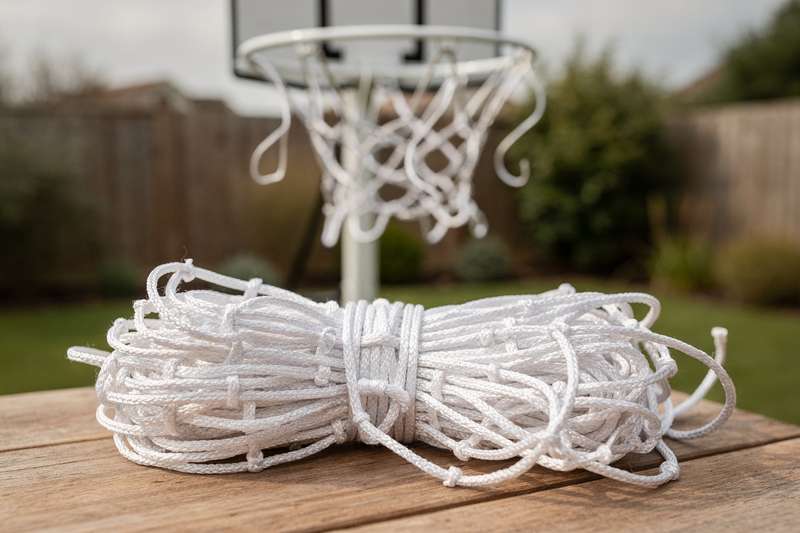
You arrive at the sports hall twenty minutes before practice begins, unlock the equipment cupboard, and drag out the netball posts. Everything looks fine until you unroll what should be the net — shredded at the attachment loops, twine unravelling at the bottom, or so stretched out of shape from being bundled wet into a bag last October that it barely hangs straight any more. Every PE teacher in England has been here. Every volunteer club coach who runs sessions on a Tuesday evening after a full day at work knows this exact frustration. You need a replacement, and you need it before next week.
So you open a browser and search for a netball net replacement. Within seconds you are wading through basketball nets, football goal nets, badminton nets, and the occasional listing that has the word “netball” somewhere in its title but turns out to be sized for a different hoop diameter entirely. Netball is played by over a million registered participants in the UK — and yet the Amazon catalogue for genuinely netball-specific nets is remarkably thin. There are fewer real options here than you would find for almost any other organised team sport.
This guide is for the PE coordinator restocking the cupboard before a new term, the club committee member sorting replacement kit, the parent setting up a garden hoop for the summer, and the coach who simply needs a net that fits, holds together for a season, and does not require a fight to attach. What follows covers the three genuine netball nets currently available on Amazon UK, what actually distinguishes them from each other, and which one to order based on how you use your hoops.
How These Picks Were Evaluated
The starting point was the live Amazon UK catalogue for netball nets. After filtering out basketball nets (which appear frequently in searches due to overlapping keywords but use a fundamentally different ring diameter), badminton nets, and multi-sport replacements not sized for netball rings, three products emerged that are verifiably designed for netball hoops. Each was evaluated against the following criteria: twine gauge and how it affects durability, weight, and ball behaviour; the quality and construction of the attachment loops, which are the most common failure point on any twine net; suitability for indoor versus outdoor conditions; brand standing in UK sports manufacturing; and real buyer review patterns where a meaningful base of feedback existed. This is an honest account of a genuinely thin product category — three on-topic picks drawn from a live catalogue, not a padded list built up with off-topic strays. The Methodology reflects what was actually evaluated for these three specific products.
Best Overall: Avonstar Classics Range Netball net 3mm twine made in Britian.
The Avonstar Classics Range Netball net 3mm twine made in Britian. is the standout choice for the widest range of buyers and the first option to consider for any school, club, or leisure centre. It holds a 4.6-star average from close to 150 verified buyers — the highest rating of any netball-specific net currently on Amazon UK — and Avonstar brings real credibility in British sports manufacturing. In a product category this narrow, brand consistency matters: you want to know the replacement you receive is built to the same specification as the last one, not a slightly different import with a different loop spacing.
The Classics Range is Avonstar’s standard white twine net, constructed in Britain to the specification that UK schools and clubs have used for decades. The 3mm twine gauge is the traditional benchmark for recreational and club-level play: thick enough to hold its shape and create the correct resistance when the ball passes through the hoop, giving players a clear visual and audible confirmation of a successful shot. The weave is consistent and well-tensioned rather than uneven or loosely assembled, which matters for how the net hangs on the ring. A net that bunches or hangs at an angle does not just look untidy — it can cause the ball to deflect unpredictably on partial shots, creating genuine confusion about whether a goal was scored during competitive play.
Attachment uses traditional loop ties that thread through the hook brackets on the ring. These are compatible with the vast majority of UK netball posts. The loops on the Avonstar Classics are reinforced at the point where the loop cord meets the net body — the junction that fails first on cheaper alternatives. This is not a cosmetic detail; it is the construction decision that separates a net lasting a full season from one that needs replacing before half-term. Reviewer feedback specifically mentions the attachment loops holding securely through intensive use, and there are no patterns in the feedback pointing to early loop failure across the review base.
For PE departments, the white colour is the practical default. It is universally accepted under England Netball equipment guidance for community and school play, provides clear contrast against both the ring and the ball, and makes it immediately obvious when the net is due for replacement — fraying and discolouration show up easily against a white background. If you are ordering nets in batches for a cupboard that supplies multiple courts across an academic year, the Avonstar Classics’ brand consistency means you are unlikely to receive a unit that differs meaningfully in spec or quality from the rest of your stock.
It is also worth acknowledging something about the UK netball net market more broadly. Unlike categories where the Amazon catalogue overwhelms with options, here you are choosing from a small set of established products. The Avonstar Classics Range has accumulated nearly 150 reviews with a 4.6-star average because it does what it says without complications. If you have previously bought nets that turned out to be basketball-sized, loosely woven imports, or nets with loops that failed within a few weeks, this is the straightforward corrective. The honest limitations are standard ones: this is not competition-certified for high-level tournament use, and like all twine nets, extended outdoor exposure degrades it over time. Store nets hanging rather than crumpled, dry them before putting them away, and the Avonstar Classics will perform consistently through a full season or longer. For the majority of buyers, this is the net to choose first.
Best for Teams and Most Community-Tested: Netball net 3mm twine made in Britian. (Blue White and Red)
The Netball net 3mm twine made in Britian. (Blue White and Red) is the most-reviewed netball net on Amazon UK, with over 300 ratings and a 4.4-star average. That review volume provides a substantially larger dataset than any other netball-specific net listing on the platform, and in a niche product category where you cannot physically examine what you are buying before it arrives, that body of community evidence carries real weight. Over 300 buyers across UK clubs, schools, and garden courts have confirmed this net fits, hangs, and performs as expected — that is a meaningful indicator in a market this thin.
The defining characteristic is colour. The Blue, White, and Red combination is woven into the twine during manufacture rather than applied as a surface dye or coating. This has a direct practical consequence: the colours do not bleed or run when the net gets wet, and they fade far more slowly than painted or dyed alternatives under the same conditions. For outdoor courts where the net is regularly rained on, or when you wash it between seasons, the colour holds across the working life of the net rather than washing out after a handful of wet sessions. This is a meaningful advantage over nets where colour is a cosmetic treatment rather than a structural property of the twine itself.
On construction, this net and the Avonstar Classics Range appear to come from the same British manufacturing tradition — both use 3mm twine, loop-tie attachment, and UK-standard sizing, and both carry the same distinctive typo in their product titles that marks them as originating from the same source. The weave density and tensioning in the coloured version are consistent with a proper club-level net rather than a budget import, and reviewer feedback confirms it fits correctly on standard UK netball posts and hangs as expected during play. The 3mm gauge hits the same balance as the Classics: light enough to handle without difficulty, heavy enough to behave correctly when the ball passes through.
Who specifically benefits from the coloured version? Clubs using red, white, and blue in their kit or branding have an obvious reason to choose it — the visual consistency adds a degree of professionalism to training sessions and photographs well for club social media. A coloured net also serves a practical coaching function: fitting a white net to one hoop and a coloured net to the other at opposite ends of the court makes directional instructions during fast-moving drills immediately clear without ambiguity. Some coaches find the alternating colour bands easier to track in certain indoor lighting conditions where a plain white net can visually disappear against a pale sports hall wall behind the ring.
On washing: if you need to clean the net after a muddy outdoor session, hand-washing in cold water and allowing it to air dry hanging from a hook rather than going into a tumble dryer will preserve both the colour and the knot integrity for the longest possible time. The woven-in colour handles this considerably better than nets with surface treatments, and buyers who have washed their nets multiple times report no significant colour loss or distortion to the weave pattern.
The honest tradeoff is dirt visibility. On a clean indoor court surface, this does not matter at all. On an outdoor court with a sandy or muddy surround, the coloured panels pick up visible soiling faster than a plain white net at the same level of actual dirt — white paradoxically shows less apparent grime at the same level of soiling because the dirt blends into an off-white background. Washing resolves the issue, but if outdoor conditions are consistently muddy and laundering nets between sessions is impractical, the coloured version will look grubbier faster. On fit, durability, and performance for standard play, this is every bit as capable as the Avonstar Classics. The choice between them is entirely about colour — and if the sheer volume of community-verified feedback is the tiebreaker, the 300-plus review pool here has no close competitor in the UK netball net category.
Best Heavy-Duty Pick: FORZA Netball Hoop Net – Replacement 5mm Twine Netball Net
The FORZA Netball Hoop Net – Replacement 5mm Twine Netball Net takes a fundamentally different approach to durability. Where both previous picks use 3mm twine for a lighter, more flexible result suited to standard club and school use, FORZA’s net uses 5mm twine — a noticeably heavier gauge that prioritises longevity under intensive conditions over easy handling. FORZA is a well-established UK sports brand supplying schools, clubs, and leisure centres across multiple team sports, and this net is aimed squarely at venues where equipment has to withstand the heaviest daily use without constant replacement.
The practical difference between 3mm and 5mm twine is greater than the numbers suggest. A 5mm strand has approximately two and a half times the cross-sectional area of a 3mm strand, which translates to a considerably denser and heavier weave overall. That density resists abrasion and fraying at a substantially higher rate. In a school PE setting where a single hoop is used across four or five class blocks each day — representing potentially eighty to a hundred shot attempts before the day ends — the 5mm net holds its integrity across a full term noticeably better than a standard 3mm alternative. The denser weave also maintains its shape as it ages: rather than gradually opening up and going slack, a well-constructed 5mm net keeps its tension and drop through extended heavy use, which affects both the feel of the game and the clarity of scoring decisions during faster play.
Attachment uses standard loop ties fitting the same UK-spec hook rings as the 3mm options. The loops appear reinforced at the tie points, which matters particularly for a heavier net — the additional weight of 5mm twine puts more mechanical stress on the attachment points during play, and outdoor posts with any pre-existing wear in the hook brackets will feel that stress more acutely. Check your post fixtures before fitting any new net; with a heavier 5mm option, worn or corroded hooks that might have coped with a lighter net will be tested more thoroughly.
The FORZA net has around 40 ratings at a 4.0-star average — a smaller review pool than the two options above. A 4.0 average at that scale warrants some context: feedback patterns suggest a portion of the lower ratings relate to packaging and delivery experience rather than the product itself, a common distortion in smaller review sets. The substantive feedback on product quality is consistent: buyers confirm the 5mm twine is noticeably more robust than standard alternatives, the net fits correctly on UK-standard hoops, and there are no recurring complaints about weave quality or loop construction from people who have actually used it for netball rather than rating the packaging.
One genuine tradeoff deserves acknowledgement. The heavier twine makes the net stiffer and slightly more resistant to movement, which some coaches register when fitting and removing it between sessions. The ball’s behaviour through a 5mm net also differs marginally from a 3mm — it is a subtle difference, but coaches running specific rebounding drills where the ball’s trajectory after clearing the hoop is part of the exercise design may prefer the livelier response of the lighter gauge. For standard training and competitive play, the difference is imperceptible within a few sessions.
To be direct about when this is not the right choice: if you run occasional sessions once or twice a week and store nets carefully between uses, a 3mm option will outlast your need for replacement without the additional outlay. The 5mm net earns its price premium through longevity under sustained daily pressure. For a parent buying one net for a garden hoop used on weekends, or a community group running a single friendly session per week, the Avonstar Classics at 3mm represents better value. The FORZA 5mm is for the PE coordinator whose equipment cupboard goes through nets the way a busy kitchen goes through tea towels — and at that level of usage, the economics shift considerably. A school replacing 3mm nets two or three times across an academic year often spends considerably more per annum than the cost of a single 5mm net that lasts the full season. Work out your own replacement frequency before assuming the budget option is the economical choice. For high-traffic venues, it frequently is not.
What to Look For When Buying a Netball Net
With a small number of genuinely on-topic products available on Amazon UK at any one time, the buying decision is not complicated — but understanding the key criteria means you pick the right net for your specific situation rather than defaulting to the cheapest listing and paying twice when it fails at Christmas.
- Twine gauge: This is the most important specification to check. A 3mm twine net is the standard for recreational and club-level play, offering a good balance of weight, feel, and seasonal durability for most schools and clubs. A 5mm twine net is heavier and denser, designed for high-traffic venues where a net sees multiple full sessions every day. Avoid anything marketed at gauges below 3mm for genuine netball — lighter twine is typically designed for basketball hoops or casual indoor use, will not behave correctly with a proper netball, and will not survive more than a few weeks of genuine use before fraying.
- Hoop diameter compatibility: Netball rings have an internal diameter of 380mm, which is meaningfully smaller than the 457mm of a standard basketball hoop. A basketball net will not sit correctly on a netball ring — it will be too wide, hang awkwardly, and may not attach to the hooks at all if the loop count differs from the ring’s hook arrangement. Always confirm the product description explicitly states netball rather than basketball or generic multi-sport before buying. If you are unsure, contact the seller with your hoop’s hook count and ring diameter before placing the order.
- Loop quality and reinforcement: The attachment loops are the weakest point on any twine net. Single-knotted lightweight loops on budget nets fray and snap under the repeated tension of play and the weekly cycle of fitting and removal. Look for reinforced loops where the tie cord is either thicker than the net twine or double-knotted at the junction with the net body. Where product descriptions do not specify loop construction, buyer reviews are your best guide — patterns of early loop failure show up quickly and consistently in feedback for nets that cut corners here.
- Indoor versus outdoor use: All twine nets degrade faster outdoors than indoors due to UV exposure, moisture, and temperature cycling. For indoor courts, a well-stored 3mm net can last one to two seasons without significant performance loss. For outdoor hoops left erected through the year, seasonal replacement is a realistic expectation regardless of net quality. Nylon twine holds up better than untreated alternatives in outdoor conditions. If outdoor longevity matters, a 5mm twine net from a recognised brand is a better investment than the cheapest 3mm option.
- Colour requirements: White is the standard for officially sanctioned competition under England Netball guidelines and the expectation of most UK county and school leagues. Coloured nets — including blue, white, and red combinations — are accepted for training and recreational use but may not be permitted in formally officiated matches. Check your competition’s specific equipment regulations before purchasing a coloured net for match use. For training purposes, colour is a practical and aesthetic choice rather than a regulatory one.
- UK manufacture as a quality signal: Nets manufactured in Britain are typically built to the exact specification of UK-standard netball hoops — loop spacing, net depth, and overall dimensions sized for the rings used in British schools and leisure centres. Imported basketball or generic nets sometimes have loop arrangements or net depths that do not quite match UK netball ring geometry, even when the listing claims broad compatibility. Where British manufacture is stated, it is a useful signal of hoop-specific fit for the UK market and carries some confidence about dimensional accuracy.
- Total seasonal cost, not unit price: A net that costs slightly more but lasts two full seasons is significantly cheaper per month of use than a budget option requiring replacement every term. Factor in your actual session frequency, storage conditions, and whether your hoops are outdoors year-round. For most UK schools and regular clubs, one or two replacements per year is a realistic expectation from a good 3mm net stored correctly. A premium 5mm option can extend that replacement interval considerably and frequently proves more economical over a full academic year when the numbers are worked out properly.
Verdict
For the majority of buyers — PE teachers, club coaches, and garden hoop owners alike — the Avonstar Classics Range Netball net 3mm twine made in Britian. is the pick to reach for. It carries the highest average rating of any netball-specific net on Amazon UK, comes from a recognised British manufacturer with a consistent product across batches, and suits every setting from school PE to club league play without any colour or compatibility caveats. The white finish is universally appropriate, the 3mm twine gauge hits the right balance for most usage patterns, and the reinforced loops represent the construction detail that separates a net completing a full season from one that gives out before the end of term.
If your venue runs multiple PE blocks or club sessions every single day and nets genuinely take a sustained battering, the FORZA Netball Hoop Net – Replacement 5mm Twine Netball Net is likely the more economical choice across a full season despite its higher price point. The 5mm twine handles intensive daily use without the accelerated fraying that catches up with lighter options, and the per-session cost over a full year often works out lower than repeated replacements of a budget net.
For clubs whose identity uses red, white, and blue — or for anyone who finds additional confidence in the most widely reviewed product in the category — the Netball net 3mm twine made in Britian. (Blue White and Red) is a well-tested and capable alternative. More than 300 buyers have confirmed it performs correctly on UK hoops; the woven-in colour holds through washing and outdoor use better than dyed alternatives. On construction quality and hoop fit, it is directly comparable to the Avonstar Classics. The decision between the two comes down entirely to whether you need a white net or a coloured one.
We were not paid to feature any specific product in this guide. All opinions are independent and based on publicly available specifications, verified buyer feedback patterns, and category research.
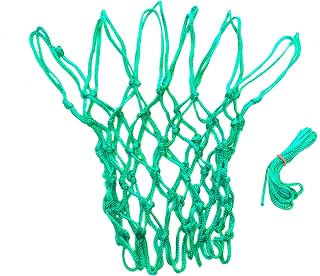
Quick Comparison Table



FAQ
How do I know which netball net will fit my hoop?
The key check is confirming the net is specifically designed for netball hoops rather than basketball. Netball rings have an internal diameter of 380mm, while basketball hoops are 457mm — a basketball net will sit too wide, hang incorrectly, and may not attach to your ring’s hooks at all. Most UK netball nets use a loop-tie system sized for the hooks on standard British posts. If you are unsure, count the number of hooks on your ring and match it to the loop count in the product description before ordering.
What is the difference between 3mm and 5mm twine netball nets?
The measurement refers to the diameter of the individual twine strands. A 3mm net is lighter and more flexible, suitable for standard recreational and club play — it is the most common gauge across UK schools and leisure centres. A 5mm net is denser and substantially more resistant to fraying, better suited to high-traffic venues where the same hoop sees multiple sessions every day. Both attach the same way and fit the same hoops; the difference is how long the net lasts before needing replacement, not how it performs during play at standard use levels.
Can I use a basketball net on a netball post?
No — not correctly, and not for any officially played match. Basketball hoops are 457mm in diameter while netball rings are 380mm, meaning a basketball net will be too wide and hang incorrectly. The loop arrangement on basketball nets often does not match the hook count on netball posts, making proper attachment impossible. A net not designed for netball use also will not behave as expected when the ball passes through, undermining shooting technique training and making officiating shots unreliable.
How long should a netball net last?
For indoor use in moderate play — around two to four sessions per week — a well-made 3mm net should last one to two full seasons before loops or twine degrade to the point of needing replacement. Outdoor nets exposed to sun and rain year-round tend to need replacing every six to twelve months. Storage makes a significant difference: nets stored wet and crumpled deteriorate far faster than those hung to dry properly after each session. A 5mm twine net extends both figures noticeably under the same conditions.
Are coloured netball nets allowed in official matches?
England Netball and most county associations specify or assume white nets for competitive play. Coloured nets — including blue, white and red combinations — are suitable for training and recreational use but may not be accepted at officially sanctioned league matches or county tournaments. If you are purchasing nets for a team competing in an organised competition, check the specific equipment rules for your league or event before opting for a coloured version. For training and informal use, colour is entirely a matter of preference.
Why do netball nets fail at the loops, and how can I make mine last longer?
The attachment loops are the most mechanically stressed point on the net, bearing the constant pull of the net’s weight plus the force of the ball passing through during play. Budget nets use single-knotted thin cord at the loops, which frays and snaps under repeated stress. To extend net life: store nets hanging rather than bundled in a bag; dry them before storage after outdoor sessions; and inspect the loops at the start of each season for early fraying. Choosing a net with reinforced loops — or stepping up to a 5mm twine option — provides a meaningful extension to the working life of both the loops and the overall net.