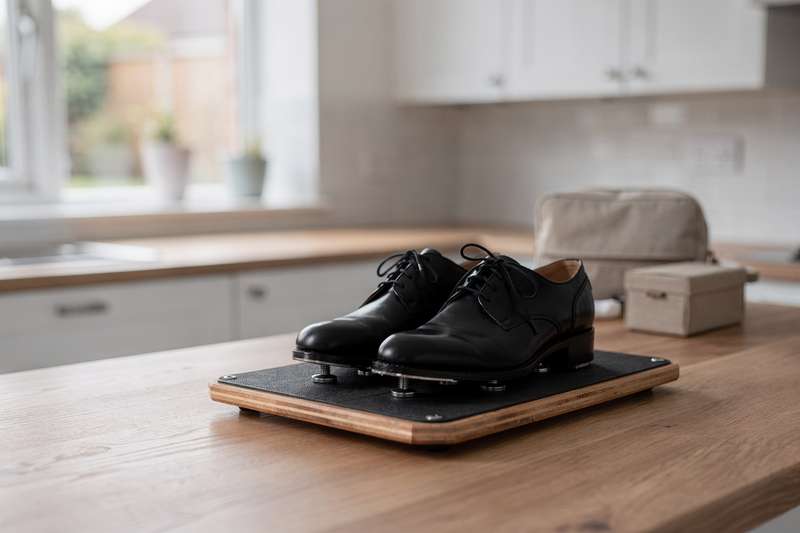
You’ve been going to tap class for three months and your teacher says your footwork is coming along nicely — but the moment you try practising at home, everything unravels. The laminate in your hallway kills the resonant snap you need to actually hear your own rhythm. The carpet in the spare room swallows sound entirely. The kitchen tiles are too slippery for safety, and the noise echoes in ways that make it impossible to distinguish a clean shuffle from a sloppy one. You’ve tried a folded yoga mat (too soft, deadens everything), bare floorboards (too loud, the downstairs flat has already knocked), and eventually skipping home practice altogether. But tap is a sound-dependent discipline: you cannot develop your ear for timing — or learn to identify your own technical errors — without the right acoustic surface under your feet. A portable tap dance board is the single most impactful piece of equipment you can add to your home setup. This guide covers the best ones currently available on Amazon UK, with honest, concrete assessments of what each one actually delivers and who each one genuinely suits.
How These Picks Were Chosen
Every product in this guide was drawn from current Amazon UK listings, with evaluation weighted toward boards that have enough verified buyer feedback to draw reliable conclusions. The criteria: acoustic resonance (does the board produce distinct, crisp tap sounds that give you useful timing feedback?), cushioning and impact protection (tap generates repetitive stress on ankles and knees — a board with no shock absorption becomes uncomfortable in extended sessions), non-slip backing performance on different floor types including carpet and hard floors, portability and storage format, overall build quality inferred from consistent patterns in buyer feedback, and size relative to realistic UK home practice spaces. Where a product had only a very small number of reviews, that limitation is flagged clearly in the relevant section — a five-star rating from a single buyer is a data point, not a pattern, and the recommendation for that pick is appropriately qualified.
Best Overall Tap Dance Board
The Tap Board For Tap Dancing | Portable Dance Floor For Any Surface opens this guide as the default recommendation because it has done something the other boards in this roundup haven’t yet managed at the same scale: accumulated meaningful, broad-based consensus. More than 90 verified buyers have rated and reviewed it at 4.2 out of 5 stars, and that depth of real-world experience across different home setups, skill levels, and floor types makes it the most reliable basis for a purchase decision. You’re drawing on a genuine pattern of buyer experience rather than a handful of enthusiastic early reviews.
The cushioned construction is central to why so many buyers return with positive feedback. Tap dancing is a high-repetition discipline — you’ll drill the same combination dozens of times in a session, with every heel drop and toe strike generating impact on your joints. A board with real give underfoot significantly reduces the cumulative load on your ankles, shins, and knees compared to practising on bare tiles or a traditional rigid surface with no backing. For beginners who haven’t yet developed the refined technique to minimise unnecessary impact in their footwork, that cushioning makes a tangible difference to how long a session feels comfortable.
The surface is designed to work on any underlying floor — carpet, laminate, tiles, or concrete — which addresses one of the most persistent frustrations for home practitioners. Buyer feedback across different home environments confirms consistent performance regardless of what’s underneath. Note that the same product line also appears under ASIN B0C8Z9HCXF as a size variant; the B0BPT53W6V version carries the larger review base and is the one to choose.
Sound quality sits in a well-balanced position for a cushioned board. The large majority of buyers describe the acoustic response as satisfying — noticeably superior to practising on domestic flooring, with clear audible distinction between different tap sounds. A smaller proportion of more advanced dancers note that the cushioning softens the very sharpest tap tones compared to a rigid studio hardwood floor. This is an inherent category tradeoff — more cushion means more comfort but marginally less audio brilliance at the attack — and for a beginner or intermediate dancer, the balance here is sensible. Non-slip backing performs reliably in buyer reports on carpet and standard hard floors alike, with the board staying put through energetic routines. Storage is practical: the board can lean against a wall, slide under a bed, or be moved between rooms. This board covers the needs of most home tap dancers without requiring you to sacrifice significantly on any single criterion.
Best for Pro-Quality Sound
The WodGod Tap Dance Floor earns the pro-sound recommendation from two converging signals: the highest star rating in this guide at 4.9 out of 5 stars, and reviewer language that consistently centres on sound clarity, crisp acoustic response, and a professional feel underfoot. Sixteen verified reviews is a more modest base than the best overall pick, but the feedback is detailed, consistent, and written by buyers who are clearly assessing this as a serious training tool rather than a casual home purchase.
The tile-based versatile format provides real advantages beyond portability alone. You can configure the tiles into whatever footprint suits your session — a smaller area for focused stationary technique work, a larger one when you’re running through travelling combinations or fuller routines. Fixed-size single boards don’t offer that adaptability, and for a dancer whose practice evolves and expands over time, this flexibility has long-term value. The sound designation as pro-quality reflects the surface’s design priority: optimised for resonance rather than maximum cushioning, which means tap tones are sharper, brighter, and more acoustically distinct — giving you better feedback on your timing and technique with every step.
The honest tradeoff is firmness underfoot. A surface tuned for acoustic performance will be noticeably less forgiving under repeated impact than a board built around cushioning. For sessions of forty-five minutes or more, or if you have any existing joint sensitivities, you’ll feel that difference. This is a deliberate design prioritisation rather than a weakness: for a dancer at intermediate or advanced level where hearing technique accurately is the primary purpose of practice, it’s the right call. A thorough warm-up and allowing your joints to settle before intensive drilling will help manage the impact load.
Assembly with a tile system takes a few minutes longer than unfolding a single-piece board, but the storage advantage is real and significant for UK homes where space is routinely constrained. Tiles stack flat and compactly into a fraction of the space a folded board occupies — a detail that matters considerably in a typical terraced house or flat. Non-slip performance in reviewer reports is dependable on standard domestic surfaces. If sound fidelity is your primary lens and you want to bring the same rigour to home practice that you’d bring to a studio session, the WodGod is the pick.
Best Modular Tile System
The Nicoman Portable Dance Floor Tiles take the most adaptable approach of any product in this guide. Rather than a single surface in a fixed size, these are individual interlocking tiles you assemble into whatever configuration fits your space and your session. With 26 verified reviews at 4.0 stars and explicit design coverage for tap dancing, jazz, ballet, and Irish dance, this is the natural choice for dancers who work across more than one style or who want the flexibility to configure their floor differently from session to session.
The modular format carries practical advantages that extend well beyond floor size flexibility. Moving to a different flat — which many UK renters do more regularly than they’d prefer — is meaningfully simpler with a tile system than with a large rigid board. Tiles pack into a bag without the awkward manoeuvring through hallways that a single board demands. If the room doubles as a living space and you need it fully clear between sessions, dismantling a tile floor takes a few minutes and leaves no trace. Nicoman highlights easy assembly, and buyer feedback consistently confirms this: most reviewers describe setup as taking only a few minutes once they’ve worked through the locking mechanism once.
The assembled floor feels stable underfoot during normal use, with tile joints reported as unnoticeable during footwork. The caveat appears on very smooth, polished hard floors — high-gloss tiles or lacquered hardwood — where a small number of buyers note the assembled floor shifts slightly more than a single-piece board with a full rubberised backing. On carpet or standard laminate, this is generally not an issue, and the board holds through energetic routines without problem.
Sound quality at 4.0 stars is solid for home practice and learning. The acoustic response is described by reviewers as satisfying and clearly superior to dancing on domestic flooring. It doesn’t quite replicate the sharpness of a purpose-built tap hardwood board, but for recreational dancers and those working across multiple styles, the trade is more than acceptable. If your practice is exclusively tap and maximum acoustic precision is the goal, the WodGod is better aligned. If you want one versatile, space-efficient system that works across your whole dance practice, the Nicoman makes a strong case.
Best Heavily Cushioned Option
The Portable Tap Dance Floor – 8MM 47.8 x38.5 Inches is the pick for dancers where joint protection sits at the top of the priority list. The 8mm thickness specification signals a notably generous cushioning profile within the portable tap board category — meaningfully more padding than thinner boards — and the 4.6-star rating from 13 reviewers reflects buyers who came to it with specific comfort expectations and found those expectations met.
The footprint at approximately 47.8 by 38.5 inches is generous for a portable single-piece board. You can run short travelling combinations without constantly hitting the edge, rather than being restricted to purely stationary footwork. This matters more than it initially sounds: a practice session limited to standing-position technique becomes repetitive and incomplete quickly, and a board large enough to allow some movement through space makes a real difference to the breadth and quality of what you can accomplish. Many home dancers discover after purchasing that a board which seems adequately sized on paper feels constraining once they actually start moving — this board avoids that frustration.
The included storage bag earns specific mention because it’s constructed more robustly than the thin, perfunctory bags that accompany some boards in this category. Reviewers note it holds up to regular use rather than just occasional transport — which matters if you plan to carry the board to a friend’s practice space, hire a community room periodically, or simply want to store it tidily rather than propping it against a wall indefinitely.
With 13 reviews at 4.6 stars, the confidence level sits below the best overall pick but comfortably above the products with single-digit reviews. Feedback patterns consistently highlight comfort during extended practice, with reviewers describing reduced joint discomfort and improved session endurance compared to harder surfaces. Sound resonance is described as satisfying and clearly distinguishable by tap type — the expected caveat is that the generous cushioning does slightly soften the sharpest acoustic attack compared to a firmer board, which is a category-wide truth rather than a product shortcoming. If you’re returning to dance after a knee or ankle injury, managing a chronic joint condition, teaching younger children who benefit from a forgiving surface, or planning consistently long sessions where cumulative impact fatigue matters, this is the board most directly designed for your situation.
Best Bamboo Tap Board
The Portable Tap Dance Floor, 120x98cm Foldable Bamboo Board With Storage Bag is the only bamboo-surface tap board currently available on Amazon UK, and for dancers with a specific reason to want bamboo underfoot — whether for the sound characteristics, the material aesthetics, or the environmental credentials — it offers something none of the other boards in this guide can. At 120 by 98cm, it provides a large practice area in a foldable format with a storage bag included for transport and tidying away between sessions.
Bamboo has a well-established reputation in professional dance flooring. The surface is naturally hard and acoustically resonant, producing a crisp, bright tap tone that many experienced dancers prefer over softer synthetic surfaces. If you’ve practised in a studio with bamboo or hardwood flooring and found the sound and feel superior to home practice boards you’ve used, a bamboo portable board replicates that experience more authentically than cushioned alternatives. The foldable format is appropriate for bamboo specifically — as a rigid material it cannot roll, and the fold mechanism allows compact storage when not in use. From an environmental standpoint, bamboo is a fast-growing renewable resource with a lower environmental footprint than many synthetic dance flooring materials, which is a relevant consideration for buyers who factor material sourcing into their decisions.
That said, one significant limitation requires direct acknowledgement: this board has only a single verified buyer review on Amazon UK. That one review is five stars and reads positively — but a single data point is not a pattern. It tells you nothing reliable about how the fold hinges perform after months of repeated use, whether the bamboo surface remains stable across the humidity variations typical of UK homes through different seasons, how the non-slip backing holds up on different floor types over time, or whether experienced tap dancers consistently find the sound quality matches what bamboo flooring promises. You are, effectively, buying as an early adopter.
If the specific combination of bamboo surface, large practice area, and foldable portability matches what you’re looking for, and you’re comfortable forming your own view without the reassurance of extensive prior buyer feedback, this board merits investigation. If you’d rather have the confidence of dozens of real-world opinions before committing, stay with the other picks in this guide. This board has genuine promise — it simply hasn’t accumulated the evidence yet to recommend with the same confidence as the boards above.
What to Look For When Buying a Tap Dance Board
- Surface material and sound resonance: The top surface material is the primary determinant of your tap tone. Harder surfaces — bamboo, dense hardwood, rigid composite — produce brighter, crisper sounds that mirror professional studios. Cushioned or softer surfaces round off the acoustic attack. For technique-focused practice where hearing your timing accurately is critical, lean toward harder surfaces. For comfort-first setups where session endurance matters more than sonic precision, a cushioned surface serves better.
- Thickness and cushioning: Board thickness directly relates to shock absorption. A board specified at 8mm provides meaningfully more impact protection than a thinner alternative. If you have existing ankle, knee, or shin issues — or plan long daily sessions — thickness and cushioning should be the first filter you apply, not an afterthought.
- Size and practice footprint: Measure your available space before purchasing, and be realistic about it. Most boards in this guide sit in the 90–120cm range in their longer dimension — adequate for stationary technique work and short combinations. For fuller routines involving meaningful travel, you’ll need either a larger board or a tile system you can scale up. Allow a clear safety margin of at least 30cm around the board on all sides: stepping off the edge mid-routine onto a slippery domestic floor is a genuine injury risk.
- Portability format: Foldable boards unfold quickly and present a continuous surface with no underfoot joints, but rely on hinges that must hold up to repeated use. Tile systems take a few minutes to assemble but store in a fraction of the space and travel more easily between locations. Consider your actual usage pattern — if the board stays down for days at a time, a single-piece board is the more convenient option. If you need the room cleared regularly between sessions, tiles earn their keep.
- Non-slip backing: A board that shifts mid-routine breaks your focus and creates a safety hazard. Check buyer feedback specifically for non-slip performance on your floor type — carpet and smooth hard floors behave quite differently, and what grips well on carpet may slide on polished tiles.
- Storage solution: A well-made storage bag transforms a board from something you prop against a wall into something you can put away neatly. Several boards in this guide include bags; where they do, reviewer feedback on bag durability is worth checking if regular transport is part of your plan.
- Tap shoes: No board compensates for inadequate footwear. Ensure your tap shoes have properly fitted, secure metal taps — loose or worn taps produce inconsistent sounds regardless of the surface quality beneath them. Good tap shoes with fixed toe-and-heel metal taps are widely available separately on Amazon UK and form the other essential half of a proper home tap setup.
Verdict
For the majority of home tap dancers — beginners establishing a practice routine, intermediate dancers building toward class performances — the Tap Board For Tap Dancing | Portable Dance Floor For Any Surface is the clearest default recommendation. More than 90 verified buyers at 4.2 stars, a cushioned surface that protects joints without deadening sound, reliable non-slip performance on multiple floor types, and any-surface compatibility make it the lowest-risk first choice. A 4.2-star rating from ninety-plus buyers carries substantially more weight than a higher rating from a handful of people.
If you’re past beginner level and acoustic precision is the deciding factor, move to the WodGod Tap Dance Floor. The pro-quality sound profile and tile-based adaptability make it the right fit for serious training, and the 4.9-star rating is a strong positive signal even from a moderate review base.
For multi-style flexibility or adaptable floor sizing, the Nicoman Portable Dance Floor Tiles make a compelling case with the strongest review count among the tile options in this guide. If joint protection is your primary concern, the 8mm cushioned construction of the Portable Tap Dance Floor – 8MM 47.8 x38.5 Inches is the most targeted choice in the range. The bamboo board is one to watch — revisit it once its review base has grown to a more meaningful size.
We were not paid to feature any specific product in this guide. All opinions are independent and based on publicly available specifications, verified buyer feedback patterns, and category research.
Quick Comparison Table




FAQ
Do I need a specialist floor to practise tap dancing at home?
You don’t strictly need one, but practising on the wrong surface creates two compounding problems: poor acoustic feedback that makes it difficult to develop your timing and identify technical errors, and no shock absorption to protect your joints during repeated sessions. A portable tap dance board addresses both issues and lets you practise effectively on carpet, laminate, or tiles without compromising sound quality or safety.
What is the difference between a tap dance board and ordinary domestic flooring?
Standard domestic flooring — laminate, tiles, floorboards — has no specific acoustic design for tap dancing, provides no cushioning against impact, and has no non-slip backing designed for dance use. A tap board combines a resonant top surface engineered to produce clean tap tones with a cushioned, non-slip base. It’s also portable — you set it up for practice and store it away afterwards, rather than permanently modifying your home.
Are tile-based dance floors as effective as a single board for tap dancing?
Tile systems work well for tap dancing and bring genuine advantages in size flexibility and compact storage. The key consideration is tile-joint stability — quality systems interlock firmly enough that you won’t feel the edges during normal footwork. Performance on very smooth, polished hard floors can vary compared to a single-piece board with full rubberised backing. On carpet or standard laminate, both formats typically hold equally well.
How much clear space do I need to set up a tap dance board at home?
Allow the board’s footprint plus a safety margin of at least 30–40cm on all sides — footwork can carry you to the edge unexpectedly, and stepping off mid-routine onto a slippery domestic floor is a real injury risk. A clear area of roughly 2 × 2 metres suits most boards in this guide for stationary technique work; more space is better for routines that travel across the floor.
Can I use a tap dance board on carpet?
Yes — all the boards in this guide are designed for use on any surface including carpet. Carpet actually assists with non-slip performance, as it provides natural friction under the board’s backing. The board itself creates the resonant dance surface above the carpet, so the texture beneath doesn’t meaningfully affect the tap sound quality you hear during practice.
How important is cushioning in a portable tap dance board?
Cushioning matters significantly if you plan sessions of more than twenty to thirty minutes, have existing joint sensitivities, or are teaching younger children. Tap generates repetitive impact stress on ankles and knees; a cushioned board reduces that load over a session. The tradeoff is that more cushioning slightly softens the acoustic sharpness of tap tones — firmer boards sound crisper but feel harder underfoot. Most beginners benefit from prioritising cushioning; dancers focused on maximum sonic precision will often prefer a firmer surface.