It’s the week before a birthday and you’ve been searching Amazon for “educational toys” for the past forty minutes. You’ve already seen dozens of products with stock photos of smiling children and badges declaring “award-winning” or “builds STEM skills” — and you’ve probably already bought a couple that sounded brilliant on the page but turned out to be either too simple to hold attention for more than ten minutes, or too complex for the child to use without constant hand-holding. The toy box is already half-full of things that gather dust.
What you actually want is something that fits your child’s current developmental stage, survives more than a few weeks of real use, and delivers on the learning promise made in the product description. Whether that’s a toddler starting to sort shapes, a four-year-old beginning to recognise letters, or a five-year-old ready for early number work, the gap between “looks educational” and “actually teaches something” is wider than most product pages let on. This guide identifies eight toys that close that gap.
How These Picks Were Chosen
Each pick was assessed against a set of criteria: age-appropriateness for the stated developmental stage, alignment with recognised early-years learning approaches (including Montessori-inspired design and phonics-based literacy methods), build quality and material safety, the coherence of the learning mechanic — does the toy actually teach what it claims to? — and overall value relative to competing options. Where verified buyer feedback from Amazon was available, those patterns were used to validate real-world performance. Several products in this guide had limited or no review data available at the time of research; in those cases, the assessment draws on brand reputation, product specifications, and category expertise rather than aggregated buyer opinion, and this is flagged clearly in each relevant section.
Best for Building Early Vocabulary
The Leapfrog Learning Friends 100 Words Book is aimed at children from around 12 months to 4 years and does one thing very well: it turns vocabulary acquisition into a tactile, responsive experience rather than a passive one.
The format is a touch-activated sound book covering 100 words across everyday categories — animals, food, household objects, and more. Touch a picture and hear the word spoken clearly; there’s no lag, no subscription, no login screen required. The book format means it can sit on a shelf alongside actual storybooks, which matters if you’re trying to build reading habits from an early age. Both English and French audio are included, which is a thoughtful addition: early exposure to a second language, even in brief bursts, supports phonological awareness and provides a gentle foundation for later language learning.
What makes the format effective for this age group is the immediate feedback loop. Children at 12–24 months are primed to repeat, touch, and explore the same thing many times over, and a sound book rewards that repetition directly. Each touch triggers a response, reinforcing the association between image, word, and sound. This differs from a tablet app that plays vocabulary content on a timer — here, the child’s action drives what happens.
Leapfrog has built a reliable track record in interactive sound books over many years, and the Learning Friends format is one of their more enduring products. Battery dependency is an honest limitation of all products in this category — keep spare batteries handy to avoid the toy going silent mid-session.
The tradeoff: once a child’s vocabulary moves well beyond 100 words — which happens faster than you might expect between ages 3 and 4 — the book becomes a reinforcement tool rather than a primary learning one. It remains useful, particularly for French equivalents, but you’ll be looking for the next challenge. This product had no substantial buyer review data available in our research dataset, so this assessment relies on brand track record and product design rather than aggregated owner feedback.
Best Spelling Game for Early Readers
For children who have started recognising letters and want to begin forming words, the Orchard Toys Match and Spell Game is one of the most direct connections between home play and the phonics work happening in UK schools that you’ll find in this category.
Orchard Toys is a British brand with a long track record in the early-years game space, and this title has remained popular across multiple product cycles. Designed for children aged 4 and above, it’s well-timed for the UK: this is the age at which most children begin systematic phonics at school, so a game that reinforces those sounds at home has direct academic relevance.
The mechanic is clean. Children look at a picture card, identify the word it represents, and arrange letter tiles to spell it out. Because the tiles need to match the card layout correctly, there’s a self-correction mechanism built in — children receive immediate feedback without needing an adult to deliver it. That kind of built-in feedback loop is more effective for early learners than being corrected externally, and it removes the adult-as-assessor dynamic that can make home learning feel pressured.
What works particularly well is that the game scales naturally for mixed-ability play. An adult or older sibling can handle the more complex words while a younger child works on three-letter ones, with both players engaged in the same game at the same time. This kind of flexible structure is something many educational games miss entirely.
Production quality is consistently good: thick, wipe-clean card that tolerates real-world use, clear illustrations that don’t crowd the word or the picture. Visual clarity matters more than it might seem — cluttered game components redirect a young child’s attention away from the skill being practised. Adult involvement helps in the first few sessions until the child grasps the mechanic, but the social dimension of playing together has its own developmental value. No substantial buyer review data was available for this product in our research dataset; the assessment draws on brand reputation and product design.
Best for On-the-Go Learning
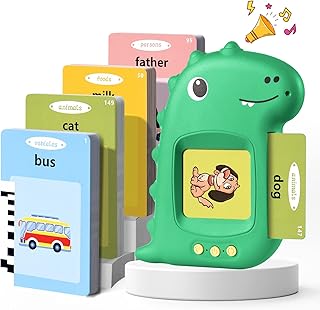
The Talking Flash Cards for Toddler Learning Toys for 3 4 5 Year Old Boys Girls are the best-evidenced pick in this guide: 371 buyer reviews at a 4.6-star rating provide real-world validation that several other products here don’t yet have.
The format pairs a set of 224 vocabulary cards with a compact reader device. Hold a card to the reader, hear the word spoken aloud, and move on. Cards are organised by topic — animals, transport, food, colours — which means you can run a focused five-minute session on a single theme rather than jumping randomly across concepts. That structured-by-topic organisation is useful for children at the stage of building category knowledge alongside individual vocabulary.
The strongest argument for this format is portability. The cards are compact, a handful can go in any bag, and the reader is small enough to use in the back of a car, at a café, or in a waiting room. A toy that only works at home has limited practical value. Flash cards that travel consistently get used far more often than dedicated play stations that live permanently in one corner of the living room.
The self-directed format suits children who resist structured sit-down activities but will happily work through cards independently. There’s no mechanic to master, no turns to wait for — pick a card, hear it, put it down, move on. For children aged 3 to 5 with high curiosity and shorter attention spans, this format tends to sustain engagement where more structured activities don’t.
The honest tradeoffs: flash card sets with reader devices have two potential failure points — the reader and the cards themselves. Based on the pattern across 371 reviews, the reader performs reasonably well with regular use, but the cards show wear over time, particularly with heavy or unsupervised handling. Storing the set carefully between sessions extends its life considerably. At the budget tier this sits in, the overall value is strong — and it works well as a complement to a physical or construction toy rather than a replacement for one.
Best Budget Pick for Early Maths
If you want a hands-on counting toy that keeps costs low, the DQMOON Montessori Toys for 3 4 5 Year Olds is a reasonable entry point into early numeracy. With 73 reviews at 4.4 stars, it has enough real-world feedback to offer some confidence in what you’re getting — even if the review sample is modest.
The core of the set is a number blocks and counting game: children handle physical objects representing quantities and learn to connect numerals to actual amounts. This is the right approach for this age group. Abstract number symbols — the digit “5” on a page — mean very little to a 3-year-old until they’re tied to something concrete and countable. Physical counting materials make that connection possible in a way that worksheets or apps cannot replicate.
The “Montessori” framing here refers to the concrete-before-abstract design principle rather than any official accreditation — worth knowing if you’re comparing this against products from established Montessori material suppliers. What matters is whether the design delivers on that principle, and based on the specifications and buyer feedback pattern, it does so adequately for its price point.
The set covers the foundational numeracy skills that reception and Year 1 teachers build on: number recognition, one-to-one correspondence between objects and numerals, and basic counting sequences. For a child who can recite numbers by rote but hasn’t yet connected them to quantities, this type of physical counting activity tends to accelerate that understanding considerably.
At this price point, quality consistency is the main risk. Blocks that don’t fit cleanly, surfaces that fade with handling, or counting components that scatter easily are common issues in budget maths toys. The 4.4-star average suggests performance is adequate for most buyers, but this isn’t built to premium Montessori material standards. Think of it as a functional starter set for the 3–5 window rather than a long-term educational resource. Pair it with a good numeracy picture book and you have the core of a home maths kit at minimal outlay.
Best for Youngest Toddlers (12 Months and Up)
For children at the 1–2-year stage, where developmental priorities centre on hand-eye coordination, spatial awareness, and colour recognition rather than letters or numbers, the Toddler Toys 1 2 Year Old, Montessori Stacking Toys Colourful Wooden Sensory Toy Pre-school Learning Shape Sorter is a better fit than most of the other picks in this guide.
Shape sorters are a classic toddler toy because the challenge they present is calibrated well for the 12–24-month developmental range. Identifying a shape, rotating it to match an opening, and posting it through requires spatial reasoning, fine motor control, and problem-solving — all developing rapidly at this age. Getting it right produces immediate, satisfying feedback that motivates continued play without adult prompting, and repeated attempts before success are where the actual learning happens.
Wooden construction is a meaningful feature at this age. Toddlers at 12–24 months mouth, bang, and drop their toys constantly, and robust wooden construction holds up to this treatment in a way that thin plastic components often don’t. The tactile quality of wood — weight, texture, temperature — provides sensory input that contributes to sensory development in a way that plastic cannot replicate. That’s not a trivial point for this age group.
The multi-function design (stacking alongside sorting) extends the toy’s play life. Once a child masters the shape-sorting mechanic — typically around 18 months for straightforward shapes — the stacking element presents a new challenge without requiring a new purchase. Given how quickly developmental milestones arrive in the 1–2-year window, a toy that offers progression within itself has considerably more value than a single-function one.
This product had no substantial buyer review data available at the time of research, so the assessment here is based on product specifications and category expertise. When the toy arrives, check that the finish is smooth with no rough edges, that posting holes are appropriately sized, and that any paint or stain is non-toxic — confirm this from the product packaging if it isn’t clearly stated.
Best Hands-On Alphabet Toy
The Toddlers Preschool Learning Toys for Girls Boys Age 2 3 4, Kid Alphabet Spell Educational Game Toy targets the 1–4-year age range with a focus on letter recognition and early spelling — making it a natural companion to the Orchard Toys Match and Spell Game covered earlier, but with a younger starting age and a more exploratory rather than game-based approach.
The mechanic centres on physical letter tiles that children handle, sort, and arrange to form words. There’s a meaningful difference between touching and moving a physical letter tile and seeing letters on a screen or in a book. Handling physical letters connects visual form to tactile experience, which appears to support letter retention in young children — a principle that has underpinned early-years classroom practice for decades.
For a child who has just begun recognising individual letters but hasn’t yet connected them into words, this kind of toy allows self-directed exploration at whatever pace the child sets. There’s no timer, no scoring, and no consequence for incorrect arrangements — which makes it appropriate for the younger end of the stated range (around 2–3 years), where exploration and familiarity are the goal rather than correct performance.
The format has a useful developmental range. A 2-year-old uses the tiles for tactile exploration and colour matching; a 4-year-old with more letter knowledge can attempt simple three-letter words. That stretch across roughly two years of development is useful in a toy — it means you’re not replacing it every few months as the child’s skills advance.
A practical note on storage: sets with many small tiles need a reliable place to go when not in use. Scattered tiles go missing quickly. Check that the product includes a storage bag or tray, and use it consistently from day one. At the budget price this sits at, build quality is functional rather than premium — adequate for regular play, but not the durability level of dedicated Montessori wooden materials. No substantial buyer review data was available for this product in our research dataset; this assessment draws on category expertise and product specifications.
Best Card Game for Group Play
The Orchard Toys Farmyard Heads and Tails Game targets children from 18 months and teaches through a matching and shared-play mechanic rather than structured academic content — which, for this age group, is exactly the right approach.
The format is straightforward: cards are split into the head and tail halves of farm animals, and children match the correct pairs to complete the pictures. The learning outcomes here are less about letters or numbers and more about visual categorisation, matching logic, and the social experience of participating in a shared activity with an adult or older sibling.
Why does a simple card game belong in a list of educational toys? For children in the 18-month to 3-year window, much of the developmental growth is happening in social cognition rather than academic content. Learning to attend to a shared task, to wait briefly for a turn, to respond to visual cues, and to experience the satisfaction of completing something together — these are foundational skills that later academic learning is built on. A matching game played consistently with a parent is doing real educational work, even if it doesn’t resemble a lesson.
Orchard Toys’ production quality is reliable: thick cards, clear and age-appropriate illustrations that don’t overwhelm young children, a format compact enough to take out and put away in minutes. The farmyard theme provides a natural extension beyond the game itself — naming the animals, discussing what they eat, connecting the pictures to storybooks. That kind of context-building is where vocabulary development happens alongside the game mechanic.
The limitation is straightforward: this is a simple matching game that most children will have mastered well within their second year of use. Once the mechanic is no longer a challenge, you’ll want to move to something more complex. The Orchard Toys range offers a clear progression path, and the brand’s consistent quality makes stepping up to a more advanced title a reliable choice. No substantial buyer review data was available for this product in our research dataset; this assessment draws on brand reputation and product design.
Best STEM Toy for Budding Builders
The Dreamon Take Apart Dinosaur Toys for Kids with Storage Box Electric Drill DIY Construction Build Set takes a different approach from every other pick in this guide: rather than teaching through cards, tiles, or matching games, it teaches through hands-on construction with child-sized tools.
The concept is a dinosaur model that can be disassembled and rebuilt using a battery-powered toy drill and screwdriver included in the set. The assembly process develops fine motor skills, hand-eye coordination, and the spatial reasoning that underpins later STEM learning. Beyond those specific skills, it introduces a broader habit of mind: the idea that objects can be understood by taking them apart and figuring out how they go back together again — a foundational approach to engineering thinking that starts forming at this age.
The dinosaur theme is a reliable engagement driver for the 3–6 age range. The overlap between “loves dinosaurs” and “wants to use tools like a grown-up” is precisely where this toy operates. The battery-powered drill makes noise and mimics real tool use, which raises engagement considerably compared to simple push-fit construction sets — though it’s worth considering your household’s tolerance for repetitive battery-powered sounds during extended play sessions.
The honest tradeoffs: for children at the younger end of the target range (around 3 years), the assembly process will likely require adult help for the first few sessions. Using a drill — even a simplified toy version — places fine motor demands that many 3-year-olds aren’t yet ready to meet independently. By 4 or 5, most children can work through this much more independently and with greater satisfaction.
The included storage box (noted in the product title) is a practical feature that many similar sets omit. Sets with multiple small components quickly become unusable when parts go missing, and having a dedicated box removes that problem if you use it consistently. No substantial buyer review data was available for this product in our research dataset; this assessment is based on product specifications and category expertise. The construction-with-tools format is well-proven across the broader STEM toy category, and the dinosaur application is a specific variant of a concept that performs consistently well with the target age group.
What to Look For in an Educational Toy
When assessing an educational toy, look past the packaging claims and focus on these specific criteria:
- Age fit beyond the box labelling: Manufacturers tend to give wide age ranges to maximise sales appeal. Think about your child’s specific developmental stage — their current abilities and what they’re ready to tackle next — rather than whether they simply fall within the stated range. A toy that sits just beyond a child’s current ability, but is achievable with effort, offers more learning value than one they’ve already mastered.
- Named learning outcome: Look for toys that support a specific, identifiable outcome — letter recognition, colour matching, fine motor development, counting — rather than vague claims about “boosting intelligence” or “stimulating development.” Specific outcomes tend to indicate specific design choices that actually deliver them.
- Open-ended vs. closed-ended play: Closed-ended toys (puzzles with one solution, matching games where each card has one pair) are good for building specific skills and providing the satisfaction of task completion. Open-ended toys (building sets, sorting toys with multiple valid arrangements) support creative thinking and self-direction. A useful collection for early learners includes both types.
- Materials and safety: For children under 3, confirm that the toy contains no small parts that could pose a choking hazard, uses non-toxic finishes, and carries a CE mark or UKCA mark indicating compliance with UK and EU toy safety standards. These marks should be clearly visible on the product packaging.
- Durability signals: Thin card, fragile plastic connectors, and poorly secured components are common failure points in budget educational toys. Wooden construction, thick card stock, and included storage solutions (bags, trays, boxes) are reliable indicators of a toy that will survive beyond the first month of use.
- Social play potential: Toys that work as shared activities between a child and a parent, sibling, or carer add a layer of social and communicative development on top of the stated learning goal. Turn-taking games and co-operative activities develop social cognition alongside academic skills — that combined value is worth seeking out.
- Portability: If you need a toy that works beyond the home — in the car, at relatives’ houses, in waiting rooms — compact formats with carrying cases or storage bags dramatically increase the chance the toy actually gets used consistently.
The Verdict
If you’re buying one toy from this guide, the Talking Flash Cards for Toddler Learning Toys for 3 4 5 Year Old Boys Girls is the pick that suits the widest range of circumstances. It carries the best-evidenced buyer support in this guide (371 reviews at 4.6 stars), covers a broad vocabulary range across 224 words, travels well, and works both independently and with adult involvement. For the 3–5 age window, the combination of portability, self-directed format, and topic-based organisation makes this the most versatile option in the set.
If your child is under 2, the Toddler Toys Montessori Stacking Toys Colourful Wooden Sensory Toy is the more appropriate starting point — shape sorting and stacking are the right developmental challenges for that stage, not letters or numbers.
For school-age children beginning phonics work, the Orchard Toys Match and Spell Game has the most direct relevance to what they’re doing in a reception or Year 1 classroom, and the brand’s consistent production quality gives you confidence the game will hold up to regular use.
The broader strategy worth adopting: build a small, curated set covering different skill areas — one physical or spatial toy, one language or literacy toy, one early maths toy, and one social game. Depth of engagement with a few well-chosen toys produces better outcomes than a large collection of things each used once and forgotten.
We were not paid to feature any specific product in this guide. All opinions are independent and based on publicly available specifications, verified buyer feedback patterns, and category research.
Quick Comparison Table




FAQ
What age are educational toys most effective?
Educational toys have value across the full early childhood range, but the period from around 18 months to 5 years tends to be where well-chosen toys have the greatest developmental impact. Language, numeracy, spatial reasoning, and fine motor skills are all developing rapidly during this window. That said, age-appropriate fit matters more than age alone — a toy pitched too far below or above a child’s current stage will be ignored regardless of how educational it looks on the packaging.
Are Montessori toys worth buying?
The Montessori label means different things on different products. What’s well-supported by early-years education research is the underlying design approach: hands-on materials, connecting abstract concepts to physical objects, and self-correction built into the activity. When a toy is built around those principles, it tends to work well. When “Montessori” is applied as a marketing label to a product without those design features, the label means nothing — evaluate the design rather than the label.
How many educational toys does a child actually need?
Fewer than most parents buy. Research on children’s play suggests that deeper engagement with a small number of appropriate toys produces better developmental outcomes than shallow engagement with a large collection. Three to five well-chosen toys covering different skill areas — physical, literacy, maths, and social — is sufficient for most children aged 2 to 5. Quality and developmental fit matter far more than quantity.
Should I avoid electronic educational toys?
Not necessarily, but be selective. Electronic toys that respond to a child’s direct action — touching a picture and hearing a word spoken, for example — can support vocabulary and language development effectively. The issue with some electronic toys is that they deliver content at the child rather than responding to what the child does. Look for toys where the child’s action drives the response, rather than those that play content passively while the child watches.
What’s the difference between open-ended and closed-ended educational toys?
A closed-ended toy has a specific correct outcome — a puzzle with one solution, a matching game where each card has one pair. These are good for building defined skills and giving children the satisfaction of completing a clear task. An open-ended toy has no single correct answer — building blocks, sorting sets, or creative craft materials. These support imaginative thinking and self-direction. A useful toy collection for early learners includes both types, since each supports different aspects of development.
How do I check whether an educational toy is safe for my child’s age?
Look for the CE mark or UKCA mark on the product packaging, which indicates the product has been assessed against UK and EU toy safety standards. For children under 3, avoid any product with small parts that could pose a choking hazard. Age guidance on the box is a useful starting point, but also consider your specific child’s habits — some 4-year-olds still mouth objects, making small-component toys unsuitable regardless of the labelled age range.