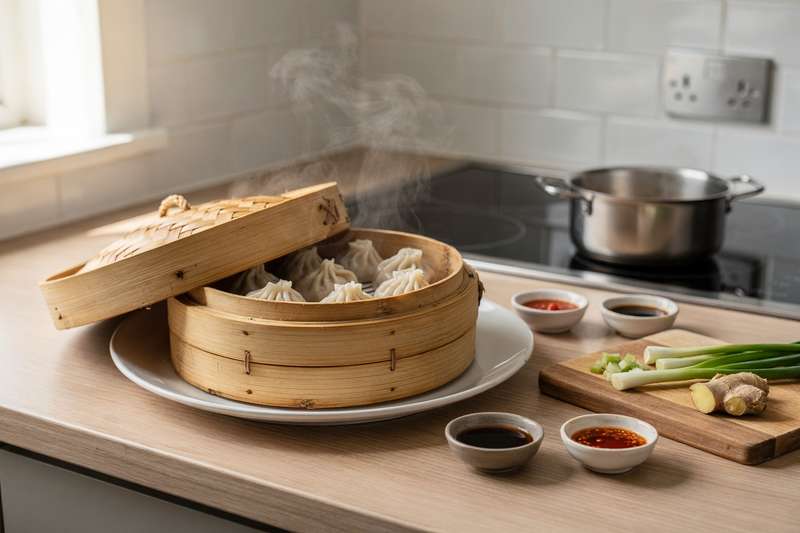
Picture this: you’ve just spent a Saturday afternoon pleating prawn har gow, shaping siu mai, and mixing a pork-and-ginger filling for potsticker-style dumplings. The kitchen smells incredible. You’ve watched enough YouTube videos to feel genuinely confident. And then you reach for the battered electric steamer you’ve had since 2018 — the one with the cracked tray and the lid that doesn’t sit flat — and within minutes your delicate parcels are waterlogged, the wrappers are gummy, and the whole batch tastes like it was boiled rather than steamed. The problem isn’t your technique. It’s your equipment.
A bamboo steamer is one of those genuinely useful kitchen tools that solves a very specific problem very well. Unlike metal or plastic steamers, bamboo absorbs excess moisture rather than letting it condense back onto your food. The result is a dryer, fluffier steam environment — exactly what dim sum needs. Siu mai skins stay silky rather than soggy. Bao buns come out pillowy and light. Har gow wrappers stay translucent and tender without splitting. If you’ve been relying on a colander over a saucepan, or an electric steamer designed for broccoli rather than dumplings, this guide is for you.
Whether you’re cooking for one on a weeknight or hosting a weekend dim sum spread for six, the right bamboo steamer makes a measurable difference. This guide walks you through what to look for, which styles suit which kitchens, and how to avoid the common pitfalls — split bamboo, warped lids, and steamers that don’t fit any pot you own.
How We Evaluated These Picks
Choosing a bamboo steamer sounds straightforward until you start digging into the differences. For this guide, we focused on five key criteria: material quality (tightly woven bamboo strips, absence of staples or metal fastenings, uniform construction), size and capacity (how many dumplings fit per tier, whether the diameter suits standard UK woks and saucepans), tier design (lid fit, tier alignment, steam distribution), durability signals (how the bamboo is joined, whether the base wears evenly, how it handles repeated use), and ease of care (how quickly it dries, whether it develops mould with normal use, how easy it is to clean between sessions).
We cross-referenced verified buyer feedback patterns across hundreds of reviews, paying particular attention to long-term durability comments (not just first-impression ratings), complaints about fit with standard UK cookware, and notes from buyers who specifically use their steamer for dim sum and dumplings rather than just vegetables. Price brackets were also considered — a steamer that lasts six months isn’t better value than one costing twice as much that lasts five years.
Best Overall: Two-Tier 10-Inch Bamboo Steamer with Deep Baskets
If you cook dumplings or dim sum more than once a month, this is the size and style to build around. A 10-inch (approximately 25cm) two-tier bamboo steamer with extra-deep baskets fits a generous batch of food — typically 8–10 siu mai or 6–8 larger dumplings per tier, meaning you can cook 16–20 pieces in a single steam. That’s enough for a proper serving for two, or a starter course for four, without needing to do multiple rounds.
The key feature to look for at this size is basket depth. Shallow baskets are fine for flat items like gyoza or thin vegetable slices, but bao buns need headroom to expand, and stacked siu mai can collapse into each other if the basket walls are too low. Look for baskets with at least 5–6cm of internal depth per tier. The lid should sit firmly — not loosely — on the top tier, with no visible gaps around the rim that would let steam escape.
At this size, the steamer will sit comfortably over a standard 28–30cm wok, which is the most common pairing in UK kitchens. The base of the steamer should rest on the wok’s inner rim with the steamer sitting above (not in) the water — approximately 3–5cm of simmering water below the base is the ideal setup. If the fit is too loose, the steamer rocks and lets steam out sideways rather than upward through the food. Before buying, check the diameter of your wok at the point where the steamer would rest.
At this price bracket (roughly £25–£35), you should expect tightly woven bamboo strips, a lid that is woven rather than stamped, and no metal staples holding the strips together — staples are a sign of lower manufacturing quality and tend to rust. The base ring should be smooth and even, sitting flush on the wok without rocking. One honest tradeoff: 10-inch steamers at this price rarely include bamboo liners or parchment. You’ll need to buy reusable silicone liners separately or cut your own parchment rounds — worth doing, as it dramatically reduces sticking and simplifies cleaning.
Best for Beginners: Classic 20cm Two-Tier Woven Bamboo Steamer
If you’re new to bamboo steamers and not yet sure how often you’ll use one, a compact 20cm (8-inch) two-tier is the sensible starting point. It’s the format that has been sold in UK kitchenware shops for decades, and for good reason: it’s small enough to store easily, fits over a standard 24–26cm saucepan as well as a wok, and handles a domestic portion of dumplings (typically 4–6 per tier) without needing a full dim sum setup.
The classic woven bamboo design at this size is widely available from established kitchenware brands and tends to come with at least a 12-month guarantee — something worth checking, as cheaper unbranded versions often don’t. The traditional woven style, where the bamboo strips run in a crossing pattern, is structurally sound and gives the steamer an attractive appearance that lets you bring it straight to the table for serving. This is genuinely useful for dim sum, where part of the pleasure is lifting the lid at the table.
What you’re trading off at this size is capacity. Two tiers at 20cm will comfortably hold 10–14 small siu mai or dumplings total — fine for one or two people, tight if you’re cooking for three or more. The lids on 20cm steamers can also fit less securely than on larger sizes, since there’s less surface area for the lid to rest on. Check buyer reviews specifically for comments about lid fit before purchasing.
For first-time buyers, this size is also more forgiving if you’re still learning how to prep the steamer (soaking it before first use, getting the water level right, avoiding letting it boil dry). A smaller, less expensive steamer means less frustration if early cooking sessions involve a learning curve. Once you’re confident, stepping up to a 25cm or 28cm version is a straightforward upgrade.
Best for Larger Groups: Three-Tier 12-Inch Bamboo Steamer Set
For anyone cooking dim sum for four or more people — or who wants to prepare an entire spread in one go — a three-tier 12-inch (approximately 30cm) set is worth the extra investment. Three tiers of 30cm diameter can hold 30–40 dumplings simultaneously, enough to do a proper dim sum service without the awkward gap between courses while batches cook.
At 30cm, the steamer will require a larger wok or a wide-based stock pot to sit over correctly. This is the first thing to check before purchasing at this size — a 30cm steamer needs to rest on a rim of at least 28cm, meaning a standard 28–30cm wok is at the lower end of suitable. Many UK home cooks find that a 32–34cm wok gives the best fit for this size. Some 12-inch steamers are designed with a slightly tapered base ring specifically to fit a wider range of wok shapes, which is worth looking for in the product description.
Three-tier sets are particularly good for dim sum spreads because you can use the tiers for different items simultaneously: siu mai on the bottom tier (closest to the steam source, needs the most heat), har gow on the middle tier, and a steamed bao or custard tart on the top. Different items need slightly different steaming times, so you can stagger when you add each tier. It takes a bit of practice, but it’s exactly how restaurant kitchens operate with their multi-tier bamboo stacks.
The honest tradeoff with three-tier sets is storage. A 30cm three-tier steamer with lid takes up more cupboard space than most UK kitchens can easily spare. If storage is a constraint, a two-tier 25cm steamer used in two rounds may be more practical than a three-tier 30cm that ends up living on the floor of the utility room. Also check that the tiers nest cleanly when stored — some cheaper three-tier sets have slight dimensional inconsistencies that make nesting difficult.
Best Budget Pick: Single-Tier 8-Inch Bamboo Steamer Under £15
There’s a place for a budget bamboo steamer, and that place is in the kitchen of someone who wants to experiment with steamed dumplings before committing to a full setup. A single-tier 8-inch (20cm) basket with a lid, priced under £15, is perfectly adequate for occasional use and gives you an accurate sense of how bamboo steaming differs from other methods.
At this price, you should not expect premium material quality. The bamboo strips may be slightly uneven, the lid may not sit perfectly flat, and the construction may use a few metal staples rather than purely bamboo-nail joinery. None of these are deal-breakers for occasional use, but they do affect longevity. A budget steamer used once a fortnight with careful drying after each use can last 18–24 months; one used several times a week, or stored slightly damp, is likely to develop mould or split within a few months.
For occasional dim sum nights, the single-tier format works fine if you’re happy cooking in batches. Steam your first eight dumplings, plate them up, refill the steamer, and repeat. It’s not efficient for a dinner party, but it works perfectly well for a solo weeknight supper or a two-person meal. Line the basket with parchment or a reusable silicone liner every single time — at this price bracket, the bamboo may not be as tightly woven, meaning food is more likely to stick to the base.
One useful tip at this budget level: buy from a seller with a clear returns policy, and check that the listed diameter is the internal basket diameter rather than the external ring diameter. Some budget listings measure the outer ring, which can be 1.5–2cm wider than the usable cooking surface. This matters if you’re trying to fit the steamer inside a specific pot.
Best for Table Presentation: Natural-Finish Bamboo Steamer with Tight Weave
Part of the appeal of dim sum at home is the theatre of it — lifting bamboo lids at the table, the steam rising, the dumplings arranged neatly on parchment inside. If presentation matters to you as much as function, look for a bamboo steamer with a particularly clean, tight weave and a natural finish that photographs well and doesn’t look utilitarian on the table.
The best steamers for this purpose have a consistent weave pattern with no visible gaps or loose strips, a smooth bamboo finish that hasn’t been varnished or lacquered (which can impart flavour and peel over time), and a lid that forms a neat dome rather than a flat top. Some manufacturers finish the outer surface with a very light food-safe oil or wax; this is fine and actually improves longevity slightly. What to avoid is any visible coating that feels plasticky or has a chemical smell when the steamer is new.
At this price bracket (around £20–£30 for a 23–25cm two-tier), the quality difference between brands can be significant. The most useful thing to check is the consistency of the weave — look at product photos carefully and read reviews from buyers who mention the build quality rather than just the cooking results. Steamers with presentation value also tend to hold their shape better over time, since the tight weave distributes steam pressure more evenly, reducing the risk of the bamboo splitting or the base ring warping.
For serving, line the steamer baskets with banana leaf squares or patterned parchment rounds rather than plain white paper — it elevates the presentation significantly and is the style you’ll see in Hong Kong teahouses. Reusable silicone dim sum liners are also available and easier to wash, though they don’t have quite the same visual appeal as natural liners.
Best for Versatility: Wide 26cm Two-Tier with Reinforced Base Ring
If you want one bamboo steamer that handles dumplings on Tuesday and a whole fish on Sunday, look for a 26–28cm (approximately 10–11 inch) two-tier with a reinforced base ring — either a band of woven bamboo or a stainless steel rim. The wider diameter accommodates larger cuts of fish, whole chicken thighs, or a full side of salmon without having to fold or cut the food to fit.
The reinforced base ring matters specifically for heavier loads. When you place a thick piece of fish or a large ceramic dish inside a bamboo steamer, the weight can cause the base of the basket to bow downward over time if the bamboo isn’t adequately supported. A stainless steel or thickly woven bamboo ring around the outer base distributes that weight and prevents long-term deformation. It also gives the steamer a more secure seat when placed over a wok.
For dim sum specifically, a 26cm diameter is generous — you can fit 10–12 siu mai per tier or 8–10 larger dumplings, arranged with proper spacing so they don’t stick together during steaming. The slightly wider base also means slightly more surface area for steam to pass through the weave from the bottom, which some cooks find gives more even cooking than a narrower basket where the steam channels more centrally.
The tradeoff here is weight and size. A 28cm steamer with reinforced rings is noticeably heavier than a standard woven bamboo steamer of the same tier count, and it’s more awkward to move when full and hot. Use a pair of silicone oven gloves rather than tea towels — the steam that escapes when you shift the lid can burn your hands quickly. Also, at 28cm, you’ll need a 28–30cm wok minimum for a proper fit, and a 32cm wok is more comfortable.
What to Look For When Buying a Bamboo Steamer
- Diameter and pot compatibility: The most common mismatch is buying a steamer that doesn’t fit your wok. The steamer should rest on the inner rim of the wok approximately 3–5cm above the waterline. Measure your wok’s inner diameter at the rim before buying. As a rough guide: a 20cm steamer fits a 24–26cm wok; a 25cm steamer fits a 28–30cm wok; a 30cm steamer needs a 30–34cm wok.
- Number of tiers: Two tiers is the most practical for home cooking. Three tiers increases capacity but requires more steam pressure to reach the top tier evenly, which means a more vigorous simmer and more attention to water levels. Single-tier is fine for small portions or budget buyers.
- Construction quality: Look for tightly woven bamboo strips, bamboo-nail joinery (not metal staples), and a smooth, even base ring. The lid should have a slight dome shape to direct condensation away from food, and it should sit snugly without gaps. Avoid steamers where strips are visibly uneven or where the weave has gaps wider than 2mm.
- Material treatment: Good bamboo steamers use natural, untreated bamboo — no lacquer, no varnish, no chemical coating. A very light food-safe oil is acceptable. If a steamer has a shiny or plasticky finish, or smells chemical when new, return it.
- Liners: Few steamers include liners, and most buyers need to buy these separately. Options include parchment paper rounds (inexpensive, disposable), reusable silicone dim sum liners (best for regular use), and cabbage or banana leaf squares (traditional and effective). Whichever you use, always line the basket before adding food.
- Drying and storage: Bamboo steamers last significantly longer when dried thoroughly after each use. Check that the design allows air to circulate freely when stored — some steamers with very tight lid fits trap moisture inside. Store disassembled if possible.
- Guarantee and brand: An established brand with a stated guarantee period (even just 12 months) is preferable to an unbranded steamer with no after-purchase support. It signals a minimum level of quality control and gives you recourse if the steamer arrives damaged or warps quickly.
Verdict: Which Bamboo Steamer Should You Buy?
For most UK home cooks who want to make proper dumplings and dim sum at home, the two-tier 25cm (10-inch) bamboo steamer with deep baskets is the right choice. It fits the most common UK wok sizes, holds enough food to feed two people properly in a single round, and the extra depth handles bao buns and siu mai equally well. At the £25–£35 price point, you’re getting a steamer that will last several years with reasonable care — a genuine step up from the budget end without the bulk and storage demands of a three-tier 30cm set.
If you’re genuinely new to bamboo steaming and not yet sure you’ll use it regularly, start with a classic 20cm two-tier from an established brand — it’s lower risk, easier to store, and still produces excellent dumplings in domestic portions. Once you’re hooked (and most people are, after one session), upgrading is simple and the original steamer becomes a useful extra tier.
Whatever size you choose, buy some reusable silicone dim sum liners at the same time — they transform the cleaning experience and extend the life of the bamboo. And always let the steamer dry fully before putting it away.
We were not paid to feature any specific product in this guide. All opinions are independent and based on publicly available specifications, verified buyer feedback patterns, and category research. Prices shown were accurate at time of writing and may change.
Quick Comparison Table


FAQ
What size bamboo steamer do I need for dumplings at home?
For most home cooks, a 25cm (10-inch) two-tier bamboo steamer is the most practical size. It holds 8–10 dumplings per tier, fits a standard 28–30cm wok, and handles both small items like siu mai and larger items like bao buns. If you’re cooking for one or two people occasionally, a 20cm (8-inch) version is sufficient and easier to store.
Do I need to soak a bamboo steamer before using it?
Yes — soak a new bamboo steamer in cold water for 20–30 minutes before first use. This rehydrates the bamboo fibres, makes them more pliable, and reduces the risk of scorching if the steamer comes into contact with the sides of a hot wok. After each use, rinse with warm water (no soap), then allow to air-dry completely before storing.
How do I stop dumplings sticking to the bamboo steamer?
Always line the basket before adding dumplings. Parchment paper rounds with a few holes punched through (to allow steam to pass) are the simplest option. Reusable silicone dim sum liners are better for regular use as they’re easy to clean and last indefinitely. Cabbage leaves and banana leaf squares are traditional alternatives that work well and add a subtle aroma. Never place dumplings directly on bare bamboo — they will stick and tear when you try to remove them.
Can I use a bamboo steamer on an induction hob?
Yes, but indirectly. You’ll need an induction-compatible wok or large saucepan to sit the bamboo steamer over. The bamboo steamer itself never touches the hob — it sits over the simmering water in the wok or pan. Most flat-bottomed induction woks work well for this; round-bottomed woks require an induction ring adapter for stable use.
How do I clean and store a bamboo steamer so it doesn’t go mouldy?
Rinse the steamer with warm water immediately after use while it’s still warm — this removes food residue most effectively. Avoid soap where possible, as it can dry out the bamboo fibres and cause splitting over time. The single most important step is drying: stand the tiers separately in a warm, well-ventilated area and allow 24 hours of drying time before stacking and storing. If you store a damp bamboo steamer in a closed cupboard, mould will develop within a few uses. A light rub with food-safe bamboo oil every few months also helps maintain the fibres.
Is a bamboo steamer better than a stainless steel steamer for dim sum?
For traditional dim sum items — dumplings, siu mai, har gow, bao buns — bamboo is preferable to metal because it absorbs rather than reflects moisture. Metal steamers allow condensation to form on the lid and drip back onto the food, making wrappers wet and sometimes causing bao buns to collapse. Bamboo absorbs that excess steam, keeping the cooking environment dryer and producing better texture. Metal steamers are perfectly fine for vegetables, fish, and denser foods where moisture isn’t a concern.