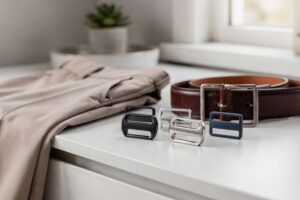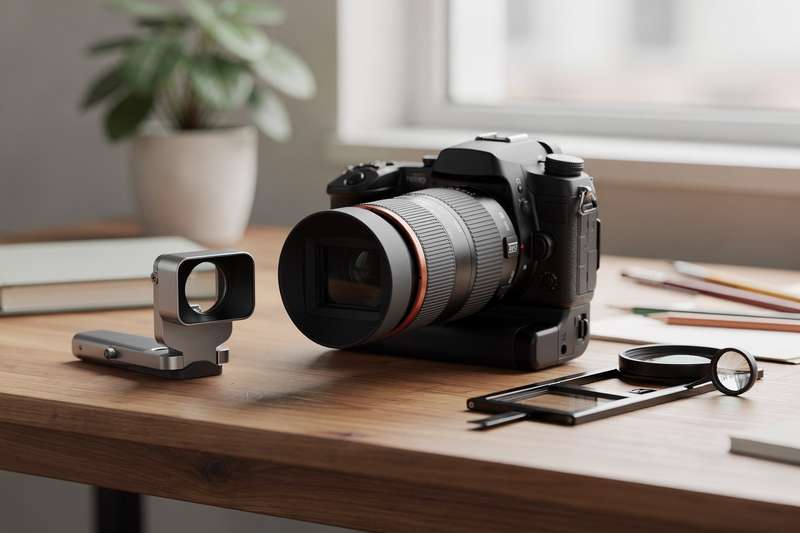
You type “viewfinder” into Amazon’s search bar and the results page looks as though someone has tipped three entirely different hobby catalogues into a single basket. On one page you will find rubbery camera eyecups sitting alongside flat plastic framing tools that belong in a watercolour class, next to a retro toy shaped like binoculars, next to something described as a slide light box. You open a few listings, read half a description, and abandon the search. Sound familiar? The word “viewfinder” is carrying an enormous amount of freight — a Canon DSLR shooter hunting for a worn-out eyecup replacement, a sketching artist wanting a compositional framing device, a parent looking for something screen-free for a six-year-old, and someone sorting through a box of old 35mm slides all land on the same results page. This guide cuts through that noise. Six concrete picks, each matched to a clearly defined scenario, so you can skip straight to the section that fits your actual need.
How These Picks Were Chosen
These six picks were drawn from Amazon UK’s search results after filtering to products that genuinely belong under the “viewfinder” umbrella: camera viewfinder eyecups and accessories, artist compositional framing tools, retro slide viewers for children, and a light-box slide scanner for 35mm transparencies. Two products that appeared in the original results — Bluetooth item-tracking tags marketed under variations of the word “finder” — were removed immediately; they are simply off-topic. Each remaining pick was then assessed against criteria relevant to its specific use case. Camera eyecups were evaluated on compatibility breadth, material durability, and stray-light blocking. Artist viewfinders were assessed on adjustability and portability. The children’s viewer was checked for optical clarity and educational substance at its price tier. The slide light box was evaluated on illumination evenness and supported formats. Verified buyer review patterns shaped the tradeoff reporting throughout. One product in this guide has only three reviews at time of writing — that is flagged plainly in its section.
Best Viewfinder Eyecup for Canon DSLR Photographers
If your Canon DSLR’s stock rubber eyecup has torn, cracked, or simply vanished during a location shoot, the KIWIFOTOS Eyepiece for Canon EOS DSLR Cameras is the most widely purchased aftermarket replacement on Amazon UK, backed by over 700 verified ratings averaging 4.4 out of 5. That review volume matters: it means the fit, durability, and viewing experience have been validated across a wide range of bodies and real-world shooting conditions — not just a handful of impressions from the first week on sale.
The eyecup is a direct replacement for Canon’s EB and EF eyecups and covers a broad compatibility range including the EOS 90D, 80D, 70D, 800D, 750D, 760D, and 77D. If your camera is on that list, installation takes seconds — the original eyecup rotates off and the replacement clicks into place. The outer layer is soft silicone, which sits comfortably against the skin during long sessions and forms a seal that blocks stray light from entering behind the eyepiece. That detail is more consequential than it sounds: when shooting in bright sunlight or under studio lighting, unblocked light creeping in from the rear significantly distorts your exposure judgement through the viewfinder. A snug-fitting eyecup solves the problem at source.
The inner ring uses rigid ABS plastic to maintain its shape, directly addressing a common complaint about OEM Canon eyecups: the original rubber compound tends to crack and crumble with UV exposure after a year or two of outdoor use. Reviewers consistently note that this aftermarket version outlasts the stock part, and several highlight that the fit is more secure — less prone to working loose mid-session. For event and sports photographers who cannot stop to retrieve a dropped eyecup between bursts, that extra grip is a practical win.
The tradeoff is specificity. This eyecup is designed for the listed Canon DSLR bodies only. If you shoot a Canon EOS R series mirrorless camera, the mounting system is different and this part will not seat correctly — mirrorless bodies require a separate model-specific accessory. Always cross-reference your exact camera model against the compatibility list before ordering. This is also an aftermarket product rather than a Canon OEM part, so it carries no integration with Canon’s own service warranty — though at this tier, that is rarely a practical concern.
Photographers who use the viewfinder while wearing glasses will find the slightly wider silicone rim more accommodating than the slim original, creating useful clearance around spectacle frames. One point worth being clear on: the eyecup itself does not affect the viewfinder’s optical prescription. If the focus-point indicators appear blurry, that is corrected by your camera’s built-in diopter adjustment dial, not by the eyecup.
Best Viewfinder Eyecup for Sony Mirrorless Users
For photographers shooting the Sony A7C II or A7CR, finding a well-fitting aftermarket eyecup is a more specific task than for Canon DSLR users — which is the gap filled by the SMALLRIG A7CII A7CR Camera Viewfinder Eyecup. With 260 reviews at 4.5 out of 5, it has strong approval for a specialist accessory, and SMALLRIG is a recognisable name among photographers who follow the cage-and-rig ecosystem.
The eyecup is made from soft silicone throughout, and that material choice drives both main user benefits: comfort and light-seal quality. Hard plastic eyecups look clean in product photographs but press uncomfortably against the face during extended sessions — portrait shoots, wildlife watches, or multi-hour event coverage. Soft silicone conforms slightly to your face shape, creating a better seal while remaining comfortable over an hour or more of continuous use. In bright outdoor conditions, that seal makes a practical difference to how accurately you can judge exposure and focus through the viewfinder.
A detail that reviewers highlight repeatedly is the small tethering lanyard included with the eyecup. It sounds minor until the first time you have watched a tiny rubber component bounce off a rooftop car park mid-wedding. The lanyard keeps the eyecup attached to the camera or strap if it works loose, preventing loss between shots. Several reviewers who had previously lost eyecups describe this as a disproportionately valuable feature for something physically so small.
The key limitation applies to all body-specific eyecups: this is built for the Sony A7C II and A7CR only. Other Sony mirrorless bodies — including the A7 IV, A7R V, and A1 — use different mounting dimensions, and this eyecup will not seat correctly on them. SMALLRIG produces body-specific eyecups for other Sony models, but those are separate products. Always confirm your exact camera body before ordering. As with the Canon pick, the eyecup itself does not adjust the viewfinder’s optical focus — Sony’s built-in diopter dial handles that independently.
For videographers shooting handheld with the A7C II, there is a practical ergonomic benefit worth calling out: pressing your eye firmly against the viewfinder while the silicone creates a face seal adds a third point of camera stabilisation contact alongside your two hands. On longer focal lengths or in conditions where movement is difficult to control, that contact makes a measurable difference to handheld footage stability — a small but real advantage for run-and-gun shooters.
Best for Viewing and Scanning Old 35mm Slides
For anyone who has inherited a shoebox of 35mm colour transparencies from the 1970s or 1980s and wants to find out what is actually on them, the Slide Viewer Light Box — a portable A4 LED light pad and slide viewer combination — is the most practical entry point at this price tier. Its 155-review base at 4.5 out of 5 gives it the strongest validation of any non-camera product in this guide.
The device is an A4 LED panel, USB-powered, with a mounted holder for 35mm slide mounts and a channel for film negative strips. Placing a slide on the illuminated surface makes colour, exposure, and sharpness immediately readable — far more reliable than holding a slide up to a bare window or desk lamp, which produces uneven and colour-shifted light. For anyone sorting through a collection of carousel trays from a family archive, the ability to lay out multiple slides simultaneously under consistent illumination saves considerable time in identifying which images are worth keeping or digitising.
The description of this device as a “scanner” deserves a precise qualification. It is not a dedicated film scanner with its own internal sensor. It is an LED light pad that lets you photograph slides using a smartphone camera in portrait or macro mode, or a DSLR with a macro lens, producing digital files from the backlit image. For family archiving and sharing, that approach yields perfectly usable results. For archival-quality digitisation at high resolution, a dedicated film scanner is a different category of product at a considerably higher price — but that level of investment is unnecessary for most domestic use cases.
Reviewers note consistently that the LED illumination is even across the full A4 surface — no pronounced hot spot in the centre, no dark corners — which is the single most important quality criterion for this kind of tool. Uneven lighting misrepresents slide density and colour, making selection decisions less reliable. USB power delivery means the device runs from a laptop, a wall adaptor, or a power bank without a dedicated mains lead, making it functional in any room or even outdoors on a garden table.
What this product does not cover: large-format or medium-format film, slide projection onto a wall for group viewing, or automated bulk scanning. Its strength is accessible personal archiving — identifying what you have, selecting the keepers, and capturing usable digital versions. At its price point, it covers that task thoroughly.
Best Retro 3D ViewFinder for Young Explorers
The Pup Go 3D ViewFinder for Kids Ages 3+ is a deliberate callback to the View-Master style stereoscopic slide viewers that populated childhoods in the 1970s and 1980s, updated with four themed reel sets covering dinosaurs, animals, the ocean, and space. It has 32 reviews averaging 4.5 out of 5 — a smaller sample than the camera accessories in this guide, but consistently positive.
Each reel delivers a sequence of stereoscopic image pairs that the viewer’s fixed optics resolve into three-dimensional pictures. A child clicks a lever to advance through the images — a mechanical action that three-year-olds can manage independently, with no screen, no battery, and no wireless connection required. The four included reels cover 28 HD images across their four themes, and the HD print quality on the slides is noticeably sharper than vintage View-Master reels — colours are more vivid and detail is more clearly defined than you may remember from original examples.
The dinosaur and ocean reels attract the most enthusiastic comments in the verified reviews, which makes sense: three-dimensional depth illusion works best when subjects have strong spatial form, and a T-Rex emerging from the image plane or a coral reef receding into the distance delivers that effect more powerfully than a flat landscape. The STEM educational angle has genuine substance here — understanding how two slightly offset flat images combine to produce a depth illusion is a real introduction to binocular vision and basic optics, and for children who ask how things work, it opens a natural conversation.
The honest limitation: the optics are calibrated for a child’s interpupillary distance. Many adults find the 3D effect does not merge correctly for them because their eyes are set further apart than the device is designed for. This is a children’s toy in the truest sense, optimised for its intended audience rather than adults revisiting nostalgia. Additional reel sets in the standard View-Master format are available separately on Amazon, allowing the collection to grow beyond the four supplied in the box as a child’s interests develop.
For relatives looking for a screen-free gift that is tactile, optical, and different from most children’s entertainment products, this occupies a real gap. It has the quality of objects that get returned to repeatedly over months rather than forgotten after a week — partly because the reel-swapping and lever-clicking ritual is itself a satisfying mechanical action that children find compelling in its own right.
Best Artist Viewfinder Set for Painters and Sketchers
The Fisssure Artist View Finder — a pack of three compact compositional framing tools for painters and sketchers — introduces a category of art supply that many beginners overlook entirely. It carries 12 reviews at 3.6 out of 5, the lowest rating of any product in this guide, and that score deserves honest attention before the description continues.
An artist’s viewfinder is a small rectangular frame that you hold up to one eye at arm’s length to isolate a portion of your visual field and assess composition before committing pencil or brush to paper. It works exactly like cropping a photograph, but in real time and before the drawing begins — forcing a compositional decision early and preventing the common beginner mistake of trying to fit an entire scene into a single image. Art instructors in life drawing, urban sketching, and landscape painting recommend viewfinders regularly because they develop compositional thinking as a deliberate habit rather than an afterthought.
This set includes three viewfinders in different aperture sizes and proportions: a portrait ratio for vertical A4 compositions, a landscape format for horizontal work, and a variant proportion for other canvas sizes. All three fit in a pencil case or small bag pocket, which is the right form factor for outdoor and location sketching. Urban sketchers who need to isolate a composition quickly before a scene changes — before a bus pulls away, before the light shifts — will find the compact portable format practical for on-the-spot decisions.
Where the 3.6-star score is relevant: several reviewers note that the construction quality is basic. The plastic frames are thin, the aperture edges are not precisely cut, and the proportions do not always correspond exactly to standard paper sizes. For a beginner developing the habit of composing before drawing, those limitations are tolerable — the tool still performs its core function of encouraging compositional awareness. For a working artist or art student who relies on a viewfinder for accurate proportion relationships, a higher-quality wooden or precision-machined metal version would serve better. This three-pack is positioned most honestly as a starter kit or classroom supply: accessible, portable, and inexpensive enough to hand out to an entire group without budget strain.
If you have never used an artist’s viewfinder before and want to try the technique without a significant outlay, this three-pack does that job. If you already use viewfinders regularly and want something more precise and durable, treat it as a stepping stone rather than a destination.
Best Adjustable Sliding Viewfinder for Outdoor Sketchers
The Sliding View Finder — a portable adjustable compositional tool for painting and sketching — extends the artist viewfinder concept by making the aperture size itself variable rather than fixed. Instead of a static rectangular opening, the inner components slide to resize the frame continuously, adapting the crop to whichever paper size or canvas ratio you are working with. This product carries only three reviews at 4.6 out of 5 at the time of writing — an encouraging early signal, but statistically too thin to draw firm conclusions about durability or long-term reliability. That caveat is flagged plainly: this is the least-proven pick in this guide.
The practical case for an adjustable viewfinder over a fixed-frame set is format flexibility in a single tool. An artist who works across A3 watercolour sheets, square sketchbook pages, and portrait-format canvases would ordinarily need three separate fixed-size frames to match each format precisely — or one adjustable tool that covers all of them continuously. For plein air painters already carrying a portable easel, a pochade box, and a bag of materials, consolidating to a single adjustable tool over a three-pack of separate cards is a sensible simplification that reduces both weight and decision-making in the field.
The sliding mechanism also enables a function that fixed viewfinders cannot match: gradually narrowing the aperture while scanning a scene, effectively zooming into a sub-section to assess whether a tight crop works better than the full composition. For outdoor sketchers working quickly under changing light, the ability to explore multiple compositional options rapidly without swapping between separate cards is a workflow advantage that experienced location artists will appreciate.
The caveat about the review count deserves repetition because it directly affects the purchase decision. Three reviews, however positive, cannot tell you whether the sliding joint holds its set position reliably after a season of field use, or how the mechanism performs after being knocked around in a bag for six months. For buyers who need verified durability before committing, the Fisssure three-pack has a larger review base to draw on. For outdoor sketchers who are comfortable buying a newer product on the strength of its early promise, the adjustable format is a thoughtful design worth exploring at its accessible price.
What to Look For When Buying a Viewfinder
- Identify the type you actually need first. Camera eyecups, artist compositional frames, stereoscopic toy viewers, and slide light boxes all share the word “viewfinder” but are completely unrelated tools. Being clear on your use case before searching prevents buying the wrong category entirely — which is the single most common source of frustration in this product area.
- Camera eyecup compatibility is non-negotiable. Mounting dimensions vary between brands, between DSLR and mirrorless lines, and sometimes between different models within the same product family. A Canon DSLR eyecup will not fit a Canon EOS R mirrorless body; a Sony A7C II eyecup will not seat on a Sony A7 IV. Always verify that your exact camera model is named in the product’s compatibility list before purchasing.
- Material quality in camera eyecups. Soft silicone paired with a rigid inner ring (ABS or similar) is the best combination for comfort, light-blocking, and longevity. Pure rubber eyecups degrade and crack with prolonged UV exposure; silicone holds up significantly better over time with regular outdoor use.
- Fixed versus adjustable aperture for artist viewfinders. A fixed multi-pack suits artists who work consistently in one or two formats. An adjustable sliding design suits artists who regularly switch between paper sizes and formats, and who prefer to carry a single versatile tool. Match the design to your actual working practice before deciding.
- Illumination evenness for slide viewers. Uneven LED light — hot spots in the centre, dark corners at the edges — misrepresents the density and colour of slides, making image selection less reliable. Look specifically for buyer reviews that comment on light consistency across the full panel surface; this is the most common point of differentiation between competing light pads.
- Diopter adjustment and glasses compatibility. Camera bodies have a built-in diopter dial beside the viewfinder eyepiece that corrects the optical focus for your individual eyesight — this is separate from the eyecup accessory. For standalone optical viewers and children’s stereoscopic toys, check whether the product specifies glasses compatibility or adjustable interpupillary distance settings if those factors matter to your intended user.
- Review volume as a reliability indicator. A product with several hundred verified reviews gives you reliable real-world data on fit, durability, and performance across different users and conditions. A product with three or four reviews might be excellent — but that cannot yet be confirmed. Weight that uncertainty in proportion to how much you are spending and how critical the application is.
Verdict
For the largest likely audience arriving at this guide — Canon DSLR photographers whose original eyecup has finally given out — the KIWIFOTOS Eyepiece for Canon EOS DSLR Cameras is the clearest recommendation here. It has the largest verified review base of anything in this guide, solves a specific and common problem reliably, and improves on the OEM part in both material durability and stray-light blocking. That combination is hard to argue against when there is an established review signal backing it.
For Sony A7C II and A7CR photographers, the SMALLRIG A7CII A7CR Camera Viewfinder Eyecup is the natural parallel pick — the tethering lanyard alone sets it apart from generic alternatives in a crowded accessories market. For anyone tackling a box of inherited 35mm slides, the Slide Viewer Light Box addresses that specific archiving task more accessibly than anything else at this price tier. And for a screen-free gift that delivers optical wonder to a child without batteries or apps, the Pup Go 3D ViewFinder for Kids sits largely by itself in its category for the under-eights.
We were not paid to feature any specific product in this guide. All opinions are independent and based on publicly available specifications, verified buyer feedback patterns, and category research.
Quick Comparison Table


FAQ
What is the difference between an optical viewfinder and an electronic viewfinder?
An optical viewfinder (OVF) shows you the scene directly through a glass prism or mirror system — real light, with no digital processing lag. An electronic viewfinder (EVF) displays a live digital feed from the camera’s sensor on a small OLED or LCD screen inside the eyepiece. EVFs can overlay live exposure data, focus peaking, and histogram information in real time; OVFs cannot. DSLRs typically use optical viewfinders, while most modern mirrorless cameras use electronic ones.
Why does my camera’s viewfinder look blurry?
The most common cause is a diopter adjustment dial that has been nudged out of position — the small rotary control located beside the viewfinder eyepiece on most interchangeable-lens cameras. It corrects the optical focus of the viewfinder to match your individual eyesight. Turn it slowly in either direction until the focus points and any on-screen text appear sharp. If adjusting the diopter does not resolve the issue, the eyepiece lens may need cleaning with a dry, lens-safe cloth.
What does an artist’s viewfinder actually do?
An artist’s viewfinder is a small rectangular frame that you hold up to one eye at arm’s length to isolate a portion of the scene before you start drawing or painting. It works exactly like cropping a photograph, but in real time — forcing a compositional decision before pencil touches paper. Used regularly, it develops the habit of thinking in defined image formats rather than attempting to capture an entire scene at once, which is one of the most common problems in beginner landscape and urban sketching.
Can I use a camera viewfinder eyecup if I wear glasses?
Yes, though comfort and coverage vary by eyecup design. Soft silicone eyecups with a wider rim tend to accommodate spectacle frames better than narrow hard-rubber versions, as they conform more readily around the frame edges. If thick-rimmed glasses mean you cannot see the full viewfinder image, look for eyecups described as offering extended eye relief, or consider a diopter correction lens attachment that threads onto the eyepiece and brings the viewfinder into focus without needing to wear glasses at all.
Are modern retro 3D viewers compatible with older View-Master reels?
Most modern stereoscopic viewers designed in the retro View-Master format accept the standard reel dimensions, so vintage reels from past decades should fit physically. Whether the images on older reels remain clearly viewable depends on how they have been stored — exposure to damp or prolonged bright light can cause fading and warping over decades. Always check the specific product listing’s compatibility notes if you have an archive of vintage reels you plan to use.
What is the best way to digitise 35mm slides without a dedicated film scanner?
Place the slides on an evenly lit LED light pad and photograph them with a smartphone camera in portrait or macro mode, or with a DSLR fitted with a macro lens, ensuring the illumination is consistent across the full slide surface. Adjust colour balance and contrast in any image-editing app afterwards. This method produces files well suited for family archiving and online sharing. For higher-resolution archival output, a dedicated film scanner with an internal sensor is the next step up — but for most domestic digitising projects, the light-pad-and-camera approach is more than adequate.