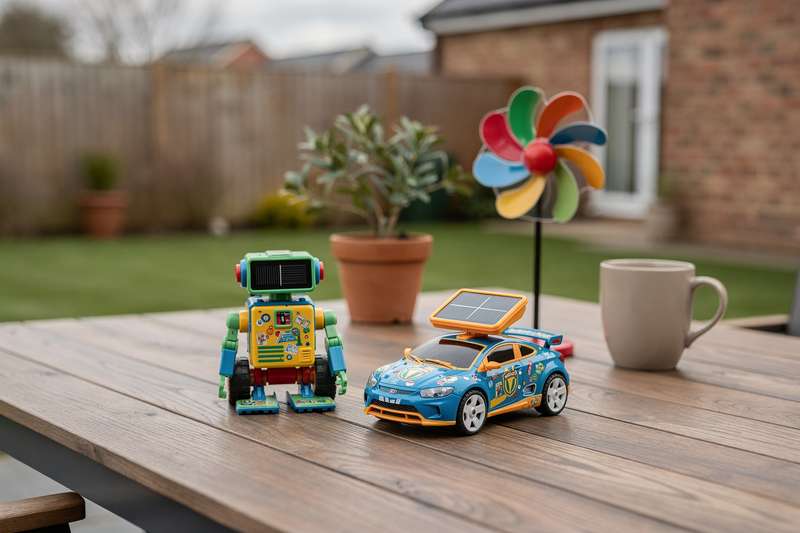
You’ve scrolled through page after page of solar toy listings, picked the one with the most impressive box art and the longest list of what it claims to teach, and ordered it. Delivery day comes, your child tears off the wrapping — and within forty minutes it’s sitting abandoned on the carpet. Sometimes the solar panel simply will not generate enough current under a grey British autumn sky to move a single gear. Other times the instructions are a baffling single-diagram sheet, and you — an adult — cannot work out how the pieces connect, let alone expect a nine-year-old to manage independently.
The solar powered toy market has real quality variation. At the good end, these kits produce the kind of hands-on science moment that children genuinely remember: something they built themselves, moving under nothing but light. At the bad end, they are an overpriced frustration that makes kids conclude science is not for them. Between those two extremes sits most of what you will find on Amazon UK — kits that work fine in the right conditions but have specific limitations that the listing won’t tell you about directly.
This guide sorts through the options currently available on Amazon UK, identifies which solar toys are worth buying for which child, and flags the tradeoffs that matter most in a British household — including the UK weather problem that affects every solar toy to some degree.
How These Picks Were Chosen
Every product in this guide was evaluated against verified buyer feedback from Amazon UK, focusing on patterns in the review content rather than just headline star ratings. For each kit, the key questions were: does the solar panel function in typical indoor light, or does it require direct outdoor sunshine? Are the instructions clear enough for a child at the target age to follow largely independently? Do the plastic parts hold up across multiple assembly and disassembly cycles? How many distinct configurations does the kit offer, and how does that translate to long-term engagement?
Configuration count was treated as a proxy for replay value — a kit that builds one model is a single-afternoon toy; a kit with twelve or thirteen configurations can sustain interest across months. A UK-weather filter was also applied: kits with no battery backup were flagged as a limitation worth noting, since reliable sunshine is far from guaranteed across most of the year. Products with zero Amazon UK reviews were excluded from the shortlist regardless of other factors.
Best Overall Solar Toy Kit
The STEM 13-in-1 Solar Robot Kit, Building Robotic Toy, DIY Science Kits for Kid tops this shortlist with close to 700 Amazon UK reviews averaging 4.4 out of 5 stars — a volume of feedback that makes the rating meaningful rather than a statistical quirk. Thirteen distinct robot configurations from a single kit is the headline figure, and in practice it translates into repeat engagement over months rather than a single afternoon.
The way multi-configuration kits work is worth understanding before you buy. You do not get thirteen separate sets of components — instead, one collection of parts can be assembled into thirteen different robots. Your child builds one, watches it move, disassembles it, and builds something else. Each rebuild teaches something slightly different: repositioning the motor changes how the robot moves, altering the gear arrangement changes its speed, and connecting parts in a new way produces a new behaviour. That loop of build, observe, disassemble, rebuild is where the real learning sits — and thirteen configurations keeps that loop going long after the novelty of the first build has passed.
The kit is pitched at ages 8 and up, which tracks closely with what reviewers report. Children at around 8 or 9 can work through the builds largely independently using the illustrated instructions, though the first build often benefits from an adult nearby. The parts are sized to be manageable for children’s hands, and the illustrated step-by-step format of the instructions is specifically noted positively by multiple buyers — it is more navigable than the single-view assembly diagrams that some competing kits use.
The honest tradeoff is solar performance. Like most kits in this price bracket, this one works noticeably better under direct sunlight or a very bright indoor window than under average household lighting. Buyers who use it outdoors on sunny days or directly against a south-facing window report lively, reliable motion. Those who try it under standard indoor artificial lighting report slower and sometimes intermittent movement. This is a physics limitation of budget solar panels rather than a product defect, but it is worth managing expectations accordingly. There is no battery backup option on this kit, which means overcast days limit what your child can do with it.
For families who have a sunny outdoor space or a reliably bright windowsill available, and for children in the 8-12 age bracket, this kit offers the strongest combination of replay value, instructions quality, and buyer confidence in this shortlist. Thirteen configurations keep it relevant well past the first session, which is the real test of whether a toy is worth the shelf space it takes up.
Best Novelty Solar Toy (No Assembly Required)
The Puckator Policeman Solar Pal belongs to a completely different category from the building kits — it is a ready-to-use solar powered figurine that bobs and sways in response to light, requiring zero assembly, zero instructions, and zero patience from the recipient. With over 460 Amazon UK reviews averaging 4.2 stars, it is one of the better-evidenced solar novelties in the UK market.
The format is a familiar one: a small character with a counterbalance mechanism that oscillates rhythmically when exposed to light. Place it on a car dashboard, a windowsill, or a desk in reasonable indoor light, and it simply works. Shadow it briefly and the motion slows; restore the light and it picks up pace again. That instant visible response to light changes — no switches, no setup, no waiting — is what makes it appealing to an audience that extends well beyond children.
The target audience is genuinely wide. Young children, including those below the typical solar kit age range, can enjoy watching the motion safely — there are no small parts and nothing to misassemble. Older children appreciate it as a desk companion. Adults buy it for car dashboards and office shelves. The Policeman character design is cheerful and recognisable, and the product range includes other character variants, so you can match the design to the recipient without worrying about any quality difference between options.
Where this differs from the STEM kits is exactly in what it does not provide. A child will not come away understanding circuits, gear ratios, or energy conversion. The educational value is limited to demonstrating that light produces motion — a basic observation that can spark curiosity in younger children, but not a curriculum-adjacent learning experience. If the goal is substantive hands-on STEM engagement, a building kit is the right category. If the goal is a low-maintenance, always-ready solar novelty that works without any fuss, the Puckator Solar Pal is a different kind of success.
Sunlight sensitivity is reasonable for an indoor novelty. A moderately bright window produces regular bobbing motion; direct sunlight produces livelier movement. The product does not struggle in the way some solar toys do — even diffuse daylight is usually enough for visible motion, which is part of what makes it a reliable desk piece year-round. For a gift where the recipient will appreciate something charming and effortless over something educational and assembly-heavy, this is a consistently well-reviewed choice.
Best for Younger Builders (Ages 8+)
The OMWay STEM Solar Robot Toys, 6-in-1 Experiment Science Kits for Kids Age 8 takes a deliberately pared-back approach compared to the 12 and 13-configuration kits elsewhere in this guide — and for a younger or less experienced builder, that restraint is a practical advantage rather than a shortcoming.
Six configurations means six distinct robots to build. That is enough variety to sustain meaningful engagement across multiple sessions without the intimidating parts count that accompanies a larger kit. Each build feels completeable within a single focused session — your child can start and finish a robot in an afternoon, watch it move, and experience the satisfaction of a completed project before returning to the box for the next one. For children who lose momentum on multi-day builds or who are attempting model kits for the first time, that sense of completion per session makes a real difference to whether the kit gets used again or migrates permanently to a shelf.
The 333 reviews averaging 4.4 stars put this among the more reliably rated kits in this category. What comes through consistently in positive buyer feedback is the clarity of the instructions — multiple reviewers specifically mention that the step-by-step diagrams are easier to follow than those in competing kits, and that children at around 8 or 9 years old can manage significant portions of each build without adult involvement. Several buyers also note that the solar panel performs adequately near a bright indoor window rather than requiring direct outdoor sunshine, which is a practical advantage for UK households using this across school holidays.
The limitations are honest and predictable. Six configurations, well-calibrated for a younger builder, will not satisfy an older or more ambitious child who wants extensive variety from a single kit. There is no battery backup — this is a purely solar kit — so overcast days mean setting it aside. And if your child has already worked through similar building toys and is ready for more complexity, the OMWay 12-in-1 reviewed below is the natural progression within the same brand.
For the specific scenario of a first solar toy purchase for a child around eight years old who has not attempted model kits before, this OMWay kit is well-matched to the challenge. Accessible enough that a capable eight-year-old can succeed largely independently, varied enough to sustain interest across multiple sessions, and well-reviewed enough to give real confidence before you wrap it up and hand it over.
Best for Cloudy UK Days (Solar Panel Plus Battery)
The ACELIFE Solar Robot Toy, 12 in 1 STEM Toys for Kids Age 8-12, Solar Power Building Toy with Solar Panel and Battery addresses the most practical problem with solar toys in the UK directly: it includes a battery compartment alongside the solar panel, giving children a reliable indoor power source regardless of what the sky is doing.
This matters more than it might initially seem. A solar kit with no battery alternative has a direct dependency on sunlight that, across a British year, limits when the toy can actually be used. Autumn, winter, and overcast summer stretches mean a purely solar kit can sit unused for weeks at a time. The ACELIFE 12-in-1 sidesteps this by including a battery option — you can power the robots indoors under ordinary lighting with the battery, then switch to solar mode on sunny days outdoors. That dual-power design turns a seasonal toy into something usable on a wet Saturday in November or during the December school holidays, which is when children most need something to keep them occupied.
Twelve configurations across the target age range of 8-12 provides solid variety. The 213 reviews averaging 4.0 stars represent a slightly lower rating than the top picks in this guide, and it is worth understanding the pattern behind that figure. Critical reviews tend to focus on instructions quality — some buyers find the assembly diagrams less immediately clear than those in other kits, requiring more interpretation or trial-and-error during early builds. This does not reflect on the hardware quality of the solar panel or motor, but it does mean the kit works better when an adult is available to assist with the first build or two rather than handing it over entirely to the child.
The solar panel performs as expected for the category under direct sunlight. The battery mode, importantly, works smoothly — buyers who mention the dual-power feature specifically tend to report it as a practical benefit rather than an awkward workaround. Plastic connectors and construction quality are typical for this tier: adequate for normal assembly and disassembly cycles, though repeated forceful handling will stress the clips over time.
If you are buying a solar toy during autumn or winter, or for a child who will use it primarily indoors, the ACELIFE 12-in-1 is the most sensible choice in this shortlist. The battery backup is not a premium extra — it is the difference between a toy that gets consistent use throughout the year and one that waits for a sunny afternoon that may not arrive for weeks.
Best Budget Multi-Config Solar Robot Kit
The OMWay 12-in-1 Solar Robot Toys, STEM E324234 Robotics Set, Science Kits for Kids Age 8-10 offers twelve configurations at a budget price point, making it a reasonable option for parents who want to test whether their child will engage with solar STEM building before committing to a higher-spec kit, or for experienced young builders who want additional variety at minimal extra cost.
At 91 reviews and a 3.8-star average, this is the lowest-rated kit in this guide, and the rating reflects genuine feedback patterns rather than a small sample anomaly. The most common critical comments concern two things: solar panel sensitivity that varies between units — some buyers report solid performance in reasonable light, others find the panel struggles even under conditions that work fine with better-rated kits — and instructions that leave more room for interpretation than the clearer options in this category. These are not universal issues, but they appear often enough that realistic expectations are important before purchasing.
Where the OMWay 12-in-1 performs well is variety for the price. Twelve configurations is a generous count at this tier, and buyers who report a positive experience tend to note that the build designs cover meaningfully different movement types rather than being slight variations on the same basic configuration. For an older child — towards the top of the stated 8-10 range or beyond — who is already comfortable with model building and can work through imperfect instructions without becoming discouraged, the twelve builds offer real value.
The strongest use case is as a supplementary purchase: for a child who has already worked through a better-rated kit and wants more configurations to explore, or for a buyer who wants to assess a child’s interest in solar STEM toys at lower financial risk before investing in a higher-spec option. As a first solar toy for an eight-year-old new to model building, this is not the right starting point — the instructions and panel consistency of the better-reviewed kits will produce a more reliably positive first experience.
There is no battery backup on this model. Combined with the panel sensitivity concerns noted by some reviewers, this kit performs best outdoors on a bright day rather than indoors on a typical British afternoon. If performance feels underwhelming after initial assembly, try using it in direct outdoor sunlight before forming conclusions — the margin between adequate and insufficient light is narrower with budget panels than it appears from indoors.
What to Look For When Buying Solar Powered Toys
- Configuration count: The number of distinct models you can build from one kit is the clearest indicator of long-term value. A single-build kit provides one afternoon of engagement; a 12 or 13-configuration kit can sustain interest across months. For children who work through toys quickly, prioritise higher configuration counts.
- Battery backup: In the UK, this is close to essential for year-round use. A purely solar-powered kit will sit idle through much of autumn and winter and on overcast summer days. Any kit that explicitly includes a battery compartment as an alternative power source is significantly more practical for most British households.
- Age rating versus parts count: Manufacturers’ age ratings on solar kits tend to be optimistic. Cross-reference the stated age with the total parts count and read actual buyer reviews about assembly difficulty. A kit with a very high parts count demands real patience — rewarding for an older child but potentially overwhelming for a younger one attempting it without adult support.
- Instructions quality: This varies considerably between kits and is one of the most common sources of negative reviews. Good instructions use numbered step-by-step diagrams rather than a single exploded-view image. Searching for the word “confusing” in a product’s reviews before buying is a reliable shortcut for assessing this.
- Solar panel sensitivity: Budget panels in solar toy kits vary in how much light they need to function. A more sensitive panel works adequately near a bright indoor window; a weaker one needs direct outdoor sunlight. Buyer reviews mentioning phrases like “had to take it outside” or “only works in direct sun” are useful signals about panel quality.
- Parts durability: Small plastic clips and connector points are the most common failure mode in solar robot kits. Look for feedback on whether parts hold up across multiple build-and-rebuild cycles, not just the initial assembly. Reviews that mention broken clips early in use are a warning worth heeding.
- Ready-to-use versus build-it-yourself: Solar novelties and build-it-yourself robot kits serve different needs. Novelties are fuss-free and broadly age-appropriate; building kits offer STEM learning but require patience and engagement. Be clear which type suits the recipient before purchasing.
Verdict
For most families buying a solar powered toy for a child aged eight to twelve, the STEM 13-in-1 Solar Robot Kit is the pick that best balances variety, instructions quality, and buyer confidence. Close to 700 reviews at 4.4 stars represents consistent real-world satisfaction, and thirteen configurations gives the kit longevity that single-build alternatives simply cannot match.
If you are buying for a younger child or a first-time builder, the OMWay STEM Solar Robot Toys 6-in-1 is a better-calibrated starting point — accessible enough to succeed without constant adult assistance, and varied enough to generate enthusiasm for follow-up builds. And if your household cannot guarantee reliable sunshine — which describes most UK households for much of the year — the ACELIFE 12-in-1 with its battery backup is the practically sensible choice that will see consistent use across autumn and winter rather than waiting for a sunny afternoon.
The Puckator Policeman Solar Pal is a worthwhile alternative when the recipient is very young, when something entirely fuss-free suits the occasion, or when a desk novelty fits the recipient better than a construction project. For patient older builders who want more configurations at a lower outlay, the OMWay 12-in-1 is viable with honest expectations about its 3.8-star limitations.
This guide was produced independently and was not commissioned or paid for by any brand or manufacturer. All opinions are based on publicly available specifications, verified buyer feedback patterns, and category research.
Quick Comparison Table


FAQ
Are solar powered toys suitable for UK weather?
They can be, but the key factor is whether the kit includes battery backup. Purely solar-powered kits work well outdoors in summer and near bright windows but will struggle significantly on overcast days, which make up a substantial portion of the British year. Kits with a battery compartment as an alternative power source are far more practical for year-round use.
What age are solar robot kits suitable for?
Most multi-configuration solar robot kits are designed for ages 8 and up, which is a reasonable guideline for independent use. Children at 6 or 7 can participate with patient adult guidance, but small parts and fine motor demands make solo assembly unrealistic at that age. Always check the stated age range and read buyer reviews about how children of specific ages actually got on with the kit before purchasing.
How long does it take to build a solar robot kit?
A single configuration from a multi-model kit typically takes between 30 minutes and two hours, depending on the child’s experience level and the clarity of the instructions. More complex builds with higher parts counts take longer, as does the first build from any kit where the connector system is unfamiliar. Kits with clear step-by-step illustrated instructions consistently complete faster than those using dense single diagrams.
Do solar powered toys need direct sunlight to work?
It depends on the solar panel included. Higher-quality panels generate enough current near a bright indoor window or under diffuse outdoor daylight. Budget panels — common in the lower price tier of solar kits — often require direct, unobstructed sunlight to function reliably. Buyer reviews are the most reliable guide: phrases like ‘works indoors’ or ‘had to take it outside’ in the review text indicate panel sensitivity accurately.
Can I buy replacement parts for solar toy kits if something breaks?
Most solar toy kits in the budget-to-mid-range bracket do not offer an official spare-parts service. If a connector or clip breaks, your best options are contacting the seller directly via Amazon or checking whether the brand offers compatible parts across its product range. Some brands with multiple kits allow parts compatibility between products, which is worth confirming if long-term durability is a primary concern.
Are solar powered toys actually educational?
Build-it-yourself solar kits offer real educational value — they demonstrate energy conversion from light to mechanical motion, introduce basic engineering principles, and develop spatial reasoning through the assembly and disassembly process. The more configurations a kit includes, the more opportunity children have to experiment with how changing a build changes its behaviour. Ready-made solar novelties are less educational in this sense but still demonstrate the light-to-motion principle in a concrete and curiosity-sparking way.