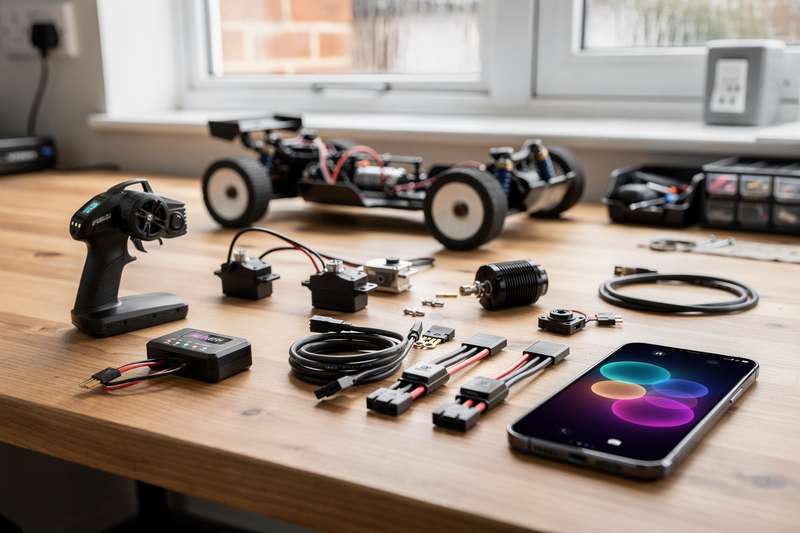
Picture this: you’re in the garden pushing your RC car hard on a gravel path, and suddenly you feel that horrible resistance through the controller — a drive shaft has snapped. You pull the car back, inspect it, and find a component cracked clean through. Or you’ve bought a second-hand RC truck with a stripped steering linkage, shoved it in a cupboard for six months, and finally decided to fix it. Or maybe the car drives fine mechanically but the receiver board died after a puddle encounter, and now the whole vehicle is an inert lump of plastic with a battery in it.
Whatever the specific failure, the next step is the same frustrating process: searching through Amazon listings that give you part names but no clear chassis compatibility, trying to figure out whether “1/16 scale” is specific enough to guarantee a fit, and worrying about whether a cheap replacement is just setting up the same failure two bash sessions from now. Some listings claim “universal” compatibility that turns out to mean nothing useful. Others list model numbers for platforms you’ve never heard of. And the ones that do look right often have no buyer reviews to confirm they actually work.
This guide covers the most practical categories of RC replacement and upgrade parts currently available on Amazon UK — drive shafts, circuit boards, receiver modules, servo arms, steering cups, steering linkages, and suspension arms — with honest assessments of what each part type is for, who it suits, and where the risks lie before you spend money.
How This Guide Was Put Together
Evaluating spare parts isn’t the same as reviewing a finished product. There’s no handling character to describe, no user experience to assess. What matters is whether the part fits its intended chassis, whether the materials represent a genuine improvement over stock, and whether installation is realistic for the buyer’s skill level.
For this guide, I assessed eight RC parts and accessories listed on Amazon UK against four criteria: stated compatibility with known RC platforms, material specification (aluminium alloy versus stock plastic, for example), likely installation complexity, and the overall value case for buying this part rather than discarding the vehicle. Only one product in this selection — the WLtoys 144001 drive shaft — carries a meaningful number of buyer reviews. The remaining seven listings are newer or less established and currently have no buyer review history on Amazon UK. I’ve flagged this clearly in each relevant section, because whether a product has independent buyer feedback is information you deserve before making a purchase decision.
Best Reviewed Drive Shaft Replacement for WLtoys 144001
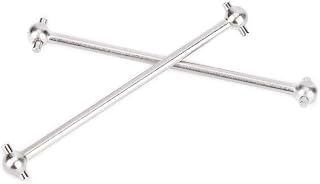
The T best Drive shaft, RC car central drive shaft auto parts accessories for WLtoys 144001 1/14 RC Car,Silver,Medium is the only pick in this guide with a substantial buyer track record — 94 reviews at a rating of 3.9 out of 5 stars — which makes it the most verifiable option in this category on Amazon UK right now.
The WLtoys 144001 is one of the most popular budget RC cars in the UK, and partly as a consequence, one of the most commonly repaired. It’s quick enough to snap its stock plastic central drive shaft on gravel or concrete, and that shaft is precisely what this listing replaces. The “medium” in the title refers to the middle section of the three-part driveline rather than a generic size indicator, so before buying, confirm it’s specifically the central shaft that has broken in your car, not one of the front or rear sections. This listing won’t fix those.
The silver finish and the improved durability reported by buyers suggest a metal alloy construction compared to the original plastic component. At 3.9 stars across 94 reviews, the feedback sits in “useful but imperfect” territory. Most buyers confirm the part fits the 144001 without modification, lasts longer than the stock shaft, and installs without drama. The lower-star reviews tend to mention cosmetic wear on the silver finish after extended use — a purely cosmetic issue rather than a structural one — and occasional installation tightness that requires patience rather than force.
This is a budget-tier part, and you shouldn’t expect performance-aftermarket quality. What you get is a confirmed-compatible replacement that real buyers have used successfully in the exact scenario this guide is about. For 144001 owners who want a metal upgrade without committing to a full driveline conversion kit, it’s the sensible starting point in this category, and the review history means you’re buying with more confidence than the rest of these picks can offer.
One firm caveat: this part is described as compatible with the WLtoys 144001 specifically. It’s not listed as fitting any other WLtoys chassis, and assuming compatibility with the 144018, 124016, or other models in the range is a risk not worth taking. If you’re not running a 144001, the other picks in this guide are your better options.
Best Budget Circuit Board for RC Repair Projects
The Prolong Life Of RC Toys With Durable Remote Control Circuit Board Best Choice For DIY Electronic Circuit Models Remote Control Board Car Rob positions itself as a low-cost solution for reviving RC cars whose electronics have failed but whose mechanical components remain intact. Be clear-eyed about one thing upfront: this listing currently has no buyer reviews on Amazon UK, so there’s no independent purchase feedback to draw on.
The main circuit board in a budget RC car handles several jobs simultaneously: it receives the radio signal, processes steering and throttle commands, and drives the motors. When this board fails — typically due to a short circuit from water ingress, a crash that bends the PCB, or a connector that has finally given up — the car becomes completely unresponsive even if the motors and servos are physically intact. A replacement board that fits and works correctly can restore a seemingly dead car for a fraction of what a new vehicle would cost.
The challenge with any generic circuit board listing is that compatibility is entirely on you to determine before ordering. Replacement boards vary considerably in their connector layouts, motor channel configurations, and operating voltage ranges. If the connectors on the replacement don’t match your existing motor and servo harness, you’ll need to solder. If the board’s channel mapping differs, you may need to re-pair your transmitter or remap channel assignments. This isn’t a job for someone completely new to electronics — but for anyone comfortable with a multimeter and a basic understanding of RC wiring, it’s achievable.
Given the absence of any buyer history, treat this as a project component rather than a proven drop-in solution. Confirm your battery voltage, check your existing connector types, and have a clear wiring plan before committing. The potential to revive a dead RC car for a low outlay is real; the risk is the compatibility uncertainty that comes with any zero-review listing.
Best 7-Channel Receiver Module for Advanced RC Builds
The Dynamic Remote Control Receiver Module RC Circuit Board Best For Remote-Controlled Models Suitable For 7 Channels RC Car Remote Control Part targets builders running more complex RC setups than the standard two or three-channel control most ready-to-run cars use. This listing currently carries no buyer reviews on Amazon UK.
Standard budget RC cars operate on two channels — throttle and steering — or occasionally three if they include a working light switch or other auxiliary function. Seven channels opens the door to significantly more complex builds: a scale crawler with working headlights, brake lights, a winch, and roof LEDs on independent channels, or a model truck with multiple auxiliary outputs. If you’re building or repairing something in that space, a two-channel receiver won’t serve you, and the 7-channel claim here puts this module in the right territory for that kind of project.
The critical compatibility question with any receiver module is protocol matching. Receivers don’t communicate with any 2.4GHz transmitter — only with transmitters using the same radio protocol. Common protocols include FHSS, DSM2, PPM, and SBUS, and they’re not cross-compatible. If you’re replacing a failed receiver in an existing setup, you need a receiver your current transmitter can bind with. If this listing doesn’t clearly specify its protocol — and many generic listings don’t — clarify with the seller before ordering, or accept that there’s a binding compatibility risk going in.
For experienced RC builders doing a complex project or a bespoke repair, this receiver module is worth investigating. For someone new to RC electronics, the next section covers a matched transmitter and receiver kit that removes the binding uncertainty from the equation entirely.
Best Complete Transmitter and Receiver Replacement Kit
The Universal Remote Control And Receiver Kits Best Choice For RC Toy Vehicle Circuit Board Replacement Accessories Remote Control Car DIY Spare addresses a common RC repair situation: the transmitter is lost, broken, or won’t pair with the car, making a standalone receiver replacement insufficient. A matched kit gives you both transmitter and receiver together, already configured to communicate with each other. This listing has no buyer reviews on Amazon UK at present.
The practical advantage of buying a kit over sourcing transmitter and receiver separately is that you know they’ll work together from the moment you power them up. This removes one significant variable from the repair process, and it’s particularly useful if you’ve acquired a vehicle without its original controller, or if both the controller and the car’s receiver were damaged in the same incident.
Where “universal” kits can fall short is in integrating with the car’s existing main board. The kit gives you a matched TX/RX pair, but the receiver still needs to connect to the car’s motor driver and servo via the correct output channels and connectors. If your car’s original main board is intact and you’re just replacing the control system, the question to answer is whether the receiver’s output connectors match your board’s input configuration. If the main board is also damaged, you’ll need to replace it separately — at which point the board, receiver, and transmitter all need to work as a coordinated system.
This listing suits intermediate to experienced RC builders who understand what they’re dealing with in RC electronics. If this is your first RC electronics repair, take time to understand your car’s wiring layout before ordering any components.
Best Aluminium Servo Arm Upgrade
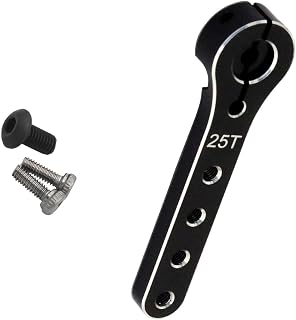
The RC Model With 25T Servo Arm Durable Aluminum Alloy Easy To Install Parts Ensuring Remote Control Aircraft Or Car Stays On Track And Performs targets one of the simplest and most cost-effective improvements you can make to almost any RC vehicle — replacing the stock plastic servo arm with an aluminium equivalent. This listing has no buyer reviews on Amazon UK at present.
The servo arm is the lever connecting your servo’s rotating output shaft to the steering or throttle linkage. In budget RC cars this arm is typically moulded from hard plastic — light but relatively brittle. Cracks in a servo arm create steering slop that worsens progressively with use, even before the arm breaks outright. An aluminium arm removes that failure mode and also reduces flex under load, which produces more direct steering response and more consistent wheel alignment under cornering forces.
The “25T” designation refers to the number of teeth on the arm’s spline hole — the socket that mates with the servo’s output shaft. Twenty-five teeth is the most widely used servo spline standard, covering a large proportion of RC servos sold in the UK. However, before buying, confirm your servo’s spline count. Counts of 23T, 24T, or 27T are not unusual, and forcing an incorrectly matched arm onto a servo output shaft strips the teeth permanently and destroys the servo in the process.
Installation is straightforward: remove the retaining screw, pull the old arm off the spline, push the new arm on in the correct orientation, and replace the screw. One thing to consider before committing to aluminium: in a hard crash, a metal arm transfers impact forces to the servo’s internal gears rather than absorbing them through flexing or controlled breakage, as a plastic arm might. Some RC builders deliberately retain plastic servo arms as crash-protection fuses to shield the servo. Whether you prefer the rigidity of aluminium or the sacrificial approach of plastic depends on your driving conditions and how replaceable the servo is.
Best Steering Cup Replacement for 1/16 RC Cars
The Revitalize 1/16 RC Car Part With Steering Cup Group Designed To Offer Superb Operational Control Strong And Durable. Replace Old Or Damaged targets a component that most RC car owners only think about when something has gone visibly wrong — the steering cup, also known in different RC communities as the hub carrier or steering knuckle. This listing currently has no buyer reviews.
The steering cup holds each front wheel hub, allows the wheel to pivot with steering input, and absorbs lateral forces in cornering. On 1/16 scale budget RC cars these components are typically made from hard plastic that works well until a crash loads the cup from an awkward angle. When a steering cup cracks, steering becomes inconsistent or the wheel alignment collapses entirely — symptoms that look alarming but are often fixable for a modest outlay if you can source the correct replacement part quickly.
The word “group” in this listing’s title suggests it includes a set of related components rather than a single isolated cup. A typical steering cup assembly includes the hub carrier body, the wheel axle pin, and the retention hardware that holds everything together. Buying a group makes practical sense, since when the main cup fails, the associated hardware is often damaged or fatigued as well, and replacing everything at once removes the risk of a secondary failure shortly after the repair.
The compatibility check for any steering cup replacement is non-negotiable before ordering. “1/16 scale” covers many different chassis from multiple manufacturers, and pin hole spacing, socket dimensions, and axle geometry vary significantly between them. If your car came with a parts diagram in the manual, compare your existing steering cup reference number against what this listing describes. A rough visual match from photographs is not enough — dimensions must correspond for the part to seat correctly.
Best Metal Steering Linkage Set
The 2pcs Best RC Steering Rod Pull Link 94123 94103 Metal Upgrade Accessory Front Rear Durable 2pcs RC Metal Upgrade Parts Steering Linkages Pul addresses one of the most accessible upgrade paths in RC car maintenance — replacing stock plastic steering rods with metal equivalents. The listing references compatibility with the 94123 and 94103 chassis designations and comes as a pair covering front and rear positions. This listing has no buyer reviews currently.
Steering linkages — the rods connecting the servo output arm to the steering knuckles — take repetitive load cycles every time the wheels turn. On budget RC cars these rods are typically plastic, which flexes slightly under load (giving a slightly imprecise steering feel) and snaps in a direct hit. Metal rods are stiffer and more resistant to both bending and breaking, and this upgrade offers one of the better cost-to-benefit ratios available in the RC parts world.
The model number references — 94123 and 94103 — are useful because they narrow the compatibility picture far more than a vague “fits 1/10 scale cars” claim would. If your chassis matches those platform numbers, you have considerably more confidence about fit. If it doesn’t, don’t assume the rods will work — steering rod length, thread pitch, and ball-end size vary between platforms, and a rod even a few millimetres off in length can prevent correct wheel alignment from being achieved.
Metal steering rods come in steel and aluminium variants. Steel is stiffer and more impact-resistant; aluminium is lighter but more likely to bend rather than snap under extreme load — which can actually be easier to deal with after a crash than a snapped steel rod. For most RC car applications in normal conditions, either material outperforms stock plastic substantially, and the choice between them is unlikely to matter unless you’re running a particularly heavy or aggressive setup.
Best Upper Suspension Arm Set for 1/16 RC Cars
The Transform 1/16 RC Car Part With Front Rear Upper Swing Arm For Control And Stability Strong And Durable. Replace Old Or Damaged Parts Of Rem targets the upper A-arms that locate each wheel assembly relative to the chassis on 1/16 scale RC vehicles. Upper suspension arms are frequent crash casualties, particularly when the car lands badly from a jump or takes a sideways hit that loads the suspension from an unintended angle. This listing carries no buyer reviews on Amazon UK.
The “front rear” phrasing in the title indicates this set covers both front and rear axles — a practical choice since crash damage to suspension arms often affects multiple corners simultaneously. Replacing all damaged arms in one order avoids the situation where a partially repaired car still handles oddly because one corner has a new arm and the opposite hasn’t been addressed yet.
Suspension arm geometry determines camber angle, roll behaviour, and how tyres contact the surface in cornering. A correctly fitting replacement restores your car’s original geometry. This matters more than it might seem for a component that looks simple in concept: an arm that bolts in but sits at a slightly wrong angle can create handling unpredictability — inconsistent cornering behaviour or uneven tyre wear — that’s difficult to trace back to the arm without knowing to look for it.
Before buying, confirm this set is compatible with your specific 1/16 scale chassis model — not just scale, but manufacturer and chassis variant. Also check whether the listing includes the hinge pins and E-clips needed to locate the arms in the chassis mounts. These small components frequently end up lost when an arm snaps in a crash, and a replacement arm without its mounting hardware is only half a repair. If the listing description is unclear on this point, ask the seller before ordering.
What to Look For When Buying RC Parts and Accessories
- Exact chassis compatibility, not just scale: “1/16” or “1/14” tells you approximate size but not specific fitment. RC parts are built to exact tolerances for specific chassis models. Always cross-reference the listing’s compatibility claims against your car’s exact model number, and where possible compare the replacement’s physical dimensions against the broken original. A linkage a few millimetres too long can prevent correct alignment entirely.
- Material and upgrade value: Upgrading from stock plastic to aluminium alloy or steel is the most common reason to buy aftermarket RC parts. Metal components generally resist crash damage better, but very rigid metal parts can transfer impact forces to adjacent components rather than absorbing energy through controlled failure as plastic might. Match material choice to how you drive and which components you most want to protect.
- Servo spline tooth count: If you’re buying a servo arm, the tooth count must match your servo exactly — 25T is the most common standard but is not universal. Counts of 23T, 24T, and 27T also exist. Forcing an incorrectly matched arm onto a servo output shaft strips the spline teeth permanently. Always check your servo’s specification before ordering.
- Channel count and protocol for electronics: Receivers and control boards must match the channel count and radio protocol of your transmitter. A transmitter and receiver using different protocols cannot communicate regardless of how many channels each supports. When replacing any control electronics, confirm both the channel count and the protocol — one without the other is not enough.
- Included hardware: Many spare parts ship without the screws, hinge pins, E-clips, and bushings needed for installation. These items are expected to survive disassembly of the broken original. Before ordering suspension arms, steering cups, or linkages, check whether the small hardware from your broken part is still intact. If not, source those items separately before attempting the repair.
- Soldering readiness for board-level repairs: Generic replacement circuit boards and receiver modules rarely arrive with connectors pre-matched to your specific car. If you’re buying electronics for a repair project, be prepared to desolder and re-solder connectors to match your car’s harness. A basic soldering iron is a practical tool for anyone doing more than simple plug-in replacements in this hobby.
- Buyer review history: Where a listing has a meaningful review count, that feedback is your most reliable reality-check on real-world fit and quality. Where reviews are absent — as with most picks in this guide — compatibility research and seller communication become more important. Zero-review listings carry more uncertainty than reviewed products; weigh this honestly against the appeal of the part before buying.
Verdict
The clearest recommendation in this guide is for WLtoys 144001 owners who need a central drive shaft replacement. The T best Drive shaft for WLtoys 144001 is the only pick here backed by real buyer experience, and the feedback confirms it does what’s needed: fit the 144001 chassis, outlast the stock plastic shaft, and install without drama. For that specific repair task, it’s the obvious choice in the category right now.
For every other pick — the circuit boards, receiver modules, servo arms, steering cups, linkages, and suspension arms — you’re working with listings that have no buyer history yet. That doesn’t disqualify them; it means you need to carry out the compatibility homework yourself before committing. The What to Look For section above is your framework for that process, regardless of which specific listing you end up choosing.
If you’re new to RC repair and unsure where to start, begin with the mechanical parts rather than the electronics. A broken drive shaft, steering arm, or suspension component is easier to diagnose, easier to match for compatibility, and easier to install correctly than a replacement circuit board or receiver module. Build confidence with the mechanical repairs first, then tackle the electronics once you understand how your specific chassis is put together.
We were not paid to feature any specific product in this guide. All opinions are independent and based on publicly available specifications, verified buyer feedback patterns, and category research.
Quick Comparison Table




FAQ
What does “1/16 scale” mean for RC car parts compatibility?
Scale describes the size of the RC car relative to the real vehicle it represents — a 1/16 scale car is roughly one-sixteenth the size of its full-scale counterpart. For parts compatibility, scale is a useful starting point but not sufficient on its own. Two 1/16 scale RC cars from different manufacturers will typically have different drive shaft lengths, different pin diameters, and different hub carrier geometries. Always confirm your specific chassis model number against the part listing before buying.
How do I find the right replacement part for my specific RC car?
Start with your RC car’s manual or the manufacturer’s parts diagram, which usually includes item numbers for every component. Use that part number to search directly, or compare it against the model numbers referenced in Amazon listings. If you don’t have the manual, your car’s model number — typically printed on the chassis or battery tray — is the key search term. RC hobbyist forums are also a useful resource for chassis-specific parts advice, particularly for popular budget platforms like WLtoys.
Can I use a generic replacement circuit board in any RC car?
Not reliably. Replacement circuit boards need to match your car’s motor connector types, servo output configuration, operating voltage, and channel count. A board that looks physically similar to your original may still fail to work if any of these parameters differ. Generic boards work best when you can compare the replacement directly against a failed board you still have in hand, using it as a reference for connector positions and channel layout before committing to the purchase.
Is aluminium always better than plastic for RC upgrade parts?
Not in every situation. Aluminium is stiffer and more resistant to crash damage in most cases, but rigid metal parts transfer impact forces more directly to adjacent components, which can damage servos or gearboxes that a plastic part would have protected by flexing or breaking first. Many experienced RC builders deliberately keep plastic parts in high-stress positions as sacrificial fuses. The right choice depends on where the part sits in the drivetrain and how you use the car.
What is a 25T servo arm and how do I know if my servo uses it?
The T refers to the number of teeth on the servo arm’s spline hole — the socket that mates with the servo’s rotating output shaft. 25T is the most widely used standard in budget and mid-range RC servos, but counts of 23T, 24T, and 27T also exist in specific brands and servo sizes. Check your servo’s packaging, product listing, or the manufacturer’s spec page to confirm the tooth count before buying a replacement arm. Forcing an incorrectly matched arm onto the spline strips the output shaft permanently.
Do I need to solder when replacing an RC car circuit board?
Often, yes — at least partly. Generic replacement boards rarely arrive with connectors pre-matched to your car’s existing harness, so you may need to swap or re-terminate connectors to match your motor and servo setup. Basic soldering skills and a soldering iron make this manageable. If you’re not comfortable soldering, prioritise boards specifically listed as compatible with your car model — these are more likely to match your existing wiring without modification.