Picture this: it’s a rainy Saturday afternoon, your child is bored, and the tablet is starting to feel like a babysitter rather than an occasional treat. You’ve already tried crafts, board games, and a half-finished jigsaw. What you actually want is something that sparks genuine imaginative play — the kind where they disappear behind a curtain for an hour and emerge having written, directed, and performed three separate shows for the dog. A puppet theatre can do exactly that. But the moment you start searching on Amazon, you’re confronted with a bewildering spread of options: floppy fabric doorway hangers, solid wooden tabletop stages, flat-pack frames, and everything in between. Some look lovely in the photos but arrive with rods that won’t stay put. Others are beautifully built but take up half the living room. This guide cuts through all of that and gives you a clear, honest steer on which theatre suits your space, your child’s age, and how much creative chaos you’re actually prepared to tolerate.
How We Evaluated These Picks
To put together these recommendations, we looked at a combination of verified buyer feedback patterns on Amazon UK, the physical specifications of each product (materials, dimensions, weight, ease of assembly), and what real parents tend to praise or complain about after a few months of use. We filtered out products that were clearly off-topic for this guide — puppets on their own, accessories, or reference books aren’t puppet theatres. We also treated colour and pattern variants of the same model as a single product rather than padding this list with near-identical options. Key criteria included: how quickly and reliably the theatre can be set up and packed away, the durability of the main structure, how well it suits different age groups, storage footprint when not in use, and whether the product genuinely encourages open-ended play rather than gimmick-led novelty. One product in the block carries no reviews at this time, and we’ve flagged that plainly in its section so you can weigh that up yourself.
Best Doorway Puppet Theatre for Quick Setup
The Pop-Up Play Town Puppet Theatre Hanging Doorway is the pick for families who want a theatre that goes up in under five minutes and comes down just as fast. It hangs from a tension rod across a standard doorframe, which means no tools, no drilling, and no dedicated floor space. The curtain drops to give puppeteers a proper hiding place, and children between three and seven years old consistently get a lot of mileage out of it, according to the 127 reviewers who have rated it 4.3 out of 5 stars on Amazon UK.
The fabric construction is clearly the practical choice here: lightweight enough that a child can help put it up themselves, and small enough to fold into a drawer or a storage basket once the show is over. That portability also makes it a solid option if you take it to a grandparent’s house or want to pack it for a holiday cottage stay. The role-play angle is well thought through — the theatre provides a proper stage window that keeps the puppeteer hidden rather than just a draped sheet, which matters when you’re trying to maintain the theatrical illusion for younger audiences (i.e. siblings, amused parents).
The tradeoff is structural rigidity. Fabric doorway theatres flex more than wooden stages, and if your child is enthusiastic about leaning on the frame or pulling the curtain aggressively, you’ll notice that tension rods can slip or tilt. It’s best suited to relatively standard UK interior doorframes; very wide or unusually narrow openings may not work as neatly. The overall aesthetic is cheerful and colourful, which most young children love, though it doesn’t have the craft-quality longevity of a solid wood alternative. Think of it as the easy-going everyday option rather than a long-term heirloom.
For the target age of three to seven, this is probably the most practical choice for most households — low faff, low cost, decent build quality. It’s a solid entry-level theatre that earns the trust of most buyers without demanding much from you in terms of space or setup time.
Best Wooden Tabletop Puppet Theatre for Everyday Play
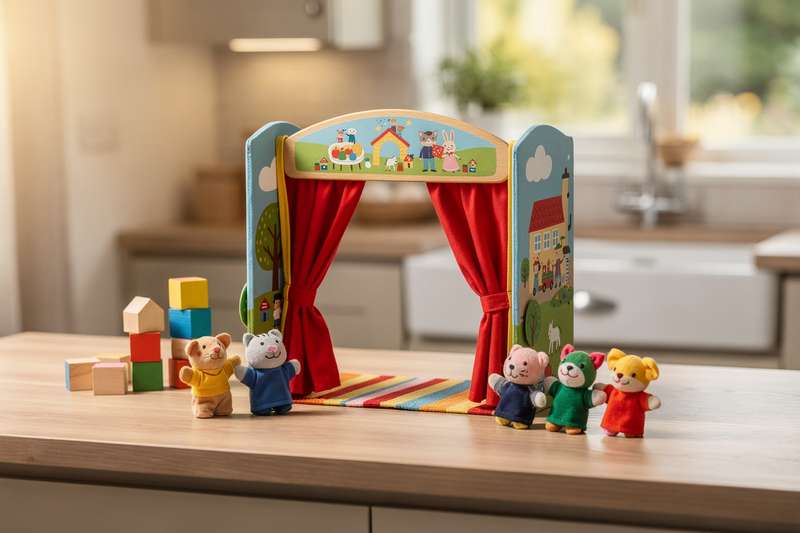
The Le Toy Van Wooden Tabletop Puppet Theatre in red and blue is the pick for parents who want something with real craft quality that can sit on a dining table or playroom shelf and look good doing it. Le Toy Van is a well-regarded name in wooden toys, and this tabletop stage reflects that — it’s solidly constructed, has proper curtains, and gives children a defined performance space that feels like a real theatre rather than a makeshift setup.
At 4.5 out of 5 stars from 23 reviewers, the feedback pool is still relatively modest, but what’s there is consistently positive. Parents highlight how quickly children start using it independently, and how the compact footprint means it doesn’t dominate the playroom. Unlike floor-standing wooden theatres, a tabletop model is easier to move between rooms, store on a shelf, and pull out for impromptu shows. The red and blue colour scheme is appealing without being garish, and the wooden construction holds up to repeated use far better than fabric alternatives.
Where this theatre is less ideal is with very large puppets — the stage opening is proportioned for hand puppets of a standard size, and rod puppets or oversized soft toys may not manoeuvre as freely. Assembly from flat-pack requires a little patience, and the curtains are on the smaller side compared to full-height doorway versions. But for children aged three and above who want a defined, structured play space, it’s a thoughtful choice that grows with them. It’s also the kind of item that genuinely holds its visual appeal — it doesn’t look like cheap plastic clutter, which matters when it’s sitting on a shelf in your living room.
If you’re buying this as a gift, it photographs beautifully and arrives in packaging that makes unboxing feel like an event. That counts for something.
Best Premium Wooden Puppet Theatre for Long-Term Use
The Le Toy Van Wooden Educational Puppet Theatre in natural wood is the theatre for families who want something that will still be standing — and still being used — five years from now. This is a floor-standing, full-height wooden stage with proper theatrical proportions. It’s a premium investment, sitting firmly in the higher price tier, and the 4.0 out of 5 stars from 67 reviewers reflects both genuine satisfaction and the honest frustrations that come with assembling any substantial piece of flat-pack furniture.
The natural wood finish is the aesthetic standout here. Rather than being printed or painted in bold primary colours, it has the calm, Scandi-influenced look that fits comfortably into a well-designed playroom without looking out of place. Children from age three and above are the stated audience, but in practice this theatre works particularly well for children of five and upwards who are ready for more involved storytelling rather than simple hand-waving play. The stage height means children can stand comfortably behind it rather than crouching, which matters for longer performances.
The honest tradeoffs are the size and the assembly time. This is not a theatre you set up in fifteen minutes — allow a proper evening for it, follow the instructions carefully, and have a screwdriver to hand. Once assembled, it’s also not the kind of thing you fold away into a cupboard between uses, so you need a dedicated space for it. The footprint is substantial. If your home is on the smaller side, the tabletop Le Toy Van version above will serve you better. But if you have the space and the budget, and you’re buying for a child who is already enthusiastic about storytelling, creative role-play, or performing for family, this is the theatre that will actually get used rather than gradually migrating to the loft.
The educational angle is genuine rather than marketing spin — a proper stage with a defined audience space really does structure play differently from a blanket over a table. It signals to children that performance is something worth doing properly.
Best Tabletop Wooden Theatre for Gifting
The WodGod Wooden Puppet Theater is designed for tabletop use and is described as suitable for drama performance, role-playing, shows, events, and educational settings. It’s worth being upfront: at the time of writing, this product has no customer reviews on Amazon UK, which means we’re working from the product specifications and the general reputation of tabletop wooden puppet theatres rather than a pattern of buyer feedback.
The wooden construction suggests durability that fabric alternatives can’t match, and the tabletop format keeps the footprint manageable — useful for classroom settings or smaller home playrooms where a full floor-standing theatre would dominate the space. The curtain system allows for a proper backstage area, which is the detail children care most about: they want to be hidden, then revealed. That theatrical logic is sound regardless of the review count.
Because there’s no buyer feedback to draw on, it’s harder to confirm how the curtain rail performs over time, how straightforward assembly actually is, or whether the timber feels solid enough to handle rough play. If you’re risk-averse about buying a zero-review product, the Le Toy Van tabletop option above has an established track record. But if the WodGod is available at a noticeably lower price point and you’re buying for an educational or classroom context where a more relaxed attitude to longevity is fine, it’s worth a look. Just factor in that you’re an early adopter without a community of reviews to consult.
This one sits in the mid-range tier. It would make a practical addition to a nursery or primary school setting, or as a supplementary theatre for a child who already has hand puppets and wants a stage to perform on.
Best Farm Animal Hand Puppets to Go With Your Theatre
The Melissa & Doug Farm Animal Hand Puppets Set is not a theatre itself, but it belongs in this guide because a puppet theatre without puppets is just a decorative frame. This set is consistently one of the best-reviewed puppet options on Amazon UK, holding 4.5 out of 5 stars from 842 reviewers — which is a level of confidence that almost nothing else in this category comes close to matching.
Melissa & Doug is a name that experienced parents tend to trust for good reason: the materials are consistently solid, the faces are expressive without being unsettling, and the sizing works well for children’s hands without being too floppy or too stiff. The farm animal theme — typically including cows, pigs, chickens, horses, and similar — gives children an immediately familiar cast of characters to work with, which lowers the barrier to starting a show. You don’t need to explain who the characters are; children already know them from books and nursery rhymes.
Where this set is less useful is if your child is past the farm animal phase and wants fantasy, dinosaur, or character-based puppets. The farm theme is excellent for children aged three to five but may feel limiting for older children who want more varied storytelling. It’s also worth knowing these are hand puppets rather than finger puppets — they require a full hand inside, so younger children with very small hands may find them a little loose until they grow into them.
If you’re buying a puppet theatre as a gift and want to pair it with something guaranteed to be well received, this set is the safest companion purchase in the category. 842 reviewers have consistently validated it, and that matters.
Best Budget Puppet Set for Young Starters
The Proumhang Hand Puppets With Full Body for Kids is a farm-themed plush puppet set aimed at younger children, sitting firmly in the budget tier. At 4.2 out of 5 stars from 19 reviewers, the sample size is small but positive. Like the Melissa & Doug set, these are companions to a theatre rather than a theatre in their own right — but for families buying their first puppet theatre and wanting to keep the total outlay reasonable, this set gives you a full cast of characters at a fraction of the premium price.
The full-body design is the distinctive feature here. Rather than just a head and hand sleeve, these puppets cover more of the child’s arm, which can feel more immersive for young puppeteers and works well for showing the puppet to an audience over a stage ledge. The plush construction is soft and washable, which is a practical consideration when the target user is under five and prone to enthusiastic drooling and snack-related incidents.
The tradeoff at this price point is that the build quality is naturally less refined than premium alternatives. The stitching and fabric won’t have the same longevity as Melissa & Doug, and with only 19 reviews it’s harder to predict how they hold up over a year of regular use. But for a child who’s just starting to explore puppet play and you want to see if the interest sticks before investing more heavily, this is a sensible starting point. Pair it with the Pop-Up Play Town doorway theatre above and you have a complete setup at a combined budget-tier cost.
It also makes a thoughtful addition to a nursery, playgroup, or childminder’s resource collection where multiple children will handle the puppets and individual longevity per item matters less than having enough variety to go around.
What to Look for When Buying a Puppet Theatre
- Structure type — doorway, tabletop, or freestanding: Doorway theatres hang from a tension rod and require no floor space, making them ideal for smaller homes. Tabletop versions sit on a dining table or low shelf and are easy to store. Freestanding wooden stages need a dedicated corner but offer the most theatrical feel and durability. Match the format to your available space first, then worry about aesthetics.
- Age suitability: Younger children (three to five) do best with simple setups where they can pop up behind a curtain immediately. Older children (six and above) benefit from more structured stages with proper wing space and height, allowing them to develop longer, more complex shows. Check the manufacturer’s age guidance, but also consider your specific child’s level of interest and coordination.
- Materials and durability: Fabric theatres are lighter, cheaper, and easier to store, but they flex and wear faster. Wooden theatres are heavier and take longer to assemble, but they genuinely last for years without sagging or fraying. If you’re buying for a child who plays roughly or you expect high usage frequency, wood is worth the extra investment.
- Ease of assembly and teardown: A theatre that takes 45 minutes to assemble every time it’s used will end up gathering dust. Look for doorway models with easy-clip tension rods and fabric theatres that fold flat. Freestanding wooden stages are usually assembled once and left in place — so make sure you’re happy with the permanent footprint before committing.
- Stage window size: The opening through which puppets perform matters more than it might seem. A wider, taller window gives puppeteers more freedom of movement and makes shows more engaging for the audience. Measure against the puppets you already own or plan to buy.
- Storage and portability: If space is at a premium, look for theatres that fold flat or roll up. Some doorway models pack into a carry bag, which is useful for travel. Freestanding wooden stages are generally not portable but can be disassembled and flat-packed if needed.
- Puppet compatibility: A theatre is only as useful as the puppets it accommodates. Hand puppets are the most common type and work with virtually every theatre design. Rod puppets and marionettes need more vertical clearance and wing space. Check the stage opening dimensions against whichever puppet type your child prefers.
Verdict
For most UK families with children aged three to seven and a typical modern home, the Pop-Up Play Town Puppet Theatre Hanging Doorway is the most practical starting point. It requires no tools, no floor space, and no lengthy assembly — you hang it from a doorframe and the show begins. The 127-reviewer track record and 4.3-star average confirm it delivers on the basics without hidden frustrations. Pair it with the Melissa & Doug Farm Animal Hand Puppets Set and you have a complete, ready-to-perform setup that children can use independently within minutes.
If you have the space and budget for something more permanent, the Le Toy Van Wooden Educational Puppet Theatre in natural wood is the theatre that will still be standing and being used years later. It asks more of you upfront — in time, space, and money — but the return on that investment is a genuinely durable, aesthetically pleasing play fixture rather than a disposable novelty. For children who are already demonstrably enthusiastic about storytelling and performance, that upgrade is well worth making.
We were not paid to feature any specific product in this guide. All opinions are independent and based on publicly available specifications, verified buyer feedback patterns, and category research.
Quick Comparison Table


FAQ
What age is a puppet theatre suitable for?
Most puppet theatres are marketed from age three upwards, which reflects when children typically develop enough hand coordination and imaginative capacity to operate hand puppets independently. Younger toddlers (under three) tend to enjoy watching puppet shows rather than performing them. Older children of six and above usually get more from structured wooden stages that support longer, more complex storytelling, while simpler fabric or doorway theatres suit the three-to-five age range well.
What’s the difference between a doorway puppet theatre and a freestanding one?
A doorway theatre hangs from a tension rod across a door frame and takes up no floor space — it’s quick to put up and easy to store flat when not in use. A freestanding theatre, typically made of wood, stands independently in a room and offers a more stable, theatrical structure with better longevity. Doorway versions suit smaller homes or families who want flexibility; freestanding options suit families with dedicated playroom space and a child who performs regularly.
Do puppet theatres come with puppets included?
Most puppet theatres are sold without puppets — the theatre is the stage, and puppets are a separate purchase. This is worth checking carefully before buying, especially if you’re giving the theatre as a gift. A few combination sets exist, but they tend to be exceptions rather than the norm. The Melissa & Doug Farm Animal Hand Puppets Set and the Proumhang puppet set in this guide are both solid standalone options to pair with whichever theatre you choose.
How do I store a puppet theatre when it’s not in use?
Fabric doorway theatres fold flat and can be stored in a drawer, under a bed, or in a storage bag — many come with one included. Tabletop wooden theatres are compact enough to sit on a shelf. Freestanding wooden stages are generally too large to store easily and work best left assembled in a dedicated corner or playroom. If storage is a concern, prioritise a doorway or tabletop format over a freestanding stage.
Are wooden puppet theatres difficult to assemble?
Tabletop wooden theatres are generally straightforward — they often slot together or use simple connectors and can be assembled in fifteen to thirty minutes. Freestanding floor-standing wooden theatres take longer and typically require basic tools like a screwdriver. Allow a full evening for a large freestanding model rather than assuming it’s a quick job. Once assembled, most wooden theatres are left in place rather than repeatedly taken apart and rebuilt, so you’re really only doing this work once.
Can puppet theatres be used in classroom or nursery settings?
Yes — puppet theatres are a well-established resource in early years education and primary classrooms. They support language development, storytelling, turn-taking, and confidence in speaking in front of others. Tabletop models are particularly practical in school settings because they’re compact, easy to move between spaces, and robust enough for group use. Fabric doorway theatres also work well in classrooms that have suitable doorframes, and they pack flat for storage at the end of the day. Look for robust construction and easy-clean fabric if the theatre will be handled by multiple children daily.