You’ve been eyeing that new route for weeks — a 45-mile loop through countryside you’ve never ridden, a short sharp climb in the middle, and a café stop you’ve been meaning to try. Except every time you attempt something similar, you end up fumbling with your phone at junctions, missing a turning, and either riding an extra four miles or pulling over to stare at a screen you can barely read in direct sunlight. You tried mounting your smartphone to the bars last year. The rubber bracket vibrated loose on a rough descent, and you spent the next ten minutes scanning the verge with your heart in your mouth. Before that, you relied on memory and a rough mileage estimate — which worked fine on familiar roads and failed the moment you took a different turning.
You don’t need to be a competitive cyclist to want better than that. A dedicated cycle computer — even a simple one — gives you accurate speed, real-time distance, and depending on your budget, step-by-step navigation on a screen built to be read at twenty miles per hour in full British sunshine. The challenge is working out which one actually matches how you ride, because the right device for a 5km commute looks very different from the right device for a 300km audax.
What Went Into These Picks
Each device in this guide was assessed across four core criteria: the quality and relevance of the data it displays during a ride, ease of setup and day-to-day use, weather resilience for UK conditions, and battery life relative to the type of riding it suits. Where significant buyer feedback was available on Amazon UK, patterns in what people praised over time and what let them down were factored in. Several picks here are newer or lower-volume Amazon UK listings with limited or no buyer reviews at the time of writing; for those, the assessment draws on published specifications, brand reputation, and established category knowledge. The guide spans a range of device types — from GPS navigators with app connectivity to simple wireless speedometers — because the best cycle computer is the one that matches your actual riding, not the one with the longest specification list.
Best for Intuitive Navigation
The Beeline Velo 2 takes a fundamentally different approach to cycling navigation than almost anything else in this guide. Instead of replicating the smartphone map experience on a small screen, it uses a circular compass-style display with a glowing directional arrow that points you towards your next turn. That sounds like an oversimplification until you try it — and then you realise how little mental bandwidth you spend on route interpretation when you’re also managing traffic, cadence, and road surface. With 641 buyer ratings averaging 4.2 out of 5 stars on Amazon UK, real-world experience broadly supports what the concept promises: most leisure and commute riders don’t need a cluttered map display to find their way.
Route planning happens through the companion app on your smartphone — draw a route, import a GPX file, or use smart routing to get from A to B with minimal setup. Once you set off, the Velo 2 communicates via Bluetooth and handles guidance from there, recalculating if you miss a turning without making the correction feel stressful. The water and shock resistance handles everyday British riding conditions — riding through rain isn’t something you need to think twice about, and the housing copes with the occasional rough dismount. Battery life is claimed at around 11 hours, enough for most full-day rides without hunting for a charging point.
The compact circular form factor is worth noting in practical terms. It sits on the handlebar without dominating the cockpit, doesn’t obstruct a light or bell, and looks tidy on bikes where aesthetics matter. Some riders find the screen limited for reading detailed information on the move — that’s a fair observation, but it’s partly by design. The Velo 2 is not trying to be a comprehensive data display; it’s trying to keep your attention on the road rather than on your computer.
Its limitations are equally worth understanding. If you want speed, heart rate, cadence, gradient percentage, and interval data across multiple configurable screens, this isn’t the right device. There’s no ANT+ support for cycling sensors, no elevation tracking, and no connection to platforms that pull in real-time metrics during a ride. Navigation also relies on an active Bluetooth link to your phone — if your phone battery dies mid-route, the guidance stops. Ride data syncs to the app afterwards rather than being comprehensively displayed on screen during the ride.
The Beeline Velo 2 is best suited to urban commuters adding unfamiliar legs to an existing route, leisure cyclists who like to explore at weekends, and any rider who finds traditional GPS interfaces too busy to deal with at riding pace. At its mid-range price point, it’s a considered tool for a specific type of rider — and that specificity is a strength rather than a limitation.
Best Budget GPS Computer
The GPS Bike Computer (2.4-inch, IPX7) covers the GPS essentials without spending much, and its 335 buyer ratings averaging 4.4 out of 5 stars on Amazon UK suggest real-world satisfaction backs up the spec sheet. At just 50 grams, it’s light enough to feel like an afterthought on the bars — a meaningful consideration if you ride a lightweight build and wince at anything that upsets the balance.
The headline specification is IPX7 waterproofing — a meaningful step up from the IP65 rating found on cheaper wired computers. IPX7 means the device handles brief submersion, not just rain splash or a bottle overspill. In practice for cycling, that means you’re covered in any weather you’d actually ride in, including the sustained downpours that arrive without warning on British roads. That level of waterproofing at this budget tier is not something you should take for granted.
GPS on board means no wheel-speed sensor to install or calibrate — accurate speed and distance come from satellites from the moment you set off, without entering tyre circumference into a setup menu. Gradient and altitude tracking add practical value on hilly routes; seeing the current gradient percentage in real time is more useful mid-climb than reviewing an elevation chart afterwards. The auto-backlight adjusts screen brightness based on ambient light, keeping the display readable across varying conditions. The claimed 28-hour battery is ambitious by GPS computer standards — most mid-range GPS units offer 15 to 20 hours — and real-world figures will vary with screen brightness and GPS refresh settings, but the specification is encouraging for longer days out.
The limitations are predictable for the category. There’s no mapping or turn-by-turn navigation — this is a data-logger and GPS speedometer, not a routing device. ANT+ sensor connectivity isn’t listed in the specification, which suggests it won’t pair with a chest-strap heart rate monitor or cadence sensor using that protocol. App sync and data export capabilities aren’t confirmed in the listing, so if automatic syncing to Strava or similar platforms is important to you, verify that before purchasing.
This device suits recreational cyclists who ride routes they know well and primarily want accurate GPS-derived distance, speed, and elevation data to review. It’s a logical step up from a basic wheel-sensor computer for anyone who wants GPS accuracy without committing to a well-known brand at a significantly higher price. The 335-reviewer rating gives a reasonable base of real-world reassurance that it performs as described.
Best Premium GPS Computer
The Garmin Edge Explore 2 is the only pick in this guide from a brand that has defined what a serious GPS cycling computer looks like. It’s worth noting clearly: this listing had no buyer reviews on Amazon UK at the time of writing, so this assessment draws on Garmin’s well-documented product track record, the Edge Explore line’s standing in the wider cycling community, and the published specification. The Explore 2 is designed for leisure and everyday riders rather than performance-focused athletes — it prioritises map quality, ease of use, and accessibility over deep training analytics, which makes it one of the more approachable Garmin units to live with day to day.
The colour touchscreen is approximately 3 inches — notably generous by handlebar-computer standards — which means maps and turn-by-turn directions are legible at riding speed. Preloaded maps covering the UK and Europe are stored on-device, so you don’t need an active phone connection once you’ve planned and transferred a route. Turn-by-turn navigation is the Explore 2’s core strength: Garmin’s routing infrastructure and rerouting capability is among the most reliable in the market, and seeing upcoming turns displayed clearly on a quality screen is a significant improvement over simplified directional approaches found on budget devices.
eBike compatibility is a forward-thinking inclusion. The Explore 2 can display battery level and motor data from compatible electric bikes, making it one of the more practical choices for riders who own or are considering an eBike. The additional safety features listed in the specification — which typically include incident detection and the ability to alert emergency contacts — are sensible additions for a device aimed at solo riders exploring unfamiliar terrain. The device charges via USB-C, now the standard connector and a practical improvement over older proprietary cables.
Where the Explore 2 steps back compared to Garmin’s more advanced Edge units is deliberate. You won’t find VO2 max estimation, training load scoring, or performance coaching metrics — those features sit higher up the Garmin range. ANT+ and Bluetooth connectivity cover sensor pairing, and battery life is competitive for the category, comfortably handling a full day’s riding. The Garmin Connect platform — shared across all Edge devices — offers route planning via community heatmap data and post-ride analysis, with long-term software support that the brand is known for.
The Explore 2 suits leisure riders, casual bike tourers, and commuters who want full map navigation in a polished, reliable package. If training data is your priority, look further up the Garmin range. If you want the best navigation experience from an established brand in a device you can set up without any particular technical knowledge, this is the right choice.
Best for Long-Distance Touring
The CYCPLUS G1 GPS Bicycle Computer addresses the most pressing need for multi-day touring and audax riding directly: it claims a runtime of over 55 hours — a figure that, if it holds anywhere close to real-world conditions at moderate GPS refresh and mid-range brightness, puts it in a different category from most alternatives. It also carries a 1,200mAh battery, which is a substantial reservoir for a compact cycling computer. This listing had no buyer reviews on Amazon UK at the time of writing; the assessment draws on CYCPLUS’s positioning in the budget GPS cycling segment and the published specification.
The device uses a 2.0-inch display — noticeably smaller than the 2.4-inch screen on the budget GPS pick reviewed above. That size reduction is a significant factor in achieving the extended runtime: a smaller screen draws less power continuously. For core metrics — speed, distance, time, altitude — a 2.0-inch display is workable, but it will feel limited for active navigation. Think of it as a data display optimised for endurance use rather than a mapping device.
IPX6 waterproofing is one step below the IPX7 rating on the budget GPS reviewed earlier, but for cycling it’s fully adequate. IPX6 handles sustained heavy rain from any direction without issue — the kind of conditions you’d encounter on a full day out on exposed Scottish roads or a long Alpine descent in a squall. The auto-backlight function adjusts to changing light conditions, which is practical on rides that start before dawn and extend into the afternoon. At 70 grams, it’s slightly heavier than the lightest GPS options but entirely comfortable in daily use on any standard mount.
The combination of claimed battery longevity, GPS-accurate tracking, and solid waterproofing makes the CYCPLUS G1 specifically valuable for the type of riding where endurance matters most. If you’re completing a 200km event in a single push, spending consecutive days cycling a long-distance route, or heading somewhere with limited charging opportunities, a claimed 55-plus-hour runtime provides a buffer that most GPS computers don’t offer. CYCPLUS has appeared positively in third-party category comparisons for budget touring GPS devices, and the G1’s specification targets long-haul use with some precision.
The caveat, as with all zero-review products in this guide, is that real-world battery performance and long-term hardware durability are harder to verify independently. If community-validated experience matters most to your buying decision, look at the Beeline Velo 2 or the budget GPS pick above. But for touring-specific use where battery longevity is the deciding factor, the CYCPLUS G1 has the specification that fits.
Best Entry-Level Pick
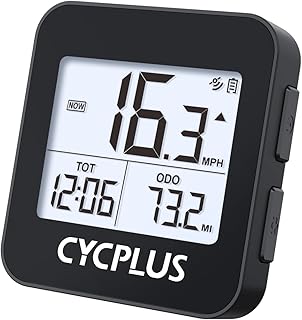
The URAQT Bike Computer is a wireless speedometer and odometer with 19 functions and IP65 waterproofing — a straightforward, low-cost option for riders who don’t need GPS on their handlebars and want something simple that just works. Not every cyclist needs GPS: if you ride the same commute daily, train on familiar roads, and primarily care about knowing your speed and building a running distance total, this covers all of that without the cost or complexity of a GPS unit. This listing had no buyer reviews on Amazon UK at the time of writing, so the assessment is based on the specification and what devices of this type typically deliver in practice.
Nineteen functions from a basic computer covers the essentials: current speed, average speed, maximum speed, trip distance, total odometer, ride time, and a clock, alongside a handful of derived metrics. That’s more than enough for most commuting and casual riding scenarios where you want a reference figure on the bars rather than a training analytics platform. IP65 protection handles rain and road spray adequately — not full waterproofing, but sufficient for a normal British commute in most conditions without complaint.
The wireless sensor is a practical improvement over older wired designs: no cable to route down the fork, no wear point at the junction of wire and head unit, and a cleaner installation on bikes where cable routing is already busy. An LED backlight makes the display readable during autumn and winter when early morning and evening rides are common. The touch-style button operation mentioned in the listing suggests a more ergonomic control interface than the small rubber buttons found on older basic computers — a welcome difference when you’re riding in gloves on a cold morning.
Without GPS, accuracy depends on correctly entering the wheel circumference during setup. Most riders get within a small margin without precise measurement, but odometer figures can drift slightly from GPS-accurate distance over extended use. There’s no elevation tracking, no navigation, and no data export to any platform — this is a display unit for the current ride rather than a training log. If you want to record progress on Strava or a similar service, you’d need to run your phone app simultaneously.
The URAQT suits first-time bike computer buyers, daily commuters who want a simple reference without overhead, and any rider who would rather not risk a pricier GPS unit in a less secure parking or lock-up situation. It’s a clean starting point with low stakes, and the absence of complexity is the point.
Best Classic Wireless Computer
Cateye is one of the most established names in cycling accessories, with decades of product history and a reputation for reliable, unpretentious hardware. The Cateye Velo Wireless Bike Computer reflects the brand’s approach to a simple wireless speedometer: compact, focused, and built to work consistently without requiring much attention. This listing had no buyer reviews on Amazon UK at the time of writing, though the Cateye Velo Wireless series is familiar territory across the cycling community and the brand’s quality control is well documented. The product listing confirms compatibility across road bikes, mountain bikes, and spin bikes — making it one of the more versatile basic computers in this guide if you ride different types of machine or want to move the device between bikes without hassle.
The defining physical characteristic of the Velo Wireless is its size. Cateye’s Velo range has always prioritised a small, tidy profile, and the Wireless model maintains that tradition — it sits on the handlebar without drawing attention to itself, doesn’t obstruct a light or bell, and has a clean display that shows what you need without visual noise. For riders who find larger GPS units imposing or out of proportion on their bike, this matters more than it might seem.
Auto start/stop is a feature that sounds minor until you’ve ridden without it for a while. The computer detects wheel movement and starts timing automatically when you pull away, then pauses when you stop at traffic lights or for a junction check. Your average speed and ride time figures then reflect actual riding time rather than total elapsed time including every pause — and you don’t need to remember to press a button at the start of every ride. For commuters who habitually forget to start tracking until they’re already a kilometre down the road, this is a meaningful improvement.
Core functions cover current speed, average speed, maximum speed, trip distance, total odometer, and a clock — the standard set for this category. The wireless signal from the wheel magnet and sensor transmits reliably in most conditions, and Cateye’s sensor design has a long track record of coping with wet weather without the water ingress issues that affect less careful designs. Setup is relatively straightforward: mount the head unit, attach the sensor to the fork, position the wheel magnet, calibrate the wheel circumference. No app, no account, no firmware update required.
GPS, elevation tracking, cadence, heart rate integration, and app connectivity are not features of this device — they’re deliberate omissions at this level of the market. If you need any of those, look to the GPS picks above. But if you want dependable, low-maintenance speed and distance tracking from a brand with a proven track record in cycling hardware, the Cateye Velo Wireless delivers that consistently. It’s also worth considering for a secondary or training bike where you want data without putting a premium GPS unit at risk of theft or weather damage.
What to Look For in a Cycle Computer
- GPS vs. wheel sensor: GPS computers derive speed and distance from satellite positioning — no sensor to install, elevation data included, and no need to measure tyre circumference. Wheel-sensor computers are simpler, cheaper, and often have better battery intervals, but accuracy depends on correct wheel circumference input. Choose GPS for precise tracking across varied terrain; choose wheel sensor if you prioritise simplicity above all else.
- Navigation capability: Navigation ranges from none (basic speedometers), through simplified arrow-based directional guidance, to full colour map displays with turn-by-turn routing. If you regularly ride unfamiliar routes, decide how much screen real estate you want to give to maps — and whether you need the route displayed on-device or are happy with a directional prompt.
- Screen size and readability: A 2.0-inch screen displays a handful of data fields clearly. A 2.4-inch screen fits more. A 3.0-inch or larger screen enables proper map navigation. Larger screens add weight and increase power draw. Think about your primary use: data display requires less real estate than active navigation.
- Waterproofing rating: IP65 handles rain and road spray. IPX6 handles sustained heavy rain from any direction. IPX7 handles brief submersion. For most UK cycling conditions, IPX6 or IPX7 is the level worth seeking. IP65 is adequate for typical commuting but can struggle in extreme weather.
- Battery life: Match battery life to your longest typical ride, not your average commute. Six-hour day rides are fine with most GPS computers. Multi-day touring or long-distance events need 20-plus hours in GPS mode. Non-GPS computers on coin-cell batteries can last an entire season between changes.
- Sensor compatibility: ANT+ is the cycling-specific standard for heart rate monitors, cadence sensors, speed sensors, and power meters. Bluetooth is more universal and works with smartphones too. Many current GPS computers support both simultaneously. If you already own a sensor, check its protocol and confirm your chosen computer supports it before buying.
- App and data sync: If you log rides on Strava, Komoot, or a similar platform, check whether the computer syncs automatically over Wi-Fi or needs a manual USB connection after each ride. Auto-sync removes the friction of keeping your ride log current. Basic computers without connectivity don’t export data at all — you’d need a phone app running in parallel for that.
Our Verdict
For the majority of UK cyclists reading this — someone who wants reliable navigation, accurate ride data, and a device that works without making setup feel like a project — the Beeline Velo 2 is the pick that best balances accessibility and day-to-day practicality. Its 641 buyer ratings at 4.2 stars provide solid real-world reassurance, and the arrow-based navigation is better suited to riding pace than a miniaturised map display for most leisure and commuting use cases. The water and shock resistance handles everyday British conditions comfortably, and the 11-hour battery covers most full-day rides without drama.
If full-colour map navigation from a brand with a long track record is your priority, the Garmin Edge Explore 2 is the appropriate step up — designed precisely for leisure riders who want the best navigation experience without the complexity of a performance training platform. For cyclists who regularly spend long days or multiple days in the saddle, the CYCPLUS G1’s claimed 55-plus-hour battery life makes it the specialist touring pick. And if you simply want to know your speed on familiar roads without any overhead, the URAQT or Cateye Velo Wireless covers that need at minimal cost.
This guide was not produced in partnership with any brand, and no products were provided for review. All opinions are independent and based on publicly available specifications, established brand knowledge, and verified buyer feedback patterns where available.
Quick Comparison Table




FAQ
Do I need GPS on a cycle computer?
Not necessarily. GPS gives you accurate speed and distance without any sensor setup, plus elevation tracking and — on more capable devices — turn-by-turn navigation. But if you ride familiar routes and don’t need to export data to a training platform, a basic wireless computer with a wheel sensor covers the same core metrics for considerably less money and with simpler setup.
Can I use my phone instead of a cycle computer?
Your phone can replicate most of what a cycle computer does, but it drains battery faster, is harder to read in direct sunlight, and is more vulnerable to vibration and water damage in a handlebar mount. A dedicated cycle computer is typically more durable, draws far less power, and has a screen designed specifically for outdoor readability at riding speed — making it easier to glance at without losing focus on the road.
What is the difference between ANT+ and Bluetooth sensor pairing?
ANT+ is the protocol used for cycling-specific sensors — heart rate straps, cadence sensors, speed sensors, and power meters. Bluetooth is a more universal standard that also works with smartphones. Many current mid-range GPS computers support both simultaneously, giving you broad compatibility. If you own a specific sensor, check its protocol before choosing a computer to make sure they can communicate.
How long do cycle computer batteries typically last?
Basic wireless computers running on a replaceable coin-cell battery can last an entire cycling season between changes — often six months or longer. GPS computers draw considerably more power and typically offer between 15 and 55 hours of runtime depending on screen brightness and GPS settings. Always match the specification to your longest planned ride rather than your typical session to avoid being caught short mid-route.
Can I sync a cycle computer with Strava?
Most GPS cycle computers can sync ride data to Strava, either directly over Wi-Fi after a ride or via a companion app on your phone. Basic wired or wireless speedometers without connectivity don’t link to any platform — you’d need to run Strava on your phone simultaneously if you want a digital ride log. Always check the specific device’s connectivity features before assuming Strava sync is supported.
Is a cycle computer worth buying for everyday commuting?
For commuting on a fixed route, a simple wireless speedometer gives you speed and mileage tracking with minimal setup and no ongoing maintenance. If your commute involves unfamiliar roads or you want to track fitness progress over time with platform integration, a GPS unit becomes more worthwhile. The practical advantage of a dedicated computer over a phone app for commuting is battery life, durability, and screen readability across varying weather and light conditions.