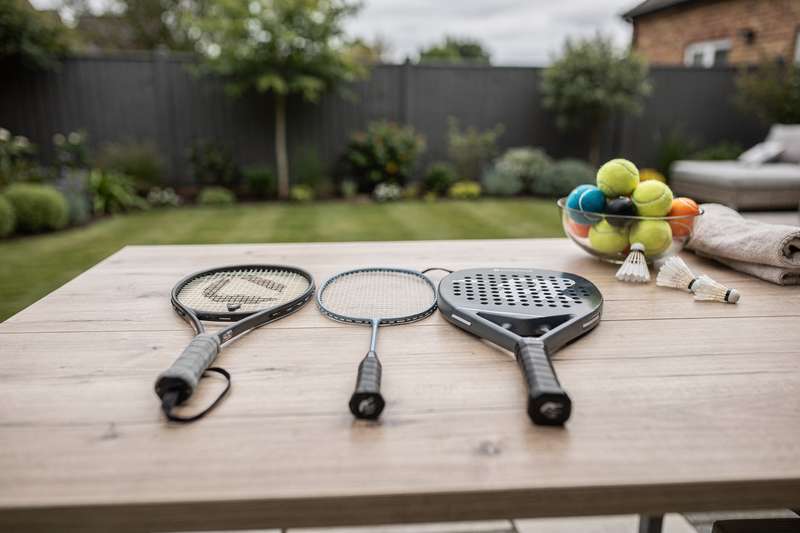
Choosing a racquet sounds simple until you realise just how broad the term is. Tennis, badminton, padel, table tennis — each of these sports demands entirely different equipment, and a frame that works perfectly for one is useless for the others. If you have landed here after searching for best racquets on Amazon, you have probably already noticed that results mix sports freely: a solid carbon-fibre padel bat sitting next to a featherweight badminton frame sitting next to a recreational tennis two-player set, with none of the listings making it easy to compare across categories.
The confusion runs deeper than category labels. You are not sure whether a pre-strung frame is better than buying unstrung, whether graphite outperforms aluminium at your level, or whether that appealing two-player bundle actually holds up after more than a few casual rallies. Perhaps you borrowed a racket at a club session and found it uncomfortable — too heavy, too whippy, or strung so loosely the ball felt dead on contact. Or you want something for garden play and cannot separate the worthwhile options from the filler.
This guide covers the best racquet options on Amazon UK across all four major racquet sports: tennis, badminton, padel, and table tennis. Each pick is matched to a specific need and buyer type, so you can go straight to the sport that applies to you and find a recommendation that actually fits your situation.
How These Picks Were Chosen
Evaluating racquets across four sports means applying different criteria to each category. For tennis and badminton, the key factors are frame material (graphite versus aluminium alloy), weight, balance point, pre-string tension, and grip size. For padel, frame shape, foam core composition, and overall racket weight are the main performance drivers. For table tennis, rubber quality and blade construction determine how much the equipment supports or hinders developing technique.
Where products carried verified buyer feedback on Amazon UK, review patterns shaped the assessment — recurring complaints and consistently praised features both carry significant weight. Several products in this guide carry no buyer reviews at the time of research; for those picks, assessment draws on brand reputation, published specifications, and how the product sits relative to comparable options in the wider market. Each zero-review pick acknowledges this explicitly in its own section. The padel racket from RYZE and the tennis options from Wilson and PUREFIT carry the strongest review-based evidence in this guide; the Yonex badminton entries and PRO-SPIN table tennis set are assessed on specifications and manufacturer track record alone.
Best Padel Racket
The RYZE PEGASUS Padel Racket is the standout pick across this entire guide, backed by 535 verified reviews and a 4.7-star rating on Amazon UK — more real-world evidence than any other product here, and the feedback is consistently strong across a wide range of buyer types.
Padel is the fastest-growing racquet sport in the UK, and the equipment works quite differently from tennis. Padel rackets are solid frames with no strings on the hitting face. Instead, a rubber-faced foam core absorbs and releases the ball, and the stiffness or flexibility of that foam defines how the racket plays. The RYZE PEGASUS uses EVA-17 flex foam, which occupies a productive middle range on the hardness spectrum: firm enough to generate power on volleys and attacking shots, but with enough give that mishits do not send unpleasant vibrations travelling up your arm. This balance suits all-round players and makes the racket forgiving without feeling sluggish or imprecise.
The frame is built from 100% carbon fibre. At this price tier, carbon offers a meaningful advantage over fibreglass alternatives: a better strength-to-weight ratio, more predictable flex response, and better durability against the incidental contact that padel courts produce — the glass walls and metal mesh surrounds mean rackets take more knocks than in tennis. The RYZE PEGASUS weighs around 360 grams, which sits squarely in the standard padel range and feels balanced rather than head-heavy, suiting all-round play from both the baseline and the net.
Buyer feedback patterns consistently highlight how well this frame holds up across extended playing sessions. Structural failures and foam delamination — the common failure modes for cheaper padel rackets — do not appear as recurring complaints in the reviews. A small number of buyers mention the grip running slightly thin and recommend adding overgrip tape over it, which costs very little and takes under a minute to apply. Given the overall review volume and the consistency of the feedback, this minor fit issue does not change the recommendation.
Who is this for? If you have been playing padel at a local club using hire or borrowed equipment and are ready to own your own frame, this is the natural first purchase. It gives you enough quality to develop your game properly without the premium pricing that specialist padel brands typically carry. It also works well as a gift for anyone who has recently discovered the sport — specific enough to be useful, broad enough in its performance profile to suit different playing styles. One realistic caveat: padel rackets are less forgiving of fundamental technique errors than oversized tennis frames with large sweet spots, so a few coaching sessions alongside this purchase will help you extract more from the frame more quickly.
Best Tennis Racket for Beginners
The Wilson Federer Adult Tennis Racket carries a name that resonates across the tennis world, and while this entry-level frame shares little with the competition sticks Roger Federer actually played with, it reflects Wilson’s understanding of how new players need to be introduced to the sport.
Wilson’s Federer series has been a dependable introductory line for years. The Black/White Series version listed on Amazon UK holds a 4.6-star rating from five reviewers at the time of research — a small sample, but a positive signal from people who have actually hit with it. With limited reviews to draw on, this assessment also leans on what the product’s design specification and Wilson’s established positioning tell us about its intent.
Beginner tennis rackets in this category typically feature a larger head size than intermediate frames — often exceeding 110 square inches — which expands the hitting zone and makes timing less critical when your consistency is still developing. They are also strung at lower tensions than competitive frames, which means the string bed produces a trampoline-like rebound that helps generate pace even on slower, shorter swings. For someone still building their groundstroke mechanics, this significantly reduces the early frustration of hitting frames and sending balls into the net on a regular basis.
The Various Bundle Options noted in the listing title suggest you can pair the racket with accessories — extra balls or a carry bag — depending on which version you select at checkout. If you are buying for a complete beginner, checking what the specific bundle includes before confirming your order is worth a moment’s attention: an all-in-one option that includes balls removes one barrier to getting on court that same week.
The honest tradeoff is that the Wilson Federer series has a hard ceiling. If you have been playing regularly for six months or more and are starting to generate real topspin with meaningful pace, you will find this frame too light and the string bed too lively for the game you are developing. It is a starting point, not a long-term option, and Wilson are clear about that positioning. For the reader just booking a beginner course, practising between lessons, or buying for a family member new to tennis, this is a low-risk purchase from a brand with genuine pedigree in the sport.
Best Budget Tennis Set
The PUREFIT Tennis Racket Set 2 Players takes a different approach to getting started: rather than a single dedicated frame, it bundles everything two people need in one purchase — two aluminium-frame rackets, two tennis balls, two spare grips, and a carry bag.
With 12 reviews and a 3.7-star rating, this is the lowest-rated product in this guide, and that requires direct acknowledgement. Buyers who purchased it for casual garden or park rallies generally found it adequate for the purpose. Those who expected a higher level of performance were let down, citing variable string tension between the two rackets and limited power output when driving groundstrokes. This is not a product that competes with dedicated racket brands on quality — it is a convenience purchase, and approaching it as such is the right mindset going in.
That said, the convenience value is real for a specific buyer. If you want to introduce two people to tennis without spending on two separate frames — a parent and child, two friends trying the sport together for the first time — a bundled set eliminates the friction of buying each component separately. The inclusion of spare grips is a practical detail that buyers often overlook when assessing value: grip degradation is one of the first things to frustrate new players, and having replacements in the bag saves an unnecessary accessories trip and keeps the set feeling fresh for longer.
The aluminium alloy frame construction is heavier and less responsive than graphite. Aluminium flexes more unpredictably on off-centre hits, and the added weight compared to dedicated beginner graphite frames can contribute to wrist and elbow discomfort over longer sessions. For 30-minute garden rallies, none of this matters much. For players who want to develop consistently and practise regularly, the limitations become apparent quite quickly. The carry bag is functional rather than premium — adequate for transporting to a local park, but not built for daily club commuting.
The PUREFIT set suits people who want to try tennis before committing to proper equipment, or households that host occasional social games without needing anything more. If you already know you want to improve and play regularly, skip this and spend the money on a dedicated beginner frame. For first-time casual play between two people with no prior gear and no certainty they will stick with the sport, this set provides a complete starting package at minimal cost.
Best Lightweight Badminton Racket
At just 77 grams, the Yonex Nanoray Light 18i Graphite Badminton Racquet is the lightest frame in this guide, and that single figure defines its playing character almost entirely.
In badminton, racket weight has a direct and measurable impact on how the game feels. Lighter frames accelerate faster through the swing arc, which translates to quicker net exchanges, faster defensive clears, and better reaction time when you are under pressure in a rapid forecourt rally. For players who favour a reactive, speed-oriented game — lots of net play, doubles formations, rapid redirections — a 77-gram frame is the right tool for the job. The tradeoff is straightforward: lighter frames carry less mass behind overhead smashes, which means power-focused play from the back of the court is not where this racket excels.
Yonex is one of the most respected badminton manufacturers globally, and the Nanoray series has built its reputation specifically around speed-oriented play. The graphite construction is a meaningful differentiator at this price point — graphite gives a stiffer, more responsive shaft than aluminium alternatives, meaning the frame responds more predictably to your swing mechanics. The racket comes pre-strung at 30 lbs tension and includes a full-cover case, making it ready to play straight from the packaging with no additional setup required.
A note on reviews: this product carries no verified buyer feedback on Amazon UK at the time of research. This assessment draws on Yonex’s established track record in the Nanoray product line and on general knowledge of 77-gram graphite rackets as a performance category. The absence of UK reviews is not inherently alarming for an established brand with a long-standing product series, but buyers should factor this into their decision-making, particularly if purchasing without the ability to try the frame first.
The included full-cover case is worth highlighting as a practical bonus. Badminton shafts are noticeably thinner and more fragile than tennis or padel frames, and unprotected storage — leaning against a wall, tossed into a bag without cover — leads to dents and distortion over time. Having a dedicated case from day one builds the storage habits that keep the frame performing correctly for longer. For recreational club play, doubles games, and anyone developing a defensive net-based style, the Yonex Nanoray Light 18i is a well-specified entry into the speed end of Yonex’s badminton range.
Best Badminton Racket for Power Play
The Yonex Astrox Smash Badminton Racket comes from Yonex’s Astrox series — the range built around rotational smash power — and brings a noticeably different playing character to the Nanoray Light 18i above.
The defining feature of the Astrox series is head-heavy balance: more of the racket’s mass is distributed toward the top of the frame. This creates additional momentum through the downswing when you are driving an overhead smash from the back court. More mass at the point of contact means more force transferred to the shuttle — the physics is straightforward, and it produces a meaningful difference once your technique has developed enough to exploit it. Players who have moved past the beginner stage and are actively building a power-based attacking game will feel that extra weight working in their favour on full smashes and jump smashes.
The black and red colourway is clean and distinctive, and the build reflects Yonex’s quality standards at this price point. Like the Nanoray Light 18i, this product carries no verified buyer reviews on Amazon UK at the time of research. The assessment relies on the Astrox series’ established reputation as a power-oriented line and on the frame’s published specification. Buyers already familiar with what head-heavy balance means in practice will find the decision relatively straightforward.
The tradeoffs are the direct flip side of the Nanoray’s strengths. A head-heavy balance means slower redirections on quick exchanges. In doubles net play — where you are often blocking, flicking, and repositioning in rapid succession — the Astrox Smash will feel less nimble than a lighter, more neutral frame. Players who frequently operate at the net in mixed doubles should weigh whether the smash-power benefit outweighs the loss of pace in the forecourt. For singles baseline play, this concern largely disappears.
Grip size and pre-strung setup are standard Yonex fare. For recreational and club-level play, the factory stringing specification is adequate, though more experienced players typically have their frames restrung to a personally preferred tension by a specialist rather than using the manufacturer default. For anyone developing a power-based singles game and looking to step up from a generic aluminium frame, the Yonex Astrox Smash is a logical and well-specified choice from a brand with real authority in the badminton market.
Best Badminton Set for Two Players
The Yonex GR 303 Combo Badminton Racquet brings Yonex’s brand reliability to the beginner end of the market in a practical two-racket format, with each frame packaged alongside its own full-cover case — making this one of the more complete out-of-the-box badminton purchases in this guide.
The GR series represents Yonex’s entry-level range. You are getting Yonex build standards and brand reliability, but not the graphite construction of the Nanoray or the power geometry of the Astrox. Frames at this level typically use steel or aluminium alloy shafts, which are heavier and less responsive than full graphite. The tradeoff is durability and cost: entry-level frames tolerate rough beginner handling better than more delicate high-performance options, and the price makes the GR 303 Combo accessible without significant financial commitment.
Buying two rackets in one listing solves a practical problem: ensuring both players are using comparable equipment. If one player is swinging a premium graphite frame and the other is using an off-brand aluminium rod, the game feels unbalanced. A matched pair from the same series eliminates that friction and means both players can assess the sport on equal terms from the start.
Like the other Yonex entries in this guide, the GR 303 Combo carries no verified buyer reviews on Amazon UK at the time of this research. Yonex’s GR series has been a fixture in the recreational badminton market for a considerable time, and a product line that consistently underperforms does not maintain a long shelf life — that context lends some confidence to the continued listing. Each racket comes with a full-cover case, which is a practical inclusion that matters more for badminton than for heavier racquet sports: the thinner shaft and frame profile of badminton rackets make them more susceptible to dents and distortion during casual storage and transport.
This set suits the parent whose children have taken up badminton at school club, two flatmates who want to take a set to the park, or siblings looking for a shared activity. For households that need more than two rackets, additional frames would need to be purchased separately. For the specific scenario of two people starting out together, the Yonex GR 303 Combo is a sensible, complete, and accessible starting point from a brand with a long track record in badminton.
Best Table Tennis Bat Set
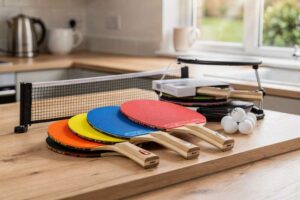
The PRO-SPIN Table Tennis Bats High-Performance Set is the only non-court option in this guide, and table tennis earns its place here — it remains one of the most widely played racquet sports in UK households, university common rooms, and community leisure centres.
PRO-SPIN describes this as a high-performance set, which warrants some context calibration. In the table tennis accessories market, high-performance at this tier means noticeably better than the bare bats that come bundled free with budget fold-out tables — not competition-grade equipment for club players with developed technique. The set includes two premium table tennis bats (bat is the standard UK term for this equipment), 3-star balls, and a compact storage case. The 3-star ball specification is the detail worth noting: these match the weight, bounce, and flight characteristics used in official competitive play. Using sub-standard balls when learning the sport means developing feel and touch for equipment that does not reflect real play conditions, which creates habits that have to be corrected later.
Like the Yonex badminton entries, this set carries no verified buyer reviews on Amazon UK at the time of research. PRO-SPIN has a wider presence in the table tennis accessories market, with a positive brand reputation built across its broader product range. Prospective buyers should factor in the absence of UK-specific verified reviews when making their decision.
Rubber quality is the central consideration for any table tennis bat purchase. Cheap rubber sheets produce inconsistent spin response and unpredictable bounce, which actively hinders technique development. PRO-SPIN bats in this series use multi-layer rubber construction that at least allows your developing spin and pace to be expressed through the bat, rather than fighting against the equipment — the most common complaint levelled at bottom-shelf options. PRO-SPIN also offers a more compact version of this set for buyers with a tighter initial budget, available separately on Amazon UK.
The compact storage case is a practical inclusion that is easy to overlook on a spec list. Table tennis bats warp when stored near radiators, in hot car boots during summer, or on sunny windowsills — a dedicated case protects the rubber surface and builds the habit of storing the equipment correctly. For the vast majority of buyers — family game nights, office spaces, beginner club members — this set provides everything needed in one purchase without the complexity of assembling individual components separately.
What to Look For When Buying a Racquet
- Frame material: Graphite (carbon fibre) offers a better strength-to-weight ratio and more predictable flex than aluminium. For badminton especially, a graphite shaft makes a meaningful difference to feel and response even at beginner level. In padel, carbon fibre construction is worth seeking out if you plan to play more than occasionally. Aluminium is heavier and less responsive but more affordable and resistant to rough handling.
- Weight and balance: In badminton, weight in grams and balance point (head-heavy versus head-light) determine whether a frame suits power or speed play. In tennis, a heavier frame absorbs more vibration and puts more mass behind the ball but requires more physical effort to swing throughout a match. In padel, the 350–380 gram range is standard — rounder frame profiles tend to be more forgiving, while diamond-shaped heads favour attacking play from set positions.
- String tension: Pre-strung rackets are ready to play from the packaging and factory tension is appropriate for most beginners. Lower tension creates a livelier, more powerful string bed; higher tension gives more control at the cost of some power. Intermediate and developing players often benefit from having their frame restrung by a specialist once they have identified their preferred playing style.
- Grip size: Most rackets come in standard adult sizes, but the diameter of the handle matters for comfort and arm health. If a grip is too thin, an overgrip — inexpensive, widely available, and easily replaced — adds circumference and solves the problem immediately. Erring on the smaller side when uncertain is safer, since it is far easier to build up a grip than to reduce one.
- Single frame versus bundled set: Two-player bundles are convenient but typically use mid-spec equipment for both players. If one player is more committed to the sport than the other, or if skill levels differ significantly, separate dedicated frames tend to serve better over time than a matched bundle optimised for shared entry-level use.
- Sport specificity: Padel, tennis, badminton, and table tennis equipment is not interchangeable. Each sport’s rules govern the dimensions, weight, and construction of its rackets, and equipment designed for one sport performs poorly in another. Confirm which sport you are buying for before purchasing — getting this wrong is an expensive mistake that returns processes do not always resolve cleanly.
- Included accessories: Cases, balls, shuttlecocks, and spare grips add real-world value to a purchase. A racket without a carry case is more vulnerable to damage during storage and transport. Check whether listed accessories are included or sold separately before adding to basket.
Verdict
For readers who know which sport they are buying for, the recommendation follows directly from the relevant section above. For the guide’s broader reader — someone who wants the single most confidently backed option across all four categories — the RYZE PEGASUS Padel Racket stands apart. More than 500 verified UK buyer reviews at 4.7 stars is a level of evidence no other product here comes close to matching, and padel’s rapid growth across UK venues means there is a good chance you are already near a court that can make use of it.
For tennis-focused buyers, the Wilson Federer Adult Tennis Racket is the cleaner single-frame choice for beginners — established brand, appropriate specification for developing players, and no extra purchases required to start playing. The PUREFIT set belongs in the conversation only if you specifically need two frames in one buy and are comfortable with the quality ceiling it comes with.
For badminton, the choice between the Nanoray Light 18i, the Astrox Smash, and the GR 303 Combo depends entirely on how you play or plan to play — speed game, power game, or shared beginner use. None of these three is a wrong choice for its intended context. The PRO-SPIN table tennis set rounds out the guide as the logical option for anyone equipping a household games space or wanting proper table tennis equipment without the hassle of sourcing components separately.
We were not paid to feature any specific product in this guide. All opinions are independent and based on publicly available specifications, verified buyer feedback patterns, and category research.
Quick Comparison Table


FAQ
What is the difference between a padel racket and a tennis racket?
Padel rackets are solid frames with no strings on the hitting face — a rubber-covered foam core does the work of absorbing and returning the ball. They are also shorter than tennis rackets and feature a perforated hitting surface. The two types are not interchangeable: padel rackets are designed specifically for an enclosed court with glass walls, and attempting to use one for tennis (or vice versa) will damage the equipment and produce very poor results on court.
Do I need a graphite badminton racket to play properly?
Graphite frames are lighter, stiffer, and more responsive than aluminium, and they do make a meaningful difference to technique development and overall feel. That said, complete beginners and casual players are unlikely to notice the gap during their first several sessions — an aluminium or aluminium-reinforced frame is perfectly adequate for learning the basics without overspending. Once you are playing at least once a week and starting to develop specific skills, upgrading to graphite is a worthwhile step.
What grip size should I choose for a tennis or badminton racket?
Most adult rackets come in a standard grip size that fits the majority of hands adequately. A simple test: hold the racket in your normal playing grip and try to fit your other hand’s index finger in the gap between your fingertips and the base of your palm — approximately one finger’s width of space is the target. If the grip is too thin, an overgrip (inexpensive, easily replaced, and widely available) adds circumference and solves the problem immediately.
What does pre-strung mean and does it matter for beginners?
A pre-strung racket comes ready to play straight from the packaging — no trip to a pro shop required. For beginners, pre-strung is almost always the right choice: you can get on court immediately and the factory string tension is appropriate for a developing player’s needs. Rackets sold as unstrung need to be strung before first use, which adds cost and waiting time that most beginners have no reason to incur.
Can I use the same badminton racket for both singles and doubles play?
The same racket can physically be used for both formats, but performance characteristics differ significantly between them. Doubles rewards lighter, head-light or even-balance frames that allow fast net reactions and quick redirections; singles play often favours slightly heavier, head-heavy frames that generate smash power from the back of the court. If you play both formats regularly, an even-balance mid-weight frame is the practical compromise that avoids significantly sacrificing either quality.
How should I store a racket to make it last longer?
Always keep your racket in a carry case, away from direct heat sources — radiators, car boots in summer, and sunny windowsills can all warp frames and degrade string tension over time. Replace grip tape or overgrip when it becomes slippery or compressed, since a worn grip increases the pressure you apply and can contribute to arm fatigue and strain. For badminton frames specifically, avoid leaning them unsupported against walls, as the thin shaft and head can gradually distort under their own weight if stored at an angle over extended periods.