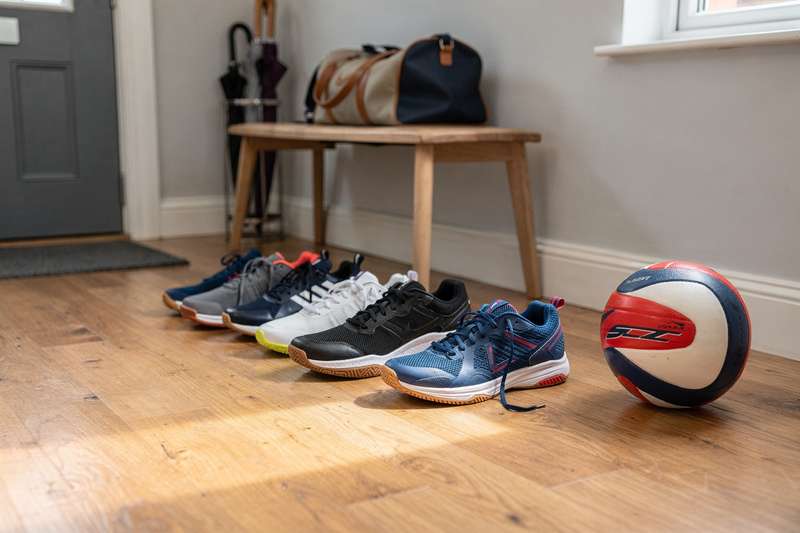
You’ve found a volleyball club you like. You’re showing up twice a week, your serve is improving, and you’re starting to understand the positional rotations. But your footwear is quietly working against you. On a sharp lateral cut to retrieve a ball that’s drifted wide, your cross-trainers slide on the polished gym floor — not enough to fall, but enough to put you half a step behind where you need to be. After a blocking session, your knee aches in a way it didn’t before you started playing. You try running shoes: too much heel cushioning, too little court feel, and the grip pattern is optimised for asphalt rather than polished wood. You borrow a friend’s basketball shoes: heavier, stiffer, and the sole compound doesn’t behave the same way on sports hall flooring.
The root problem is that volleyball has a very specific set of movement demands — explosive vertical jumps, repeated lateral direction changes, sudden stops from full speed, low defensive stances with wide foot positioning — and footwear not engineered for those patterns creates real performance and injury risks. Wrong shoes slow your reaction time, reduce your traction when you need it most, and transfer impact into your joints rather than absorbing it. Getting the right volleyball shoe isn’t about brand loyalty or aesthetics; it’s about matching the engineering of the shoe to the biomechanics of the sport. This guide does that job for you, covering the best volleyball footwear currently available on Amazon UK across a range of budgets and playing levels.
How These Picks Were Selected
Volleyball footwear on Amazon UK shares search results with badminton shoes, squash shoes, water shoes, and a range of generic multi-sport listings that mention volleyball as one of a dozen compatible activities. Filtering to relevant options required applying consistent criteria: traction performance on the polished wood and synthetic surfaces found in UK sports halls; lateral stability to brace the foot during direction changes; cushioning appropriate for volleyball’s impact loading patterns; breathability for sustained training sessions; and lockdown — the shoe’s ability to keep your foot secure through explosive movement without restricting blood flow.
Where a shoe had a substantial pool of verified buyer feedback from people using it specifically for court sports, that feedback carried real weight. Brand heritage in court sport engineering mattered too — manufacturers with dedicated volleyball shoe lines have had more opportunity to refine the specific demands of the sport than brands adapting general athletic shoes. One product in this guide has a significantly smaller review count than the others; this limitation is clearly flagged in its section, and the assessment for that shoe relies more heavily on specification than on deep buyer feedback patterns. Off-category products — including water shoes and zero-review listings — were excluded entirely.
Best Overall Volleyball Shoe
The Mizuno Wave Momentum 3 is the most complete volleyball shoe in this guide, rated 4.6 out of 5 from 163 Amazon UK reviewers — and that score reflects genuine volleyball performance rather than first-impression comfort or appealing design. If you could only buy one pair and needed it to handle every position and every phase of play, this is it.
Mizuno has been building volleyball footwear for decades, and the Wave Momentum line represents their current understanding of what a performance volleyball shoe should do. The third generation of this model refines the cushioning response and overall weight profile of earlier versions, with the midsole tuned to return energy during take-offs rather than simply absorbing it passively. That responsiveness matters enormously when you’re digging a ball out of the corner and need to recover your defensive position in under a second — every increment of energy return from the shoe translates directly into court mobility.
Traction is where the Wave Momentum 3 consistently draws praise from UK players. British sports halls are varied in surface condition: some have pristine maple wood floors maintained to a high standard, others have ageing synthetic surfaces coated in years of accumulated dust. The outsole compound and tread geometry on this shoe are designed for multidirectional volleyball movement, and buyers consistently report grip holding up on imperfect surfaces where cheaper shoes begin to slide. That real-world resilience is a meaningful practical advantage in the UK club context, where facility quality can vary considerably from venue to venue.
The lateral lockdown is another meaningful strength. A wavy foam wall structure on the outer midsole braces the foot during sideways movements, reducing the micro-slippage inside the shoe that contributes to ankle fatigue during extended defensive play. The upper wraps the midfoot firmly through a lacing system that distributes tension evenly, keeping your foot anchored without creating pressure points. Setters and liberos — positions requiring near-constant movement throughout a match — will feel the cumulative benefit of this over a long session.
The honest tradeoff is cushioning depth. The midsole is calibrated for responsiveness over plush comfort, which serves the majority of players well but may be insufficient for heavy-landing blockers or anyone managing existing joint issues. A quality aftermarket insole addresses this without compromising the shoe’s other strengths. For recreational and club-level players without those specific concerns, the cushioning is well-matched to volleyball’s demands — and 163 buyer reviews is a substantial enough pool to trust.
Best for Women’s Club and Competitive Play
The ASICS Volley Elite FF Women’s Court Shoes offer a purpose-built option for women training regularly or competing at club level who want performance-oriented footwear shaped specifically around women’s foot geometry. Rated 4.4 out of 5 from 99 Amazon UK buyers, this shoe has developed a loyal following among women who prioritise responsive court feel and reliable grip over cushioning volume.
ASICS holds a prominent position in volleyball footwear because the brand invests seriously in understanding the sport’s mechanical demands rather than adapting general athletic technology. The Volley Elite FF uses FlyteFoam in the midsole — a lightweight compound designed to reduce overall shoe weight without stripping out the structural support a court shoe requires. Weight matters more than casual players often appreciate: lighter footwear reduces lower-leg fatigue across a long training block or a multi-set match, keeping your movement sharper in the later stages when heavier shoes would be making their presence felt in your calves and quads.
The last shape — the three-dimensional internal form around which the upper is constructed — is designed around women’s foot geometry rather than being a scaled-down men’s last. This produces a fit that suits most women’s foot shapes well, with the midfoot wrapped snugly and the heel staying reliably anchored. Reviewers with average-width feet describe the fit as accurate to size and comfortable from first wear; those with narrower feet note the secure lockdown as a particular strength. Mesh panelling in the upper contributes ventilation during longer sessions, reducing heat build-up in warm sports hall environments.
Court traction is a core strength of this shoe. ASICS’s grip compound across a multidirectional tread pattern performs well on both wooden and synthetic gym floors, and buyer feedback consistently describes feeling stable during lateral movements and sharp directional cuts. The shoe sits close to the floor — lower than a cross-trainer — which improves proprioception and makes fine footwork adjustments feel more intuitive. That ground connection matters particularly for setters making contact decisions under pressure and for defensive players reading ball trajectory from low positions.
The caveat worth noting is model age. The Volley Elite FF is an older entry in ASICS’s lineup and may not incorporate the most recent material refinements the brand has introduced. Stock availability in certain sizes can also be inconsistent on Amazon UK. If you find your size in stock, though, the combination of women’s-specific design, court sport heritage, and 99 buyer reviews supporting its real-world performance makes it a well-founded choice for women playing seriously at club level or above.
Best for Women Just Starting Out
The ASICS Gel-Tactic 2 Women’s Indoor Court Shoes represent the most accessible entry point into real volleyball footwear engineering for women taking up the sport or playing recreationally. Rated 4.4 out of 5 from 120 verified Amazon UK buyers, this shoe has accumulated enough feedback to paint a reliable picture — and that picture describes a dependable, well-performing court shoe at an approachable price tier.
The headline feature is GEL cushioning in both the heel and forefoot. ASICS places gel inserts specifically to absorb the shock loads generated by volleyball’s jump-and-land sequences, and for beginners this protection is particularly valuable. When you’re still refining your landing mechanics — learning to bend your knees correctly, absorb impact through your legs rather than your joints, and control your descent after a block or spike — having a meaningful cushioning layer in place reduces the consequences of imperfect landings while your technique develops. This isn’t merely comfort; it’s an injury prevention measure built directly into the shoe’s construction.
The outsole grips well on indoor court surfaces, which is the first practical requirement of any volleyball shoe. Reviewers who specifically mention volleyball use highlight grip and stability during lateral movements as key strengths — exactly the feedback that matters when you’re assessing a shoe for this sport. The tread is multidirectional, suiting volleyball’s varied movement demands better than a pattern optimised solely for forward motion, and the low profile gives you useful court feel during footwork drills and defensive positioning sequences.
Fit requires some attention with this model. Reviewers with wider feet report the shoe runs narrow, and sizing up by half a size is a consistent recommendation throughout the buyer comments. Standard and slightly narrow feet are generally well served by the stated sizing, but if foot width is a concern, check the feedback for your specific size before ordering. The upper construction handles recreational training frequency well — two to three sessions per week should present no durability issues — but players training daily at higher intensity may notice the materials ageing faster than those of higher-tier options.
As a first pair of proper volleyball shoes, the Gel-Tactic 2 makes a strong case. You’re getting ASICS’s court-sport engineering expertise at an approachable price point, with GEL cushioning technology that provides real biomechanical value during the learning phase of the sport. The 120-buyer review base confirms that actual players are finding it fits the bill for court use. When you’re ready to progress to more performance-oriented footwear, the step up will be immediately apparent — but as a starting point, this shoe gives you what you need to train safely and move confidently.
Best for Regular Club Sessions
The ASICS Women’s Gel-Rocket 12 is the most-reviewed shoe in this guide — 197 Amazon UK buyers, rated 4.4 out of 5 — and that review volume reflects consistent, session-after-session performance from a shoe that has found its audience among women playing volleyball regularly without needing to justify top-tier spending.
The Gel-Rocket line from ASICS has a long and established history in indoor court sports, and the 12th iteration carries that lineage with purpose. The GEL cushioning unit in the heel is the standout feature for regular players — ASICS’s gel technology maintains more consistent cushioning characteristics across a shoe’s lifespan than basic foam compounds, which compress progressively under repeated loading. For club players training two or three times per week, that consistency matters: the shoe performs reliably in session 80 much as it did in session 10, rather than losing cushioning performance before the outsole shows obvious wear.
The outsole provides reliable grip on standard indoor court surfaces — the polished wood and synthetic floors found in UK leisure centres, school sports halls, and club facilities. It’s a step below ASICS’s dedicated high-performance volleyball lines in terms of lateral grip precision during explosive directional cuts, but for club-level play where movement demands are high but not at elite pace, it handles what the sport requires at that level. Back-row players, recreational setters, and players in mixed-level club teams will find the traction dependable throughout a full session without needing to second-guess their footwork.
Fit on the Gel-Rocket 12 suits medium-width feet well. The upper maintains shape across regular use and keeps the foot from shifting excessively during direction changes, and the heel counter provides appropriate stability for recreational and intermediate play. Compared to the Wave Momentum 3’s bootie-style lockdown, there’s slightly more freedom of movement inside the shoe — some players find this more comfortable over long sessions, particularly those who find tightly-wrapping uppers claustrophobic after an extended warm-up.
The limitation to be clear about is specialisation. The Gel-Rocket 12 doesn’t incorporate the position-specific features of higher-tier volleyball shoes — dedicated lateral support walls, refined low-to-the-ground profile, energy-return midsole foam. For elite-level or position-specialist players, the step up to the Wave Momentum 3 or Volley Elite FF is worth making. For the majority of UK club players who train twice a week and want something reliable from a brand with a strong court-sport track record, the Gel-Rocket 12 backed by 197 reviews is a well-supported choice.
Best for Occasional Players on a Tight Budget
If you’re attending your first volleyball sessions and want court-appropriate footwear without committing to significant upfront spending, the Volleyball Shoes Mens Squash Shoes Non-Slip Athletic Sport Indoor Sneakers offer a low-cost starting point. Rated 4.6 out of 5, but from only 6 reviews — a sample far too small to draw reliable conclusions from, and that constraint needs to be stated clearly before anything else.
Six reviews means six people bought the shoe and left positive feedback. It doesn’t reveal how the shoe performs after 40 sessions, whether the outsole grip degrades faster than expected, or how the cushioning holds up under the repeated loading of regular volleyball training. For any conclusion about long-term durability or consistent performance across a range of users and court conditions, this shoe simply doesn’t carry the evidence base that the ASICS and Mizuno options do. Factor that directly and honestly into your decision-making.
What can be assessed from the specification is that the shoe uses a non-marking indoor outsole — appropriate for UK sports halls that enforce sole-marking policies — and a lightweight breathable upper suited to indoor court use. These are the two most fundamental requirements for volleyball-appropriate footwear, and this listing meets both. The multi-sport positioning across volleyball, badminton, squash, and netball means the design targets general indoor court movement rather than volleyball-specific biomechanics, so the lateral support features and position-tuned cushioning found in the ASICS and Mizuno options above are not present here.
The realistic use case is narrow but real: a one-off taster session, an occasional leisure centre drop-in that runs monthly at most, or a situation where you need court-appropriate footwear immediately and a budget option is the only viable route. In those circumstances, this shoe gets the basic job done — your feet stay on the court rather than sliding across it, you won’t mark the floor, and the fundamental indoor court functionality is there. For anything beyond very occasional use, the joint protection and traction precision of the mid-range ASICS options is worth the additional spend.
Treat this as a gateway, not a long-term solution. If you attend a few sessions and volleyball clicks for you — which tends to happen quickly — plan your upgrade to the Gel-Tactic 2 or Gel-Rocket 12 before your training frequency picks up. The difference in landing cushioning and lateral support will be noticeable almost immediately, and your footwork will improve alongside the better traction.
What to Look for in Volleyball Footwear
- Non-marking indoor outsole: Most UK sports halls require non-marking soles as a condition of floor use. Purpose-built indoor court shoes use non-marking rubber compounds as standard, but generic multi-sport options don’t always guarantee this. Verify before purchasing — playing on a facility’s floor with a marking sole can mean being turned away from your session entirely.
- Multidirectional traction pattern: Volleyball involves rapid movement in every direction. An outsole tread designed for multidirectional movement grips more consistently across forward, lateral, and diagonal pushes than a pattern optimised for straight-line running. Herringbone-style tread is common in quality court shoes for exactly this reason, and it’s worth checking that any shoe you consider uses it.
- Lateral stability features: Ankle rolls are among the most common volleyball injuries, typically occurring during rapid direction changes. Look for a firm heel counter, midfoot stability structure, and an upper that braces the foot during sideways loads. Higher-performance volleyball shoes often include specific midsole walls or reinforced side panels that provide this bracing in ways general court shoes don’t.
- Position-appropriate cushioning: The ideal cushioning level depends on your role on court. Setters and liberos who prioritise ground feel and quick footwork may prefer a more responsive, minimal midsole. Hitters and blockers who jump and land from height repeatedly benefit from more substantial heel and forefoot cushioning. Technology like GEL inserts or performance foam maintains cushioning consistency better than basic EVA foam across the shoe’s full lifespan.
- Shoe weight: Volleyball shoes should be noticeably lighter than basketball shoes and significantly lighter than cushioned running shoes. Extra weight adds up across a two-hour training session, particularly in fast-moving positions. Lightweight construction is a specific selling point in most quality volleyball shoes — if it isn’t mentioned prominently, check the stated weight specification before committing.
- Fit and width compatibility: Many volleyball-specific shoes fit narrow-to-medium widths well but feel cramped for wider feet. Check buyer feedback for the specific model and size you’re considering — recurring comments about running narrow or needing to size up are reliable indicators. Your toes should have room to splay naturally without touching the front of the shoe, and your heel should stay anchored during forward lunges rather than lifting away.
- Brand heritage in court sports: Manufacturers with dedicated volleyball shoe lines have spent years refining the engineering that volleyball’s movement patterns demand. Generic multi-sport brands or unbranded options that list volleyball as one of many compatible activities rarely incorporate the position-specific design elements that experienced players can feel directly on court. As your playing level increases, this heritage difference becomes a more meaningful differentiator.
Verdict
For most UK volleyball players — whether you’re training with a leisure centre club, competing in a regional league, or finding your feet somewhere between those two levels — the Mizuno Wave Momentum 3 is the pick to prioritise. It combines purpose-built volleyball engineering, strong traction across varied court surfaces, excellent lateral lockdown, and a responsive midsole in a package supported by 163 buyers using it in real training environments. It handles every position on court and performs on both the clean and the imperfect surfaces that UK players actually encounter.
Women training regularly at club level or above have two strong options alongside it: the ASICS Volley Elite FF for a premium fit designed specifically around women’s foot geometry, or the Gel-Rocket 12 for a dependable workhorse backed by the largest review count in this guide. Women just starting out should consider the Gel-Tactic 2, which provides ASICS court engineering with GEL cushioning at an approachable price point — exactly what you need while building consistency in your movement patterns. For very occasional use before you’ve committed to the sport, the budget option covers the minimum requirements — just plan your upgrade before training becomes regular.
The common thread across all of these picks is that they’re all genuine indoor court shoes with volleyball-appropriate outsoles, not general athletic shoes repurposed for the gymnasium. Making that shift — away from cross-trainers or running shoes and onto a court-specific shoe — is the single most impactful footwear change most beginners can make. Everything else follows from there.
This guide was produced independently. We were not paid to feature any specific product in this guide. All opinions are based on publicly available specifications, verified buyer feedback patterns, and category research.
Quick Comparison Table


FAQ
Can I use running shoes for volleyball?
Running shoes are designed for forward heel-to-toe movement, not the lateral cuts and sudden stops that volleyball demands. Their elevated heel cushioning raises your centre of gravity and reduces court feel, while the outsole tread grips differently on polished gym floors than on road or track surfaces. Playing volleyball in running shoes regularly increases your risk of ankle instability and makes your footwork less precise — switching to court-specific footwear makes a noticeable difference from the first session.
What’s the difference between volleyball shoes and basketball shoes?
Basketball shoes tend to be heavier and often higher-cut than volleyball shoes, with outsole compounds optimised for basketball court rubber rather than the polished wood and synthetic surfaces of a volleyball hall. Volleyball shoes prioritise a lower profile and lighter weight to support the constant quick lateral movement the sport demands. You can play volleyball in basketball shoes in a pinch, but the extra weight and different grip characteristics make them a suboptimal choice for regular training.
Do I need high-top shoes for ankle support in volleyball?
Most volleyball-specific shoes are deliberately low-cut, and this is a considered engineering decision rather than a limitation. The ankle range of motion required for volleyball’s lateral movements is actually restricted by high-top designs, reducing agility and court feel. Ankle support in volleyball footwear comes from the fit, heel counter construction, and midsole stability features within the shoe — not from height above the ankle. If you have a history of ankle injuries, consult a sports physiotherapist about whether ankle bracing alongside your footwear is appropriate.
How long do volleyball shoes typically last with regular training?
With consistent training at two to three sessions per week, most mid-range volleyball shoes maintain their performance for roughly 12 to 18 months before traction and cushioning degrade noticeably. The first reliable sign is grip loss — if you start sliding more than you used to on a surface that previously felt secure, the outsole compound has worn down. Wiping your soles with a damp cloth before each session removes dust build-up and extends grip life, and rotating between two pairs significantly extends the total lifespan of both.
Are volleyball shoes suitable for other indoor sports like badminton or squash?
Volleyball shoes work reasonably well for badminton and squash since those sports share lateral movement demands, non-marking sole requirements, and similar indoor court surfaces. They’re less suited to indoor football or basketball due to differences in outsole pattern and structural priorities. A volleyball shoe is one of the more transferable indoor court options if you play multiple sports — but a purpose-built badminton or squash shoe will outperform it in those specific contexts, for the same reason a dedicated volleyball shoe outperforms general trainers on the volleyball court.
Should I buy my normal shoe size or size up for volleyball shoes?
Court shoe sizing varies by brand, and many volleyball-specific shoes fit slightly narrower or slightly shorter than everyday footwear from the same nominal size. A common recommendation among regular players is to go half a size up from your usual measurement, allowing enough toe space when your foot pushes forward during explosive movement. Always check the buyer comments for the specific model you’re considering — sizing patterns vary between models even within the same brand, and the community feedback on this point is usually reliable.