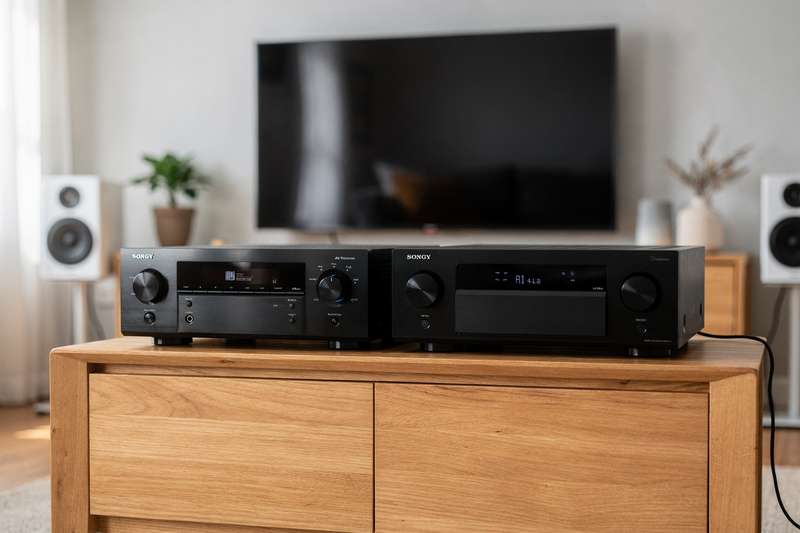
You’ve got passive speakers in boxes, a new TV that sounds like it’s broadcasting from a tin can, and a streaming device with nowhere useful to send audio. Or maybe you’re upgrading from a soundbar and you’ve finally decided to properly fill your living room with sound — except every time you search for an AV receiver, you land in a wall of listings that all use the same vocabulary: Bluetooth, multi-channel, 2000 watts, Dolby Atmos. Some cost less than a decent pair of trainers. Others cost more than a weekend away. The spec sheets look nearly identical until you start reading carefully, and then you realise they’re describing fundamentally different products.
The frustration is real. Budget amplifiers use the same marketing language as genuine network AV receivers, and the phrase “Dolby Atmos” appears across an enormous price range — sometimes as a real functional capability, sometimes as a label that doesn’t reflect what the hardware actually does. Working out which product genuinely decodes cinema audio formats, which one switches your HDMI sources, and which is simply a powered amplifier with Bluetooth bolted on is harder than it should be when the Amazon listing doesn’t always make the distinction clear.
This guide covers products across several tiers: from a genuine full-featured network AV receiver with Dolby Atmos processing and gaming optimisation, through to budget multi-channel amplifiers that will power your speakers reliably for everyday home audio, parties, or venue use. Each pick is assessed honestly against a realistic UK use case — not an idealised dedicated cinema room, but the living rooms, dining areas, rehearsal rooms, and small venues where these products actually end up.
One important point before reading on: “AV receiver” on Amazon covers a very wide spectrum. A proper AV receiver decodes multi-channel audio internally, switches between HDMI sources, connects to your home network, and usually includes automatic room calibration. A budget Bluetooth amplifier is a different category of device — useful for different reasons, for different buyers. This guide is transparent about which product belongs in which category.
How We Evaluated These Products
Five factors shaped every assessment in this guide. First, specification honesty: peak wattage figures from budget amplifier manufacturers are treated as marketing context rather than engineering facts — sustained output is what determines whether a unit can drive your speakers cleanly at normal listening volumes, and it is typically a fraction of the headline peak claim. Second, input and connectivity breadth: HDMI switching, optical and coaxial digital inputs, phono preamp inclusion, and wireless credentials all determine how a unit integrates with a real-world setup. Third, audio format support: whether a product genuinely decodes Dolby Atmos internally or simply carries the name in its listing is a meaningful distinction — one that separates proper home cinema receivers from budget amplifiers entirely. Fourth, buyer feedback patterns across Amazon UK: common complaints about long-term reliability, build quality, setup experience, and thermal behaviour were weighed against positive consensus themes, with particular attention paid to products backed by larger review pools. Fifth, use-case fit: each product was matched to a realistic buyer scenario rather than evaluated against an abstract performance ideal.
Best All-Round Home Cinema AV Receiver
The Yamaha RX-V6A is the only genuinely full-featured network AV receiver in this lineup, and that distinction separates it from every other product in this guide. Where the budget amplifiers reviewed here are essentially powered speaker drivers with Bluetooth connectivity added on, the RX-V6A is a proper processing hub: it decodes Dolby Atmos with Height Virtualizer technology, supports gaming functions for current-generation consoles, integrates with voice assistants, and connects to your home network. If what you want is a home cinema receiver in the traditional sense, this is the only product in this lineup that actually qualifies.
The Dolby Atmos Height Virtualizer is worth unpacking clearly. If you don’t have ceiling-mounted or upward-firing speakers — the norm in the overwhelming majority of UK homes — this feature processes audio to simulate height channels using your existing speaker arrangement. It is a software approximation rather than a substitute for physically placed overhead speakers, but in practice it produces a meaningfully more enveloping sound stage during film scenes with active overhead audio design. Whether that matters to you depends on how seriously you take cinema sound at home, but it is a real functional feature rather than a marketing label.
Gaming support is highlighted explicitly in the product specification, which is worth noting for anyone planning to connect a PS5 or Xbox Series X. Current-generation consoles output 4K at 120Hz over HDMI when titles support it, and your AV receiver’s connectivity spec determines whether that signal passes through cleanly. If gaming performance is central to your setup, verify the current HDMI specification in the product sheet before purchasing — bandwidth capabilities have varied across production runs of receivers at this tier, and it is a point worth confirming rather than assuming.
Voice control integration — Alexa and Google Assistant compatibility — sounds like a gimmick until you are actually using the unit daily. Adjusting volume or switching inputs by voice when your hands are full, or when the remote has disappeared between sofa cushions, turns out to be more useful than it initially appears. The integration works passively once set up and does not require any additional hardware if you already have smart speakers in the room.
The RX-V6A carries a 4.3/5 star rating from 69 Amazon UK buyers — a smaller pool than the budget products in this guide, but with a consistently positive pattern. Buyers regularly highlight sound quality and the quality of Yamaha’s YPAO automatic room calibration, which uses a supplied microphone to measure your room acoustics and adjust speaker levels, distances, and frequency response accordingly. Critical feedback, where it appears, tends to focus on the initial setup process taking longer than expected — a characteristic of virtually all full-featured receivers at this level, where calibration menus require patience and attention. First-time AV receiver owners should expect to spend time on setup; experienced users will find it straightforward.
The honest tradeoff is cost. The RX-V6A sits at a substantially higher price point than every other product in this guide. If your intended setup is a single pair of bookshelf speakers for music listening, you would be paying for Dolby Atmos decoding, HDMI switching, and network streaming capabilities you will never use. But for anyone building or upgrading a genuine 5.1 or 7.1 home cinema system with a connected TV or projector, this is the only product in this lineup that belongs in that conversation.
Best Budget Multi-Channel Amplifier
The Donner 4-Channel Home Audio Amplifier occupies a completely different position from the Yamaha above, and that is precisely its appeal for a specific type of buyer. This is not a home cinema receiver. It has no HDMI inputs, no Dolby Atmos decoding, and no network streaming capability. What it offers instead is a practical, budget-priced way to power passive speakers for music playback, background audio in multiple rooms, or casual home entertainment — and it delivers that reliably, according to a substantial body of buyer feedback.
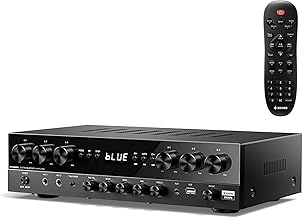
The four-channel configuration means you can drive two pairs of speakers simultaneously. This opens up basic multi-zone audio: a pair in the living room and a pair in the kitchen, or a front pair and a rear pair for a simplified stereo effect in a single space. Bluetooth 5.3 handles wireless connection from a phone, tablet, or laptop and connects quickly and stably in the experience of most reviewers. The FM radio tuner is included and appreciated by buyers who want a standalone listening option that does not depend on a streaming subscription or a phone being nearby. USB input adds playback from a memory stick — genuinely useful for a permanently installed background music setup that needs to run without phone involvement.
The dual microphone inputs with adjustable echo are an unusual feature at this price tier. They serve buyers who want a budget karaoke setup, and a meaningful portion of the 676 Amazon UK reviewers — who rate the product 4.1/5 — cite this as part of their reason for purchasing. The echo effect is controllable from the front panel, and if karaoke is irrelevant to your setup, the mic inputs sit passively without interfering with normal audio operation.
The stated 1000W maximum power output is a peak marketing figure, not an engineering specification. Actual sustained output per channel will be a fraction of that number — typical of how most budget amplifiers are rated and marketed. For normal listening levels through bookshelf speakers in a standard-sized UK living room, this is not a practical limitation. The unit is reported in multiple reviews to run warm during extended use, which is characteristic of class AB amplifiers in this price bracket. Adequate ventilation matters — do not install it in a sealed media cabinet or stack equipment on top of it.
Donner offers 2-channel and 6-channel variants in the same series. The Donner 6-Channel Amplifier is worth considering if you need to drive three pairs of speakers across separate zones and want the addition of fibre and coaxial digital inputs. For most home buyers, though, the 4-channel version hits the most practical middle ground between simplicity and flexibility without paying for channels you won’t use.
Best for Vinyl Records and Stereo Listening
If your priority is stereo music listening — particularly from a turntable — the Donner 2-Channel Stereo Audio Amplifier has one specification that sets it apart from practically everything else in this price bracket: a built-in phono preamp. That single feature makes this the natural choice for vinyl enthusiasts who want a budget amplifier without the hassle or extra cost of additional hardware.
For turntable users, the phono stage matters considerably. A standard moving-magnet cartridge produces a very low-level signal that requires specific RIAA equalisation and amplification before it can be processed by a normal line-level input. Most amplifiers and AV receivers in this price range do not include phono circuitry, which means you need either a turntable with its own built-in preamp (limiting your choice and sometimes affecting sound quality) or a separate phono stage box — an additional purchase and another device to find shelf space for. The Donner 2-channel handles this internally, keeping the setup simple and the budget intact.
Beyond the phono input, the connectivity is genuinely impressive for a budget stereo amplifier. Optical and coaxial digital inputs allow connection of a TV, Blu-ray player, or external DAC without HDMI switching. This makes the unit a credible dual-source hub: vinyl through the phono input and TV audio through the optical input, for example, covers the two most common listening scenarios in a typical UK living room without requiring any additional equipment. RCA analogue inputs and an AUX input cover further sources, and Bluetooth 5.3 adds wireless connectivity for phone or tablet streaming.
The FM radio tuner and USB input extend the standalone use case — this can function as a complete listening station without any external source device if needed. Two microphone inputs are present here as well, though they feel secondary to the product’s primary identity as a clean stereo listening amplifier. The design attention is clearly on the audio signal chain rather than the performance features.
The 4.1/5 star rating from 424 Amazon UK buyers reflects a broadly satisfied customer base. Reviewers frequently highlight sound quality, noting warmth and reasonable clarity across music genres for the price. Some feedback cautions about matching the amplifier to your speaker load carefully — pairing it with particularly inefficient or low-impedance speakers may not achieve the best results. For typical bookshelf speakers with sensitivities in the mid-to-high range and standard 6–8 ohm impedance, this is unlikely to be an issue in a medium-sized room.
Two things to be clear about: this is a two-channel stereo amplifier, full stop. There is no surround sound capability, no HDMI, and no Dolby Atmos. Anyone wanting to build a home cinema system should look at the Yamaha RX-V6A rather than this. But for a buyer who wants clean, fuss-free stereo listening with a turntable at the centre of it, the Donner 2-channel is the most practical option in this guide for that specific purpose.
Best Rack-Mount Option for Venues and Multi-Room Setups
The Pyle 6-Channel HiFi Bluetooth Amplifier is the most reviewed product in this entire guide — 792 Amazon UK ratings — and it occupies a specific niche that is worth understanding clearly before purchasing. This is not an amplifier for a typical UK living room setup, and understanding why begins with the form factor.
The rack-mount design means this unit is built to be installed in a standard 19-inch equipment rack. That tells you immediately about its intended context: bars, restaurants, shops, community spaces, rehearsal rooms, small venues, or homes with dedicated AV installation cabinets. For a living room where the amplifier sits on a shelf or inside a media unit, the rack-mount format is impractical and unnecessary. But if you are fitting out a commercial or semi-commercial space, the ability to mount this alongside mixing equipment, processors, or other rack gear is a practical advantage that none of the other products in this guide can offer.
The six-channel configuration allows simultaneous power to three pairs of speakers, which opens up basic multi-zone audio — background music in three areas of a venue, or separate speaker pairs in different rooms of a larger domestic installation. The onboard EQ controls allow broad tonal adjustment without external processing equipment, which is useful in a venue context where room acoustics vary. Bluetooth handles wireless input from a phone or tablet, and the FM tuner and USB playback input add standalone options for spaces where a connected streaming device is not practical.
The 3.9/5 star rating from 792 buyers is the lowest aggregate score of the products reviewed in this guide, and reading the feedback pattern carefully is worthwhile before committing. Recurring critical themes mention the unit running warm during extended use — expected of a multi-channel class AB amplifier at this price — and build quality that is described as functional rather than premium. The hardware feels appropriate to the price point. Positive reviews tend to concentrate on value for the number of channels provided and reliability in installation contexts. A useful signal: the high review volume at this price suggests widespread adoption in commercial and semi-commercial settings, where the bar for satisfaction is functional durability rather than audiophile precision.
The “2000W” claimed output carries the same caveats as the other budget amplifiers in this guide — treat it as a peak marketing figure and focus instead on whether the unit drives your specific speaker installation cleanly at the volumes you require. For background and ambient levels in a venue, this will not be a limiting factor. For demanding high-volume applications, the specification warrants closer scrutiny before installation.
If you are equipping a venue, community space, shop floor, or rehearsal room and need a rackmountable multi-channel amplifier at a budget price, the Pyle 6-channel is a pragmatic and widely road-tested choice. For domestic home cinema or dedicated stereo listening, the Yamaha or one of the Donner units will serve you better.
Best Compact All-in-One Budget Pick
The Pyle 600W Karaoke Mini Amp carves out a distinct role that none of the other products here fills: a compact six-channel amplifier where karaoke functionality is built in as a first-class feature rather than an awkward afterthought. If informal home entertainment — particularly karaoke — is central to your use case, this covers it in a form factor that actually fits on a shelf.
The compact body is the starting point. Where the Pyle rack-mount unit requires installation infrastructure and dedicated housing, this one sits next to your TV or on a bookshelf. That makes it accessible for home use in a way that rack equipment simply is not for most buyers. The six-channel output in a compact enclosure opens up multi-speaker possibilities without the need for rack hardware — useful for a dining room, a garden party setup, or a smaller living room with multiple speaker pairs that a two-channel amplifier cannot address.
The digital LCD display is a small but genuinely practical detail. With six channels and multiple inputs to manage, visual feedback on the current operating state matters more than it does on a single-input two-channel amplifier. Front panel controls keep adjustment accessible without needing to locate a remote, which suits the informal and social context this unit is primarily designed for. Bluetooth connectivity handles wireless audio from a phone or tablet in the same way as the other products here.
The karaoke functionality — dual microphone inputs with adjustable echo effect — is integral to the design in a way that distinguishes this product from the Donner 4-channel, which also has mic inputs but treats them as secondary features. Here, the karaoke brief is clearly the primary design driver, with general amplification built around it. For households where karaoke is a regular part of social events, this self-contained solution avoids the need for separate microphone preamps or a mixer — everything is in the one box.
The 4.2/5 star rating from 122 Amazon UK buyers is the strongest average of the Pyle products in this guide. Positive feedback regularly mentions build quality that feels sturdier than expected for the price, and overall ease of operation once connected. Critical feedback, where it appears, tends to focus on volume ceiling in larger rooms — a compact six-channel amplifier at this price point has realistic limits, and trying to fill a large open-plan space or drive demanding floor-standing speakers to high volumes will expose them. For a small-to-medium room, these limits are unlikely to be a concern in practice.
To be direct: this is not a home cinema AV receiver. There is no HDMI connectivity, no Dolby Atmos, and no network streaming. The “600W” power figure carries the standard peak-rating caveats that apply across all budget amplifiers reviewed here. For a small-to-medium entertainment space, a party room, or a dedicated karaoke setup, none of that matters. For a home cinema system or serious music listening, look at the Yamaha RX-V6A or the Donner 2-channel respectively.
What to Look For When Buying an AV Receiver or Amplifier
- Channel count matched to your speaker configuration: A 2-channel amplifier suits a stereo pair; a 5.1 home cinema setup needs at least five channels plus a subwoofer output; 7.1 needs seven. Buying more channels than your speaker system can use adds cost without adding performance. Confirm your speaker layout before deciding on channel count.
- HDMI connectivity and bandwidth: If your receiver will serve as the switching hub between your TV and sources like a streaming box, Blu-ray player, or games console, you need HDMI inputs and at least one HDMI output with ARC or eARC. For 4K gaming at 120Hz on current-generation consoles, HDMI 2.1 bandwidth is the spec to check. Verify this directly in the product datasheet — not all receivers at the same price tier match on this point.
- Genuine audio format decoding vs marketing labels: “Dolby Atmos” in an Amazon listing can mean the receiver actively decodes and spatially processes Atmos audio, or it can mean something far more limited. For genuine Atmos processing through your speaker system, the receiver needs HDMI connectivity and internal decoding hardware. Budget amplifiers without HDMI are not decoding Atmos in any meaningful sense.
- Input variety — especially phono: Consider every source you want to connect: turntable (requires a phono input with built-in preamp, or a turntable with its own preamp), TV (optical, coaxial, or HDMI ARC), streaming device, CD player. A unit that covers all your sources cleanly avoids convoluted signal-routing workarounds down the line.
- RMS power versus peak power: Peak power figures in budget amplifier listings are frequently many times the actual sustained output. Where available, look for RMS (root mean square) power ratings — this reflects real-world continuous performance. For bookshelf speakers in a normal-sized room, adequate sustained power per channel is typically well within the capabilities of most amplifiers at this price tier, even without taking headline peak figures at face value.
- Wireless streaming credentials: Bluetooth is standard across every product in this guide and works well for single-device playback in a single room. If you want multi-room audio, or integration with a streaming ecosystem, look for AirPlay 2, Google Chromecast built-in, or a proprietary network streaming platform. Bluetooth alone has range and multi-room limitations that matter in larger homes.
- Automatic room calibration: Mid-range and above AV receivers typically include microphone-based calibration systems that measure your room and adjust speaker timing, levels, and frequency response automatically. This is a meaningful feature for home cinema and not available on budget amplifiers without HDMI. If accurate speaker integration matters to your listening experience, factor this in when setting your budget.
Verdict
For the majority of UK buyers who want a genuine home cinema AV receiver — one that decodes Dolby Atmos, switches HDMI sources, calibrates automatically to their room, and connects to their home network — the Yamaha RX-V6A is the clear recommendation in this lineup. It is the only product here that actually delivers all of those things, and the buyer consensus at 4.3/5 stars reflects a unit that performs well in real-world home cinema setups. The Dolby Atmos Height Virtualizer makes surround sound accessible even without ceiling speakers, which makes it practical for standard UK living rooms where overhead speaker installation is not an option.
If your setup is simpler — specifically stereo music listening, particularly with a turntable — the Donner 2-Channel Stereo Audio Amplifier is the most thoughtfully specified budget option, primarily because of its built-in phono preamp. The combination of phono, optical, coaxial, and Bluetooth inputs covers the most common music listening sources without additional hardware.
For buyers equipping a venue, community space, or multi-room installation where rack mounting matters, the Pyle 6-Channel HiFi Bluetooth Amplifier is the pragmatic budget pick — its 792-review history gives confidence in its reliability for that specific context. For informal home entertainment with karaoke as a central feature, the Pyle 600W Karaoke Mini Amp covers it in a compact form factor the other products here cannot match. And for general multi-channel home audio at a budget price, the Donner 4-Channel Home Audio Amplifier has the strongest review consensus of the budget options, with 676 ratings backing its reputation for everyday reliability.
We were not paid to feature any specific product in this guide. All opinions are independent and based on publicly available specifications, verified buyer feedback patterns, and category research.
Quick Comparison Table


FAQ
What is the difference between an AV receiver and an amplifier?
An AV (audio/video) receiver combines a multi-channel amplifier with audio format decoding, HDMI source switching, and usually network streaming in a single unit — it is the processing and control centre of a home cinema system. A standalone amplifier powers speakers but does not include HDMI connectivity or cinema audio decoding. Many budget products on Amazon use “AV receiver” loosely to describe what are essentially Bluetooth amplifiers, so checking the specification carefully before purchasing is worthwhile.
How many channels do I actually need?
Match the channel count to your speaker configuration: two channels for a stereo pair, five channels for a 5.1 surround setup (left, centre, right, two rears, plus a subwoofer output), seven for 7.1. Buying more channels than your speaker system can use adds cost without improving performance. If you are starting from scratch with home cinema, a 5.1 setup is the practical and widely supported entry point. For music-focused listening, two channels is entirely sufficient.
Can I connect a turntable directly to any of these products?
Only if the unit includes a dedicated phono input with a built-in preamp. Standard moving-magnet turntable cartridges output a very low-level signal that requires specific RIAA equalisation before it reaches a line-level input. Of the products in this guide, the Donner 2-Channel Stereo Audio Amplifier explicitly includes phono input, making it directly compatible with standard turntables. Without a phono stage — in the amplifier or the turntable itself — you will hear either very low volume or no audio at all.
Do budget amplifiers genuinely support Dolby Atmos?
Not in any meaningful sense. Genuine Dolby Atmos decoding requires HDMI connectivity to receive the audio bitstream from a TV or disc player, plus internal processing hardware to decode height information and distribute it to speaker channels. Budget Bluetooth amplifiers without HDMI cannot perform this function. Of the products in this guide, only the Yamaha RX-V6A genuinely decodes Dolby Atmos, including via its Height Virtualizer for setups without ceiling speakers.
What is the difference between peak power and RMS power, and which figure should I trust?
Peak power is the maximum instantaneous output a unit can theoretically produce for a very brief period — it is commonly used in budget amplifier marketing and is frequently an inflated figure. RMS (root mean square) power reflects sustained continuous output, which is what actually determines whether an amplifier can drive your speakers cleanly at normal listening volumes without distorting. When available, always look for RMS figures, and apply healthy scepticism to headline peak claims from budget manufacturers.
Do AV receivers and amplifiers include speakers?
No — they are amplification and processing components only. They power passive speakers (speakers with no internal amplification) by delivering an amplified signal through speaker wire connections; the speakers must be purchased separately. If you want a complete system with speakers included, you would be looking at a powered speaker system or a soundbar rather than a separate amplifier or receiver.