Picture this: it’s late February, you’ve sown a tray of tomatoes and sweet peppers on the windowsill, and two weeks later the seedlings are pale, stretched, and leaning desperately towards the glass. Britain’s winter light — even on a south-facing sill — delivers perhaps four hours of usable photosynthetic light on a clear day. On a typical grey February day, you’re getting closer to one. The seedlings aren’t being dramatic; they’re starving for photons.
You’ve probably tried a few things. Maybe you pushed the trays right up against the coldest pane of glass. Maybe you tried a cheap grow bulb screwed into a desk lamp, only to find it gave one tray decent coverage and left the edges in shadow. Or you discovered that most clip-on lights sold for “plants” are barely bright enough for houseplant maintenance, let alone driving germination and compact vegetable seedling growth. The frustration is real, and it costs you the growing season: leggy seedlings transplanted into the garden rarely recover quickly.
This guide is for people who are done with improvised solutions. Whether you’re working with a single wire shelf in the spare room, a purpose-built propagation rack, or just a section of kitchen worktop, there’s a grow light here that will fit your setup — and your shelf dimensions. Every pick is available on amazon.co.uk right now, and the options range from an entry-level desktop lamp to a proper horticultural bar light capable of driving multiple trays simultaneously.
How These Picks Were Evaluated
To select these lights, the following criteria were weighted for the specific use case of seedling production on indoor shelves:
- Spectral quality: Does the light genuinely cover the blue wavelengths (400–500 nm) critical for compact seedling growth, and the red wavelengths (600–700 nm) needed for germination triggering and early photosynthesis? UV and IR additions were noted as a bonus.
- PPFD at seedling distance: Manufacturer claims were cross-referenced against independent reviewer measurements and buyer feedback patterns to assess real-world light intensity at 15–30 cm hanging height.
- Coverage footprint: How many seed trays does it realistically illuminate? This matters enormously when you’re stacking a propagation shelf.
- Timer and dimming controls: Seedlings need consistent photoperiods. Built-in timers and dimming avoid the need for extra plug-in timers.
- Shelf compatibility: Mounting options (clip, gooseneck, T8 bracket, hanging cord) and how easily the light attaches to standard wire shelving or shelf uprights.
- Verified buyer sentiment: Rating volume and consistency across amazon.co.uk listings, with particular attention to reports of longevity and whether seedlings genuinely stayed compact.
Products with fewer than 30 verified UK reviews were only included if they came from established horticultural brands with strong track records in other markets. Price tiers are described as budget, mid-range, and premium — no specific figures are given here, as Amazon pricing updates constantly.
Best Budget Clip Light for a Single Shelf
The Garpsen Grow Light for Indoor Plants, 52 LEDs Full Spectrum Plant Light with Clip & Gooseneck is the light to reach for if you want a no-fuss entry point that genuinely works for a small seed tray without committing to a full shelf setup. Rated 4.3/5 stars from 110 reviewers, it punches above its price bracket in terms of build quality for the clip-and-gooseneck category.
The 52-LED array covers a compact footprint well — realistically one standard half-sized seed tray or a row of small pots. The gooseneck is stiff enough to hold position without drooping, which matters because a light that slowly angles away from your seedlings overnight defeats the purpose. You get three installation options: clip, desk base, or a small rubber suction-cup pad, which is genuinely useful if you’re attaching it to a glass shelf or the side panel of a shelving unit rather than a shelf edge.
The full-spectrum output leans towards the cooler white-blue end, which is exactly what you want for the germination and early seedling phase — blue-heavy light suppresses the cell elongation that causes legginess. Dimming is available, and a built-in timer covers 6/12-hour cycles, so you can set it and forget it without buying a separate plug-in timer.
The tradeoff is coverage. If you’re running two or three trays side by side, one Garpsen won’t cut it — you’d need two units, and at that point, a T8 strip set starts making more sense both financially and in terms of even distribution. Heat output is negligible, which is a plus when your seedlings are close to the light source. This is a solid choice for a hobbyist starting a modest number of tomatoes, chillies, or herbs, but it’s not the right tool for a dedicated propagation shelf with serious volume.
Best Desktop Light for Germination Trays
The Wiaxulay Grow Light, 78 LED Plant Light for Indoor Plants, Full Spectrum Desktop Growing Lamp with Auto Timer 6/12/16 Hrs, 3 Lighting Modes sits in a slightly different category: it’s a free-standing desktop unit rather than a clip or hanging light, and that distinction matters for shelf setups where you can’t easily clamp anything to a bracket.
With 839 reviews at 4.1/5 stars, this is one of the more widely purchased grow lights in this size class on amazon.co.uk. The 78 LEDs are arranged in a head that adjusts on a short gooseneck, and the base is weighted enough to sit stably on a shelf without toppling when you brush past it. The three lighting modes give you some flexibility — a warmer red-dominant mode, a cool white mode, and a combination — though for seedlings specifically, you’ll likely run it in the full-spectrum combined mode throughout.
The auto-timer at 6, 12, or 16-hour cycles is a practical feature: set it once and the light will switch on and off at the same time each day without any plug-in timer. Coverage is honest for a desktop unit — think one standard 40-cell seed tray at about 20 cm distance, or two small trays if you push them close together. It won’t cover a full 60 cm × 40 cm propagator lid, but for starting a modest batch of herbs or flowers, it’s more than adequate.
The main limitation is that the stand takes up shelf space rather than hanging from it, so you lose some room for seed trays. If your shelf is already crowded with propagators, the clip-based Garpsen is a better fit. But if you’re working on a solid shelf — a kitchen counter or a wide windowsill board — this freestanding design is actually more convenient because you don’t need anything to clip onto.
Best Multi-Arm Light for Propagation Shelves
The Grow Lights for Indoor Plants 4 Arm LED Grow Light 4/8/12H Timer with Remote Control, Violet Red Blue Plant Growth Lamps for Seedlings & Succulents takes a different approach to coverage: instead of one large panel, it uses four independently adjustable arms that you can spread to cover a wider area or angle differently across a tray. At 4.1/5 stars from 43 reviews, the sample size is smaller than some options here, but the reviewer feedback is consistently positive for seedling use cases.
The four arms make this genuinely useful on a wider shelf where you need to cover two trays side by side without leaving a dark stripe down the middle — a real problem with single-head lights. Each arm carries a mix of violet, red, and blue LEDs rather than the broad white spectrum you’d see in white-dominant panels. This is a deliberate horticultural choice: the violet and deep red wavelengths drive chlorophyll synthesis and early root development efficiently. The trade-off is that the light looks purple-pink, which some people find intrusive in a living space — factor that in if the shelf is in a bedroom or home office.
Remote control is a genuinely useful addition here, not a gimmick: when your seed trays are tucked under a shelf and you need to adjust brightness or mode without disturbing the setup, being able to do it from across the room matters. The timer covers 4, 8, and 12-hour cycles with auto-repeat, which suits seed starting schedules well — most vegetable seedlings do well on 14–16 hours of light, so the 12-hour setting is a sensible starting point combined with some ambient daylight.
The footprint of the four-arm spread is the main selling point, but it also makes this light less suited to a narrow shelf where there’s no room for the arms to splay outward. If your shelves are 30 cm deep or less, the arms will overhang or foul the shelf above. For a 40–50 cm deep propagation shelf, this is a smart and flexible option.
Best LED Strip Pack for Shelf Lighting
The Grow Lights for Indoor Plants, 4 Pack Full Spectrum LED Plant Light Strips with 540 LEDs, Auto Timer 3/9/12H, 3 Lighting Modes & 10 Brightness Levels is for growers who want even, wall-to-wall coverage across an entire shelf rather than a spotlight effect. Four strips in a pack means you can lay them across the full width of a standard wire shelf and eliminate the hotspot-and-shadow problem that plagues single-head lights.
With 540 LEDs across the four strips, light output is substantial for the category. The 10 brightness levels give you fine control — useful because seedlings need lower intensity in the first few days after germination before you ramp up to prevent leaf scorch. Three lighting modes (full spectrum, warm red-heavy, cool blue-heavy) let you dial in what the seedlings actually need at each growth stage rather than running the same spectrum from day one through to transplanting.
This listing has only 8 reviews at the time of research — that’s a low sample size, so approach with appropriate caution. The rating is 5.0/5, which with such a small review count tells you very little statistically. That said, the specification is solid: 540 LEDs across four strips is a genuinely high LED count for this price tier, and the multi-mode dimming is a feature usually found in more expensive kits. The auto timer covering 3, 9, and 12-hour cycles is slightly unusual — 3-hour increments are less useful than the 6/12/16 patterns on competing units, but 12 hours is the setting most growers will use anyway.
If you’re investing in a dedicated propagation shelf and want the cleanest, most even light distribution possible, this strip pack is worth considering — but given the low review count, pair it with realistic expectations and check recent buyer feedback before purchasing.
Best Floor-Standing Light for Larger Indoor Growing
The MICCYE Grow Lights for Indoor Plants UV IR Full Spectrum 286 LEDs Floor Plant Light with Stand, Dimmable Grow Lamp with 4/8/12H Timer for Seedlings occupies a different niche from the shelf-mounted options above: it’s a free-standing floor light with an adjustable stand, making it suitable when you’re running seed trays on a table, a low bench, or even directly on the floor during early season propagation. Rated 4.5/5 stars from 449 reviewers — the strongest combination of rating and review volume in this guide — it has earned genuine trust from a wide range of buyers.
The 286 LED count includes UV and IR diodes alongside the standard full-spectrum array. UV addition accelerates germination in some species and can improve seedling stem thickness; IR penetrates deeper into the canopy and contributes to overall photosynthetic efficiency. For seedling production, these additions are a bonus rather than a necessity, but they explain why this light tends to produce noticeably compact, dark-green seedlings compared to white-LED-only units at the same distance.
The adjustable stand is practical: you can raise or lower the light head as seedlings grow, keeping the light-to-plant distance consistent rather than raising the whole tray. The 4/8/12-hour timer cycles with auto-repeat cover all realistic seedling photoperiod schedules. Dimming is continuous rather than stepped, giving you precise control rather than jumping between preset brightness levels.
The honest consideration for this light is that the floor-standing footprint — the base takes up real floor space — makes it less ideal if you’re working on a wall-mounted shelving unit where hanging or clipping a light is more practical. It’s best suited to a table-height or bench-height seed-starting setup in a spare room or garage. For that use case, the combination of UV/IR spectrum, strong reviewer consensus, and flexible stand height makes it one of the most complete options available in the mid-range tier on amazon.co.uk.
Best T8 Strip Lights for a Dedicated Propagation Rack
The Barrina T8 Grow Lights for Indoor Plants, 4FT, 5000K Full Spectrum Grow Light, 168W (4 x 42W), Plant Grow Light, V-Shape with Reflector, Seedlings is the choice for anyone building a serious propagation rack — the kind of setup where you have a purpose-built metal shelving unit and you want proper, even horticultural lighting across every tier. Rated 4.4/5 stars from 86 reviewers, it’s a newer listing but with a strong track record in the T8 strip category from Barrina, which has a well-established reputation for grow strip lights.
Four 4-foot T8 tubes at 42W each gives you 168W of actual power draw — this is not an LED panel claiming a “100W equivalent” from 20W actual draw. The 5000K colour temperature is a neutral white that covers the full photosynthetic spectrum well, with enough blue content to drive compact vegetative growth. The V-shape reflector behind each tube is a meaningful design choice: it redirects upward light back down into the growing area, meaningfully improving the usable PPFD at plant level compared to a flat-backed tube of identical wattage.
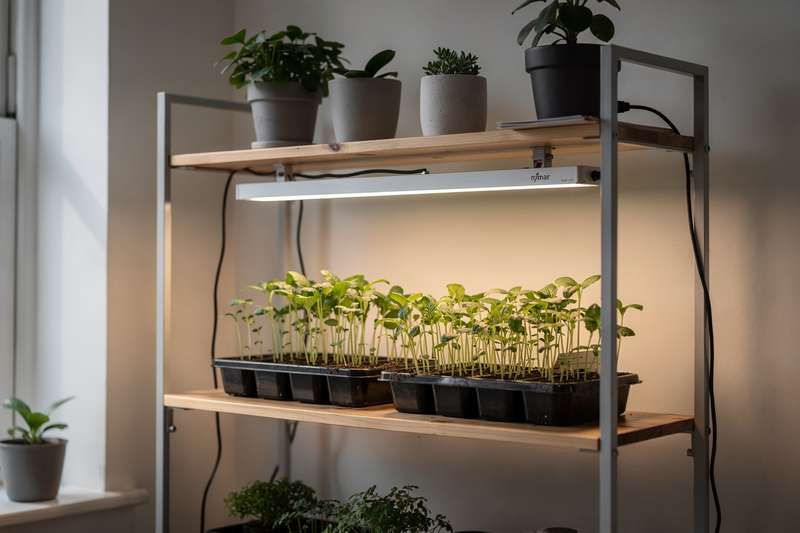
At four feet long, each tube spans the full depth of a standard 120 cm wire shelving unit. You’d typically run two or four tubes per shelf tier — two for herbs and flowers, four for demanding seedlings like peppers or tomatoes that need higher light intensity for compact growth. The tubes are linkable, which means you can daisy-chain multiple shelf tiers from a single plug rather than running separate cables to every shelf.
The limitations are real: this is a hardwired strip system without built-in timer or dimming. You’ll need a plug-in timer (add it to your basket) and you can’t dim these tubes to manage light intensity for newly germinated seedlings. You’ll manage intensity by adjusting hanging height instead. If you want plug-and-play simplicity, look at the panel and clip options above. But if you’re running a four-tier propagation rack and you want reliable, professional-level coverage at a reasonable price for the wattage, the Barrina T8 set is the most practical option in this guide for that specific setup.
Best Premium Pendant Light for Clean Aesthetics
The Claria Full Spectrum LED Grow Light Pendant for Indoor Plants – Indoor Grow Light for Growing Succulents Herbs & Cactus, Germination of Seeds occupies a specific position in this guide: it’s the option for growers who want a light that looks designed rather than industrial. At 4.5/5 stars from 38 reviewers and positioned at the premium end of the range, it’s aimed at people whose seedling shelf is in a kitchen, dining room, or living space where a hanging T8 tube or a sprawling clip light would look out of place.
The pendant format means it hangs on a cord like a light fixture — appropriate for a shelf positioned under a cabinet, a ceiling-mounted hook, or a stylish freestanding shelving unit in a visible room. The full-spectrum LED output covers germination and seedling growth as well as maintenance of established houseplants, herbs, and succulents. This makes it a versatile fixture if your propagation season is February to May and you want the light to earn its keep year-round on decorative plants.
For seedling-specific performance, the pendant’s main constraint is adjustability: pendant height is limited by cord length and how high above the trays you can mount the fixture. Seedlings ideally want the light at 15–25 cm above the canopy; if the pendant hangs at a fixed height of 60 cm above your shelf, you’ll be working at the lower end of effective PPFD. Some growers resolve this by building the shelf height to suit the pendant rather than the other way around, which works well if you’re designing your setup from scratch.
With a smaller review count than some options here, the statistical confidence is lower — but the reviews that do exist are from buyers who specifically used it for seedlings and herbs, and the feedback on germination outcomes is positive. If your priority is a light that integrates into your home without looking like a grow tent accessory, and you’re working with herb seeds, salad crops, or flowers rather than heavy-feeding peppers and tomatoes, this pendant is worth the premium.
Best Premium High-Output Light for Serious Growers
The MARS HYDRO 2026 Upgraded E3000 300Watt LED Grow Light 3×3ft UV IR Full Spectrum Grow Light Bar with 1184pcs Diodes Dimmable & Detachable is in a different league from everything else in this guide — and that’s the point. At 300W actual draw with 1184 individual diodes, UV and IR channels, and a 3×3ft rated footprint, this is the light for growers who are running serious volume: multiple propagation shelves, early-season brassica batches of 200+ plugs, or a combined propagation-and-grow space where seedlings graduate to vegetative growth under the same light.
Rated 4.6/5 stars from 155 reviewers, the MARS HYDRO E3000 has the strongest rating in this guide, and the reviewer base includes experienced horticulturalists running it in professional-adjacent home setups. The Samsung and other premium diode mix delivers high PPFD efficiency — more photons per watt than older LED technologies — which matters when you’re running the light for 14–16 hours daily and the electricity meter is turning.
The detachable bar design means you can reconfigure the light spread to suit different shelf widths, which is genuinely useful if your propagation space doubles as a growing space later in the season. Dimming is smooth and continuous, with a dial controller that lets you run seedlings at 30–40% output (enough for compact growth) and ramp up to 100% for mature vegetative plants. UV and IR diodes are separate channels in some configurations, giving you control over their application.
The honest caveat is scale. If you’re starting 30 tomato plants on one shelf, this is significant overkill — you’d be running a 300W light at 20% output, which is inefficient both financially and energetically. This light earns its cost when you have the volume to use the full footprint. For a hobbyist with one or two seed trays, any of the mid-range options in this guide will serve you better. For a serious kitchen gardener running 300+ plugs across multiple shelves from January through May, the MARS HYDRO E3000 is the professional-standard choice available on amazon.co.uk.
What to Look for When Buying a Grow Light for Indoor Seedlings
- True full-spectrum output, not just white LEDs: Check that the light includes meaningful blue wavelengths (400–500 nm) for compact vegetative growth and red wavelengths (630–700 nm) for photosynthetic efficiency. Some budget lights labelled “full spectrum” are simply warm white LEDs — fine for visibility, but not optimised for plant growth. UV and IR additions are genuinely useful for seedling development, not just marketing terms, though they’re a bonus rather than a baseline requirement.
- Actual wattage versus LED count: LED count alone tells you little. A light with 200 LEDs drawing 10W real power will produce less photosynthetically useful light than 50 LEDs drawing 40W. Always check the actual power draw (in watts, from the wall) rather than the LED count or the “equivalent” wattage figure.
- Coverage footprint at seedling distance: Manufacturers test maximum coverage at minimum brightness, or at heights that aren’t practical for seedlings. For seed starting, you want the light 15–30 cm above the tray. Check buyer reviews specifically for commentary on coverage at that distance — it’s more reliable than the manufacturer’s coverage diagram.
- Built-in timer and dimming: Seedlings need consistent photoperiods. A light without a built-in timer requires a separate plug-in timer, which is fine but adds cost and complexity. Dimming is useful during the first few days after germination, when intense light can stress newly emerged seedlings; being able to dial back to 40–50% and ramp up over a week is a genuine advantage.
- Mounting compatibility with your shelf: A clip light assumes you have a shelf edge to clip to. A pendant assumes a ceiling hook or cabinet underside. T8 strips require end brackets screwed or zip-tied to the shelf frame. Floor stands need clear floor space. Match the mounting type to your actual setup before ordering — this is the most common reason for returns in this category.
- Heat output and seedling proximity: At seedling distance (15–30 cm), heat becomes a real concern if the light is poorly designed. LED grow lights run cool relative to older HID and fluorescent technologies, but cheap panels with inadequate heatsinks can still stress seedlings positioned too close. Check buyer reports specifically for heat-at-close-range comments.
- Linkability for multi-shelf setups: If you’re running two or more shelf tiers, check whether units can be daisy-chained from a single plug. Barrina’s T8 strips are linkable, for example. Unlinkable lights mean a separate plug per shelf, which multiplies cable management complexity quickly.
Verdict
For the typical reader of this guide — someone running one or two seed trays on an indoor shelf, starting tomatoes, chillies, herbs, or salad crops between January and April — the MICCYE Grow Lights for Indoor Plants UV IR Full Spectrum 286 LEDs Floor Plant Light with Stand is the most rounded pick. Its 4.5/5 rating from 449 reviewers gives genuine statistical confidence. The UV and IR spectrum additions produce visibly compact, healthy seedlings. The adjustable stand means you can adapt the light height as seedlings grow without rewiring anything. And the continuous dimming lets you treat freshly germinated seedlings gently before ramping up intensity.
If you’re working specifically on a wire shelving rack with no floor space for a stand, the Barrina T8 Grow Lights for Indoor Plants, 4FT, 5000K Full Spectrum is the more appropriate tool — it delivers even, powerful coverage across a full shelf tier with the reliability of an established T8 strip format.
For a single tray and a tight budget, the Garpsen Grow Light gets the job done without unnecessary complexity. Start there, and upgrade to a MICCYE or Barrina strip set when your propagation ambitions outgrow it.
We were not paid to feature any specific product in this guide. All opinions are independent and based on publicly available specifications, verified buyer feedback patterns, and category research.
Quick Comparison Table


FAQ
How many hours per day should I run a grow light for seedlings?
Most vegetable seedlings — tomatoes, peppers, courgettes, brassicas — perform well with 14 to 16 hours of light per day. Herbs and flowers are typically fine with 12 to 14 hours. Use the built-in timer on your light rather than guessing; consistent photoperiods matter more than hitting an exact hour count, and irregular schedules confuse seedlings that use daylength as a developmental cue.
How far should a grow light be from seedlings?
For most LED grow lights in the budget to mid-range category, 15 to 25 cm above the canopy is the effective range. High-output lights like the MARS HYDRO E3000 can be hung higher — 30 to 45 cm — because they produce enough PPFD at that distance. Start at the higher end and watch for signs of light stress (bleached leaf tips, curling) before moving the light closer.
Will a full-spectrum grow light work for seed germination, or only after sprouting?
Most seeds germinate in darkness and don’t require light until the seed coat splits and the seedling emerges. Once sprouted, light quality matters immediately — blue-dominant full-spectrum light keeps seedlings compact from day one. Running the grow light on newly sown trays before germination wastes energy but doesn’t harm the seeds.
Why are my seedlings still leggy even with a grow light?
Legginess (etiolation) under a grow light usually means either the light is too far away, the wattage is too low for the coverage area, or the photoperiod is too short. Try lowering the light by 5 cm at a time and extending the photoperiod to 16 hours. Also check that the light is actually full spectrum — some budget lights labelled as grow lights are simply warm white, which produces little blue wavelength output and results in stretched seedlings despite appearing bright.
Can I use a single grow light for both seed starting and growing on to transplant size?
Yes, but check the coverage footprint. A clip light like the Garpsen covers one small tray at seedling stage — fine for germination, but if you’re potting on into individual 9 cm pots and need to cover 20 plants simultaneously, you’ll quickly outgrow a single small unit. Plan for the end goal: if you intend to grow seedlings on for 8 to 10 weeks under the same light, buy something with enough coverage for the potted-on volume, not just the seed tray.
Is a UV/IR grow light worth the extra cost for seedlings specifically?
UV and IR additions are genuinely useful rather than purely marketing — UV exposure in moderate doses thickens seedling cell walls, producing sturdier transplants, and IR wavelengths support efficient photosynthesis at depth in the canopy. For seedlings, the effect is real but not dramatic compared to the difference between adequate and inadequate blue/red spectrum. If the UV/IR option is only marginally more expensive, it’s worth it; if it doubles the price, prioritise getting adequate base spectrum and intensity first.