You’ve been here before: it’s late February, the windowsills are full of wobbly seedlings that have stretched themselves leggy reaching for weak winter light, half your chilli seeds never germinated because the compost dried out before they had a chance, and the one frost-free night you thought you had turned out not to be. You’ve tried repurposing a clear storage box as a propagator (it misted up and went mouldy), you’ve balanced trays on radiators (too hot, too dry), and you’ve watched pigeons demolish every tender shoot you moved outside before it was properly hardened off. What you actually need is a setup that controls temperature, humidity, and shelter — whether that’s a proper propagator for the kitchen windowsill, a compact seed-tray system for the spare room, or a walk-in greenhouse for the patio. This guide cuts through the noise and tells you exactly which products solve which problems, based on real buyer feedback patterns and the kind of specifications that actually matter once the growing season is underway.
How We Chose These Picks
To put this guide together, we looked at eight products currently listed on Amazon UK that directly serve the greenhouse and seed-germination space — covering everything from basic multi-cell propagation trays to full walk-in polytunnels. Each product was assessed on five criteria: cell count and capacity relative to the type of gardener it targets; dome or cover quality, since humidity retention is the single biggest germination variable; drainage design (crucial for avoiding root rot in early seedlings); build durability based on real-reviewer patterns, particularly how lids and frames hold up after repeated seasonal use; and, where relevant, how easy a structure is to assemble and anchor. We weighted strongly towards products with verified UK buyer reviews to make sure the feedback reflects British weather conditions and Amazon UK delivery experiences, not US climate assumptions.
Best All-Round Propagator: EarlyGrow Medium Propagator
The EarlyGrow MPL50031/P Medium Propagator with Shatter Resistant Lid is the closest thing to a consensus pick in this category — nearly a thousand UK buyers have left reviews and the rating holds steady at 4.6 out of 5 stars, which is genuinely difficult to sustain in a product category where lids crack and bases warp. At 38 × 24 × 18 centimetres, it fits most windowsills and propagator shelves without monopolising space, and the shatter-resistant lid is the detail that separates it from cheaper alternatives that splinter the moment you drop them on a tiled floor.
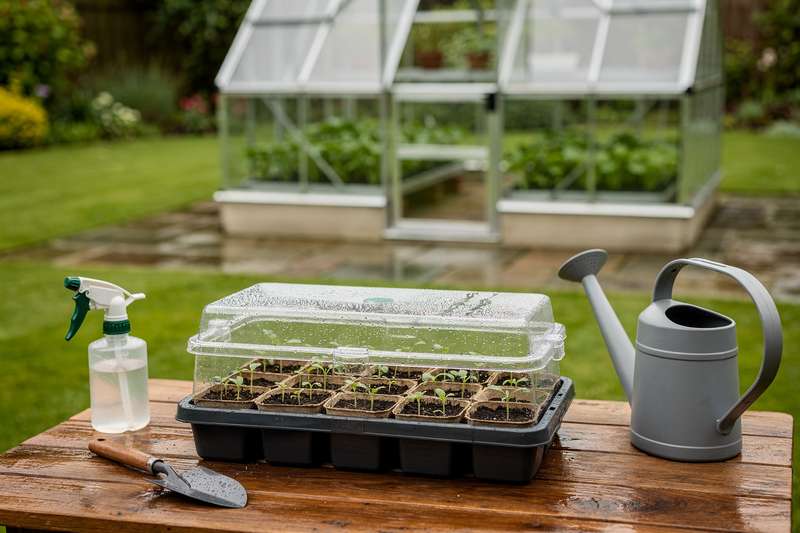
The lid is the real selling point. Many budget propagators use brittle clear plastic that fogs irreversibly after a season or two, but the shatter-resistant construction here means it stays clear enough to monitor seedling progress without lifting the lid and disrupting the humidity bubble you’ve been building for days. The vented design allows you to crack humidity progressively — which matters a lot when you’re transitioning seedlings from germination conditions (high humidity, no air movement) to hardening-off conditions (more airflow, drier air).
In terms of tradeoffs, this is a single-tray propagator, so if you’re starting 200+ seeds across multiple varieties, you’ll either need several units or a different approach entirely. The base tray is green rather than clear, which some reviewers note makes it harder to check water levels in the reservoir below. It’s also worth noting this is a passive propagator — there’s no heat mat built in, so if your windowsill is genuinely cold (below around 12–15°C overnight), germination of heat-loving crops like tomatoes and peppers will still be slow. Pair it with a separate seedling heat mat if you’re serious about warm-season vegetables. For herbs, bedding plants, and most hardy vegetable seeds, though, this is the straightforward, durable choice that most UK gardeners will get the most from.
Best Budget Seed Tray Kit: 10-Pack Seed Starter Tray with Humidity Adjustable Dome
If you’re starting a lot of seeds and want to keep costs down without sacrificing the basics, the Seed Trays 10-Pack Sturdy Seed Starter Tray Kit with Humidity Adjustable Dome Lid and Base gives you a serious volume of capacity for a budget outlay. With 287 verified UK reviews and a 4.6-star rating, it punches above its price tier. The kit includes trays, domed lids with adjustable vents, and a base tray — everything you need to create a closed germination environment without buying components separately.
The adjustable dome vent is the feature that makes this worth picking over the very cheapest non-vented alternatives. Being able to open the vent slightly as seedlings emerge means you can start weaning them off the high-humidity environment without the shock of full exposure — a common cause of damping off in young seedlings. The sturdy construction (the product name isn’t lying about this) means the trays don’t flex and spill when you’re carrying them from a warm room to a windowsill, which sounds trivial until you’ve lost a full tray of germinating basil to a wobble on a cold morning.
The tradeoff is that these are open-cell trays rather than divided cell inserts, so you’ll want to add your own seed-starting compost and, ideally, a cell-insert tray if you’re growing anything that needs transplanting with minimal root disturbance. The domes are clear and well-fitting based on buyer feedback, though some reviewers note they’re not as rigid as the EarlyGrow lid — they’re fine for tabletop use but may not withstand a knock from a passing elbow quite as graciously. For gardeners who want maximum flexibility and a high quantity of propagation space at a sensible price, this set is hard to beat.
Best for High Cell Count: 200 Cells Seed Trays 20-Pack
Volume growers — allotment holders, people raising plants to sell or give away, or anyone who wants to start dozens of varieties simultaneously — need a different solution from the casual windowsill propagator. The 200 Cells Seed Trays 20 PCS Reusable Seedling Plug Trays Starter Container for Nursery Greenhouse Garden Growing Plants Propagation delivers exactly that. Twenty plug trays with 200 cells total means you have the capacity to run a serious seed-starting operation, and the reusable design means this is a one-time purchase rather than a consumable.
With 349 reviews at a 4.3-star rating, the feedback picture is solidly positive with a few recurring caveats. The plug cells are the right size for starting seeds that will be pricked out and potted on — think tomatoes, peppers, brassicas, leeks, and bedding plants — but they’re too small for anything you want to grow on to a significant size in the same cell. Think of these as germination stations, not grow-on containers. The reusable plastic is described by buyers as flexible enough to pop plugs out cleanly without snapping roots, which is the key functional requirement for plug trays at this price point.
What to watch for: plug trays at this density need careful watering to avoid either waterlogging or drying out, since the small cell volume gives you less margin for error than larger pots. Bottom watering — sitting the tray in a shallow tray of water and letting capillary action draw moisture up — is the recommended approach here, and you’ll need to source your own base trays if you want to do this consistently. At a 4.3 rating across nearly 350 reviews, the quality is reliable enough to trust for a full growing season, but don’t expect the same rigidity as a thicker-walled propagator tray.
Best for Consistent Humidity: WY8 10 Pack Seed Trays Starter Kit
The WY8 10 Pack Seed Trays Starter Kit 120 Cells Reusable Greenhouse Seedling Starter Tray with Dome and Deep Base earns its place through two features that reviewers consistently single out: the deep base and the quality of the humidity dome. With 221 reviews and a 4.6-star rating — the joint-highest in this comparison — it has clearly clicked with UK buyers who’ve tried cheaper alternatives and found them wanting.
The deep base matters because it holds significantly more water than a shallow reservoir tray, which means you can bottom-water your seedlings and leave them for longer without the tray running dry overnight. This is particularly valuable if you’re germinating seeds in a warm room where moisture evaporates faster than you’d expect. The dome on this kit is described by buyers as fitting securely and maintaining humidity well — one of those things that sounds obvious but is surprisingly hit-or-miss across different brands, where domes that rock or leave gaps defeat the purpose of having a closed propagation environment.
The 120-cell count across 10 trays (12 cells per tray) gives you a useful middle ground between the very small kits and the high-density plug-tray approach — large enough cells to give seedlings room for initial root development, but enough trays to run multiple varieties without mixing them up. The tradeoff is that this kit is positioned as a mid-range buy and costs a little more than the basic 10-pack trays; whether the deep base and superior dome quality justify the difference is a judgment call based on how frustrated you’ve been by dry-out and poor-fitting lids in the past. If that’s been your pain point, it’s worth it.
Best Thickened Propagation Tray with Lid: YAUNGEL 6 Pack 72 Cells Seed Trays
The YAUNGEL Seed Trays 6 Pack 72 Cells Propagator Growing Thicken Seedling Starter Growing Trays with Clear Lids and Adjustable Window is worth considering for anyone who has snapped a thin-walled tray mid-season and lost a batch of carefully nurtured seedlings as a result. The emphasis in the product design is on wall thickness — the trays are described as thickened specifically to address the durability complaints that plague budget seed-tray sets.
It’s worth noting this product has a 4.5-star rating but carries no verified review count in the live data, so the rating figure should be treated with a degree of caution — there isn’t the depth of buyer feedback available to confirm how it holds up over multiple seasons. That said, the specification is sound: 6 trays, 72 cells total (12 cells per tray), clear lids with adjustable venting windows. The adjustable window on the lid is a feature you genuinely want — it lets you regulate airflow during the critical transition from sealed germination to hardening-off without fully removing the lid and risking a humidity crash.
The 72-cell total capacity across six trays is a more modest volume than some other kits here, making this a realistic choice for the gardener who’s not starting hundreds of seeds but wants robust, reusable trays that won’t flex, crack, or degrade after one season. If you’re starting a kitchen herb collection, a modest range of annual flowers, or a small selection of vegetable seedlings for a patio or raised bed, this set gives you the right capacity without buying more trays than you’ll ever use. The thickened construction is the key differentiator — if durability is your priority over raw cell count, this set deserves consideration.
Best Compact Outdoor Grow House: DIVCHI 2 Tier Mini Green House
When seed trays on the windowsill are no longer enough — either because you’ve run out of indoor space or because you need to harden seedlings off before transplanting — a small outdoor structure is the next logical step. The DIVCHI Greenhouse 2 Tier Mini Green House For Indoor and Outdoor Use Heavy Duty Garden Grow House Ideal For Growing Vegetables, Flowers, Herbs offers a sheltered growing environment that doesn’t require a full-scale polytunnel. With 164 reviews at a 4.3-star rating, it has a reasonable track record for a compact two-tier structure.
The two-tier shelving means you can fit a meaningful number of pots and trays into a small footprint — useful for patio gardeners or anyone with a limited outdoor space who still wants the benefit of a protected microclimate. The cover provides shelter from wind and light frost, which is particularly valuable in the UK shoulder seasons (March and October) when temperatures fluctuate unpredictably. It’s dual-purpose — you can use it outdoors as a mini greenhouse or bring it inside a garage or shed as a protected growing station.
The honest tradeoffs: a two-tier mini greenhouse is not a substitute for a proper polytunnel when it comes to thermal mass or structural rigidity. In exposed positions, these lightweight structures need pegging or weighting down to prevent them blowing over in strong winds — a recurring note in buyer reviews for this category generally. The cover material will degrade over time with UV exposure, and after two or three seasons you may find yourself replacing the cover rather than the frame. It’s also not suitable for overwintering tender plants in the coldest parts of the UK without additional insulation. For hardening off seedlings, protecting young plants from late frosts, and extending the growing season by a few weeks either side, though, this category of product is genuinely useful and the DIVCHI version performs solidly for its size.
Best Walk-In Greenhouse for Patio Gardeners: Outsunny Walk In Greenhouse
If you’ve outgrown windowsill propagation and tabletop grow houses and want a proper protected growing space, the Outsunny Walk In Greenhouse with 2-Tier Shelves Roll Up Zip Panel Door Garden Polytunnel Steeple Grow House for Outdoor 6 x 4 x 6ft is the most accessible entry point into walk-in greenhouse territory on this list. At 410 reviews and a 4.2-star rating, it has the largest buyer pool here and the feedback is broadly positive — though with clear patterns in the critical reviews that are worth understanding before you buy.
The steeple shape is a practical design choice: the peaked roof sheds rain rather than allowing it to pool and stress the cover. The roll-up zip door is a significant usability upgrade over cheaper versions with clip or tie closures — you can actually get in and out without wrestling with fastenings every time, which sounds minor but matters if you’re checking your plants twice a day. The two-tier shelving included gives you immediate storage for trays, pots, and equipment without additional purchases, and the 6 × 4 × 6ft footprint is spacious enough to move around in comfortably.
The honest assessment: this is a budget walk-in greenhouse, and it behaves like one in certain respects. The cover material and frame are not the same quality as a professional polycarbonate greenhouse — in very exposed or windy positions, the frame can flex and the cover can develop wear at stress points over time. Buyers in sheltered gardens or with good anchoring report years of satisfactory use; buyers in exposed positions have had more mixed experiences. Assembly is described as manageable for one person but easier with two, particularly when tensioning the cover. This is the right buy if you want walk-in space at a budget price and have a reasonably sheltered spot to put it — it’s not the right buy if you’re expecting the rigidity of a polycarbonate structure at this price point.
Best Lean-To or Freestanding Polytunnel Cover: VOUNOT Garden Greenhouse with Roll-up Zipper Door
The VOUNOT Garden Greenhouse Tomato Grow House with Roll-up Zipper Door Reinforced 135g/m² PE Cover Ideal for Vegetables Plants Flowers addresses a specific need: a freestanding covered growing structure with a reinforced cover that’s noticeably heavier-duty than the standard thin-film polytunnels in this price bracket. The 135g/m² PE specification is the number worth paying attention to here — general-purpose covers in this category are often in the 80–100g/m² range, and the heavier weight translates directly to better UV resistance and durability in exposed conditions.
With 110 reviews at a 4.3-star rating, the buyer base is smaller than some other products here, but the feedback pattern is consistent: reviewers note the cover quality favourably and the roll-up zip door functions well across multiple seasons. The tomato grow house format — a tall, narrow structure designed specifically for growing fruiting crops vertically — suits UK vegetable gardeners who are trying to get reliable crops of tomatoes, cucumbers, and peppers outdoors in a climate that doesn’t reliably deliver the heat these crops need without protection.
The tradeoff with this format is that it’s more specialised than a general walk-in structure. If you want flexible shelf space for a range of seedlings and pots, the Outsunny walk-in unit gives you more versatility. But if your primary goal is protecting taller growing crops through the summer and the reinforced cover weight matters to you, this is the more targeted solution. The roll-up zip door is a practical feature on any covered structure — it prevents the full wind-catch effect of a swinging panel door, which is relevant in a UK garden where unexpected gusts are a fact of life.
What to Look for When Buying Greenhouse and Germination Equipment
- Humidity control and venting: The single most important feature of any propagation dome or propagator lid is adjustable venting. Seeds and young seedlings need high humidity to germinate, but once they’ve emerged they need progressively more airflow to prevent damping off — the fungal condition that collapses seedling stems at soil level. Look for a vent that you can open incrementally rather than a lid you can only fully open or close.
- Cell size relative to crop type: Small cells (72-cell and above) are fine for seeds that will be pricked out early — tomatoes, peppers, bedding flowers. Larger cells are better for crops that resent root disturbance — beans, squashes, sweetcorn — where you want to minimise transplant shock. Match cell count to your growing style rather than just buying the highest cell count available.
- Base tray depth and drainage design: A deep base tray is a genuine practical advantage — it holds more water for bottom-watering and gives you more margin between waterings. Check whether drainage holes in the cell tray align with the base tray’s collection area, and whether the base tray is sold as part of the kit or as a separate purchase.
- Cover or structure material weight: For outdoor structures, PE cover weight (g/m²) is the key quality indicator. Heavier covers (130g/m² and above) last longer, resist UV degradation better, and withstand wind stress more effectively than lightweight covers. For indoor propagator lids, shatter-resistant plastic is worth specifying — standard clear plastic becomes brittle over time and cracks when dropped.
- Frame construction and anchoring: For any outdoor greenhouse structure, check how the frame is anchored. Lightweight mini greenhouses need pegging, weighting, or tying to a wall or fence to prevent them becoming airborne in wind. Larger walk-in structures should have ground pegs included and ideally be positioned in a sheltered spot regardless of what anchoring is provided.
- Reusability and cleaning: Good propagation trays should survive cleaning between seasons — which means they need to be robust enough to withstand dilute disinfectant solution (gardeners typically use garden disinfectant to prevent disease carry-over between crops). Flexible plastic that can be flexed to pop out root plugs cleanly is preferable to brittle rigid plastic that holds plugs so tightly you damage roots removing them.
- Size relative to your space: Measure before you buy. A 38 × 24cm propagator sounds compact until you realise your windowsill is 30cm deep. Walk-in greenhouses typically need a flat, level surface and reasonable shelter from prevailing winds — check your intended spot before purchasing the largest structure you can afford.
Verdict
For most UK gardeners — those growing a seasonal range of vegetables, herbs, and annual flowers from seed on a windowsill or in a spare room — the EarlyGrow MPL50031/P Medium Propagator is the most straightforward recommendation. The combination of a shatter-resistant lid, reliable venting, and nearly a thousand verified UK buyer reviews at 4.6 stars tells you this is a product that holds up in real-world conditions season after season. It’s not the highest-capacity option and it doesn’t include a heat mat, but for most seeds most of the time in a reasonably warm indoor position, it does exactly what a propagator should do.
If you need volume rather than a single propagator unit, the WY8 10 Pack Seed Trays Starter Kit is the tray-based alternative with the best balance of dome quality, deep base, and buyer satisfaction at its price point. And if you’re ready to move outside, the Outsunny Walk In Greenhouse gives you walk-in space at a realistic budget for a sheltered UK garden. Match the product to the specific problem you’re solving, and you’ll get far more from this equipment than from buying the most expensive option available.
We were not paid to feature any specific product in this guide. All opinions are independent and based on publicly available specifications, verified buyer feedback patterns, and category research.
Quick Comparison Table


FAQ
What temperature do most seeds need to germinate successfully?
Most common vegetable and flower seeds germinate best between 18°C and 24°C. Heat-loving crops like tomatoes, peppers, and aubergines prefer the upper end of that range or slightly above, which is why a heated propagator or heat mat is recommended if your germination space drops below about 15°C overnight. Hardy vegetable seeds — brassicas, leeks, onions — will germinate at lower temperatures but take longer.
Do I need a heat mat as well as a propagator?
For most UK gardeners starting seeds from March onwards in a heated room, a passive propagator (no heat mat) is sufficient for the majority of crops. Heat mats become valuable when you’re starting heat-loving crops like chillies or peppers in January or February, or if your propagation space is genuinely cold — below 15°C consistently. If you’re getting slow, patchy germination despite good humidity, temperature is usually the variable to address.
How do I prevent damping off in seedlings?
Damping off is a fungal condition that causes seedling stems to collapse at soil level, and it’s almost always caused by excessive moisture combined with poor airflow. Use a sterile seed-starting compost, avoid overwatering, and start opening propagator dome vents as soon as seeds have germinated. Good hygiene between seasons — cleaning trays with dilute garden disinfectant before reuse — also significantly reduces the risk.
Can I use a mini greenhouse outdoors year-round in the UK?
Lightweight mini greenhouses (two-tier covered structures) can extend your growing season in spring and autumn but are not suitable as year-round frost protection in most parts of the UK. They provide some insulation and wind protection but don’t retain heat effectively in cold winters. For year-round use, you’d need a solid-glazed or twin-wall polycarbonate greenhouse, or a significantly insulated polytunnel structure.
How many cells do I need in a seed tray?
It depends on how many varieties and how many plants of each you’re growing. A 40–72 cell tray is practical for a typical home garden where you’re starting 3–6 plants of each of 10–15 varieties. Higher cell counts (120–200+) suit allotment growers or anyone starting large batches of a single variety. Remember that more cells means more careful watering management — small cells dry out faster and leave less margin for error.
What’s the difference between a propagator and a seed tray with a dome?
In practice, the functional difference is mainly build quality and fit. A dedicated propagator like the EarlyGrow unit typically has a more precisely engineered lid-to-base fit, better venting controls, and more durable materials than a basic seed tray with a snap-on dome. For occasional use or budget-conscious gardeners, a good seed tray kit with an adjustable dome lid works well. For anyone propagating seeds regularly season after season, a purpose-built propagator with a shatter-resistant lid is worth the step up.