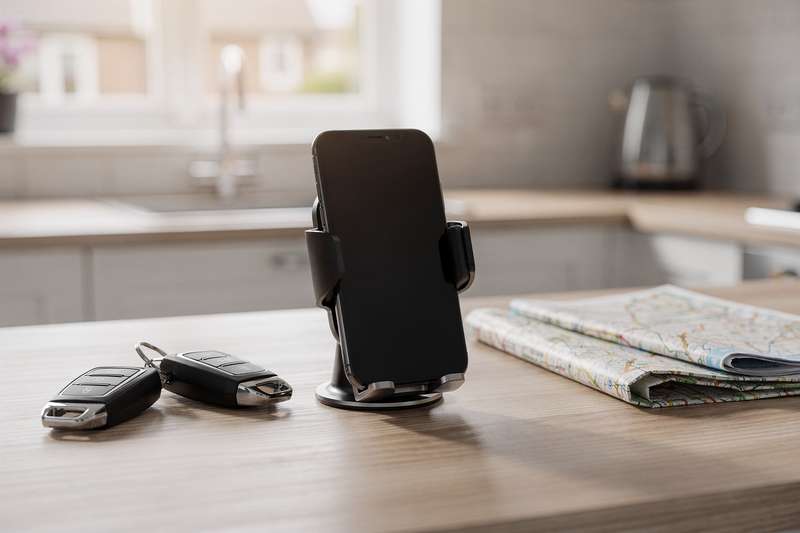
You’re merging onto a dual carriageway when your phone slides off the dashboard and disappears under the seat. Or you’ve propped it against the cupholder again — that precarious lean that works until the first roundabout, at which point your navigation vanishes mid-turn. You’ve tried wedging it between the gear lever and the handbrake. You’ve balanced it on the passenger seat. You might even have duct-taped a pouch somewhere and quietly pretended that was fine. It wasn’t.
A proper car phone mount solves all of this without costing a fortune or requiring a second pair of hands to attach each morning. But the market is genuinely crowded, and a cheap mount that loses its grip after a fortnight is worse than useless — it’s a distraction. UK roads, with their speed bumps, potholes, and tight roundabouts, are harder on mounts than the smoother motorway cruising you see tested in American guides. You need something that holds under real British driving conditions: stop-start commuting, country lane rattles, and the occasional emergency brake.
This guide cuts through the noise. Whether you’re after a budget sticky-pad mount, a premium suction option, or a MagSafe-compatible holder for a newer iPhone, there’s a specific pick below for your situation — with honest information about where each one falls short.
How We Evaluated These Picks
Each product in this guide was assessed against five core criteria: mounting security (how well it grips the dash, screen, or vent under vibration and sharp cornering), phone grip (does the cradle actually hold the phone when you hit a pothole), adjustability (can you reposition it for different drivers and phones without tools), installation simplicity (how long does it take to fit and remove), and compatibility breadth (which phones and cases work without modification).
Beyond those primary criteria, we cross-referenced verified buyer feedback patterns for each product — paying particular attention to long-term reliability complaints (“fell off after two weeks”), MagSafe charging consistency, and vent-clip durability. Where a product makes bold claims in its title (“88+ LBS suction”, “rally racing grade”), we treated those with appropriate scepticism and weighted actual reviewer experience over marketing language. The result is a shortlist that covers the main mounting styles available on Amazon UK at a range of price tiers.
Best Budget Gel-Pad Suction Mount
The Blukar Car Phone Holder with Sticky Gel Pad is the right starting point if you want something that works on both the dashboard and windscreen without any fuss. Rated 4.4 stars, this mount uses an upgraded gel-pad adhesive rather than a traditional vacuum suction cup, which means no lever to pump and no seal to fail in cold weather — a genuine advantage during UK winters when suction cups can lose their grip on a frosted windscreen.
The mounting mechanism deserves a closer look. The gel pad grips smooth, clean surfaces well, and can be removed, rinsed under water, and reapplied multiple times before its stickiness degrades. For most drivers, that means months of reliable use without buying a replacement. The ball joint rotates a full 360°, and the one-button side-release makes inserting and removing a phone genuinely one-handed — something that sounds basic but is surprisingly rare at this price tier.
Tradeoffs exist, though. The gel pad absolutely requires a smooth, dust-free surface to work properly. Textured dashboards — common in older Fords, Vauxhalls, and VWs — reduce adhesion significantly, sometimes to the point where the mount won’t stay put at all. If your dashboard has any visible grain or matte finish, skip this one and move to a suction-cup option instead. Similarly, the cradle arms are plastic and suit phones up to approximately 6.8 inches wide, but very chunky cases (especially rugged cases with raised lips) can make the one-button release feel stiff rather than smooth.
For what it is — a no-frills, budget-tier mount for a modern touchscreen phone on a smooth dashboard — this Blukar does the job reliably. It’s the pick you give to a family member who just wants something simple that stays where it’s put, without spending more than necessary.
Best Standard Suction Mount for Dashboard or Windscreen
If the gel pad approach doesn’t suit your dashboard texture, the Blukar Car Phone Mount with Strong Suction Cup is the step up you need. This variant uses a traditional vacuum suction mechanism rather than a gel pad, making it significantly more effective on glass surfaces — including the windscreen — and on the smoother sections of plastic dashboards that aren’t entirely flat.
The mount offers the same 360° rotation and one-button phone release as its gel-pad sibling, but adds a telescoping arm that extends the head away from the mounting surface. That extension matters more than it sounds: it means you can mount the base lower on the windscreen or further back on the dash and still position the phone at a comfortable viewing angle, rather than having the screen hover awkwardly close to the glass. The adjustable cradle accepts phones from compact 4-inch models up to larger flagships.
Bear in mind that suction-cup mounts in general need a little maintenance attention. The suction cup should be cleaned monthly with a damp cloth to remove the fine film of dust and skin oils that gradually reduce grip. It also performs better on glass than on plastic — if you’re mounting to the windscreen, the hold is typically excellent; on dashboard plastic, you may find it needs reseating every few weeks. For UK drivers in particular, parking in direct sun for long periods can cause suction cups to contract slightly and lose their seal, so recheck the mount each time you return to a hot car in summer.
This is a competent, mid-range suction mount. It lacks the premium feel of the more expensive options in this guide but gets the fundamentals right: it holds, it rotates, and it doesn’t require two hands to use while you’re already settled in the driver’s seat.
Best Vent Mount for Everyday Drivers
The Miracase Car Phone Holder with Double Steel-Hook Air Vent Mount earns its place here because of one specific design choice: dual steel hooks rather than the plastic single-hook clip used by most budget vent mounts. Most vent mounts fail at the clip — the plastic cracks, or the single hook loses its tension after months of being inserted and removed daily. Steel hooks distribute the load across two contact points, which meaningfully extends longevity.
Installation is straightforward: the hooks grip the horizontal slats of a standard car vent, and the ball-joint head adjusts to the 360° rotation you’d expect. One-button phone release keeps single-handed operation intact. The cradle itself is spring-loaded, so it self-adjusts to hold phones of different widths without needing to manually squeeze the arms open before inserting your device — useful if you swap between a phone-with-case and a phone-without-case regularly.
The honest tradeoff with any vent mount — this one included — is airflow restriction. When the mount is installed, it partially blocks the vent it’s attached to. This is mildly inconvenient in summer but can become genuinely problematic in winter, when restricting airflow to the windscreen or side windows slows demisting. If you rely heavily on your front vents for defrosting in January and February, a dash or windscreen mount may serve you better. Also, vehicles with narrow or angled vent slats (common in some modern compact cars) may not grip the hooks securely — check your vent profile before buying.
Rated 4.4 stars, this mount strikes a good balance between build quality and simplicity. It’s the pick for drivers who want their phone positioned low and central — roughly at eye level near the vent rather than up on the windscreen — and who value durability in the clip mechanism over outright feature count.
Best High-Strength Suction Mount for Rough Roads
The 2025 BEST Rally Racing-Grade Car Phone Holder makes an immediate impression with its headline suction claim, and while marketing numbers should always be treated cautiously, the underlying design does back up the premium positioning. Rated 4.5 stars — the highest in this group — this mount is designed as a 3-in-1 option, attaching to dashboard, windscreen, or air vent depending on your preference.
The suction mechanism is notably more robust than the standard single-lever designs: it uses a vacuum pump system that creates significantly higher negative pressure against the mounting surface before locking. The practical effect is that the mount stays firmly planted even on heavily textured dashboard surfaces where a standard suction cup would periodically give way. If you drive a van, a pickup, or an older vehicle with a particularly uneven dash, this is the mount worth spending more on.
The 3-in-1 versatility also makes this the smart buy if you’re not sure which mounting position you’ll prefer, or if you switch between multiple vehicles. The same head unit clips to the suction arm for windscreen use, transfers to the dash pad, or attaches to a vent clip — all without needing separate purchases. The 360° ball joint is stiff enough to hold position without drifting under vibration, which is where cheaper mounts often disappoint: they’re fine when stationary but slowly sag to portrait orientation during a long motorway run.
The tradeoff at this tier is that the mount is bulkier and heavier than the compact budget options. It’s not intrusive, but it’s noticeably more substantial — fine for most cars, but potentially awkward in very small cockpits (a Fiat 500 or a Smart car, for instance). At mid-range pricing, it’s the pick for drivers who want genuine long-term reliability and don’t mind paying slightly more to avoid replacing a budget mount every six months.
Best 3-in-1 Mount for Versatility on a Tighter Budget
The Miracase Car Phone Holder for Cars Dashboard Windscreen Desk offers three mounting positions — dashboard, windscreen, and desk — in a single compact package at a budget-friendly price point. The 360° rotatable cradle, spring-loaded arms, and one-button release are all present, which covers the basics. Rated 4.3 stars, it sits slightly below its sibling vent mount in overall satisfaction, but the versatility of also functioning as a desk stand adds genuine value if you use the same mount at home or in the office as well as in the car.
The suction cup on this model is more conventional than the high-strength system on the Rally-grade pick above — adequate for smooth surfaces but less impressive on textured dashboards. Where this mount genuinely earns its place is as a first car phone mount for someone who isn’t sure what mounting style will suit their workflow: buy this, try it on the windscreen, try it on the dash, take it indoors for a week to use as a desk stand, and you’ll quickly know which position you actually prefer before investing in something more permanent.
The desk functionality is a practical bonus rather than a headline feature — the suction cup doesn’t work on all desk surfaces, so a smooth glass or lacquered wooden desk is needed. On a standard office desk with a matte finish, expect variable results. In the car, the mount performs its core function reliably for most drivers with standard-textured dashboards. If your phone lives in a very thick rugged case, check the cradle width specification before purchasing — extremely wide cases can push against the adjustment limits of the spring arms.
Best MagSafe-Compatible Mount for iPhone Users
The Miracase MagSafe Car Mount with Strong Suction and Nano Gel is built for iPhone 12 and later models, which have MagSafe magnets built into the back of the handset. The magnetic connection snaps the phone into the mount instantly — no cradle arms, no adjusting grip width, no fumbling. You pick up the phone one-handed, and docking is a single fluid motion. For regular commuters who mount and unmount the phone dozens of times per week, this convenience adds up quickly.
The mounting system combines a vacuum suction cup with a nano-gel pad to achieve the claimed strong hold on both windscreen and dashboard surfaces. The mount is foldable and 360° rotatable, meaning it stores flat when not in use and adjusts freely to portrait or landscape orientation. The magnetic connection itself is sufficiently strong for normal driving — the phone stays put through roundabouts and speed bumps — though very aggressive cornering at speed can occasionally cause rotation of the phone rather than full detachment, which is more of a nuisance than a safety concern.
The key limitation is compatibility. The magnetic connection works natively with iPhone 12 onwards — specifically the built-in MagSafe ring. Android phones and older iPhones do not have this magnet array, so you’d need to attach a metal plate or MagSafe-compatible ring to the back of the phone or case, which is a semi-permanent modification that many people prefer to avoid. If your phone is a MagSafe-equipped iPhone and you use a MagSafe-compatible case (or no case at all), this mount works extremely well. If you switch between devices or have a non-MagSafe case, consider one of the cradle-style mounts in this guide instead. Rated 4.0 stars, it’s a competent option for the right user but not the pick for mixed-device households.
Best Premium MagSafe Suction Mount
The MRGLAS 2026 Upgraded Vacuum Magnetic Mobile Phone Holder for MagSafe takes the same MagSafe magnetic attachment concept and pairs it with a more powerful suction mechanism, claiming 98+ LBS of suction force. As with all such claims, the real-world relevance is what matters: this mount stays stuck. Reviewers consistently note it holds on textured dashboards where standard suction cups fail, and the combination of suction cup plus magnetic phone attachment creates a genuinely stable two-point connection that reduces the micro-vibrations that make phone screens hard to read while driving.
The 360° rotation locks firmly into position, and the build quality feels a step above the budget options — the materials are denser, the joints stiffer, and the overall package more confidence-inspiring. For MagSafe iPhone users who spend a lot of time using navigation on longer journeys, the stability difference between this and a cheaper vent mount is noticeable and worthwhile. Rated 4.2 stars, it’s a mid-to-premium tier pick with proportionally higher expectations.
The honest caveats apply equally here as to the Miracase MagSafe mount: if you don’t have an iPhone 12 or later with a MagSafe-compatible case, this mount’s headline feature is irrelevant to you. The suction is strong, but the magnetic attachment is the reason to choose this product, not just a bonus. Also note that without a MagSafe case, magnetic strength through a non-MagSafe case is reduced — the magnetic field has to work through additional material that wasn’t designed to transmit it. Buy this for a naked iPhone or a MagSafe case, and it’s excellent. Buy it for an Android or an older iPhone in a standard case, and you’re overpaying for a feature you can’t use.
Best Universal Magnetic Mount for Mixed-Device Use
The MSXTTLY Car Phone Holder for MagSafe iPhone and Non-MagSafe Android Devices is the pick that solves the compatibility problem head-on. Using N55 magnets — a stronger grade than the standard N52 used in many budget magnetic mounts — this mount is designed to work with MagSafe iPhones natively and with non-MagSafe devices via the included metal ring attachment. The practical result is a household or multi-driver situation where one person has an iPhone 14 and another has a Samsung — both can use the same mount without purchasing adapters separately.
Rated 4.4 stars, the MSXTTLY also uses a vacuum suction cup for windscreen or dashboard mounting, and the 360° rotation locks more firmly than many similarly priced competitors. The N55 magnet grade is worth noting specifically because the step up from N52 produces noticeably stronger phone retention through a case — if you want a magnetic mount but won’t remove your case each time, the stronger magnet genuinely reduces the risk of vibration-induced slipping. For thicker protective cases (around 4–5mm depth), this remains the better magnetic option compared to lower-grade magnets.
Where the MSXTTLY sits at a slight disadvantage is in the suction mechanism itself, which is powerful but requires the standard monthly cleaning routine to maintain peak adhesion. It also doesn’t fold as flat as the Miracase MagSafe unit, so it’s slightly more obtrusive when parked. But for a driver who wants one magnetic mount that handles whatever phone they’re currently using — or shares a car with someone on a different platform — this is the most practical solution in the lineup. The N55 magnet strength and genuine cross-platform compatibility make it worth the slightly higher price compared to the single-platform magnetic options.
What to Look For in a Car Phone Mount
- Mounting surface compatibility: Match the mount type to your car’s interior. Suction cups work best on glass and very smooth plastic. Gel pads need a clean, smooth, non-textured surface. Vent clips require horizontal slat vents of sufficient width. Before buying, look at your dashboard and vent design — a vent mount is useless if your vents are circular or have very thin slats.
- Phone size and case compatibility: Check the maximum width the cradle can accommodate, especially if you use a rugged or wallet-style case. Most cradles handle phones up to around 90–95mm wide, but very thick cases can add enough depth to make the release button awkward. MagSafe mounts specifically require iPhone 12 or later with either no case or a MagSafe-compatible case for full magnetic strength.
- Rotation and positioning: A 360° ball joint is the minimum to look for — it lets you switch between portrait (navigation) and landscape (video calls or maps) without removing the mount. Equally important is how well the joint locks: a loose joint that slowly droops to portrait on a long motorway run is a genuine frustration. Read reviewer comments specifically about joint stiffness over time.
- One-handed operation: UK law treats handling a phone while driving seriously, and while you should only mount or unmount your phone when stationary, a mount that requires two hands to operate while seated is significantly more awkward in tight cabin spaces. Spring-loaded cradles with a single release button are preferable to designs where you have to manually spread both arms simultaneously.
- Vent obstruction: Any vent-mounted holder partially restricts airflow. In summer this is negligible; in winter, blocking a central vent reduces demisting speed. If you live somewhere with long cold winters or regularly need both front vents for windscreen defrosting, a windscreen or dashboard mount avoids this problem entirely.
- Long-term grip maintenance: Both suction cups and gel pads degrade over time and need periodic cleaning to maintain adhesion. Suction cups should be wiped monthly; gel pads can be rinsed under cool water and allowed to air-dry. Mounts that fail after two months are almost always failing because of accumulated dust rather than a product defect — knowing this saves you from needlessly returning a perfectly good mount.
- Cradle vs magnetic design: Cradle mounts are universally compatible regardless of phone brand or case type. Magnetic mounts are more convenient to use daily but require either MagSafe compatibility or a metal ring attached to your phone. If you switch phones regularly or share the car with someone on a different platform, a cradle mount is the lower-friction choice.
Verdict
For most UK drivers — commuting daily, using Google Maps or Apple Maps for navigation, occasionally switching between portrait and landscape — the 2025 BEST Rally Racing-Grade Car Phone Holder is the pick that earns its price premium. Its 3-in-1 mounting flexibility means you’re not locked into a position that turns out not to suit your car, the high-strength suction system genuinely holds on surfaces that defeat budget suction cups, and the stiff ball joint stays where you put it on a long motorway run. The 4.5-star rating — highest across this guide — reflects consistent satisfaction in verified buyer feedback rather than a product making bigger promises than it keeps.
If you’re on a tighter budget and your dashboard has a smooth surface, the Blukar gel-pad mount is the most cost-effective starting point. And if you’re on iPhone 12 or later with a MagSafe case and want the fastest daily mount-and-dismount experience, the MSXTTLY universal magnetic mount handles both MagSafe iPhones and Android devices, which makes it the pragmatic pick for multi-device households without compromising on magnet strength.
We were not paid to feature any specific product in this guide. All opinions are independent and based on publicly available specifications, verified buyer feedback patterns, and category research.
Quick Comparison Table


![2025 BEST [Rally Racing-Grade] Car Phone Holder for Cars [88+LBS Strongest Suction] 3In 1 Dashboard Windscreen Vent Mobile Phone Holder for Car [Big phone & Thick Case Friendly] for iPhone Samsung](https://m.media-amazon.com/images/I/81I4JwLexaL._AC_UY218_.jpg)


![Miracase for MagSafe Car Mount, [Strong Suction + Nano Gel] Vacuum Magnetic Phone Holder for Car, [360° Rotatable & Foldable] Phone Holder for iPhone 17 Pro Max, Air, 16, 15, 14, 13, 12,Black](https://m.media-amazon.com/images/I/91-TtEHwqyL._AC_UY218_.jpg)
![MRGLAS 2026 Upgraded Vacuum Magnetic Mobile Phone Holder Car for Magsafe Car Mount, Suction Cup Mobile Phone Holder [98+LBS Suction Power & 2800gf Strongest Magnet], 360° Rotatable for Mirror/Gym](https://m.media-amazon.com/images/I/71gDnKc+rNL._AC_UY218_.jpg)

FAQ
What type of car phone mount is most secure on UK roads?
High-strength suction cup mounts generally offer the most secure attachment on smooth surfaces like windscreens, because the vacuum seal is independent of driving vibration. On rough UK roads with frequent speed bumps and potholes, look for mounts with a locking suction mechanism and a stiff ball joint — loose joints are the most common cause of a phone slowly drooping out of position during a journey.
Are vent phone mounts legal in the UK?
Using any phone mount is legal in the UK provided the phone is secured in the holder and you are not touching or interacting with the phone while driving. Vent mounts, windscreen mounts, and dashboard mounts are all lawful mounting positions. The windscreen caveat to be aware of is that the Highway Code advises against placing anything that obscures your field of vision — mount your holder to the far left or far right of the windscreen, away from your primary driving sightline.
Do MagSafe car mounts work with Android phones?
Not natively. MagSafe magnets are built into iPhone 12 and later models by Apple, and Android phones do not include them. However, some magnetic car mounts — including the MSXTTLY model in this guide — include a metal ring or plate that attaches to the back of any phone, allowing Android users to benefit from magnetic mounting. The tradeoff is that the metal ring is a semi-permanent modification to your phone or case.
How do I stop my car phone mount’s suction cup from falling off?
The most common reason suction cups lose grip is a thin film of dust, oil, or skin residue on either the cup itself or the mounting surface. Clean both the suction cup and the target surface with a damp cloth and allow them to dry fully before reattaching. In very cold weather, suction cups can lose tension as the rubber contracts — parking in a garage overnight or reseating the mount before setting off in winter helps. Avoid mounting to textured or porous plastic surfaces; glass or very smooth dashboard plastic hold far better.
Can I use a car phone mount for navigation without touching my phone?
Yes, and this is precisely the intended use case. A properly positioned mount lets you glance at a map or accept a hands-free call without picking up the device. Under UK law, operating a phone while driving — even at a red light — can result in a fine and penalty points, so a mount that keeps the screen in your natural sightline is genuinely useful beyond mere convenience. Set your navigation destination before setting off and let the mount do the rest.
Is a dashboard or windscreen mount better for UK drivers?
Both positions are legal and practical. Windscreen mounts hold more securely on glass and typically position the phone closer to eye level, but they should be placed where they don’t obstruct your view — bottom-corner positioning is safest. Dashboard mounts sit lower, which requires slightly more eye movement, but they’re less intrusive visually and suit drivers who find windscreen-mounted devices distracting at the edge of their vision. If your car has a flat, smooth area of dashboard directly in front of the passenger (or to the left of the steering column), that’s usually the best position for a dashboard-mounted holder.