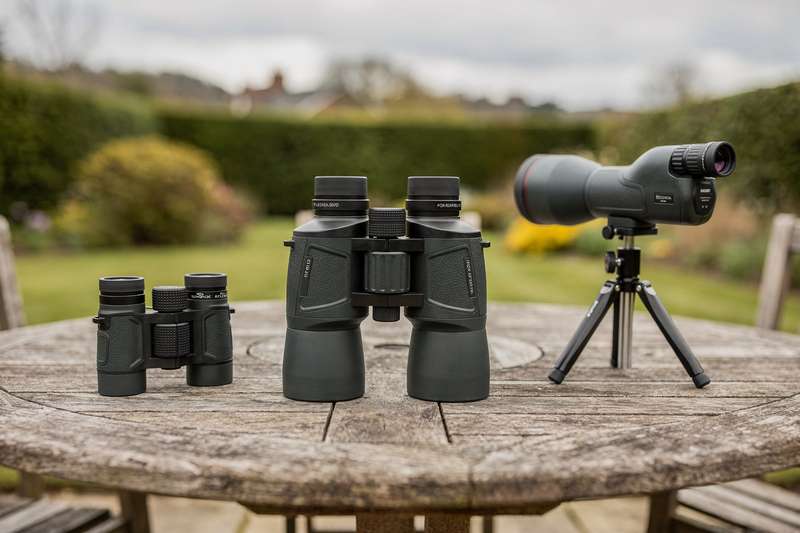
Picture this: you’re standing on a clifftop in Cornwall, a peregrine falcon gliding on the thermals below you. You fumble with your phone, try to zoom in with the camera, and watch it disappear before the lens has even focused. Or perhaps you’ve dragged yourself out of bed at 2am during a clear November night, telescope balanced precariously on the patio table, spending twenty minutes trying to locate Jupiter’s moons and finding only blurry streetlight reflections. Maybe you bought a cheap pair of binoculars years ago — the kind that came in a branded outdoor shop bag — and the image was so dark and wobbly you gave up entirely.
The optics market is full of bold numbers on boxes: 20x magnification! HD! Military Grade! But those claims rarely map to real-world performance in British drizzle or low-light coastal conditions. You want something that actually works — something that snaps into focus quickly, doesn’t leave you squinting, and won’t fall apart when your kids inevitably drop it at Slimbridge. This guide cuts through the noise and matches you to the right optic for what you actually need.
How We Evaluated These Picks
Every pick in this guide was selected against a consistent set of criteria drawn from real-world usage patterns and verified buyer feedback. The key factors were: optical quality relative to the price tier (specifically prism type and lens coating), exit pupil diameter for low-light usability, field of view for tracking moving subjects, build quality and weatherproofing, ergonomics including weight and focus-wheel action, and the breadth and consistency of UK buyer reviews on Amazon. We also paid close attention to negative review patterns — things like cloudy optics, shaky focus mechanisms, and false advertising around magnification — to flag genuine problems. No product made this list without strong evidence it performs as advertised under real conditions.
Best Compact Budget Pick
The Kylietech High Power 12×42 Binoculars for Adults Fogproof & Waterproof is the pair to reach for when you want capable optics without spending a great deal. At 12x magnification with a 42mm objective lens, this sits in a genuinely useful sweet spot — enough reach to bring distant birds and landscapes into satisfying detail, with an objective diameter large enough to perform respectably in overcast British weather.
The BAK4 prism is the real story here. BAK4 (barium crown glass) is a higher-density prism material that delivers rounder, fully illuminated exit pupils compared to the cheaper BK7 prisms found in similarly priced rivals. Combined with fully multi-coated (FMC) lenses, you get noticeably better light transmission than you’d expect at this price tier. The image isn’t as crisp as something from the premium end of the market, but for general wildlife observation, hiking, and casual stargazing, it does a solid job.
At 12x, you do need a reasonably steady hand — particularly in windy conditions. This isn’t a dealbreaker, but it’s worth knowing that anything above 10x magnification amplifies hand tremor. If you plan to use these for extended bird watching sessions from a hide, consider using a monopod or resting your elbows on a solid surface. The fogproof and waterproof construction makes these practical for typical UK outdoor conditions: coast, moor, or woodland in all weathers.
Where this model struggles is in very low light — dawn or dusk mammal watching — where the 42mm objective starts to show its limits compared to larger 50mm alternatives. The focus wheel action on budget binoculars can also vary unit to unit, so check yours as soon as it arrives. Overall though, if you’re entering the hobby or buying a pair to keep in the car for opportunistic wildlife moments, this is a genuinely strong starting point.
Best Mid-Range 20×50 for Versatility
The 20×50 Binoculars for Adults High Powered, Military Compact HD Professional/Daily Waterproof Binoculars Telescope for Bird Watching Travel offers a step up in magnification that makes a real difference for open-country birding, coastal whale watching, and scanning mountain ridgelines.
The 20x specification means distant subjects appear significantly larger than through standard 8x or 10x binoculars, which sounds great on paper. In practice, the tradeoff is a narrower field of view and increased sensitivity to hand movement. These are not binoculars for tracking a fast-moving bird through woodland — that’s a recipe for frustration. But set up on a tripod (most 20x binoculars have a tripod adapter thread), pointed at a distant estuary or mountain face, and they reveal a level of detail that genuinely surprises people encountering high-power optics for the first time.
The 50mm objective lenses mean a larger physical instrument, but the payoff is a better exit pupil diameter at higher magnification — important for glassing in the early morning or late evening. FMC coatings and BAK4 prisms appear across this specification class, and the waterproof construction is rated for real outdoor use, not just rain splash. The physical build is robust and reassuring to hold, with a rubberised armour that provides grip even with cold, wet hands.
One honest limitation: at 20x magnification, atmospheric shimmer (heat haze and air turbulence) becomes clearly visible over distances greater than a kilometre or so. This is a physics issue that affects all high-power optics, not a defect in this model specifically. For static targets at medium distances — a red deer stag across a glen, or a distant lighthouse — these binoculars perform well above their price point.
Best All-Rounder for Stargazing and Wildlife
The Binoculars for Adults Bird Watching usogood 12×50 High Power Binoculars for Stargazing, Traveling, Hunting and Hiking with Tripod Phone Adapter earns its place in this guide by doing almost everything well. The combination of 12x magnification with a 50mm objective is one of the most popular specifications among serious amateur astronomers and wildlife watchers precisely because it balances reach, light gathering, and handheld usability.
For astronomy, a 50mm objective gathers considerably more light than a 42mm equivalent, making a genuine difference when you’re hunting for the Andromeda Galaxy, the Orion Nebula, or open star clusters. Through 12×50 binoculars, the Pleiades resolve beautifully; the Milky Way arm on a dark Scottish night looks genuinely spectacular. Jupiter’s Galilean moons are visible as pinpoints of light, and the Moon reveals crater detail that surprises first-time users. These won’t replace a dedicated astronomical telescope for planetary viewing, but as a gateway into the night sky, they’re excellent.
For bird watching and wildlife, the larger objective lens provides noticeably better performance at dawn and dusk when many of the most interesting species are active. Woodcock roding at dusk, bats over a woodland edge, or deer moving at first light — all are more viewable through 50mm lenses than 42mm. The included tripod adapter is a thoughtful addition that transforms these into a stable viewing instrument when you’re settled at a fixed vantage point.
The phone adapter is a bonus that allows basic afocal smartphone photography — useful for recording sightings, though quality won’t match a dedicated camera. At this specification and price tier, optical quality does vary, so it’s worth reading recent reviews carefully to ensure the batch you’re receiving maintains the coating and prism quality the specification promises. When production quality is on point, this is a standout performer.
Best Highly Rated Budget Option
With a 4.7-star rating from 29 verified buyers, the 20×50 High Power Binoculars for Adults Bird Watching, Waterproof Binoculars Telescope with Clear Vision, BAK4 Prism, FMC Lens, Ideal Essential is one of the highest-rated options in the budget-to-mid-range category — and that rating from actual buyers carries real weight.
Like the other 20×50 option in this guide, this model delivers substantial reach at a price point that won’t hurt if you later decide to upgrade. What separates this particular model is the strong early reviewer consensus on optical clarity and build finish. When buyers who have actually received and used a product rate it this highly, it’s a meaningful signal that the manufacturer’s quality control is consistent — a common weakness in value-tier optics where unit-to-unit variation can be significant.
The BAK4 prism and FMC lens combination delivers good contrast and colour rendering for its class. Waterproofing is a practical necessity for UK buyers, and this model delivers it. The 20x magnification again demands a steady platform for the best results: a stone wall, a car window mount, or a proper tripod all make a significant difference to the image you experience versus attempting to handhold at high power.
The relatively newer listing means the review sample size is still growing, so keep an eye on the review count trend before purchasing. However, the early indicators are very positive. If you’re drawn to the 20×50 specification and want the option with the strongest early buyer confidence, this is the one to consider. It’s a good pick for anyone who wants capable distance viewing at a genuinely accessible price point.
Best for Serious Long-Range Viewing
The Aurosports 20×70 Binoculars for Bird Watching – High Powered binocular for Stargazing – HD Long Range Viewing Binoculars for Hunting Outdoor is in a different physical league from anything else on this list. With 486 reviews and a 4.3-star rating, it’s the most reviewed product here — and the sheer number of reviews means you’re getting genuine population-level feedback, not a handful of early adopters.
The 70mm objective lenses are where this instrument earns its keep. A 70mm objective gathers noticeably more light than 42mm or 50mm alternatives — the difference is visible even in mid-day birding, but it becomes dramatic at twilight and beyond. For astronomical use, this is arguably the most capable pure binocular in this selection: the Andromeda Galaxy shows structural detail, the Orion Nebula displays nebulosity clearly, and star clusters resolve into individual stars rather than a smear of light. Many amateur astronomers use large-aperture binoculars like this as their primary instrument for wide-field sky surveys.
You need to be realistic about what 20×70 means physically. This is a large, heavy instrument that is not comfortably handheld for extended periods. A sturdy tripod is essentially mandatory — and a good one, because at 20x magnification any wobble in the tripod head becomes an annoying shimmy in the image. Factor that into your purchase planning. These are not binoculars you grab from a jacket pocket to spot a passing kingfisher.
The tradeoff in field of view is real too: at 20x, you’re looking at a comparatively narrow slice of the world, which makes locating moving targets more challenging. But for systematic scanning of a distant hillside, a coastal bay, or the night sky from a fixed position, the combination of power and aperture is genuinely impressive. At 4.3 stars from nearly 500 buyers, the honest verdict is that some users are frustrated by the tripod requirement, but those who go in with realistic expectations are consistently satisfied.
Best Ultra-Compact for Travel
The USCAMEL® Folding Pocket Binoculars Compact Travel Mini Telescope HD Bak4 Optics Lenes Easy Focus Colour Black answers a specific question: what do you carry when weight and bulk are the primary constraints? Folding pocket binoculars like this one disappear into a jacket pocket, weigh almost nothing, and mean you’re never without optical reach on a day out.
The BAK4 optics specification at this compact size is a genuine differentiator from the very cheapest pocket binoculars, where poor prism material results in darkened, vignette-afflicted views. This model delivers a usable, reasonably bright image for casual daytime use — scanning a bay for dolphins from a cliff path, checking the number board on a distant bird hide, or following a cricket match from the back of the ground. These are thoroughly daytime instruments: the small objective lenses mean limited light gathering, so don’t expect them to perform at dusk or dawn.
The folding design is practical for fitting in a chest pocket or small bag. The easy-focus central wheel is quicker to use in the field than individual eyepiece focus systems. Build quality at this size and price point is functional rather than premium — the chassis is lightweight plastic — but the BAK4 prisms inside represent genuine optical engineering rather than corner-cutting.
These work brilliantly as a secondary pair: something you keep in the car, drop in a day-pack, or hand to a child without anxiety. They won’t satisfy a serious birder or astronomer on their own, but as a go-anywhere optic for opportunistic viewing, they fill a real gap. If you’re the type who always misses things because you don’t have binoculars with you, the solution is a pair small enough that you’ll actually carry it.
Best Premium Mid-Range Pick
The Celestron 71346 8×42 Outland X Binocular, Black represents a step into genuinely trusted optics territory. Celestron is a brand with decades of heritage in the optics world — they make some of the most respected telescopes and binoculars available to amateur astronomers and naturalists — and the Outland X series is their well-regarded mid-range outdoor line.
The 8×42 specification is considered by many wildlife observers and birders to be the ideal general-purpose binocular configuration. Eight times magnification is steady enough to handhold in virtually all conditions; even on a pitching boat or in a stiff coastal wind you can maintain a usable image. The 42mm objective provides a generous exit pupil, meaning bright, full images in a wide range of lighting conditions. This is the specification choice of professional ornithologists for a reason: it’s the most versatile combination across early morning marshes, woodland canopy, and open coastal terrain.
The Outland X comes with multi-coated optics, BAK4 prisms, rubber armour, and waterproofing — and critically, with Celestron’s build standards behind it. The optical quality at 8×42 is a noticeable step up from budget alternatives: the image is sharper edge to edge, colour rendition is more natural, and the field of view is wider. That last point matters enormously for tracking birds in flight or following a fast-moving animal through cover.
This is a binocular you buy when you’ve decided the hobby is serious and you don’t want to upgrade again in two years. It’s more money than the budget options here, but the difference in daily use experience is substantial. The rating speaks for itself — 4.6 stars from verified buyers who have used it in real conditions. If you’re a committed birdwatcher, coastal wildlife enthusiast, or someone who spends significant time outdoors, this is the one to consider. You’ll notice the quality every time you raise it to your eyes.
Best for Verified Optical Performance
The K&F CONCEPT 10X42 HD Binoculars, IP66 Binoculars Telescope for Adults with BAK4 Prism & FMC Lens for Bird Watching Hiking Hunting Camping Travel earns the highest rating of any product in this guide — 4.8 stars from 53 buyers — and the specification sheet explains why buyers are so consistently satisfied.
The IP66 waterproof rating is meaningful: IP66 means sealed against powerful water jets from any direction, not just rain splash. That’s proper outdoor-grade protection for use in real British conditions — sea spray, heavy rain, river crossings. For anyone who uses binoculars seriously in the field, genuine waterproofing rather than the vague “water resistant” claimed by cheaper models is a material quality-of-life improvement.
The 10×42 specification hits the sweet spot between magnification and usability. At 10x, you get noticeably more reach than 8x binoculars while still maintaining enough stability to handhold confidently. The 42mm objective provides a good exit pupil — wider than the 10/2.5mm = 4.2mm you might expect, thanks to efficient prism light transmission — giving bright, clear images across a range of lighting conditions. The BAK4 prism paired with fully multi-coated lenses maximises light transmission through the optical path, which you notice immediately as a clean, high-contrast image.
K&F Concept has built a strong reputation in the photography accessories market for delivering optical quality above what their pricing suggests, and these binoculars appear to reflect that ethos. Buyers consistently mention image sharpness and build quality as standouts. For someone who wants a serious instrument with verified buyer satisfaction and meaningful weatherproofing, this is the most confidence-inspiring option in the selection. Newcomers to quality optics are often genuinely surprised at how different a well-specified 10×42 feels compared to the budget alternatives they may have used before.
What to Look For When Buying Binoculars
- Magnification and objective diameter: The two numbers in a binocular specification (e.g. 10×42) tell you magnification and objective lens diameter in millimetres. Higher magnification means more reach but a narrower field of view and more sensitivity to hand movement. Larger objectives gather more light but add size and weight. For general wildlife use, 8×42 or 10×42 are the most versatile choices. For astronomy or long-range observation from a fixed point, consider 12×50 or larger — but plan to use a tripod.
- Prism type — BAK4 vs BK7: BAK4 prisms use higher-density glass that provides fully circular exit pupils and better light transmission. BK7 prisms are cheaper and produce slightly cut-off, less bright images. Always look for BAK4 on any binocular you’re considering seriously — it’s a genuine indicator of optical quality that filters out the worst budget models.
- Lens coatings: Coated lenses reduce reflective losses and increase brightness. “Multi-coated” means multiple layers on at least one surface; “fully multi-coated” (FMC) means multiple layers on all air-to-glass surfaces — the gold standard for maximising light transmission. Budget binoculars often claim “coated” but only treat a single surface. FMC is what to look for.
- Exit pupil diameter: Divide the objective diameter by the magnification (42 ÷ 10 = 4.2mm). A larger exit pupil means the binocular performs better in dim light. In daylight, 3–4mm is fine. For dawn, dusk, or woodland work, aim for 4–5mm or more. The human pupil dilates to around 7mm in darkness, but exit pupils above 5mm offer diminishing returns for most users.
- Field of view: Expressed in degrees or as metres at 1,000 metres (or yards). Wider fields of view make it easier to locate moving subjects and scan terrain quickly. A wider field generally correlates with better build quality in the eyepiece design. Binoculars with very high magnification (20x and above) will have narrow fields of view — an unavoidable physical tradeoff.
- Waterproofing and fogproofing: Look for nitrogen or argon-purged binoculars for fogproofing (prevents internal condensation when moving between temperature extremes). An IP or JIS waterproof rating tells you how well-sealed the instrument is. For UK outdoor use, meaningful waterproofing isn’t optional — it’s essential.
- Eye relief and eyecup design: Eye relief is the distance between the eyepiece lens and the point where the full image is visible — typically expressed in millimetres. If you wear glasses, look for at least 15mm of eye relief. Twist-up or fold-down eyecups that lock into position are far more practical than fixed ones in the field.
Verdict
For the majority of UK buyers — those who want a capable, genuinely versatile binocular for wildlife watching, walking, and occasional stargazing — the K&F CONCEPT 10X42 HD Binoculars is the standout recommendation. The 10×42 specification is the most broadly useful combination available: steady enough to handhold, bright enough for early morning wildlife work, and versatile enough to deliver genuine night-sky views. The IP66 waterproofing is serious protection for British outdoor conditions, not marketing language. And the 4.8-star rating from verified buyers is the strongest signal of consistent quality control in this selection.
If your budget is tighter, the Kylietech 12×42 is the sensible entry point — the BAK4 prism and FMC coating combination delivers real optical quality at an accessible price. For those committed to astronomy or long-range coastal scanning from a tripod, the Aurosports 20×70 is in a different league for light gathering and reach. And if you simply want something pocketable for everyday carry, the USCAMEL Folding Pocket Binoculars will go places the others won’t.
We were not paid to feature any specific product in this guide. All opinions are independent and based on publicly available specifications, verified buyer feedback patterns, and category research.
Quick Comparison Table


FAQ
What is the best magnification for bird watching binoculars in the UK?
For most bird watching scenarios — woodland, wetland, coastal — 8x or 10x magnification with a 42mm objective is the most practical choice. Eight times magnification is easier to hold steady and offers a wider field of view for tracking fast-moving birds; 10x gives you more reach for open-country species like raptors and waders. Anything above 10x generally requires a tripod to be usable.
Can binoculars be used for stargazing?
Yes, and they’re often recommended as the ideal first step into astronomy. Binoculars reveal the Moon’s craters, Jupiter’s Galilean moons, the Andromeda Galaxy, and dozens of star clusters invisible to the naked eye. A 10×50 or 12×50 binocular is particularly capable for astronomical use. For detailed planetary viewing you’ll eventually want a telescope, but binoculars are faster to set up, easier to use, and provide stunning wide-field sky views that no telescope eyepiece can match.
What does BAK4 mean and why does it matter?
BAK4 refers to barium crown glass — a high-density optical glass used for the roof or porro prisms inside binoculars. It produces fully circular, evenly illuminated exit pupils, which translates to brighter and sharper images compared to the cheaper BK7 glass alternative. Any binoculars you’re considering seriously should specify BAK4 prisms — it’s one of the most reliable indicators of optical quality in this category.
Do I need waterproof binoculars for use in the UK?
Given British weather, meaningful waterproofing is a very worthwhile feature rather than a luxury. Look for binoculars that specify nitrogen or argon purging, which prevents internal fogging when moving between temperature extremes, and an IP waterproof rating for clarity on the actual level of protection. Budget binoculars often claim water resistance but may only handle light rain — check the specification carefully.
What is exit pupil and why should I care about it?
Exit pupil is the diameter of the shaft of light that leaves the eyepiece and enters your eye — calculated by dividing objective diameter by magnification (e.g. 42 ÷ 10 = 4.2mm). A larger exit pupil delivers a brighter image in low light conditions, which matters significantly for dawn and dusk wildlife watching. In bright daylight a smaller exit pupil is fine, but for early morning wetland birding or twilight mammal watching, aim for an exit pupil of at least 4mm.
Should I buy binoculars or a telescope as my first optic?
For most beginners, binoculars are the more practical first purchase. They require no setup, work equally well for daytime wildlife and casual astronomy, and are immediately usable without learning to align, collimate, or focus a telescope on an object. A quality 10×42 or 12×50 binocular will deliver years of versatile use across multiple activities. Telescopes deliver greater astronomical capability but demand more time investment — they make most sense once you’ve caught the astronomy bug and know what you want to observe.