Picture the scene: your three-year-old has been shadowing you around the house all morning, desperately wanting to join in while you tighten a hinge or assemble a flat-pack shelf. You hand them a toy screwdriver from a cheap set you bought on a whim — and it snaps in half within minutes. Or worse, the “drill” makes a shrieking electronic noise that drives everyone in a two-room radius slightly mad. You’ve tried a couple of these sets before, and they’ve either been too flimsy to survive a single afternoon, too babyish for a sharp four-year-old, or so poorly designed that half the pieces go missing by the end of the first week.
What you actually want is a play tool set (or a fine motor skills kit, depending on your child’s age and interests) that holds together, sparks genuine curiosity, and gives your child the satisfying sense of doing something real. Not a toy that collects dust after day two. Whether your child is obsessed with watching tradies work, loves role play, or you’re a parent or early years teacher trying to support hand-eye coordination and dexterity — this guide is aimed squarely at you.
The UK market is flooded with options at every tier, from budget role-play costume sets to thoughtfully designed fine motor tools. We’ve cut through the noise to bring you the picks most worth your attention.
How We Evaluated These Picks
To shortlist these recommendations, we assessed each product across several practical criteria: age appropriateness, piece count and variety, build quality (materials, edge safety, durability signals from buyer feedback), storage solution, and how well the set actually supports learning — whether that’s imaginative play, hand-eye coordination, or fine motor development. We prioritised products with verified buyer reviews where possible, paying attention to consistent themes in feedback rather than individual outliers. For newer listings with limited reviews, we assessed product specifications, brand reputation in the educational toy space, and how the design compares to established products in the category. Safety signals — smooth edges, non-toxic materials, and appropriate age ratings — were weighted heavily throughout.
Best Overall Pick for Young Builders
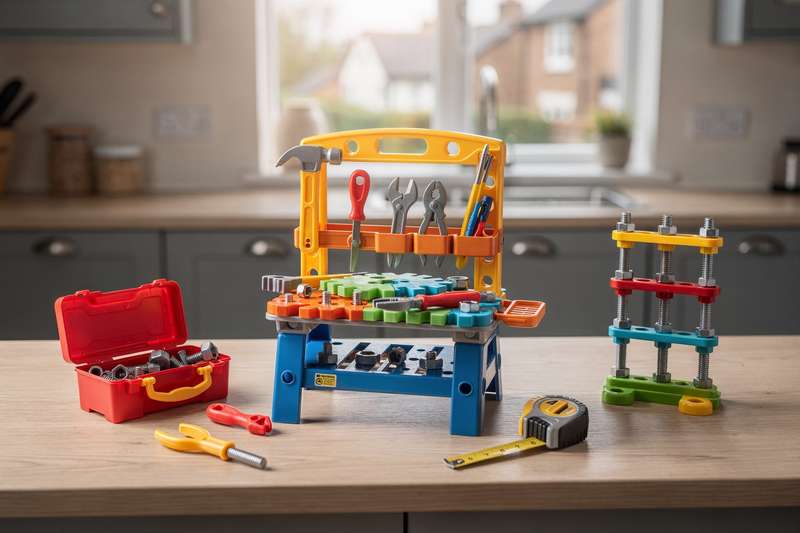
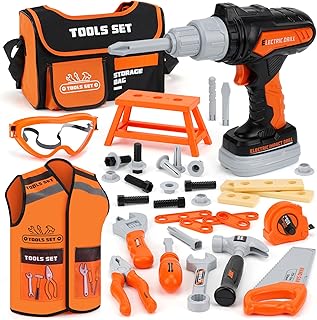
The Vanplay Kids Toys Kids Tool Set Electric Drill with Tool Bag & Vest is the standout pick for families who want a genuinely comprehensive pretend play experience without breaking the bank. With 43 pieces in the set — including an electric drill, tools, accessories, a tool bag, and a vest — this is the kind of kit that keeps young children occupied for more than just a single afternoon. It has earned a 4.6-star rating from 284 reviewers on Amazon, which is a solid signal for a product in this category.
The set is aimed at children aged three to five, and the inclusion of both a wearable vest and a dedicated tool bag is a thoughtful touch. Children at this age respond strongly to dressing up as part of their play — putting on the vest transforms a simple toy session into a full construction-worker role play scenario. The tool bag doubles as a tidy storage solution, which any parent of a child this age will appreciate.
The electric drill is the centrepiece here, and it’s what separates this kit from more basic sets. It makes sounds when operated, giving children the satisfying feedback that makes pretend drilling feel convincing. Reviews consistently mention that children return to this set repeatedly rather than losing interest quickly — a good sign that the play value is genuine rather than novelty-led.
The tradeoff worth knowing: at 43 pieces, there are a lot of small components, so this set requires some parental supervision for younger children around the three-year mark to prevent pieces from being mislaid or put in mouths. If your child is at the younger end of the age range, you may want to introduce pieces gradually rather than tipping out the whole set at once. The build quality, while solid for the price tier, isn’t heavy-duty — this isn’t designed for rough outdoor play. Keep it as an indoor role-play set and it should last well.
For parents looking for a first tool set that genuinely impresses without requiring a premium outlay, this is the one to start with. The combination of costume element, tool variety, and battery-powered play features makes it the most versatile pick in this guide.
Best Premium Pick for Extended Play
The KidBloom Kids Tool Set with Toy Drill, Construction Tools with Tool Box and Vest sits at the premium end of the play tool market and is designed with a slightly older toddler in mind — primarily three to four year olds who are ready for a more refined pretend play experience. It’s a newer listing with limited buyer reviews at the time of writing, so treat this pick with that caveat in mind, but the product design and specification warrant attention.
What distinguishes KidBloom’s approach is the emphasis on a cohesive set: the tool box, vest, and drill are designed to work together aesthetically and functionally, giving the whole kit a more polished, gift-ready feel compared to some competing sets. If you’re buying this as a birthday or Christmas present, the presentation matters — and this one delivers on that front more than most in the category.
The toy drill is the headline feature, and based on the product specification it operates in a similar fashion to other battery-powered options in this space — satisfying sounds and tactile feedback that make it feel convincing to a young child. The tool box provides structured storage, which helps children develop the habit of tidying up after play rather than leaving pieces scattered across the floor.
The honest tradeoff here is the lack of a substantial verified review base. With zero reviews at the time of writing, you’re buying partly on faith in the product design rather than accumulated buyer experience. If you’re risk-averse, the Vanplay set above offers proven buyer satisfaction. But if you’re looking for something that feels a step up in presentation — particularly as a gift — KidBloom’s set is worth considering. It’s positioned at a mid-to-premium price point, and the quality signals in the product design reflect that.
This pick suits parents of three to four year olds who want a tool set that looks great under the Christmas tree and holds together through sustained imaginative play. Just check for any updated reviews before purchasing, as buyer feedback will accumulate quickly for a product at this level.
Best Budget Pick for Role Play Fun
The ACWOO Kids Construction Worker Costume Set takes a slightly different angle from the pure tool-set approach: its 16-piece kit centres on the role-play costume experience rather than maximising tool count. You get a hard hat, safety vest, tool belt, and a selection of toy tools — everything a child needs to fully inhabit the construction worker persona. It’s earned 140 reviews at a 3.7-star rating, which places it squarely in the budget tier and warrants some honest comment on what that means in practice.
A 3.7-star rating is below the threshold you’d normally want for a confident recommendation, and you should factor that in. Recurring themes in buyer feedback suggest the costume elements are the strongest part of the set — children love wearing the hard hat and vest — while the individual tool pieces are more basic than premium alternatives. At this price point, that’s a reasonable expectation rather than a dealbreaker: you’re paying for the costume experience, not precision-engineered toy tools.
Where this set genuinely works well is in group settings: nurseries, playgroups, and fancy dress situations where the costume is the point. If your child has a construction-themed party, or you need a prop-rich outfit for school play, this is a cost-effective way to get the full look without worrying about longevity. It also makes sense as a secondary set to complement a higher-quality tool kit — children can wear the ACWOO costume while using better-quality tools from another set.
The tools themselves are simple plastic pieces without battery-powered features, and the overall build quality reflects the entry-level price. For everyday sustained play, you’d likely want to invest in one of the higher-rated sets in this guide. But for costume-led imaginative play on a tight budget, this set does exactly what it says and children respond enthusiastically to the dressing-up aspect.
If budget is your primary concern and the role-play costume element is what your child is most excited about, this is a practical choice. Go in with realistic expectations about the tool quality, and you won’t be disappointed.
Best for Fine Motor Development
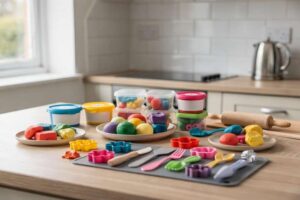
The 114 PCS Fine Motor Skills Sensory Bin Filler — which includes 10 sorting bowls, 100 pom poms, 2 tweezers, and 2 scooper scissors — takes a fundamentally different approach to “play tools” than the construction-themed sets. This is designed specifically for developing the hand and finger strength that underpins all future tool use, writing, and craft skills. With a 4.5-star rating from 151 reviewers, it has a meaningful review base for a product in this niche.
The concept is simple but effective: children use the tweezers and scooper scissors to pick up, sort, and move the pom poms into the sorting bowls. This activity — which looks deceptively basic — is genuinely valuable for children aged three and above because it builds the pincer grip and hand-eye coordination that later translates into using real tools, scissors, and pencils competently. Early years practitioners and occupational therapists frequently recommend exactly this type of activity for fine motor development.
The 114-piece count sounds unwieldy, but in practice it’s manageable: the pom poms are the bulk of the count, and they’re large enough not to be a choking hazard for children over three. The sorting bowls add a categorisation and colour-matching dimension to the play, making this suitable for structured learning sessions as well as free play. Parents who use this as a sensory bin activity report that children spend surprisingly long periods of focused time with it.
The tradeoff is that this set has a narrower play profile than a full tool kit — it won’t satisfy a child who wants to “fix things” in imaginative play. It’s a dedicated fine motor development tool rather than a role-play prop. But paired with one of the construction-themed sets in this guide, it fills a genuinely different developmental need. For parents and educators specifically targeting hand strength and coordination, this is the most purposeful pick in the guide.
If your child is heading towards starting school and their pencil grip or scissor skills need work, start here. The investment is modest and the developmental payoff is real.
Best for Learning Through Building Skills
The Learning Resources Helping Hands Fine Motor Tool Set is a four-tool kit from an established educational toy brand, designed specifically to build fine motor strength in children aged three and above. It includes a set of child-sized tools — typically tweezers, tongs, and similar gripping implements — that make the purposeful act of picking up and manipulating objects feel like a game. The listing has zero reviews at the time of writing, so factor that into your decision, but Learning Resources is a well-regarded name in the UK educational toy market with a strong track record across their product range.
What makes this set worth highlighting is the brand’s design philosophy: Learning Resources products are typically built with genuine input from educators and occupational therapists, which means the tools are sized and weighted to actually work for small hands rather than being scaled-down adult implements that don’t function properly. The grips are designed to encourage correct hand positioning, which means children are building good habits alongside building strength.
The four-tool count is deliberately limited — this isn’t a quantity play, it’s a quality one. Each tool serves a specific developmental purpose, and the focused set is easier for both children and adults to use intentionally rather than being overwhelmed by choice. It works well as a structured activity during a nursery session or as a complement to sensory bin play at home.
The absence of reviews is the main caveat. If you’ve used Learning Resources products before and trust the brand, this is a considered addition to your child’s developmental toolkit. If you’re less familiar with the brand, the Fine Motor Sensory Bin set reviewed above offers a similar developmental focus with more buyer feedback to draw on. For educators specifically, Learning Resources’ institutional reputation makes this a lower-risk choice than an unknown brand at a similar price point.
Best for Scissor & Craft Skills
The Skillmatics Scissor Skills Activity Book — Snip Snip rounds out this guide with a different kind of play tool entirely: a structured activity book that teaches children how to use scissors safely and effectively, complete with two child-safe scissors included in the pack. It carries a 4.7-star rating — the highest in this guide — though the review count is zero at the time of writing, so that rating should be treated cautiously.
The book contains 25 cutting and creative activities pitched at preschool-age children, progressing from simple straight-line cuts to more complex shapes and patterns. The child-safe scissors included are designed with rounded tips and appropriate blade tension for small hands, making this a self-contained learning kit rather than just a workbook. Skillmatics is an educational games brand with a good reputation in the UK children’s activity market, and their product design tends to be thoughtful and age-appropriate.
Scissor skills are one of the most important fine motor milestones for children approaching school age, and many children arrive at reception without having had much practice. This set addresses that gap directly and does it in a way that feels like play rather than a lesson. The 25 activities provide enough variety to sustain interest over multiple sessions, and the progressive difficulty keeps children appropriately challenged.
The tradeoff is that this is a consumable product — once the pages are cut, the book is done. It’s not a reusable toy in the same way a tool set is. Think of it as a structured activity resource rather than an open-ended play tool, and it makes excellent sense as a short-term developmental investment. For parents preparing a child for school entry or supporting scissor skill development at home, this is one of the most targeted and practical purchases in this guide.
It also works well as a rainy-day activity or a quiet-time resource — children who enjoy crafts and hands-on activities tend to engage with it seriously rather than treating it as a one-session novelty.
What to Look For When Buying Play Tools for Kids
- Age appropriateness and safety rating: Most play tool sets specify a minimum age, typically three years, based on piece size and choking risk. Check that the set’s recommended age genuinely matches your child — a set designed for three-year-olds may be frustrating for a sharp five-year-old, and a set with small components can be hazardous for younger toddlers. Look for non-toxic materials and smooth edges as baseline requirements.
- Piece count vs. piece quality: A 43-piece set sounds impressive, but if the individual components are poorly made, the count is meaningless. Read reviews specifically for comments on durability — do pieces snap, crack, or lose functionality quickly? A smaller set of well-made tools will typically outlast a larger set of fragile ones.
- Storage solution: Whether it’s a tool bag, a tool box, or a belt with pockets, a dedicated storage system is worth prioritising. Sets without storage lead to pieces being scattered and lost within days. The best sets make tidying up part of the play itself.
- Developmental purpose: Think about what you want the set to actually do. Pure role-play sets (construction worker costume, pretend tools) serve imaginative and social development. Fine motor tool sets (tweezers, tongs, scooper scissors) directly build hand strength and coordination. Scissor skill books target a specific developmental milestone. Knowing which you need helps narrow the field quickly.
- Battery-powered features: Drills that make real sounds add play value for younger children, but battery requirements are worth checking before you buy. Some sets include batteries; others don’t. Also consider noise levels if you’re sensitive about electronic toy sounds — some battery-powered drills are louder than they might appear from product photos.
- Costume elements: Vests, hard hats, and tool belts significantly enhance the role-play dimension for children aged three to six. If your child is in a phase of dressing up and inhabiting characters, prioritise sets that include wearable elements alongside the tools themselves.
- Verified buyer reviews: This category has a lot of newer listings with limited feedback. Where possible, prioritise products with at least 100 verified reviews over those with none — real-world experience from buyers reveals durability and play value in ways that product descriptions don’t. For zero-review products, brand reputation and design quality are your next-best indicators.
Verdict
For most families looking for a play tool set for a three to five year old, the Vanplay Kids Tool Set is the most complete starting point. The combination of 43 pieces, a battery-powered electric drill, a wearable vest, and a dedicated tool bag covers the full range of what young children want from this type of play — role play, sound feedback, dressing up, and somewhere to put everything when they’re done. Its 4.6-star rating from a meaningful number of buyers gives genuine confidence, and it sits at a price point that doesn’t require a difficult decision.
If your child’s needs are more specifically developmental — you’re targeting fine motor skills or scissor practice ahead of school — then the Fine Motor Skills Sensory Bin or the Skillmatics Scissor Skills Activity Book address those needs more directly than any role-play tool set could.
For a gift that feels special and looks impressive, keep the KidBloom set on your radar as its review base builds. But right now, for day-to-day play value and proven buyer satisfaction, Vanplay is the clear choice.
We were not paid to feature any specific product in this guide. All opinions are independent and based on publicly available specifications, verified buyer feedback patterns, and category research.
Quick Comparison Table

![[2 Pack] Genialba 8.5 inch LCD Drawing Tablet for Kids Colorful Screen Writing Board Toddler Toys Learning Educational Stocking Fillers Kids Gifts for for 3 4 5 6 7 Year Old Boys Girls, (Pink&Blue)](https://m.media-amazon.com/images/I/81aWHdRhZnL._AC_UL320_.jpg)


FAQ
What age are play tool sets suitable for?
Most pretend play tool sets are designed for children aged three and above, based on the size of components and the cognitive level required for imaginative play. Fine motor tool sets — tweezers, tongs, and scooper scissors — are also typically rated for three-plus. Always check the specific age recommendation on the product, as sets with very small parts may pose a choking risk for younger toddlers.
Are the tools in children’s play sets safe?
Quality play tool sets use non-toxic plastic with smoothed edges and are designed to meet toy safety standards. Look for products that specify non-toxic materials and child-safe construction on their listing. Avoid sets with sharp edges or very small loose parts for children under four. Real tool sets designed for small hands (rather than pure toy sets) should always be used under adult supervision.
Do play tools actually help with child development?
Yes — in several ways. Pretend tool play supports imaginative and social development, as children re-enact real-world scenarios they observe adults doing. Fine motor tool sets (tweezers, tongs, scissors) directly build hand strength, pincer grip, and hand-eye coordination, which are foundational skills for writing and self-care. The developmental benefit depends on choosing a set matched to your child’s current stage and needs.
How many pieces should a good play tool set have?
Piece count matters less than the quality and variety of what’s included. A set of 10 well-made, varied tools will serve a child better than 40 poorly made ones. That said, sets in the 20-45 piece range tend to offer enough variety to sustain interest without creating an unmanageable mess. A storage solution — bag, box, or belt — becomes increasingly important the higher the piece count.
Should I choose a play set with battery-powered features?
Battery-powered drills and tools add a satisfying sound and action element that younger children — typically three to five year olds — respond to strongly. They make pretend play feel more convincing. The downsides are battery replacement costs and noise, which some households find wearing over time. If noise is a concern, opt for a purely mechanical set; if your child loves interactive toys, the battery-powered option is usually worth it.
What’s the difference between a play tool set and a fine motor skills kit?
Play tool sets are primarily role-play props — toy hammers, drills, screwdrivers — designed to support imaginative play centred on building and fixing. Fine motor skills kits use tools like tweezers, tongs, and scooper scissors to directly develop hand strength and coordination through structured activities. Both are valuable, but they serve different purposes: the former builds imaginative and social skills, the latter targets specific physical developmental milestones.