You’ve already lost your car keys twice this month. Or maybe you’re a parent watching a teenager take the family car out for the first time, wishing you had some way to know it’s parked safely at a friend’s house rather than a car park two towns over. Perhaps you’re a small business owner with tools and equipment that keep walking off job sites. Whatever brought you here, you’ve probably already typed something like “GPS tracker UK” into Amazon and come back thoroughly confused — because the results mix together Bluetooth tags, dedicated sat navs, OBD dongles, golf rangefinders, and cheap Chinese units with suspiciously perfect ratings from three reviews. The category is genuinely messy, and picking the wrong type of device is the single most common and costly mistake people make.
The frustration is real: you buy what looks like a GPS tracker, stick it under your car bumper, and discover it only updates location when someone else’s smartphone happens to drive past. Or you pay for a subscription-backed real-time tracker and then realise the monthly fee adds up to more than the hardware cost every six months. This guide cuts through that noise and points you to the most useful options currently available on Amazon UK — including where each one genuinely shines, and where it will let you down.
How We Evaluated These Picks
To narrow down the live Amazon UK product pool for this guide, we looked at several criteria. First, we considered real-world use case fit — does this device actually solve the problem it claims to solve? A Bluetooth-relay tag and a cellular GPS tracker are fundamentally different technologies, and we treat them as such. Second, we factored in review quality and volume: a high rating from two or three buyers is much less meaningful than a 4.2 from hundreds of verified purchasers. Third, we looked at ongoing cost transparency — particularly whether a device requires a subscription and whether that subscription is clearly disclosed. Fourth, we considered hardware quality signals: magnet strength, weatherproofing ratings, battery claims, and compatibility with both iOS and Android where relevant. Finally, we assessed the clarity of companion apps and setup processes, since a tracker nobody can figure out how to configure is effectively useless. The picks below span different use cases so there’s a genuine fit for most UK buyers rather than eight variations of the same product.
Best No-Monthly-Fee Bluetooth Tag for iOS Users
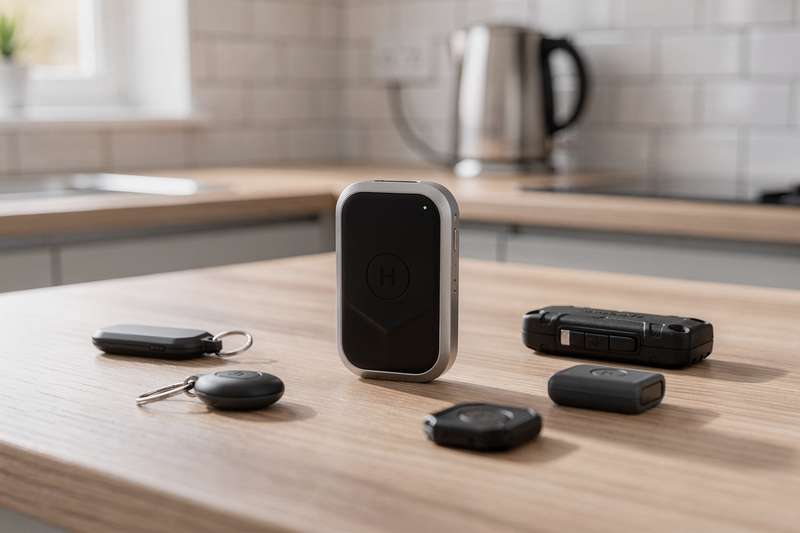
The GPS Tracker Tag for Vehicles Work with Apple Find My (iOS only), Car Tracker No Monthly Fee or Subscription, Global Coverage Mini Air Tracke is the pick for anyone already deep in the Apple ecosystem who wants a low-commitment way to keep tabs on a vehicle, bag, or piece of equipment — without paying a penny beyond the hardware.
Let’s be direct about what this device actually is and isn’t. It works via Apple’s Find My network, which means it piggybacks on the location signals broadcast by hundreds of millions of iPhones and other Apple devices worldwide. When your tracker passes near another Apple device (which, in urban and suburban UK, happens constantly), it silently updates its last-known location in your Find My app. This is genuinely useful for knowing roughly where a parked car is, confirming that a bag made it to the right destination, or checking whether a bicycle is still where you left it. With over 20 verified UK buyer reviews and a rating of 4.1 out of 5, it has enough real-world feedback to be taken seriously for its category.
The tradeoff is the same as with any Bluetooth relay tag: this is not live GPS tracking. If your car is stolen and driven through a rural area where no iPhones are present, the last-known location could be hours out of date. It also works exclusively with iOS — Android users are completely locked out, which is a hard compatibility limit you need to check before buying. Setup through Apple’s Find My is straightforward for anyone already familiar with AirTags, and the compact form factor makes it easy to tuck into a glovebox, clip onto a keyring, or slip into a bag pocket.
For someone who just wants the peace of mind of being able to pull up a rough location in the Find My app without committing to a monthly subscription, this is a sensible and affordable entry point. Just go in with realistic expectations: it’s a finder, not a live tracker, and it’s iOS-only. If you need Android compatibility or genuine real-time updates, you’ll want to look further down this guide.
Best Dual-Platform Tag for iOS and Android
The GPS Tracker for Vehicles Compatible with iOS and Android, Magnetic Car GPS Tracker No Monthly Fee, Global Real-Time Tracking Hidden Car Trac earns its place here by solving the single biggest limitation of Apple Find My-only tags: Android compatibility. It carries a 5.0 rating from seven UK buyers, which is a small sample size to hold too much weight, but the combination of cross-platform support and no ongoing subscription cost makes it worth highlighting for mixed-device households.
The magnetic mount is a key practical feature. Rather than requiring tape or cable ties, you can simply press it against the underside of a vehicle, inside a wheel arch, or behind a bumper and the magnet holds it in place. This makes it far easier to move between vehicles or reposition if you’re not happy with the original placement. For car owners, this is a notable quality-of-life improvement over units that need to be wired in or permanently fixed.
Honesty matters here: the “global real-time tracking” language in the title is marketing shorthand. Like the iOS-only pick above, this device works through a Bluetooth crowd-sourced network rather than a cellular SIM, which means location updates depend on other smartphones being nearby. In dense UK urban areas that works reasonably well; in rural Scotland or mid-Wales, it becomes much less reliable. The “no monthly fee” is genuinely true, which is its biggest selling point over cellular trackers that cost more to run over a year than the hardware itself.
This is a good option for someone who wants a set-and-forget, low-maintenance way to keep a rough eye on a secondary vehicle, a caravan, or a trailer — particularly if they switch between iPhones and Android devices and don’t want to be locked into one ecosystem. Don’t buy it expecting live pursuit-grade tracking, but for everyday peace of mind it delivers solid value.
Best Budget Two-Pack for Multiple Assets
The 2 Pack GPS Tracker for Vehicles Work with Find My (iOS Only) Real Time Bluetooth Air Tracker Tag Mini Car Locator Global Tracking Device Item is the pick when you need to cover more than one asset without spending heavily — a car and a motorbike, two company vans, or a vehicle and a trailer. Buying in a two-pack brings the per-unit cost down meaningfully compared to buying individual trackers, and for iOS households this is a straightforward way to get both covered through a single Find My account.
With a 5.0 rating from just two reviews at the time of writing, the sample size is too small to draw firm conclusions about long-term reliability. Treat the rating as neutral-to-encouraging rather than definitive. The core technology is the same Find My relay approach as the single-unit iOS tracker covered above: no SIM, no monthly fee, location updates dependent on nearby Apple devices. If you’re already comfortable with how that works and you simply need two units rather than one, this pack makes obvious sense.
The form factor is described as mini, which in practice means it’s small enough to tuck out of sight in most vehicles. Physically small trackers are genuinely harder for opportunistic thieves to spot and remove, which adds a marginal but real deterrent benefit. The magnetic attachment also means you can move them between vehicles as needed rather than committing them permanently to one asset.
The iOS-only limitation remains the key caveat to check before adding this to your basket. If anyone in your household uses an Android phone and needs access to the tracker’s location, this pack won’t work for them at all. For a purely iOS household covering two vehicles or assets, it’s a sensible budget move. Keep expectations grounded: these are finders, not live pursuit trackers, and they work best in areas where iPhone density is high — which in most UK cities and suburbs means they perform adequately for day-to-day use.
Best 4G Real-Time Cellular Tracker with Long Battery
The Salind 11 4G – GPS Tracker with Magnet for Cars, Vehicles & Machinery – Real-Time Tracking, Route History & Security Alarms – Up to 70 Days is a fundamentally different class of device from everything else on this list. It uses a genuine 4G cellular connection and built-in GPS to report live location over the mobile network — which means actual real-time tracking, not crowd-sourced Bluetooth approximations. This is the type of tracker you need if you want to know where a vehicle is right now, receive geofence alerts when it leaves a designated area, or review a full route history.
The standout claim is the battery life: up to 70 days on a charge in low-frequency tracking mode. For context, most cellular GPS trackers with comparable features manage a week to three weeks before needing a charge, so this is a significant practical advantage — particularly if you’re tracking a vehicle or piece of machinery that’s parked for long periods (a caravan, a horse trailer, a site dumper). The magnetic mount is strong enough for covert placement under a vehicle, and the unit is described as suitable for cars, vehicles, and machinery, which suggests durability appropriate for outdoor use. It carries a rating of 4.4 stars, though the UK review count is currently low, so supplement your research with reviews from other European Amazon marketplaces if you want a fuller picture.
The important caveat with any cellular GPS tracker is the subscription. Real-time cellular tracking requires a data SIM, and that means an ongoing cost. Before you buy, check the current subscription options and factor that into your total cost of ownership — a device that looks like a bargain upfront can become expensive if the plan cost is high. The Salind 11 is a 4G device, which is important for UK compatibility as the 2G and 3G networks that older trackers relied on have been progressively switched off by UK carriers.
This is the right pick if you genuinely need live tracking — a teenager taking the family car, a company vehicle you need to monitor, or high-value equipment you can’t afford to lose. The long battery life removes the anxiety of wondering whether the tracker has gone flat at the worst possible moment. Just go in knowing that running costs exist and need to be budgeted for alongside the hardware price.
Best for Dedicated Sat Nav Navigation
The 9-inch GPS Navigator for Car, Latest 2026 Map Touch Screen GPS Navigation System, Truck GPS Sat Nav, Voice Guidance and Speed Camera Warning occupies a different corner of the GPS accessories space entirely: it’s a dedicated in-car sat nav rather than a tracker. If your need is navigation — particularly for a truck, HGV, or large vehicle where phone mounts are impractical and you want a large-screen, offline-capable unit — this is the most relevant option in the current product pool.
The 9-inch touchscreen is genuinely useful in a truck cab or motorhome where a standard 5-inch sat nav looks tiny and a phone mount wobbles every time you hit a pothole. Voice guidance and speed camera warnings are both practical features for UK driving. The unit ships with 2026 maps preloaded, which matters because a sat nav with outdated maps is actively harmful on roads that have changed recently — new roundabouts, altered speed limits, and closed routes all cause problems when the map hasn’t kept up. With a rating of 4.2 from 20 UK reviewers, it has enough real-world feedback to be considered credible.
The tradeoff compared to phone navigation is that dedicated sat navs don’t receive live traffic updates in the same way that Google Maps or Waze do — at least not without an additional traffic receiver or data connection. For motorway driving or long hauls where the route is fairly fixed, that matters less. For city driving where traffic conditions change minute by minute, a phone-based solution will usually route you more intelligently.
This is a good fit for professional drivers, motorhome owners, and anyone who drives a vehicle where phone mounts are awkward, illegal, or simply impractical. It’s also relevant for older drivers who prefer a dedicated physical device to fiddling with smartphone settings on the move. The large screen reduces eyestrain on long journeys, and having maps stored locally means no reliance on mobile data coverage in rural areas.
Best Golf GPS for Course Management
The Izzo Swami 7000i Touchscreen Golf GPS Rangefinder, Blue is the outlier in this guide — a GPS device built specifically for golfers who want accurate yardages to the front, centre, and back of the green without lifting out a phone mid-round. If golf is your context, this is the most purpose-built option in the live product pool.
Golf GPS units earn their keep through the depth of their course database. The Swami 7000i is a touchscreen device from Izzo, a brand with a track record in golf GPS hardware, and it preloads course layouts for tens of thousands of courses worldwide — which is useful for UK golfers who travel for golf holidays in Ireland, Spain, or Portugal. The touchscreen interface means you can tap between holes easily, and yardage accuracy on a course-mapped device is typically more reliable than trying to use a generic phone GPS app mid-round. The 3.7 rating from 20 UK reviewers suggests it’s competent rather than exceptional, and that’s worth noting: it won’t replace a premium laser rangefinder for precision, but it gives you reliable distance information without requiring you to aim at a flagstick.
The key distinction from a laser rangefinder is that a GPS unit gives you pre-mapped distances to fixed points (front, middle, back of green; hazards) rather than a measured distance to whatever you point it at. For most amateur golfers that’s all they need — knowing you have 147 yards to the centre of the green is more actionable than knowing the exact flagstick position. For competitive amateurs or professionals who need exact pin-sheet distances, a laser remains the more precise tool.
Battery life on a dedicated golf GPS unit is typically sufficient for a full round and then some, which beats a phone that might struggle through 18 holes while also running your music and messaging apps. If you play two or three times a week and want a lightweight, fuss-free distance device that lives in your bag pocket, the Swami 7000i is worth a look — just calibrate your expectations against that mid-range rating.
Best Compact Two-Pack for Android and iOS
The 2Pcs GPS Tracker for Vehicles Car Tracker Devices No Monthly Fee Real-Time Magnetic Hidden Vehicle Tracker Compatible with iOS & Android Glo targets a similar audience to the dual-pack iOS-only tag covered earlier, but with the added benefit of cross-platform compatibility. If your household or small business runs a mix of Android and Apple devices and you need to cover two vehicles or assets, this is the multi-unit option to consider.
The 3.9 rating from three UK reviewers is a small sample, so treat it as early-stage feedback rather than established track record. The compatibility claim — iOS and Android — is the primary differentiator from the Apple Find My-only two-pack, and for households where different family members use different phone platforms, that’s a meaningful practical advantage. Both units include magnetic mounts, enabling the same flexible placement options as the single-unit Android-compatible tracker: under bumpers, behind wheel arches, inside a trailer chassis.
Like all the no-subscription units in this guide, the underlying technology is crowd-sourced Bluetooth network location rather than cellular GPS. That means location accuracy depends on network density in your area. In cities and larger towns across the UK, smartphone density is high enough that these devices update with reasonable frequency. In genuinely remote rural settings, you may find hours pass between location refreshes — at which point a cellular GPS tracker is the better tool for the job.
The two-pack format makes practical sense for anyone covering a car and a bicycle, two company vehicles, or a van and a trailer. The no-subscription model keeps the total cost of ownership low, which is a genuine advantage for budget-conscious buyers who don’t want to commit to ongoing monthly charges just to keep an eye on two assets. Verify the companion app compatibility with your specific devices before purchasing, as mixed-platform household setups occasionally throw up compatibility quirks that single-platform options avoid.
What to Look For When Buying GPS Finders and Accessories
- Bluetooth tag vs. cellular GPS — know which you’re buying. This is the most important distinction in the entire category. Bluetooth relay tags (including Apple Find My devices) update location when another smartphone passes nearby and require no subscription. Cellular GPS trackers have a built-in SIM, report live location from anywhere with mobile coverage, and require an ongoing data plan. The right choice depends entirely on whether you need real-time live tracking or just a last-known location finder.
- Subscription costs — calculate the two-year total. For cellular GPS trackers, the hardware price is often the smallest part of the cost. Add up the monthly plan fee over 24 months and compare that total across devices. A cheaper unit with a more expensive plan can end up costing twice as much as a pricier unit with a low monthly fee. For Bluetooth tags, there’s typically no ongoing cost — but you trade live tracking capability for that saving.
- Network compatibility — 4G is now essential for UK use. The 2G and 3G networks that many older GPS trackers depended on have been substantially wound down by UK carriers. Any cellular tracker you buy should explicitly support 4G LTE to ensure reliable connectivity now and in the near future. Check the product listing carefully before purchasing older or discounted stock.
- Battery life and power source. Plug-in OBD trackers (for vehicles with an OBD-II port) draw power from the car and never need charging. Magnetic battery units are more flexible for placement but need periodic recharging — battery life claims range from a few days in real-time mode to 70+ days in low-frequency mode. If you’re tracking something that sits unused for weeks at a time, a long-battery unit is far more practical than one that needs recharging every week.
- Platform compatibility — iOS only or both? Several of the Bluetooth-relay trackers in this guide work exclusively with Apple’s Find My network, meaning Android users cannot access location data at all. If your household uses a mix of devices, or if you use an Android phone, look explicitly for units that support both platforms before buying.
- Waterproofing and mounting. A tracker placed outside a vehicle or on machinery needs to handle rain, road spray, and temperature changes. Look for an IPX rating if outdoor exposure is part of the use case. Magnetic mounts are practical for vehicles but ensure the magnet is strong enough for the surface — a weak magnet on a rough road will eventually vibrate loose.
- App quality and alert features. The hardware is only half the product — the app you use to view location, set geofences, and receive alerts is equally important. Check recent reviews specifically mentioning the app experience, as some trackers have solid hardware paired with clunky or unreliable software that makes day-to-day use frustrating.
Verdict
For most UK readers landing on this page, the choice comes down to what problem you’re actually trying to solve. If you want a low-cost, no-subscription way to keep track of a car, bag, or bicycle and you’re already in the Apple ecosystem, the GPS Tracker Tag for Vehicles Work with Apple Find My (iOS only) is the simplest and most cost-effective starting point — just be clear that you’re buying a finder, not a live tracker.
If you need genuine real-time cellular tracking — for a teenager’s car, a company vehicle, or high-value equipment — the Salind 11 4G is the most capable device in the current pool, offering 4G connectivity, route history, security alerts, and a seriously long battery life that removes the anxiety of constant recharging. Factor the subscription cost into your budget, but for live tracking this is the right category of product.
For mixed iOS and Android households who want no subscription and two-asset coverage, the cross-platform two-pack is a pragmatic budget choice. Golfers after course management distances will find the Izzo Swami 7000i fills a genuine niche that general-purpose trackers don’t touch. The single right answer depends on your specific scenario — use the category breakdowns above to match technology type to actual need, and you won’t go wrong.
We were not paid to feature any specific product in this guide. All opinions are independent and based on publicly available specifications, verified buyer feedback patterns, and category research.
Quick Comparison Table


FAQ
What’s the difference between a GPS tracker and a Bluetooth tag like an AirTag?
A GPS tracker uses a cellular SIM card to report its location over the mobile network from anywhere with coverage — it requires a monthly subscription but gives you live, real-time location. A Bluetooth tag like an AirTag has no SIM and no independent GPS; it relies on other people’s smartphones passing nearby to relay its approximate location. Tags are cheaper to run but can’t provide live tracking and become unreliable in areas with few smartphones around.
Do GPS trackers work in rural parts of the UK?
Cellular GPS trackers depend on mobile network coverage, so their reliability in very rural areas mirrors that of a standard mobile phone — patchy in parts of Scotland, Wales, and remote English countryside. Bluetooth relay tags are even more affected, since they need another smartphone nearby rather than just a mobile mast. For tracking in genuinely remote areas, dedicated satellite communicators are a better fit than standard GPS trackers.
Are GPS trackers legal to use on vehicles in the UK?
Tracking your own vehicle is legal in the UK. Tracking a vehicle or person without their knowledge or consent can breach privacy laws and potentially criminal law depending on the circumstances. Always ensure you have appropriate consent when tracking any person, and be aware of relevant data protection obligations if you’re tracking employees’ vehicles for business purposes. When in doubt, seek legal advice specific to your situation.
Do I need a subscription for a car GPS tracker?
If you want real-time live tracking via cellular GPS, yes — the device needs a data SIM and that means an ongoing cost, either monthly or annually. Bluetooth relay tags avoid this cost entirely, but they only show a last-known location rather than live movement. Some sellers market Bluetooth devices as “no subscription GPS trackers” which is accurate but can be misleading — always check whether a unit has a physical SIM card before expecting live tracking.
How long do GPS tracker batteries last?
It varies widely depending on update frequency and hardware quality. Cellular GPS trackers in real-time mode (frequent updates every few seconds) can drain a battery within days. In lower-frequency modes, many last one to three weeks per charge. Some premium units like the Salind 11 4G claim up to 70 days in low-frequency mode. OBD plug-in trackers sidestep the issue entirely by drawing power from the vehicle. Always check the battery life claim at the update frequency you actually intend to use, not just the headline maximum figure.
Can I use a golf GPS device on any course in the UK?
Most dedicated golf GPS devices like the Izzo Swami 7000i come preloaded with a large database of courses worldwide, which typically includes the vast majority of UK courses. Coverage of smaller or very new courses may occasionally lag, so it’s worth checking whether your regular course is in the device’s database before buying. Many manufacturers offer free course updates, which helps ensure the database stays current over time.