Picture this: you’ve just dragged your family to the local park for an afternoon of badminton. You’ve got a net, a handful of shuttlecocks, and a set of creaking rackets that came free with a garden game kit five years ago. The grips are sweaty and slippery, the frames wobble on contact, and every other shot either skims the tape or sails six feet out. You call it a day after twenty minutes, not because anyone ran out of energy, but because the equipment made the game thoroughly unsatisfying. Or maybe you’ve recently signed up for a club night and your coach politely suggested you should invest in something a little more serious than a toy-shop starter set — but the sheer number of options on Amazon has you completely lost. What’s the difference between graphite and carbon fibre? Does balance point actually matter for a casual player? Do you really need to spend a lot to get something decent? These are fair questions, and you deserve straight answers without anyone trying to upsell you on a racket a touring professional would use.
How We Evaluated These Rackets
Choosing the right badminton racket involves more variables than most people expect: frame material, shaft flexibility, balance point, head shape, grip size, string tension, and the all-important question of who is actually swinging it. To narrow down this list to a useful set of picks, we focused on five main criteria. First, material quality — whether the racket is built from steel, aluminium, or some form of graphite/carbon-fibre composite, and how that affects feel and longevity. Second, balance point — head-heavy for power, head-light for control and speed, or even-balanced for versatility. Third, suitability by skill level — a beginner needs different things from a racket than an intermediate club player does. Fourth, practical packaging — whether a pick comes as a single racket or a set, whether shuttlecocks and covers are included, and whether the value stacks up for the typical buyer in that tier. Fifth, real buyer feedback patterns — we looked at review counts and ratings from the live Amazon product data to see which products are actually generating consistent satisfaction rather than just marketing copy. The picks below represent the strongest options currently available on amazon.co.uk across different use cases and budgets.
Best Lightweight Beginner Racket
The YONEX Nanoray 10F Hi-Flex Pre-Strung Badminton Racquet is the sensible starting point for anyone picking up a racket for the first time — and it carries the Yonex name, which is genuinely meaningful in badminton. Yonex has been the dominant force in professional and recreational badminton for decades, so even their entry-level models carry a quality baseline you won’t find in generic no-name options.
The key feature here is in the name: hi-flex shaft. A more flexible shaft bends more on the downswing and then snaps back through contact, generating extra shuttle speed without requiring you to swing harder. For beginners who haven’t yet built up wrist snap and forearm strength, this is a significant practical advantage. You can play rallies without exhausting yourself, and the racket does a portion of the work for you. The isometric head shape — standard on most modern Yonex rackets — gives you a larger sweet spot than older oval-head designs, which means your off-centre hits still carry reasonably well instead of dying immediately.
Where the Nanoray 10F does ask something of you is in timing. Because the shaft flexes, there’s a slight lag between your swing and the moment of maximum power. Beginners who come from tennis or squash sometimes find this disorienting at first; the racket feels almost rubbery compared to stiffer alternatives. That said, once you adjust your timing — usually within a session or two — you’ll find rallies much easier to sustain. The pre-strung setup means you can take it straight out of the box and play; you don’t need to visit a specialist stringer.
It’s worth noting that hi-flex shafts are not ideal for players who have already developed a fast, explosive swing. At that point the shaft can actually cost you accuracy, since the extra flex introduces variability. But if you’re just starting out, that’s not a concern yet. As a solo purchase for a beginner who wants a reputable, lightweight racket that rewards correct technique as their game develops, this is hard to fault in its tier.
Best Power-Focused Single Racket
If you’ve been playing for a while and find yourself favouring big overhead clears and aggressive smashes over touch shots at the net, the YONEX Astrox Smash Badminton Racket is designed with your game style in mind. The Astrox line from Yonex is their power-oriented series, built around a head-heavy balance point that puts more mass behind each swing — and the Smash variant keeps that principle in a more accessible format.
Head-heavy balance is the single most important concept to understand when choosing a racket for power. When the weight is distributed towards the top of the frame rather than the handle, your swing momentum translates more directly into shuttle speed. Think of it like the difference between swinging a heavy mallet and a light stick — there’s more kinetic energy going into the hit. The trade-off is that head-heavy rackets are slower to manoeuvre, which can be a disadvantage at the net when you need quick reactive flicks. For baseline or mid-court players who prefer to dominate the rally from the back of the court, though, it’s a good match.
The black and red colourway is clean and purposeful rather than garish, and the build quality feels solid for its tier. The shaft stiffness sits in the medium range, which suits intermediate players — stiff enough to give you feedback on your swing mechanics, flexible enough not to punish minor timing errors too harshly. It arrives pre-strung, so again you’re ready to play immediately without any extra setup.
What you should be aware of is that power rackets demand more from your shoulder and elbow. If you have any history of tennis elbow or shoulder impingement, a head-heavy racket can exacerbate those issues because the extra resistance on every swing puts more stress on the joint. In that case, you’d be better served by a lighter or more even-balanced option. For physically fit intermediate players without injury concerns, however, the Astrox Smash delivers satisfying depth on your clears and a noticeable pop on smashes.
Best Budget Two-Racket Set
Not everyone needs a single high-performance racket; plenty of people just want two decent rackets so they can play with a friend or partner without either person having a disadvantage. The Yonex GR 303 Combo Badminton Racquet with Full Cover, Set of 2 hits that mark neatly. You get two matched rackets and full covers for both — a practical detail that often gets overlooked in budget combo sets.
The GR 303 uses an aluminium frame rather than graphite. That’s a deliberate choice for this price band: aluminium is heavier than graphite but significantly more durable under casual use, and it holds its shape well even if the rackets get stored loosely in a bag or bumped around. For recreational players who might play once a week in the park or the leisure-centre sports hall, aluminium’s extra robustness is a practical benefit. The frames won’t warp or crack from accidental knocks the way a thin graphite-walled frame might.
The weight of the aluminium frame does affect the feel compared to graphite options. Shots require a bit more physical effort, and the rackets feel slightly sluggish compared to what you’d experience with a pure carbon-fibre setup. For casual play this is a non-issue — rallies are slower in recreational badminton anyway, and the durability advantage more than compensates. Where you’d notice it is if one of the players using this set graduates to more competitive club play; they’d quickly find the racket limiting their development.
The full covers included with each racket are a thoughtful addition. They protect the strings and frame during transport, which matters more than people realise — shuttlecock shuttles can poke through unprotected strings when a racket is loose in a bag. At its tier, this Yonex combo is the right choice for households or pairs who want matched equipment from a reputable brand without paying a premium for graphite construction they won’t fully exploit.
Best Four-Player Family Set
If you’re buying for family games or group outings where four people need rackets, the HIRALIY Badminton Rackets Set of 4 for Outdoor Backyard Games covers everything in one purchase. The set includes four rackets, twelve nylon shuttlecocks, four replacement grip tapes, and a carry case — genuinely everything you need to set up and play.
The inclusion of twelve nylon shuttlecocks is a genuine practical advantage for outdoor and garden use. Nylon shuttlecocks are far more resistant to wind and rough grass surfaces than feather alternatives, and they last considerably longer when used outdoors. Beginners and casual players often don’t realise that feather shuttlecocks — the type used in professional play — are fragile and degrade quickly, especially outdoors. Nylon is the right call here. Four replacement grip tapes is also a thoughtful touch; grips wear out faster than most people expect, and being able to re-wrap the handle without an extra Amazon order is convenient.
The rackets themselves use a steel frame construction. Steel is the heaviest of the common frame materials, and it’s the entry point in terms of performance. The benefit is that steel frames are essentially indestructible under normal recreational use — you can leave them in a shed, throw them in a sports bag, and generally treat them with the kind of casual indifference that good kit deserves not to receive, and they’ll survive. The performance ceiling is low: steel is not suitable if any of the four players wants to develop their game seriously, but for garden and backyard use where the priority is fun and durability over precision, it’s the right material.
The carry case means the whole set is reasonably portable and can be packed into a car boot without rattling loose. If you’re planning a holiday with sports facilities, a garden party, or just want something that lives in the garage for weekend use, this is a sensible complete solution. Don’t expect it to perform like a club racket — that’s not what it’s designed for.
Best Starter Set with Real Racket Quality
The Carlton Nanomax Pro Ti Badminton Set brings a recognisable UK badminton brand into the two-player set category. Carlton has been part of British badminton culture for a long time — their rackets have been used at club and county level — and the Nanomax Pro Ti set is a step above the purely recreational options in terms of frame technology.
The “Ti” in the name refers to titanium-reinforced construction. Titanium is used in the frame to add stiffness and strength without adding significant weight, which means the rackets feel more responsive than plain aluminium or steel options. You get more feedback on each shot — when you hit cleanly, you’ll feel the difference compared to a dull thud from a heavy steel frame. The set includes two rackets, a carry cover, and shuttles, making it a complete ready-to-play package.
Carlton’s isometric head design gives you the larger sweet spot that suits developing players well, and the overall construction feels appreciably more refined than pure entry-level options. With 12 verified reviews on Amazon and a 4.4-star rating, early buyer feedback is promising. Players who’ve upgraded from toy-shop sets specifically comment on the improved control and the lighter feel in the hand.
The honest tradeoff is that this set is still targeted at recreational and beginner-intermediate players rather than serious club competitors. If you’re already playing twice a week at a club and developing a real technique, you’d benefit from a single higher-performance graphite racket rather than a matched pair at this tier. But for two players who want to genuinely improve their game without a large outlay — perhaps a couple starting to play at the local sports hall — the Carlton Nanomax Pro Ti punches above its weight and carries brand credibility that the no-name alternatives don’t.
Best Overall Set for Improving Players
The Senston Badminton Set S300 Graphite Full-Carbon Badminton Rackets With Carry Case is the standout pick on this list in terms of the combination of real performance materials and proven buyer satisfaction. With 654 reviews and a 4.6-star rating, this is by far the most validated product in the current Amazon selection — and the numbers match the spec.
The key word here is full-carbon. These are genuine graphite/carbon-fibre rackets, not aluminium or steel with a carbon-look finish. Full-carbon construction means a significantly lighter frame, which translates directly to faster swing speed, better wrist control, and less arm fatigue over a long session. For players who are getting serious about their game — perhaps playing club nights or taking lessons — the difference between a full-carbon racket and an aluminium one is immediately noticeable. Shots feel crisper, net play becomes sharper, and you can sustain a higher tempo without your arm tiring.
The set includes two rackets, a tube of shuttlecocks, two overgrips, and a carry case. The overgrips are a practical addition: factory grips on most rackets at this level are functional but often slightly too thick or too smooth for some players’ preferences, and being able to wrap a fresh overgrip from day one means you can customise the feel before your first session. The carry case is proper — not a flimsy sleeve — which matters for transport and storage.
One thing to be aware of: full-carbon rackets, while light and responsive, are less forgiving of hard knocks than steel or aluminium frames. A sharp impact with a wall, a door frame, or another racket can crack a thin carbon-fibre frame in a way that a more robust steel frame would simply shrug off. Treat these rackets with a bit more care than you might a garden set, and store them in the included case. For improving players who will naturally develop more respect for their equipment as they invest more in their game, this isn’t a significant concern — and the performance benefit far outweighs the added care requirement.
Best Budget Complete Set for Two
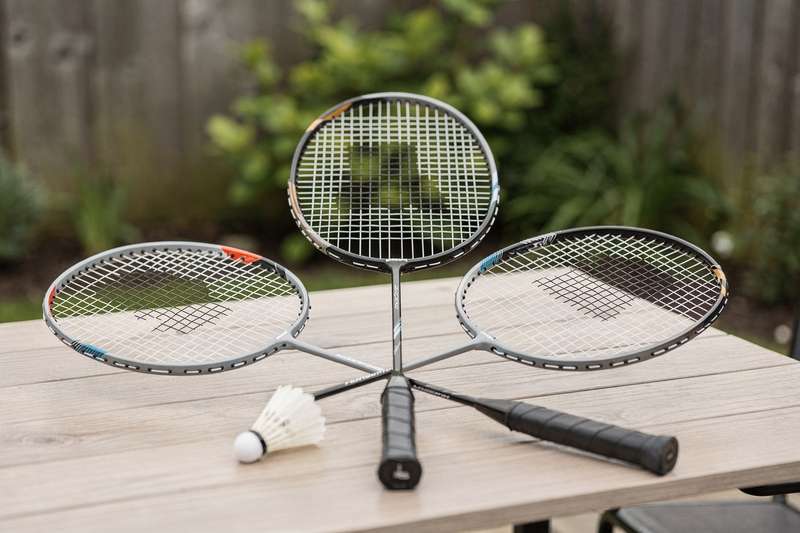
The Redfield Badminton Set for Outdoor Backyard Games strips things back to the essentials: two rackets, two shuttlecocks, and a carry bag. It’s a clean, no-frills option for buyers who want a pair of rackets for occasional garden or park use and don’t want to pay for features they won’t use.
The Redfield set is positioned as an outdoor and backyard option, and its construction reflects that. The frames are built for durability in rough conditions rather than precision performance, which is the right priority for this use case. When you’re playing on an uneven lawn with a light breeze and kids chasing the shuttlecock mid-rally, a set like this does exactly what you need it to do without any pretension about shot quality.
Two shuttlecocks is on the lean side for a session — you’ll want to have a few more in reserve, especially outdoors where they get lost in hedges or undergo terminal damage from concrete surfaces — but as a starter bundle, it covers the basics. The carry bag makes it easy to grab and go to the park, which is the primary use case this set is designed for.
Where the Redfield set is limited is anywhere that performance starts to matter. If one of the players using it wants to work on technique or start playing more regularly, they’ll outgrow the rackets quickly. Think of this as a gateway purchase — something to discover whether you enjoy badminton before committing to better equipment. It’s also a decent option as a spare set to take on holiday or leave in the car for opportunistic games, where you don’t want to risk your good rackets getting damaged or left behind.
Best Single Racket for Intermediate and Club Players
The Professional Badminton Racket – Carbon Graphite & Carbon Fibre, Ultra-Light Single Racket for Enhanced Performance is pitched at the player who has moved beyond recreational kits and wants a dedicated single racket for regular club or competitive use. With 106 reviews and a 4.1-star rating, it’s generating meaningful feedback from real players.
The combination of carbon graphite and carbon fibre in the construction is worth understanding. Carbon fibre provides structural rigidity and low weight; graphite adds a degree of flex and vibration dampening. Together they produce a racket that is responsive without being harsh on the arm — an important balance for players who are training multiple sessions per week. The ultra-light design means your swing speed can be maximised, which directly influences shuttle speed on smashes and clears.
At this tier, balance point and shaft stiffness become more important to match to your playing style. Power-oriented players — those who favour attacking, smash-heavy games — tend to prefer a slightly head-heavy balance and stiffer shaft to maximise impact. Control-oriented players, particularly those who excel at net play and defensive retrieval, often prefer a more even or head-light balance with medium flex for faster racket handling. Without a specific balance point listed in the product details, it’s worth checking the current listing and, if in doubt, buying from a seller with a clear returns policy so you can assess the feel in a real session.
The honest note on this pick is that with 106 reviews it’s a newer entrant to the market compared to the Senston set, and there’s less long-term data on how the frames hold up over extended use. Early feedback is positive but if you’re committing to serious regular play, the Senston S300 (with its 654-review track record) arguably offers more proven reliability. For intermediate players who want a dedicated single racket for their own game development and are willing to invest in a proper carbon-composite option, however, this is a well-specified choice.
What to Look for When Buying a Badminton Racket
- Frame material: Steel is the most durable but heaviest — fine for casual garden use but limiting for developing players. Aluminium sits in the middle: lighter than steel, more robust than graphite, suitable for regular recreational play. Graphite and carbon-fibre composites are the gold standard for performance — lighter, more responsive, and the choice for anyone playing seriously. Most of the best sets in the mid-range use full-carbon construction.
- Balance point: Head-heavy rackets put more weight towards the top of the frame, delivering more power on smashes and clears. Head-light rackets are faster to handle, suiting net play and defensive doubles players. Even-balanced rackets are versatile all-rounders. Beginners generally do well with even-balanced frames; once you understand your game style, you can move towards whichever end suits you.
- Shaft flexibility: A more flexible shaft generates extra shuttle speed through stored energy being released on impact — helpful for beginners and players without powerful swings. A stiffer shaft gives more direct control and suits experienced players with fast, explosive swings. Medium-flex is the practical default for recreational club players.
- Head shape: Isometric heads — slightly squared off at the top — offer a larger sweet spot and are standard on most modern rackets. Traditional oval heads have a smaller sweet spot but slightly more control in the hands of skilled players. For the vast majority of buyers, isometric is the right choice.
- Grip size: Most rackets come with a standard grip that fits the majority of adult hands. If you have particularly small hands, look for junior sizing or a thinner grip. You can always add an overgrip tape to build up a thin handle, but you can’t easily reduce a grip that’s too thick. Several sets on this list include spare overgrips, which is a practical bonus.
- Set vs. single: Sets (two or four rackets with accessories) suit households and casual players who need multiple rackets without spending on individual units. A single racket is the right purchase for a serious player who wants to own their specific tool and possibly have it re-strung to their preferred tension by a specialist.
- String tension: Pre-strung rackets in the budget and mid-range are typically strung at a moderate tension suitable for general play. Higher tension gives more control but requires a faster, more precise swing; lower tension is more forgiving. Most recreational players never need to think about this — but if you progress to club competition, having your racket strung by a professional at your preferred tension is worthwhile.
Verdict
For the majority of UK buyers reading this guide — players who are serious enough to invest in proper equipment but not yet at competitive club level — the Senston Badminton Set S300 is the pick we’d reach for. It’s the only option here that combines genuine full-carbon construction, a proven track record (over 650 real reviews at 4.6 stars), and a complete package with everything you need to play immediately. The two-racket format suits the majority of use cases — most people play with a regular partner or at club nights where equipment sharing is common. The overgrips and shuttle tube round it out neatly.
If you’re buying for a household of four, the HIRALIY four-racket set is the practical call. If you’re a complete beginner buying your first individual racket from a trusted brand, the Yonex Nanoray 10F is the right entry point. And if you’re already an established club player who has outgrown sets entirely, the carbon-composite single racket gives you a dedicated tool to work with. The Senston S300, though, hits the sweet spot for the most readers — improving players who want real performance materials without a professional-level price tag.
We were not paid to feature any specific product in this guide. All opinions are independent and based on publicly available specifications, verified buyer feedback patterns, and category research.
Quick Comparison Table


FAQ
What is the best badminton racket for a complete beginner in the UK?
For a complete beginner, a lightweight racket with a hi-flex shaft and isometric head shape is the most forgiving setup. The Yonex Nanoray 10F is a strong choice because the flexible shaft generates shuttle speed without requiring a fully developed swing technique. If you’d rather start with a two-racket set so you have a partner’s racket covered too, the Senston S300 or Carlton Nanomax Pro Ti both offer real quality at a sensible entry point.
Is graphite or aluminium better for recreational badminton?
Graphite (carbon fibre) is lighter and more responsive, making it better for developing technique and playing at pace. Aluminium is heavier but more robust under casual treatment — it won’t crack if knocked around in a bag. For regular recreational play at a sports hall or club, graphite is worth the step up. For purely occasional garden games where the rackets live in a shed and get rough treatment, aluminium’s durability advantage is more relevant.
What does head-heavy vs head-light mean on a badminton racket?
The balance point describes where the weight is concentrated along the racket’s length. A head-heavy racket has more mass towards the frame — this increases the power behind smashes and clears but makes the racket slower to manoeuvre. A head-light racket is quicker to react, suiting defensive players and net specialists. An even-balanced racket is the versatile all-rounder that most beginners and intermediate players find easiest to use effectively across different shot types.
Can I use an indoor badminton racket outdoors?
Yes — the racket itself doesn’t care whether it’s used indoors or out. The more important factor is which type of shuttlecock you use. Feather shuttlecocks are standard for indoor professional and club play but are easily destabilised by wind and degrade quickly on rough outdoor surfaces. Nylon (plastic) shuttlecocks are far better suited to outdoor and backyard use because they’re more wind-resistant and durable. Several sets on this list include nylon shuttlecocks specifically for this reason.
How many shuttlecocks should I buy for a session?
For a casual 30–60 minute session indoors with feather shuttles, six to twelve shuttlecocks is a reasonable starting stock — feathers get damaged regularly even by recreational players. For outdoor play with nylon shuttlecocks, you need fewer replacements as nylon is more durable, but having six on hand is still sensible given how easily they get lost in grass or hedgerows. Most sets on this list include a starter supply; buying a separate tube of nylon shuttlecocks as backup is a worthwhile precaution for regular play.
What grip size should I look for on a badminton racket?
Most adult rackets ship with a standard G4 or G5 grip that fits the majority of adult hands comfortably. If the handle feels too thin — common for players with larger hands — wrapping an overgrip tape over the factory grip builds up the diameter easily. If the handle feels too thick, a thinner replacement grip is available from most sports retailers. Beginners generally don’t need to worry about grip size until they’re playing regularly enough to notice discomfort; at that point, adding an overgrip is the simplest and cheapest fix.