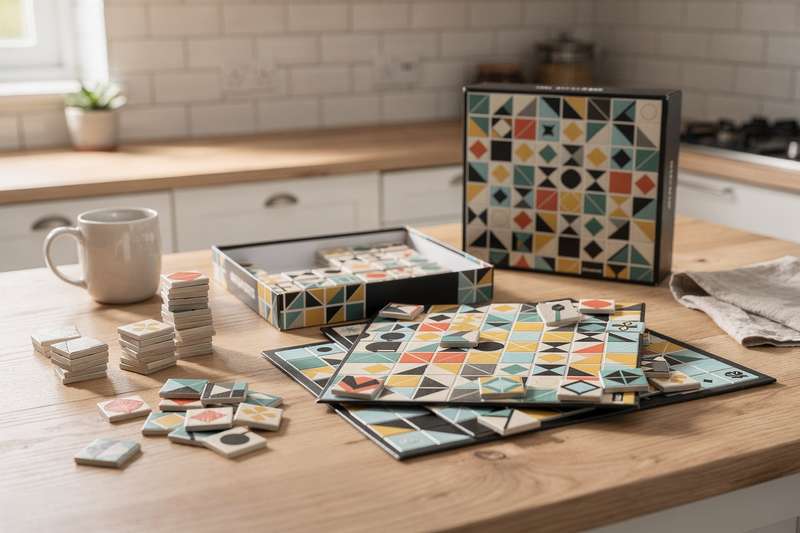
Picture this: it’s a rainy Saturday, the sofa is occupied by a bored eight-year-old and a couple of adults who’ve already exhausted Netflix. Someone digs out an old pack of cards, there’s a half-hearted attempt at Snap, and by 4pm everyone is staring at their phones again. Sound familiar? The problem isn’t a shortage of enthusiasm — it’s a shortage of the right game. Card games can feel too passive, board games with a hundred plastic pieces too fiddly to set up, and video games too isolating. What that afternoon needed was a tile game: tactile, visible, and just complex enough to keep grown-ups invested while remaining approachable enough that a child can join in without a forty-minute rules explanation.
Tile-based games occupy a brilliant middle ground. Whether you’re building colourful patterns, racing to place numbered sets, or forming words on a giant grid, the physical act of shuffling, drawing and placing tiles gives the game a satisfying texture that cards and screens simply can’t replicate. But the category covers an enormous range — from meditative solo puzzles to competitive strategy games for up to six players — and picking the wrong one for your household is an easy mistake to make. This guide cuts through the noise and points you towards the specific product that fits your situation, rather than just listing everything vaguely labelled “fun for all ages”.
How We Chose These Picks
Every product featured here was evaluated against the same set of criteria. First, topic fit: does the game genuinely centre on tile placement or tile manipulation as its core mechanic, rather than using tiles as a minor accessory to something else? Second, verified buyer feedback: we analysed rating patterns and review volumes on Amazon UK, looking for consistent praise or consistent complaints across a broad base of purchasers rather than cherry-picking glowing one-off reviews. Third, player range and age suitability — a game that works for two players but collapses at six, or claims to suit ages eight and up but requires a maths degree, gets flagged honestly rather than glossed over. Fourth, portability and build quality, because a game that sheds tiles or warps after three plays isn’t worth your shelf space. One product in this guide has no reviews at the time of writing; it’s included because the mechanic is genuinely distinct and worth knowing about, but that caveat is noted clearly in its section.
Best Compact Strategy Pick: Azul Mini
The Plan B Games Azul Mini is exactly what it promises — all the strategic depth of the full Azul experience, compressed into a travel-friendly box that fits in a bag without dominating it. Rated 4.6 out of 5 stars by nearly 950 Amazon UK reviewers, this version has earned its reputation not just as a shrunk-down novelty but as a genuinely satisfying standalone game.
The mechanic is elegant: players draft colourful tile pieces from central factories and arrange them across personal player boards to score points. Completing rows and columns earns bonuses; leaving gaps costs penalties at the end of each round. The beauty of this design is that it rewards forward-thinking without overwhelming newer players — you can play a reasonable game on instinct alone, but the more you anticipate what your opponents will draft, the more competitive you become. Sessions typically run 30 to 45 minutes, which is long enough to feel substantial but short enough that a second game is always tempting.
The “Mini” label refers to the physical footprint rather than any reduction in component count. The tiles themselves are smaller than in the original Azul, which is the one genuine tradeoff: players with larger hands or any difficulty with fine motor control may find the pieces fiddlier than the classic version. Children at the younger end of the recommended age range (8+) may need a few rounds to get used to the tile size. That said, the smaller format makes it perfect for holidays, restaurant waits, or any situation where table space is at a premium.
Where Azul Mini really excels is in households that already enjoy strategy games and want something that introduces genuine decision-making tension without a rulebook that takes twenty minutes to absorb. The rules fit on a single sheet, setup takes under three minutes, and the visual appeal of the patterned tiles means it attracts curious onlookers even mid-game. If you’re buying one tile game for adults and older children who appreciate a bit of competitive edge, this is a strong starting point.
Best Calming/Solo Pick: A Gentle Rain
Not every tile game needs to be a race. A Gentle Rain – Calming Tile-Laying Puzzle Game is positioned at the opposite end of the spectrum: it’s designed for solo play, cooperative play, or gentle two-player sessions, and it genuinely earns the word “calming” in its title. With a 4.7-star rating across 222 reviews, it’s punching well above its visibility for a relatively niche product.
The concept is built around soft-touch tiles and wooden pieces, with a visual language that’s closer to an art object than a typical board game. Players lay tiles to form interconnected patterns — think of it as a meditative jigsaw that resets each session rather than a competition. Sessions clock in at around 15 minutes, making it ideal for a wind-down ritual rather than a full game night centrepiece. The cooperative mode means two players work towards a shared goal rather than competing, which removes the potential friction that can come with tile games when one player is significantly more experienced than the other.
The tradeoff is obvious: if your household wants competition, conflict, and the satisfaction of blocking an opponent’s best move, this isn’t the game for you. It’s also a quieter gift choice — someone who specifically mentions wanting to decompress, or who enjoys puzzles rather than competitive games, will appreciate it far more than a household of enthusiastic game-night competitors. The soft-touch tile finish is genuinely pleasant to handle, and the wooden components feel durable rather than throwaway.
Where it earns a firm recommendation is for adults who want to engage in a mindful, tactile activity that isn’t screen-based, for households with one player who finds competitive games stressful, or as a gentle introduction to tile-laying mechanics for a child who isn’t yet ready for strategy-level decision-making. It’s a thoughtful, well-made product in a part of the market that doesn’t get enough attention.
Best Classic Word Game: Ideal Super Scrabble
If your household contains at least one person who considers themselves a word game devotee, the Ideal Super Scrabble is worth serious consideration. Rated 4.6 stars from 123 Amazon UK reviewers, this is the supersized version of the most famous letter-tile game ever made — a giant board with twice the number of tiles compared to the standard edition, plus more premium squares to aim for.
The expanded format changes the character of the game meaningfully. Standard Scrabble can stall in the late stages when the board fills up and players struggle to find valid placements; Super Scrabble keeps the board open for longer, rewards players who think spatially across a larger grid, and generates higher-scoring games. For experienced Scrabble players who find the original version feels constrained, this is a natural and satisfying upgrade.
The caveats are real, though. The box is large — this isn’t a game you slip into a bag or store in a small flat without noticing it. Setup and teardown take longer than the standard version simply because there are more tiles to sort and bag. And because the recommended age is 10+, it’s not a pick for households with only younger children, who may find the expanded vocabulary requirements and longer play time frustrating rather than engaging. For competitive families or households where Scrabble is already a fixture, however, this edition adds genuine longevity to a game that can otherwise feel overfamiliar.
Build quality on the board and tile racks is solid, and the tile bag is generous enough to accommodate the larger tile count without becoming unwieldy. If you’re buying for an enthusiastic word-game household or as a gift for someone who takes Scrabble seriously, this delivers an experience that the standard edition simply can’t match.
Best Retro/Collectible Pick: Pressman Rummikub in Retro Tin
The Pressman Rummikub in Retro Tin occupies an interesting niche: it’s the classic Rummikub tile game — draw numbered tiles, form runs and sets, race to empty your rack — packaged in a vintage-style tin that makes it both a functional game and a presentable gift. At the time of writing it has no published review count on Amazon UK, so this recommendation is based on the well-established mechanics of Rummikub itself and the evident appeal of the format rather than aggregated buyer feedback, which is worth acknowledging upfront.
Rummikub’s core mechanic is genuinely clever. Each player draws a starting hand of numbered tiles and must form valid runs (consecutive numbers in the same colour) or sets (same number in different colours) to place tiles on the table. Once tiles are on the table, any player can reorganise existing groups to create new ones — which is where the game generates real tension, because a creative reorganisation can unlock a hand that seemed unplayable. The strategic depth is higher than it first appears, and the game works well across a wide age range.
The retro tin format adds an aesthetic layer that matters if you’re buying this as a gift or want something that looks good on a shelf rather than stacked in a cupboard. The tin is sturdy and the compact 5-inch diameter makes it genuinely portable for travel. The tradeoff is that the tiles within are standard size rather than large-format — if you want oversized tiles for easier handling, you’d want to look elsewhere in this guide. But as a combination of nostalgic presentation and proven gameplay, this version has a clear identity and a clear audience.
Best for Larger Groups: Smilejoy Mini Rummy Cube Six Player Edition
The Smilejoy Mini Rummy Cube Six Player Edition solves a specific problem that the standard Rummikub editions don’t: what do you do when there are five or six people who want to play? Most Rummikub editions cap out at four players, which means someone gets left out or has to wait for the next game. This edition includes 160 tiles and supports up to six players, wrapped up in a portable canvas bag that makes it genuinely easy to bring to a gathering.
Rated 4.6 stars from 186 Amazon UK reviewers, this is a solid performer for the group-gaming scenario. The mechanics are identical to classic Rummikub — runs, sets, reorganisation — so anyone who knows the original game can join without relearning rules. The six-player capacity means it works for family gatherings, dinner parties, or any social occasion where you need a game that can flex to however many people are actually in the room.
The “Mini” in the name refers to the tile size, which is noticeably smaller than standard Rummikub tiles. That’s a genuine tradeoff: younger children and anyone with dexterity concerns may find the tiles fiddly, particularly later in the game when the table fills up and tiles need to be rearranged carefully. The canvas bag is a practical storage solution but doesn’t have the premium feel of a tin or a box — if presentation matters for gifting purposes, it’s worth factoring that in. But for pure functional value — more players, lower footprint, solid build — this edition earns its place for households that regularly host larger groups.
Best Full-Feature Rummikub: Ideal Rummikub Tile Strategy Game
The Ideal Rummikub Tile Strategy Game is the version most households should reach for when they want the classic Rummikub experience in a complete, well-presented package. With a 4.6-star rating from 142 Amazon UK reviewers, it delivers on the promise of the original game — numbered tile runs and sets, strategic reorganisation, first to empty their rack wins — in a format that includes proper tile racks, a sturdy bag, and the standard 2-4 player configuration.
What sets this edition apart from the Pressman tin and the Smilejoy six-player version is balance: the tiles are a comfortable standard size (easier to handle than the mini versions), the packaging is presentable enough for gifting without being oversized, and the included tile racks are solid rather than flimsy. If you’ve played Rummikub before and know what you want, this is the straightforward choice that won’t disappoint on component quality.
The limitation is that it caps at four players, which is fine for most households but rules it out for larger gatherings. It’s also the most conventional version in this guide — if you’re drawn to the retro tin aesthetic of the Pressman edition or need the six-player capacity of the Smilejoy, those versions have clear advantages for specific situations. But as the default full-feature choice for a family of two to four who want the complete classic experience, this edition delivers it cleanly and reliably.
One honest note: Rummikub games in general require a decent table surface to play comfortably, because reorganising tiles mid-game means tiles spread out quickly. It’s not a game for cramped spaces or those notorious wobbly café tables — plan for a proper table and you’ll have a much better time.
Best Fast-Reaction Game for Kids: BANANAGRAMS Cobra Paw
The BANANAGRAMS Cobra Paw Board Game is categorically different from everything else in this guide. Rather than strategic placement or set-building, Cobra Paw is a reflexes game: two dice with symbols are rolled, and players race to grab the tile that matches the rolled pattern before anyone else does. It’s fast, physical, and loud in the best possible way — sessions last 5 to 15 minutes and work for two to six players from age five upwards.
At the time of writing, this listing carries no published review count on Amazon UK, so buyer feedback patterns aren’t available to draw on. The game itself, however, is well-established in the wider market and its mechanic is transparent enough that the suitability is easy to assess before buying. If your household includes young children who find longer strategic games frustrating or hard to engage with, Cobra Paw offers something genuinely different: a tile game that rewards quick visual processing rather than planning, making it far more accessible for the under-eight crowd.
The tradeoff for adults is obvious — there’s little strategic depth here, and once the initial novelty wears off, older players may find the game more of an icebreaker than a centrepiece. It works best as part of a game-night rotation rather than as the sole tile game in the house. Build quality is sturdy for the price point, and the dice and tiles are chunky enough that young children can handle them without too much frustration. Think of it as a tile game for the moments when you need everyone at the table to be engaged immediately, without negotiation or setup time.
What to Look For When Buying a Tile-Based Game
- Player count range: Check both the minimum and maximum. A game that works beautifully at two but becomes chaotic at five, or one that requires four players to function properly, can be frustrating if your household size doesn’t match. Some editions, like the six-player Smilejoy version, solve this explicitly.
- Recommended age and actual complexity: Age recommendations are a starting point, not a guarantee. A game rated 8+ can still be genuinely challenging for adults, while some 10+ games work perfectly well for a bright seven-year-old. Read the mechanic description, not just the age label — if it involves reorganising complex number sequences, that’s genuinely harder than it sounds for younger children.
- Tile size and material: Larger tiles are easier to handle, particularly for younger players or anyone with dexterity challenges. Mini versions trade portability for ease of handling. Hard plastic tiles are durable but can be loud on a table; cardboard tiles are quieter but may show wear over time. Wooden tiles tend to be the most durable long-term.
- Session length: Tile games range from 15-minute fillers to 90-minute strategy sessions. Consider when and where you’ll actually play. A 45-minute game is perfect for a dedicated game night but may not work for a spontaneous half-hour before dinner.
- Storage and portability: Tile games are bulkier than card games by nature. Check whether the box or bag is manageable for your storage situation, and whether it’s robust enough for regular travel. Canvas bags and tins handle transport better than plain cardboard boxes.
- Solo and cooperative options: If you want a game that works when you’re playing alone or when you’d rather not compete, look specifically for games that offer these modes. Most tile games are competitive by default — the exceptions (like A Gentle Rain) are genuinely distinct in feel.
- Review volume vs rating: A 4.8-star rating from 20 reviews is less reliable than a 4.6-star rating from 900. Weight both numbers together rather than focusing on the headline rating alone.
Verdict
For most UK households asking “what’s the best tile-based game to start with?”, the Plan B Games Azul Mini is the recommendation. It works for two to four players across a wide age range, teaches quickly, rewards repeated play without ever feeling solved, and its compact format means it doesn’t demand dedicated shelf space. The nearly 950 Amazon UK reviewers backing it with a 4.6-star rating reflect genuine, consistent satisfaction rather than early hype.
If your household leans towards word games, the Ideal Super Scrabble is the natural upgrade for anyone who’s outgrown the standard edition. For number-tile fans with larger families, the Smilejoy Mini Rummy Cube Six Player Edition solves the group-size problem elegantly. And if you need something a five-year-old and an adult can play together without the adult wanting to fall asleep, BANANAGRAMS Cobra Paw delivers energy and laughter in under fifteen minutes. Match the game to your actual household rather than to an idealised version of it, and you won’t go wrong.
We were not paid to feature any specific product in this guide. All opinions are independent and based on publicly available specifications, verified buyer feedback patterns, and category research.
Quick Comparison Table


FAQ
What is the easiest tile-based game for young children?
For children aged five and above, Cobra Paw is the most accessible tile game in this guide — it relies on quick visual matching rather than reading, maths, or strategy, so children can compete on roughly equal terms with adults. Games last under 15 minutes, which suits shorter attention spans well.
Is Rummikub suitable for children?
Rummikub is generally recommended for ages 8 and above, but the actual challenge depends on the child. The core mechanic — forming numbered runs and sets — requires basic number recognition and simple sequential thinking, which most eight-year-olds handle comfortably. The strategic reorganisation element becomes more relevant as players develop, meaning the game grows with your child rather than being quickly outgrown.
Can tile games be played solo?
Most tile games in this guide are designed for two or more players, but A Gentle Rain is specifically built with solo play as a primary mode. It offers a calming, puzzle-like experience for one player and is one of the few tile games where playing alone is genuinely the intended experience rather than an afterthought.
What is the difference between Azul Mini and the standard Azul?
Azul Mini contains the same core gameplay as the original Azul — drafting tiles, filling your player board, scoring points for completed rows — but in a smaller physical package. The tiles are noticeably smaller, which makes the game more portable but can be trickier to handle for younger players or anyone who finds small components fiddly. The game mechanics and player count (2-4) are identical.
How many tiles do I need for a six-player Rummikub game?
Standard Rummikub sets are designed for two to four players and typically include 106 tiles. To comfortably accommodate five or six players, you need a larger set — the Smilejoy six-player edition, for example, includes 160 tiles specifically to support the expanded player count. Trying to run a six-player game on a four-player set results in a depleted draw pile and a less satisfying experience.
Are tile games good for cognitive development in children?
Yes, across several dimensions. Word-based tile games like Scrabble support vocabulary and spelling skills. Number-based tile games like Rummikub build pattern recognition and basic numerical sequencing. Pattern-matching games like Azul develop spatial reasoning and forward planning. Reflex-based tile games like Cobra Paw sharpen visual processing speed. The right tile game for cognitive development depends on which skills you want to target and the child’s current age and ability.