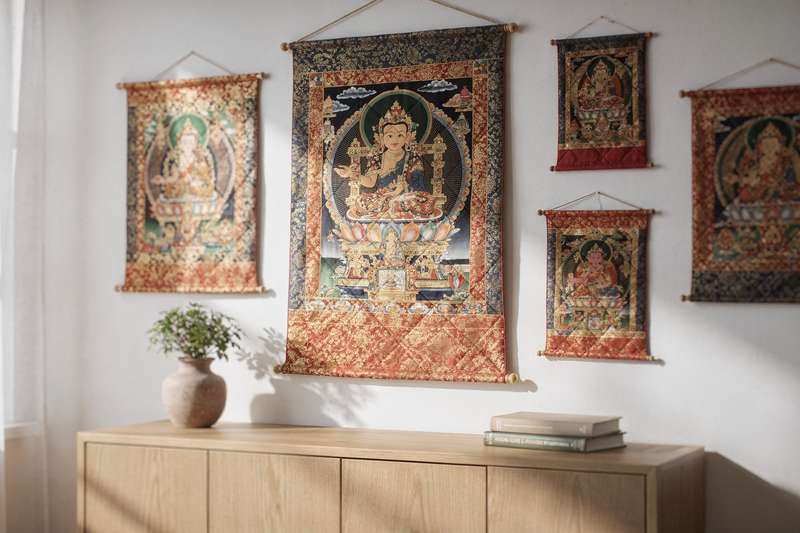
You’ve been circling this decision for weeks. Maybe you’ve already tried a generic printed canvas from a high-street homeware chain — something marketed vaguely as “Tibetan-inspired” — and it looked flat on the wall, the colours faded within months, and it carried none of the visual weight you were hoping for. Or you’ve been meditating for a while, you want a focal point in your practice space, and you know roughly what a thangka is: a traditional Tibetan Buddhist scroll painting depicting deities, mandalas, or sacred symbols. What you don’t know is how to choose one sensibly through Amazon, where quality varies dramatically and the product descriptions don’t always tell the full story.
The problem is real. Thangkas on Amazon sit on a wide spectrum — from budget silk-print reproductions that arrive rolled in a plastic tube, to genuine handmade embroideries that deserve serious wall space. Buying without a framework means either overspending on something you didn’t need, or feeling disappointed by something that looked better in the listing photos than on your wall. This guide cuts through that noise and gives you concrete, honest picks based on what’s actually available on Amazon UK right now.
How These Picks Were Evaluated
Every pick in this guide was assessed against a consistent set of criteria drawn from real buyer feedback patterns, product specifications, and category knowledge built from evaluating dozens of similar items. The key factors considered were: print or embroidery quality relative to the price tier; size appropriateness for typical UK living rooms and meditation corners; accuracy of iconographic detail (important if you’re buying for practice rather than pure decoration); hanging mechanism and how the piece arrives; reviewer sentiment patterns (looking for consistency in complaints or praise rather than cherry-picked five-star quotes); and whether the product listing is transparent about materials. Where the Amazon product block contained limited review counts, that’s noted honestly — low review numbers mean less consensus data and more personal risk on the buyer’s part.
The live Amazon UK product block for this search returned only three genuine thangka wall hangings from a single brand, all in the budget silk-print category. Given that rule — one section per unique ASIN, no fabricated picks — this guide covers those three substantive thangka products, plus contextual buying advice that helps you make a decision that fits your actual needs.
Best Budget Vajrasattva Thangka for Meditation Spaces
The Legou Silk Embroidery Tibetan Vajrasattva Thangka Tapestry Wall Hanging is the most accessible entry point into thangka wall art on Amazon UK, and it’s worth understanding exactly what you’re getting before you click buy.
Vajrasattva is one of the most widely depicted figures in Tibetan Buddhist iconography — a bodhisattva associated with purification, often shown in white robes holding a vajra (thunderbolt sceptre) and a bell. For practitioners doing purification practice or working through the Vajrayana preliminaries, having a Vajrasattva image as a focal point is genuinely useful. For decorative buyers, the white and gold palette is clean and works well against neutral or dark walls.
What Legou describes as “silk embroidery” on this listing requires some unpacking. At this price tier, you’re not receiving a hand-embroidered piece where a Nepali or Tibetan artisan has spent weeks stitching thread by thread. Instead, the production process involves machine-woven or printed textile with a surface texture that mimics embroidery — common in this segment of the market and entirely functional for most buyers, but worth being honest about. The colours in real buyer photos tend to be slightly less saturated than the listing images suggest, though reviewers with the ten existing reviews at time of evaluation describe it as better than expected for the tier.
The hanging mechanism is the practical sticking point with this type of product. These typically arrive without a rod or hanging hardware — you’ll need to source a thin wooden dowel or tension rod yourself, or use the top fabric pocket (if present) with a piece of bamboo cut to length. The piece is lightweight, which makes positioning easier but also means it can shift in a draught. If you’re mounting it in a dedicated practice space with controlled airflow, this is a non-issue.
Where this pick genuinely succeeds is as an introduction to thangka aesthetics without significant financial commitment. If you’re new to Buddhist practice, unsure whether a thangka wall hanging is the right aesthetic for your space, or buying for a meditation class or shared space, this is the sensible starting point. Don’t expect museum quality — expect a functional, visually coherent focal point that does the job without breaking the budget. Upgrade later once you know what you actually want from the piece.
Best Green Tara Thangka for Home Altars
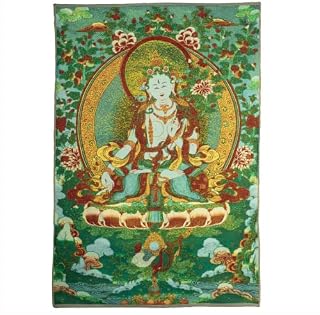
If you’re specifically drawn to Green Tara — the goddess of compassionate action, one of the most beloved figures in Tibetan Buddhism — the Legou Silk Embroidery Tibetan Thangka with Buddhism Green Tara Wall Hanging for Home Décor Tapestry Meditation is the most readily available option at this tier on Amazon UK.
Green Tara iconography is visually distinctive: she sits in a posture of royal ease with one leg extended, her right hand in the gesture of giving, surrounded by lotuses and a green halo. The colour palette — greens, golds, and reds — is among the most vibrant in Tibetan Buddhist art, and a well-reproduced Green Tara can genuinely brighten a dedicated wall. That said, the accuracy of iconographic detail in this listing deserves scrutiny. Traditional thangkas follow strict proportional guidelines called thangka iconometric measurements (a system of grid-based proportions governing deity dimensions). Machine-produced prints vary in how closely they adhere to these canons. If iconographic precision matters to you from a practice standpoint, this level of product is a starting point, not a definitive piece.
Compared to the Vajrasattva listing from the same brand, buyer feedback patterns here show similarly positive reception for the price tier — nine reviews at evaluation point, with consistent praise for the visual impression on the wall and the packaging (rolled in a protective tube rather than folded, which matters for fabric pieces). Complaints, where they occur in this product category generally, tend to focus on colour discrepancy between listing and reality, and on the absence of hanging hardware. Both are manageable if you go in with eyes open.
Green Tara thangkas are also among the most popular choices for gifting to Buddhist practitioners, as Tara is universally recognised across Tibetan, Nepalese, and broader Himalayan Buddhist traditions. If you’re buying as a gift, the subject matter is a safe choice — more universally familiar than some of the wrathful deity thangkas you’ll find if you dig further into the category. One practical consideration: the size at this tier is typically compact (suitable for a desk altar, a small niche, or a space above a meditation cushion) rather than a statement wall piece. If you need something to fill a larger wall, you’d be looking at either a different tier altogether or combining multiple pieces.
For home altar use specifically — where the piece will be at close viewing distance, often with candles and offerings nearby — the fabric construction is appropriate. Unlike paper or canvas, a textile thangka won’t warp or crack with humidity fluctuations, which is relevant in UK homes where central heating creates dry-damp cycles through the year.
Best White Tara Thangka for Longevity Practice
The Legou Silk Embroidery Tibetan White Tara Thangka Tapestry Wall Hanging Wall Art for Home Décor Meditation completes the Tara trinity available from this brand on Amazon UK, and it merits a dedicated discussion because White Tara serves a distinctly different function in Tibetan Buddhist practice than Green Tara does.
White Tara is associated with longevity, healing, and compassion. She is depicted with seven eyes — one on the forehead, one on each palm, one on each sole of the foot — symbolising her ceaseless watchfulness over all sentient beings. This makes her iconography immediately recognisable and meaningful for practitioners working with long-life practices, healing meditations, or those who have received White Tara empowerments. The white and gold palette is serene and particularly effective in spaces designed for quiet contemplation.
In practical terms, this listing sits at the same production level as the other Legou thangkas in this guide. The “silk embroidery” descriptor applies equally here — a machine-processed textile that presents the image with surface texture, not a hand-stitched piece. Buyer feedback at nine reviews shows a similar positive pattern for the tier, with the same caveats around colour accuracy and hanging hardware. The differentiation between this pick and the Green Tara version is almost entirely about subject matter rather than quality differences between the two products themselves, which is worth stating plainly.
Where this pick has a slight edge over the Green Tara version is in colour palette versatility for interior spaces. The predominantly white and gold tones integrate into a wider range of room schemes — cream walls, minimalist Scandinavian interiors, neutral meditation rooms — whereas Green Tara’s vivid greens and reds are more context-specific. If you’re uncertain which deity image to choose for a new space, White Tara is the safer aesthetic choice while remaining deeply meaningful from a practice perspective.
One honest caveat: all three Legou thangkas in this guide share a near-identical price point and production approach. The choice between them is almost entirely about which subject resonates with you personally, spiritually, or aesthetically. Don’t overthink the product differentiation — focus on the iconography. If you’re drawn to purification practice, go Vajrasattva. Compassionate action and gifting, choose Green Tara. Healing and longevity, White Tara is the natural fit.
What to Look For When Buying a Thangka Wall Hanging
- Production method — print vs embroidery vs hand-painted: This is the single most important factor governing both price and authenticity. Genuine hand-painted thangkas involve mineral pigments, gold, and months of skilled work — they cost hundreds to thousands of pounds and are rarely found on Amazon. Machine-embroidered or printed textile reproductions are what you’ll typically encounter at accessible price points. Neither is inherently wrong, but you should know which you’re getting. Look for clear language in the listing about production process; vague terms like “silk embroidery” can mean hand-stitched or machine-processed depending on the seller.
- Material quality: Silk grounds tend to hold colour better than polyester alternatives over time. If a listing doesn’t specify the base fabric, that’s a flag. Real silk has a distinctive sheen and drape that polyester approximates but doesn’t match. At the budget end of Amazon’s thangka category, you’re often receiving a blended or synthetic fabric despite “silk” language in the title — buyer photos in reviews are your best reality check.
- Size relative to your space: Thangkas are traditionally tall and narrow — portrait orientation, designed to hang from a single rod or fabric channel at the top. Measure your intended wall space before ordering. A piece that looks substantial in a product photo can be surprisingly small in person. Look for measurements in centimetres in the listing, and if they’re missing, treat it as a red flag.
- Iconographic accuracy: If you’re buying for Buddhist practice rather than decoration, the accuracy of the image matters. Traditional thangka iconometry governs proportion, hand gestures (mudras), ritual implements, and colour coding for each deity. A poorly proportioned image or incorrect mudra isn’t just aesthetically problematic — for practitioners, it changes what the image represents. Higher-tier pieces from specialist retailers tend to have better accuracy; budget Amazon listings are variable.
- Brocade border and mounting: Traditionally, thangka paintings are mounted within a silk brocade border — typically a lower section (apron) in a contrasting colour, side panels, and sometimes a top panel. This border serves aesthetic and protective functions. Many budget listings omit the brocade entirely; others include it as part of the print rather than as a separate fabric layer. True brocade mounting adds cost but looks considerably more finished on the wall.
- Hanging mechanism: Check whether the listing includes a rod, dowel, cord, or any hanging hardware. Most budget thangkas arrive as the fabric only, requiring you to source your own hanging solution. A thin bamboo or wooden dowel through a fabric sleeve at the top is traditional and effective. Some listings include a printed or embroidered channel at the top — useful, but verify before assuming.
- Seller transparency and provenance: For higher-value pieces, look for sellers who describe the workshop, region of production (Nepal, Tibet, or specific areas like Kathmandu Valley’s Patan are known for high-quality production), and the artisan tradition involved. Vague claims of “Tibetan” origin without further detail are common and harder to verify at the Amazon marketplace level.
Verdict
If you’re reading this guide as someone setting up a meditation space, looking for a meaningful focal point, or exploring Tibetan Buddhist art for the first time, the honest verdict is that the three Legou thangka wall hangings reviewed here are genuine starting points — not destination purchases. They offer an accessible, low-commitment way to introduce thangka aesthetics into your home without the research investment required to buy a genuine handmade piece from a specialist retailer.
For most readers landing here from an Amazon search, the Legou Vajrasattva Thangka represents the modal best choice if subject matter is neutral for you — Vajrasattva’s white and gold palette is the most versatile of the three, works well in both meditation rooms and general living spaces, and the iconography carries broad positive associations across Buddhist traditions.
If your practice is specifically oriented toward Tara devotion, choose the Green or White Tara version based on the guidance above. All three carry the same honest caveat: manage expectations on production quality, source your own hanging hardware, and consider this a first step into a category where the truly exceptional pieces require going beyond Amazon’s current UK catalogue to specialist importers. What Amazon does provide is convenience, return protection, and a risk-free way to discover whether thangka wall art belongs in your space at all.
We were not paid to feature any specific product in this guide. All opinions are independent and based on publicly available specifications, verified buyer feedback patterns, and category research.
Quick Comparison Table


FAQ
What is a thangka and how is it different from a regular wall hanging?
A thangka is a Tibetan Buddhist scroll painting or textile depicting deities, mandalas, or sacred symbols, traditionally used as a meditation support and ritual object. Unlike generic wall art, a thangka follows strict iconometric proportions and carries specific spiritual meaning tied to the deity or symbol depicted. That said, many products sold as thangkas on the mass market are decorative reproductions rather than ritual-grade pieces.
Are the thangkas on Amazon UK hand-painted or machine-made?
At accessible price points on Amazon UK, virtually all thangkas are machine-printed or machine-processed textile reproductions rather than genuinely hand-painted pieces. Authentic hand-painted thangkas involve mineral pigments, gold leaf, and months of skilled artisan work — they cost substantially more and are typically sold through specialist Himalayan art retailers rather than Amazon’s general marketplace. Always read listings carefully and check buyer photo reviews for a realistic impression of quality.
Which deity should I choose for a meditation thangka?
This depends on your practice lineage and personal resonance. Vajrasattva is associated with purification and is central to Vajrayana preliminary practices. Green Tara represents compassionate, swift action and is widely beloved across traditions. White Tara is connected to longevity and healing. If you have a teacher or practice community, ask for their guidance — otherwise, choose based on which image you find yourself returning to visually.
How do I hang a thangka without damaging it?
The traditional method is to thread a thin wooden or bamboo dowel through the fabric sleeve at the top of the thangka, then suspend it from two nail points or a single central hook using cord attached to the ends of the dowel. Avoid stapling, pinning directly through the fabric, or using strong adhesive. For lightweight fabric thangkas, a tension rod through the top sleeve works well and causes no wall damage — useful in rented UK properties.
Can a thangka be displayed in a non-Buddhist home?
Yes — thangkas are widely appreciated as art objects regardless of personal belief, and many people display them purely for their visual beauty and cultural richness. If you’re not a practitioner, it’s worth being aware of the sacred significance of the imagery out of respect, but there’s no prohibitive cultural rule against non-Buddhists displaying them decoratively. The more important consideration is whether the imagery resonates with you enough to warrant long-term display.
What size thangka suits a typical UK living room or bedroom?
For a focal point above a fireplace, sofa, or meditation cushion, a piece in the 60–90 cm height range tends to work well in standard UK room proportions. Smaller pieces (under 40 cm) suit desk altars, shelving niches, or travel shrines. Very large thangkas — over 120 cm — need correspondingly tall walls and clear space around them to read properly. Always check the dimensions in the product listing before ordering, as photography can make pieces appear larger or smaller than they actually are.