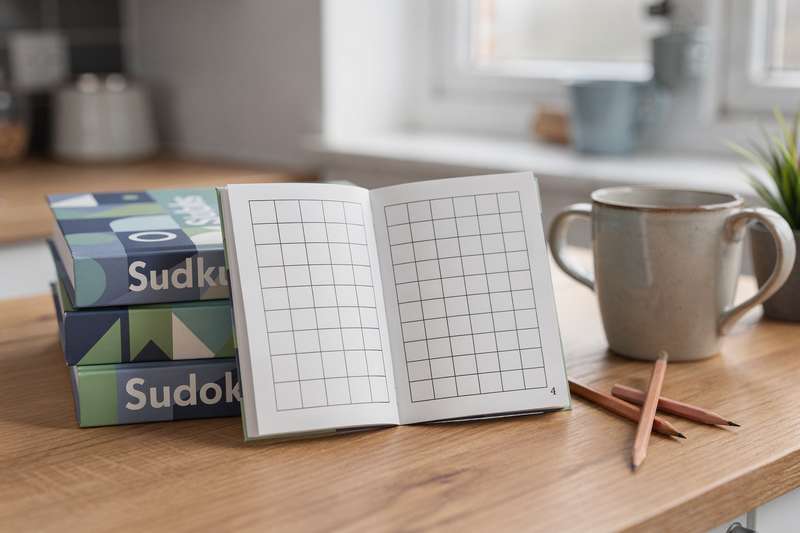
Picture this: you’ve just settled into your favourite armchair on a grey Sunday afternoon, a cup of tea cooling beside you, and you’re staring at a sudoku book that’s either far too easy — you’ve blazed through six puzzles in twenty minutes without breaking a sweat — or so fiendishly hard that you’ve abandoned it after two pages of fruitless pencil marks. You ordered it on a whim, attracted by the vague promise of “hundreds of puzzles,” and now it’s gathering dust on the side table. The real frustration isn’t that sudoku is too hard or too easy; it’s that the wrong book landed in your hands.
Whether you’re a complete newcomer who wants to build confidence without hitting a brick wall on puzzle three, a regular solver who needs a thick, reliable volume to fill commutes and lazy weekends for months, or an experienced player who feels patronised by anything less than a proper challenge, the range of sudoku books on Amazon is both vast and bewildering. Print quality varies wildly, difficulty labels are inconsistently applied, and some collections that promise “1,000 puzzles” squeeze them onto tiny grids that strain your eyes. This guide cuts through the noise and gives you seven specific, well-reviewed picks — each chosen for a distinct type of solver.
How These Picks Were Chosen
Evaluating sudoku books isn’t quite as straightforward as reviewing a kitchen gadget. You can’t measure a puzzle book in watts or millimetres. Instead, the assessment here focused on five criteria: verified buyer review volume and rating consistency on Amazon UK; the breadth of difficulty levels offered within a single volume; the quality of solutions sections (step-by-step hints versus bare answer grids); puzzle count relative to book size and readability; and how clearly the publisher or author calibrates difficulty — meaning, do the “hard” puzzles actually require advanced techniques like X-wings or naked triples, or are they merely “medium” dressed up in harder clothing? Books with fewer than ten reviews were treated with caution and only included where they filled a genuine gap that better-reviewed alternatives could not.
Best All-Round Collection for Regular Solvers
The Sudoku Puzzle Book for Adults: 1000+ Easy, Medium & Hard Puzzles with Solutions is the book you want on your shelf if you solve sudoku regularly and don’t want to think too hard about which book to reach for next. With over 1,000 puzzles spread across three difficulty tiers, it gives you genuine longevity — this isn’t a book you’ll burn through in a fortnight unless you’re solving at a serious pace. It carries a 4.5-star rating from 250 reviewers, which is a solid signal of consistency rather than a single fluke of good press.
What buyers consistently highlight is that the difficulty curve feels genuine. The easy puzzles are genuinely approachable without being trivial, the medium tier requires actual deduction rather than just scanning, and the hard section delivers puzzles that will keep an experienced solver occupied for a meaningful stretch. The grid layout is clean and spacious enough for pencil candidates — a detail that sounds minor but matters enormously when you’re using elimination techniques that require jotting small numbers in cells.
The solutions section is presented at the back of the book rather than interspersed, which is the right call: you don’t accidentally spoil the next puzzle when checking your work. One honest caveat is that the hard section, while legitimately challenging, doesn’t venture into the most brutal territory — solvers who routinely tackle extreme or “diabolical” grids may find the upper end just slightly tamer than they’d like. For everyone else, though, this is a reliable, well-structured workhorse of a book. It’s the pick that suits the widest range of regular solvers.
Best Budget Pick for Beginners
If you’re new to sudoku or returning after a long break and want a gentle reintroduction without spending much, the 1000+ Sudoku Puzzles for Adults: Easy to Medium Puzzles Book for Beginner Adults with All Solutions are included in the back VOL 2 is worth considering. It sits at the budget end of the range, carries a 4.0-star rating from 26 reviewers, and is deliberately pitched at beginners and casual solvers — all solutions are included, and the difficulty stays within easy to medium territory throughout.
The “VOL 2” designation is worth noting: this is part of a series, which tells you the format was well-received enough to warrant a follow-up. Buyers report that the puzzles are genuinely accessible — you can pick this up with no prior sudoku experience and work through the early puzzles using basic scanning techniques before the medium puzzles nudge you toward slightly more logical deduction. The review count is modest at 26, so the evidence base is thinner than some other picks here, but the ratings are broadly positive and consistent.
The main tradeoff is straightforward: if you’re already comfortable with medium-difficulty sudoku, this book will feel easy fairly quickly, and the lack of hard puzzles means you’ll outgrow it. Think of it as the right starting point, not a long-term companion. The price makes it easy to justify as a first purchase — once you’ve worked through it, you’ll have a clearer sense of which difficulty tier to target next. It pairs well with a more challenging volume once you’re ready to step up.
Best for Building Skill Across All Levels
The Sudoku Puzzle Book for Adults: 500+ Puzzles – Easy & Medium with Full Solutions sits at a sweet spot for readers who want a structured progression without being overwhelmed. It holds a 4.6-star rating from 62 reviewers — a strong signal for a book in this size category — and the emphasis on full solutions rather than bare answer grids makes it especially useful for anyone who wants to understand where their logic went wrong rather than just confirm a final answer.
Five hundred puzzles is a generous count that keeps the book useful for several months of regular solving. The easy-to-medium range is sensibly calibrated here: reviewers note that the easy puzzles are satisfying without being trivially solved in under two minutes, while the medium puzzles require genuine thought — techniques like hidden pairs and pointing candidates start to become useful rather than optional. This is exactly the right environment for building skill methodically.
Where this book distinguishes itself from others in a similar tier is the quality of its solutions section. Full solutions — meaning the complete filled grid rather than just the final answer for each cell — allow you to trace back through a puzzle and pinpoint the move you missed. For a developing solver, that’s genuinely educational rather than just confirmatory. The book does stop at medium difficulty, so if you’re already comfortable there, you’ll want to look at the harder-focused picks below. But as a skill-builder, this is one of the most thoughtfully structured options available.
Best for Intermediate Solvers Who Want a Real Challenge
The 1000+ Sudoku Puzzles for Adults: Medium to Hard Sudoku Puzzle Book with Detailed Step-by-step Solutions and Hints When You Get Stuck is the pick that bridges the gap between casual competence and genuine expertise. With a 4.3-star rating from 176 reviewers, it has a substantial evidence base, and what makes it stand out in reviews is the step-by-step solutions with hints — not just a filled grid at the back, but guidance on the logical path through tricky puzzles.
That hint structure is the defining feature. When you get stuck on a hard puzzle, most books offer you one option: look at the answer and feel mildly defeated. This book gives you an intermediate step — a hint that nudges you in the right direction without giving the whole game away. For solvers trying to push their technique from intermediate to advanced, that’s a meaningfully different learning experience. You can use the hints sparingly and still feel the satisfaction of completing the puzzle with your own logic.
The medium-to-hard range is well-calibrated according to reviewers, with the hard puzzles requiring techniques beyond basic scanning — expect to use elimination strategies, X-wings, and other intermediate-to-advanced methods as you progress through the book. The volume of 1,000+ puzzles means you won’t exhaust this quickly. The honest tradeoff: the 4.3-star average suggests a small number of buyers found the difficulty calibration inconsistent in places — a handful of supposed “hard” puzzles that felt closer to medium. That’s a minor gripe in the context of 1,000 puzzles, and the majority of reviewers rate the challenge level as genuinely appropriate.
Best Brand-Name Pick for a Gift or Established Solver
If you want a sudoku book that comes with the credibility of a recognised publisher behind it, The Telegraph All New Sudoku Puzzles 1 (The Telegraph Puzzle Books) is the standout choice. It carries a 4.6-star rating from 147 reviewers, and the Telegraph brand brings with it a consistency of editorial quality that self-published collections can’t always guarantee — these puzzles have been curated and tested to the standards of a national newspaper’s puzzle department.
Telegraph sudoku books are a perennial favourite as gifts for puzzle enthusiasts, and it’s easy to see why: the presentation is polished, the grids are clean and well-sized, and the difficulty range covers enough ground to keep a regular solver engaged across the whole volume. Buyers frequently note that the puzzles feel properly constructed — no shortcuts, no clunky grid layouts, no ambiguous solutions. That last point matters more than it might seem: a well-constructed sudoku has exactly one valid solution, and poorly produced books occasionally contain puzzles with errors or multiple solutions, which is deeply frustrating when you’ve spent fifteen minutes working through one.
The tradeoff is that this book doesn’t include the step-by-step solution hints that make some self-published alternatives so useful for learning. It’s a book for someone who already knows how to solve sudoku and simply wants a reliable supply of well-crafted puzzles. As a gift for a sudoku enthusiast, it’s hard to beat — the branding is reassuring, the quality is consistent, and it feels like a proper book rather than a print-on-demand pamphlet. If you’re buying for yourself, it’s equally solid, particularly if you value editorial rigour over sheer puzzle volume.
Best for Experienced Solvers Wanting Hard Puzzles Only
The Sudoku Puzzle Book for Adults: 100 Hard Puzzles with Solutions for Experienced Players is the most specialised pick in this guide — a book that makes no attempt to cater to beginners or casual solvers, and is better for it. It carries a 4.6-star rating from 13 reviewers, which is a small sample, but the ratings are consistently high and the feedback specifically confirms that the hard difficulty label is genuine rather than aspirational.
One hundred puzzles is a more modest count than the 1,000-puzzle behemoths elsewhere in this guide, but that’s entirely appropriate for a hard-only collection. Hard sudoku puzzles take significantly longer to solve than easy or medium ones — an experienced solver might spend thirty to sixty minutes on a genuinely difficult grid — so 100 hard puzzles represents a substantial investment of solving time. The book is better understood as a quality-over-quantity proposition: each puzzle requires genuine technique, and the solutions section gives you the correct grid to check your work.
This is the right choice if you find yourself breezing through mixed-difficulty books because the easy and medium sections feel like padding. You want to skip straight to the challenge. The caveat is clear: this book is not for beginners or even confident intermediate solvers who haven’t yet tackled hard-level puzzles regularly. Jumping in unprepared will produce frustration rather than satisfaction. But if you’ve worked through the hard sections of mixed-difficulty books and want a volume that respects your ability from the first page, this delivers exactly that.
Best Large-Format Mixed Collection
The Sudoku Puzzle Book for Adults: 600+ Puzzles – Easy to Hard carries a 5.0-star rating — which is the highest raw rating in this selection — from 9 reviewers. The sample is small enough that the perfect score should be treated with appropriate perspective rather than taken as a definitive verdict, but the feedback is uniformly positive. Buyers report clean grid layouts, well-structured difficulty progression, and a book that delivers on its stated promise of covering easy through to hard territory across 600-plus puzzles.
Six hundred puzzles across the full easy-to-hard range makes this a versatile option for households where more than one person uses the same book, or for a single solver who wants variety in a single volume. The easy puzzles give you a warm-up option on days when you want a quick, satisfying solve rather than a lengthy battle. The hard puzzles give you somewhere to go when you want genuine difficulty. That flexibility is genuinely useful — not every solving session is the same, and a book that meets you where you are has practical value.
The honest context: with only 9 reviews, there’s less certainty here than with books that have 150 or 250 verified buyers confirming the quality. The consistently high ratings are encouraging, but they represent a narrow slice of opinion. This is a reasonable choice if the format appeals — particularly if 500-puzzle books feel too thin and you’re not quite ready for the hard-only specialised volumes — but if you want maximum confidence from buyer evidence, the 1,000-puzzle all-rounder or the Telegraph collection have the stronger track records behind them.
What to Look For When Buying a Sudoku Book
- Genuine difficulty calibration: The most common complaint in sudoku book reviews is that the difficulty labels don’t match the actual puzzles — “hard” puzzles that only require basic scanning, or “easy” puzzles with errors. Look for books where buyer reviews specifically confirm that the difficulty feels correctly applied, and where the hard section requires named techniques (X-wings, naked triples, pointing candidates) rather than just more patient scanning.
- Grid size and readability: Sudoku grids need to be large enough to write pencil candidates (small numbers) in each cell. Books that cram too many puzzles per page produce tiny grids that are uncomfortable to use with a pencil. If readability matters to you — and it will if you’re solving for any extended period — check buyer reviews for mentions of grid size or print clarity before committing.
- Solutions quality: A bare answer grid at the back is the minimum. Step-by-step solutions or hint systems are significantly more useful if you’re still developing technique. If you regularly abandon puzzles after getting stuck, a book with hints or walkthrough solutions will teach you more than one that only confirms the final answer.
- Puzzle count versus solving time: More puzzles isn’t always better. A 100-puzzle hard-only book might represent more total solving time than a 500-puzzle easy-to-medium collection. Estimate your solving pace — how long do you typically spend per puzzle at your current level? — and choose a count that gives you at least three to four months of use to justify the purchase.
- Single valid solution guarantee: Well-constructed sudoku puzzles have exactly one valid solution. Poorly produced books occasionally contain puzzles with errors or multiple solutions. Established publishers like the Telegraph and books with large review samples are safer bets here; very low-review books carry a slightly higher risk of unchecked errors slipping through.
- Paper quality and binding: If you’re a pencil-and-eraser solver, you’ll be erasing frequently. Thin, poor-quality paper shows ghosting and tears easily. Reviewers sometimes mention paper quality explicitly — it’s worth scanning recent reviews for any complaints about bleed-through or flimsy pages, particularly if you intend to use the book heavily.
- Series availability: If you find a book you like, check whether it’s part of a series. Running out of puzzles and having to research a new book from scratch is mildly annoying. A publisher or author with an established series means you can simply move to volume two once you’ve completed the first.
Verdict
For the majority of readers landing on this guide — people who solve sudoku regularly, want a book that will last months, and need a genuine range of difficulty — the Sudoku Puzzle Book for Adults: 1000+ Easy, Medium & Hard Puzzles with Solutions is the strongest all-round pick. Its 4.5-star average from 250 reviewers is the most robust evidence base in this selection, the difficulty range is well-calibrated from easy through to a genuinely challenging hard tier, and the sheer puzzle count means you won’t need to think about your next sudoku purchase for quite some time.
If you’re buying as a gift for an established puzzle fan, the Telegraph All New Sudoku Puzzles 1 is the better-presented option with the brand credibility to match. And if you’re already an experienced solver who finds mixed-difficulty books frustrating because the easy and medium sections feel like filler, go straight to the 100 Hard Puzzles volume — it respects your ability and doesn’t make you wade through beginner material to reach the puzzles you actually want. Match the book to your solving level, and you’ll get far more enjoyment from the experience.
We were not paid to feature any specific product in this guide. All opinions are independent and based on publicly available specifications, verified buyer feedback patterns, and category research.
Quick Comparison Table


FAQ
What is the best sudoku book for a complete beginner?
Look for a book that stays within easy to medium difficulty and includes full solutions at the back rather than just bare answer grids. A large puzzle count is helpful so you can build confidence across many puzzles before stepping up in difficulty. The 1000+ Easy to Medium Puzzles book (VOL 2) in this guide is pitched squarely at this audience, with accessible puzzles and all solutions included.
How many puzzles should a good sudoku book have?
It depends on how quickly you solve at your level. Easy puzzles might take five to ten minutes each, while hard puzzles can take thirty to sixty minutes or more. A 500-puzzle easy-to-medium book offers months of casual solving, while a 100-puzzle hard-only volume can represent a similar total time investment. Match the count to your pace rather than simply choosing the highest number.
Are Telegraph sudoku books better than self-published ones?
Not categorically, but they tend to offer more consistent quality control — the puzzles are curated to newspaper editorial standards, which means each one has a single valid solution and the difficulty labelling is reasonably reliable. Self-published books with large review samples (150+ verified buyers) can be equally good, but you have more confidence in a known publisher when buying blind without extensive research.
What techniques do I need for hard sudoku puzzles?
Basic scanning and elimination will get you through easy and most medium puzzles. Hard puzzles typically require techniques such as naked pairs and triples (identifying cells where only the same two or three numbers are possible), hidden pairs, pointing candidates (where a number in a box can only go in one row or column, eliminating it from that row or column elsewhere), and X-wings. Books with step-by-step solutions are particularly valuable for learning these techniques when you get stuck.
Can a sudoku book have errors or puzzles with more than one solution?
Yes, unfortunately. A properly constructed sudoku puzzle has exactly one valid solution, but poorly produced books — particularly low-cost, high-volume self-published collections — occasionally contain puzzles with errors or multiple valid solutions, which is genuinely frustrating mid-solve. Choosing books with a large number of positive reviews significantly reduces this risk, as faulty puzzles tend to draw specific complaints in buyer feedback.
Is there a difference between sudoku books and sudoku puzzle magazines?
Books typically offer a larger puzzle count at a lower per-puzzle cost and don’t have the time pressure of a weekly magazine’s publication schedule. Magazines often include a mix of puzzle types alongside sudoku, which suits solvers who enjoy variety. Books are the better choice if sudoku is your primary puzzle interest and you want to work through a structured difficulty progression at your own pace.