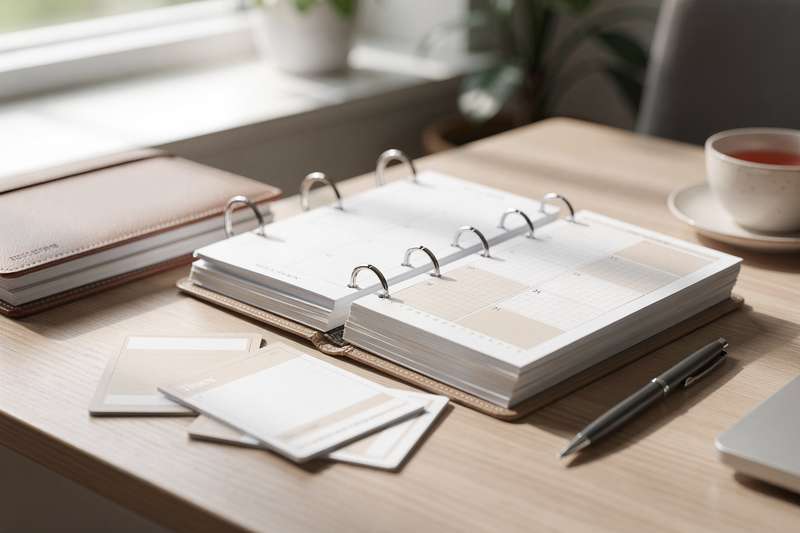
You bought a beautiful leather Filofax two years ago — the kind with the satisfying clasp and the crisp cream pages. Then January rolled around and you realised: it’s a system that only works if you keep feeding it fresh refills. So you searched online, found half a dozen options in baffling format codes (Personal? A5? Compact? Size 3?), ordered something that looked right, and received pages that were either the wrong size, punched with the wrong number of holes, or so flimsy that your pen bled straight through. Sound familiar?
Whether you’re a committed Filofax user who wants a mid-year academic diary refill for the new school or work cycle, someone who bought a budget ring binder and needs decent lined notepaper to fill it, or a planner enthusiast hunting for weekly spreads with monthly tabs and enough white space to actually write in — finding the right refill pack is surprisingly tricky. The UK market is narrower than the US one, sizing conventions vary wildly between brands, and cheap listings often turn out to be thin paper that smears with even a ballpoint pen.
This guide cuts through that confusion. You’ll find picks covering the main formats sold in the UK: A5 weekly diary refills, personal-size inserts, vertical year planners, and plain lined refill paper — all for ring-bound and six-hole systems.
How These Picks Were Chosen
Every product in this guide was selected from live Amazon UK listings at the time of research. The criteria were straightforward: format accuracy (does the listing clearly state the hole count, ring size, and paper dimensions?), paper quality signals (gsm rating where stated, buyer feedback on ink bleed-through and ghosting), layout clarity (are the weekly and monthly spreads genuinely usable or just decorative?), and compatibility transparency (is the binder standard — Filofax personal, A5 six-hole — stated explicitly so you aren’t guessing?). Where buyer review counts were available, patterns in that feedback were used to validate or disqualify picks. Products with zero reviews were only included where no reviewed alternative covered the same format niche, and that’s flagged clearly in each relevant section.
Best Weekly Diary Refill for A5 Binders
The Diary 2026 2027 Refill Week on 2 Pages, A5 Weekly & Monthly Planner with Tabs, Contact, Ruler Bookmark & Stickers July 2026 – June 2027, 6 H is the standout pick if you want a fully featured mid-year weekly planner for an A5 six-hole binder. Running from July 2026 to June 2027, it covers the academic or business year that most UK workers and students actually plan around — not the calendar year, which tends to leave you scrambling for a replacement in September.
The layout follows the week-on-two-pages format, which gives you a full view of Monday through Sunday on an open spread. That’s more generous than the week-to-a-view compact style, and it means you can write more than three words per day without cramping your handwriting. Monthly overview pages are included with tabs, so flipping to the right month is quick. The inclusion of a contact section, a ruler bookmark, and stickers is a genuinely useful bonus rather than filler — the ruler bookmark in particular saves you the usual faff of hunting for the current week.
With a rating of 4.9 from 14 verified buyers, the feedback pattern is strongly positive. That’s a small but enthusiastic set of reviews, so it doesn’t carry the same statistical weight as something with hundreds of ratings — but the score is unusually high and the format spec is clearly stated in the listing, which reduces the risk of receiving the wrong size. Compatible with standard A5 six-hole binders, it slots into any Filofax A5 organiser or equivalent brand without adapting.
The main tradeoff here is that it’s a dated refill: once June 2027 arrives, it’s done. If you prefer an undated system you can start mid-month, this isn’t for you. And if your binder is personal size rather than A5, you’ll need a different pick — personal size uses narrower pages (approximately 95 × 171 mm) and this refill won’t fit without being crammed in awkwardly.
Best for Filofax Personal Organisers — Weekly Mid-Year
For the classic Filofax personal size — the format millions of people in the UK have been using since the 1980s — the 2027 Week on two pages diary refill organiser insert | January 2027 – December 2027 | Compatible with Filofax personal size organisers | 95 covers the full calendar year 2027 in the personal six-hole punch format. At 4.8 stars from 32 verified reviews, it has enough real-world feedback to confirm it fits correctly and performs well in day-to-day use.
The week-on-two-pages layout is the standard format for personal organisers: each week gets a left-right spread, which in personal size is compact but perfectly usable for appointments and short tasks. The listing explicitly states compatibility with Filofax personal size organisers, which means you can buy with confidence rather than measuring your pages and hoping for the best. This matters more than it sounds — many budget refills list dimensions in millimetres that are close but not identical to the personal standard, leading to pages that don’t sit flush in the rings.
This is a calendar-year refill running January to December 2027, so it’s the right choice if you start your planning year in January rather than September. If you’re buying mid-year for an immediate start, it means you’ll have several months of unused pages at the front — worth bearing in mind, but not unusual for diary refills. The paper quality, based on buyer feedback patterns, appears solid enough for ballpoint and fine-liner use, though heavy fountain pen inks may show some ghosting on thinner diary paper — a caveat that applies to most diary-format refills at this price tier.
Where this pick falls short is feature depth: it’s a clean diary refill without extras like stickers, contact pages, or a ruler bookmark. If you want a more fully loaded insert, the A5 pick above adds those elements, but they don’t exist in this personal-size format from the same source. Treat this as your reliable, no-frills workhorse insert.
Best Vertical Year Planner Refill — Personal Size
The Filofax Personal Vertical Year Planner 2027 solves a very specific problem: you need to see the entire year on one or two pages so you can spot clashes, block out holidays, and track deadlines without flicking between monthly spreads. The vertical format presents months as columns and dates as rows, giving you the kind of bird’s-eye-view that standard week-on-two-pages layouts simply can’t offer.
This is an official Filofax product, which matters for two reasons. First, the hole punching and page dimensions will be precisely calibrated for Filofax personal size rings — no guesswork, no paper that catches on the rings mid-turn. Second, the paper quality is consistent with the brand’s own standards, which have been benchmarked against ring-bound use for decades. At 4.9 stars from 30 reviews, the buyer satisfaction rate is high and the feedback reflects genuine use in personal organisers rather than loose-leaf binders.
The vertical year planner format won’t replace your weekly or daily diary — it’s a planning tool, not a day-to-day diary. Think of it as the overview layer in your system: you slot it at the front of your organiser and use it to pencil in annual leave, project deadlines, and recurring commitments before drilling down into weekly pages. Many experienced organiser users combine a year planner with a week-to-view or week-on-two-pages refill for exactly this reason.
The limitation is obvious: it covers 2027 only, so if you’re buying before July 2026 and want something that bridges the mid-year gap, you’ll need to pair it with a 2026 version (sold separately) or use a mid-year weekly refill in the interim. It’s also specifically personal size — the A5 variant (see below) is a different product. Don’t mix up the two if you’re ordering for different organisers.
Best Vertical Year Planner Refill — A5 Size
The Filofax A5 Vertical Year Planner 2027 is the A5 sibling of the personal-size year planner above, and it carries an even higher rating: a perfect 5.0 from 10 reviews. Sample size caveats apply — ten reviews is a limited pool — but the score and the Filofax branding together make a strong case for reliability.
Because A5 pages are noticeably larger than personal size (roughly 148 × 210 mm versus 95 × 171 mm), the vertical year grid has more room to breathe. Date cells are wider, so you can write brief notes alongside appointments — something that’s genuinely cramped on the personal-size equivalent. If you use your organiser for both personal and work planning, that extra space is worth having. The A5 format is also more compatible with people who prefer writing with broad-nibbed pens or who find personal-size pages too small for comfortable daily use.
Like the personal-size version, this is an official Filofax insert, which means precision-punched holes and paper that won’t buckle or tear under normal organiser use. It covers 2027 as a calendar year, so the same temporal caveat applies: plan your purchasing timing to avoid paying for months you won’t use. As a planning overlay rather than a day-to-day diary, pair it with a weekly A5 refill (the first pick in this guide covers July 2026 to June 2027) for a complete A5 system.
The gap this pick doesn’t fill is daily structure — there are no to-do columns, no time blocks, no space for notes per day. It’s purely a visual calendar overview. If you need more granular structure built into a single refill, look at weekly-format inserts instead. But for annual planning clarity in an A5 binder, this is the cleanest option currently available on UK Amazon.
Best Mid-Year Weekly Refill for A5 — Academic Year Focus
The Academic Diary 2026 2027 Refill A5, Week on 2 Pages, Weekly & Monthly Planner with Tabs, Notes & Contact, August 2026 to July 2027, 6 Hole O runs from August 2026 to July 2027 — a slightly different window than the July-to-June mid-year options, making it the better fit for university students, teachers, and anyone whose work or study year starts in September rather than July or August.
The layout includes both weekly and monthly views with tabbed monthly dividers, a notes section, and a contact page. That combination gives you a proper reference system within a single insert rather than a bare diary with no supporting structure. If you frequently need to jot down recurring phone numbers, project notes, or reference information alongside your appointments, having those sections built in saves you from carrying additional inserts or reaching for a separate notebook.
It carries a 4.7 rating with zero reviews at the time of research, which is the significant caveat here. The format specification is clearly stated (A5, six-hole, week on two pages, August to July), which reduces the compatibility risk, and the rating itself suggests some quality signal — but without verified buyer feedback to draw on, it’s harder to confirm paper quality, print clarity, or ring-hole durability under repeated daily use. If you’re risk-averse, the July-to-June weekly refill above is the safer choice; if the August start date matters to your planning cycle, this is the only option in this listing set that covers it.
One practical note: the listing title is truncated on Amazon, which sometimes happens with longer product descriptions. Read the full product detail page before purchasing to confirm the exact dimensions and hole count match your binder — a step worth taking with any refill, but especially with zero-review products where there’s no buyer community to catch errors in listing specs.
Best Personal-Size Weekly Refill — Mid-Year
The Orgnizme 26-27 Middle Year Diary Refill Personal Size, Week on Two Pages, July 2026 – June 2027, Compatible with Filofax Personal Organiser is built for one specific need: a week-on-two-pages personal-size insert that covers the mid-year July-to-June period. Where the calendar-year personal diary above starts in January, this one starts in July — making it the right choice if you’re setting up your organiser for the new work or academic year mid-2026.
The Orgnizme brand produces inserts that are explicitly marketed as Filofax personal-compatible, which means the six-hole punch spacing and page dimensions are designed to sit cleanly in the rings without rubbing or catching. At 4.6 stars, the rating is solid, though like the academic refill above, zero verified reviews at the time of listing means the score’s origin is unclear — it may reflect ratings carried over from a related product or previous listing iteration. Treat it as a moderate-confidence pick rather than a verified bestseller.
The week-on-two-pages format gives you the same generous daily space as the A5 weekly refill reviewed earlier, but in the slimmer personal-size footprint. That’s a worthwhile tradeoff if you carry your organiser in a bag or handbag — personal size fits into smaller spaces than A5, and many users find A5 organisers too bulky for daily carry despite the extra writing space. The mid-year date range (July 2026 to June 2027) is well-matched to UK academic and business planning cycles.
The main limitation is the absence of extras: no stickers, no ruler bookmark, no contact pages flagged in the listing. If those extras matter to your system, the A5 weekly pick includes them (though in A5 format only). For a clean, functional mid-year personal diary refill without frills, this delivers what it promises.
Best Mid-Year A5 Weekly Refill — Alternative Option
The Orgnizme 26-27 Middle Year Weekly Diary Refill A5 Size, Week on Two Pages, Monthly Tabs, Jul 2026 – Jun 2027, Filofax A5 Compatible covers the same July 2026 to June 2027 window as the A5 weekly pick reviewed first, but from the Orgnizme brand rather than the more fully featured version. It includes monthly tabs for quick navigation between months, which is useful if you’re flicking back and forth between current and future months frequently.
The A5 format and Filofax A5 compatibility are clearly stated, making it a safe fit for any standard A5 six-hole ring binder or Filofax A5 organiser. Like the personal-size Orgnizme refill, it carries a 4.6 rating with zero reviews in the live listing data — the same caveats about confidence level apply. It’s a reasonable backup option if the top A5 weekly pick (with 14 verified reviews) is out of stock or if you want to compare formats from the Orgnizme range before committing.
Where it differs from the top-rated A5 pick is in extras: the listing doesn’t mention stickers, a ruler bookmark, or a contact section — you get the diary structure and monthly tabs, but the additional organisational features are absent. For a purist who wants just the planning pages without decorative additions, that’s a positive. For someone who wants a more complete out-of-the-box system, the first A5 pick remains the stronger choice.
The week-on-two-pages layout is identical in concept to the other weekly picks in this guide: Monday to Sunday on an open spread, with enough space per day for short notes and appointments. If you’re already a committed planner user who knows exactly how you use your pages, the format choice between these two A5 weeklies comes down to brand preference and stock availability rather than fundamental differences in structure.
Best Plain Lined Refill Paper for A5 Binders
Not every planner user wants dated diary pages. If you prefer to build your own planning system using blank or lined paper — bullet journalling, custom trackers, free-form notes alongside tabbed dividers — then the A5 Lined Refills Paper for Filofax Planner/Binders/Organizer, 6 Hole Punched Loose Leaf Paper, 100 Sheets/200 Pages, 100gsm, White, 148 x 21 is the most practical option in this listing set for that use case.
The 100gsm paper weight is the headline specification here, and it matters. Most diary refills use paper in the 70–80gsm range, which is fine for pencil and ballpoint but can ghost or bleed with felt-tip markers, fine-liners, or wet fountain pen inks. At 100gsm, this refill handles a wider range of writing instruments more confidently — you’re less likely to see the previous page showing through when you hold a page up to light, and less likely to get ink bleeding to the reverse side. That’s a meaningful practical difference if you do any kind of visual planning, colour-coding, or journalling with marker pens.
At 4.7 stars with zero verified reviews in the live listing data (the reviews listed are associated with the Amazon.com version of the product in some cases), the rating again carries the same caveat. However, the 100gsm specification is verifiable and the A5 six-hole format is standard — the compatibility risk is lower than with dated diary refills, which have more variables (start month, layout structure, ring spacing) to get wrong. At 100 sheets, it gives you 200 writing pages, which is a reasonable stock for several months of active use.
The tradeoff with plain lined paper is obvious: you’re providing your own structure. If you don’t already have a planning method that works without pre-printed layouts, a dated weekly refill will serve you better. But if you’re an experienced planner user who finds pre-printed boxes too restrictive, or you want to create monthly spreads exactly the way you want them, 100gsm lined A5 paper gives you a clean, quality canvas without paying for structure you won’t use.
What to Look For When Buying Planner Refills
- Format compatibility first: Check the size code carefully — A5, personal, A6, compact, and pocket are not interchangeable. A5 pages are 148 × 210 mm; personal size is approximately 95 × 171 mm. If your binder is a Filofax Personal, an A5 refill will not fit. If it’s an A5 Filofax or equivalent, personal-size pages will float inside the rings. Measure your current pages or check your binder’s size label before buying.
- Hole count and ring spacing: Most ring binders in this category use a six-hole system, but the spacing between holes varies between standards. Filofax personal and A5 both use six rings, but the ring spacing differs from some cheaper binders. A refill listed as “Filofax compatible” should match the Filofax standard precisely; generic “6 ring” inserts may not. If in doubt, check that the listing states explicit compatibility with your binder brand or confirms the hole spacing in millimetres.
- Paper weight (gsm): Diary refills typically use 70–80gsm paper, which is fine for ballpoint and pencil. If you write with fine-liners, gel pens, or fountain pens, look for 90gsm or higher. At 100gsm, ink bleed-through and ghosting become much less common. The paper weight is often stated in the listing title or product description — if it isn’t mentioned at all, treat that as a caution sign.
- Dated vs. undated: Dated refills give you pre-printed day and month headers, which saves setup time but commits you to a specific date range. If you miss a week or start mid-year, you’ll have unused pages. Undated inserts let you fill in dates yourself — slower to set up, but they never expire and can be started on any day of the year. Choose based on how reliably you use your planner and whether you tend to skip periods.
- Layout type: Week-on-two-pages (W2P) gives the most daily writing space and is the most common format for A5 and personal-size refills. Week-to-view (one week on one page) is more compact. Monthly-only gives you an overview without daily detail. Vertical year planners give a full-year grid. Most serious planner users combine two formats — a year planner for overview and a weekly refill for day-to-day — rather than relying on one refill to do everything.
- Date range and academic vs. calendar year: UK buyers often need mid-year refills running July–June or August–July rather than January–December. Check the start and end months explicitly — listings sometimes bury this information and headline the year range (e.g., “2026–2027”) without making the start month obvious.
- Extras and inclusions: Some refills include monthly tabs (useful for quick navigation), stickers (decorative but popular), contact pages, or ruler bookmarks. These add perceived value but also add to the page count and thickness — if your binder is already full, extra insert pages can make closing the clasp difficult. Factor in your current binder capacity before ordering a heavily loaded insert pack.
Verdict
For most UK buyers running an A5 Filofax or equivalent ring binder on an academic or work-year cycle, the Diary 2026 2027 Refill Week on 2 Pages, A5 Weekly & Monthly Planner with Tabs, Contact, Ruler Bookmark & Stickers July 2026 – June 2027, 6 H is the pick to start with. It has the highest verified rating (4.9 from 14 buyers), covers the most useful UK planning period (July 2026 to June 2027), and includes genuine extras — ruler bookmark, contact pages, stickers — that justify paying a little more than a bare-bones insert.
If you’re on personal size rather than A5, the 2027 Week on two pages diary refill organiser insert is the safest choice: 4.8 stars from 32 reviews gives it the strongest real-world validation of all the personal-size options here. For anyone who wants a year overview rather than a weekly diary, the official Filofax year planners (available in both A5 and personal size) are the most reliable format-accurate option and work best as a companion to rather than a replacement for a weekly refill.
If you write with anything heavier than a standard ballpoint pen, prioritise the 100gsm lined refill paper pick for your note-taking pages and pair it with one of the dated diary inserts for your scheduling needs.
We were not paid to feature any specific product in this guide. All opinions are independent and based on publicly available specifications, verified buyer feedback patterns, and category research.
Quick Comparison Table


FAQ
What size refill do I need for a Filofax Personal organiser?
Filofax Personal size uses pages approximately 95 × 171 mm with a six-hole punch. This is smaller than A5 (148 × 210 mm) and a common source of confusion when buying online. Always check that a refill explicitly states “Filofax personal compatible” or lists the page dimensions before purchasing — buying an A5 refill for a personal organiser is a common and frustrating mistake.
Can I use any six-hole refill in my ring binder?
Not always. While the hole count may match, the spacing between the holes varies between binder standards — Filofax personal, Filofax A5, and many cheaper generic binders each have slightly different ring spacing. A refill punched for Filofax personal size won’t sit correctly in an A5 Filofax, and vice versa. Look for refills that explicitly state compatibility with your specific binder brand or size code.
Is a week-on-two-pages refill better than a week-to-view layout?
It depends on how much you write each day. Week-on-two-pages gives you a full open spread for seven days, so each day gets a generous column — good if you track multiple appointments, tasks, and notes. Week-to-view fits seven days onto a single page, which is more compact but leaves less daily writing space. For A5 binders, week-on-two-pages is usually the better choice; for smaller personal or pocket sizes, the difference is less pronounced because both layouts are working with limited page area.
What gsm paper should I look for in a planner refill?
For ballpoint pen and pencil, 70–80gsm is perfectly adequate and is what most standard diary refills use. If you write with gel pens, fine-liners, or fountain pens, look for 90gsm or higher — at 100gsm, ink bleed-through and ghosting are significantly reduced. Very few dated diary refills reach 100gsm; it’s more common in plain lined paper refills, so bear in mind you may need to compromise on paper weight if you want pre-printed layouts.
Should I buy a dated or undated planner refill?
Dated refills are more convenient if you use your planner consistently — day headers are pre-printed, so setup is instant. The downside is that unused pages at the start or end of the date range are wasted. Undated refills work better for irregular planners or anyone who takes breaks and doesn’t want to feel they’re “behind.” They’re also useful mid-year when dated options for the current period have sold out. The tradeoff is that filling in dates yourself adds a small but recurring setup task.
Do I need a separate year planner refill as well as a weekly diary refill?
Not strictly, but many experienced planner users find the combination genuinely useful. A vertical year planner gives you a full-year grid — ideal for blocking out annual leave, project phases, or school terms at a glance. A weekly diary refill handles day-to-day scheduling. Together, they cover both the overview and the detail without either format trying to do both jobs at once. If you only want one refill, a weekly format with monthly tabs is the best single compromise.