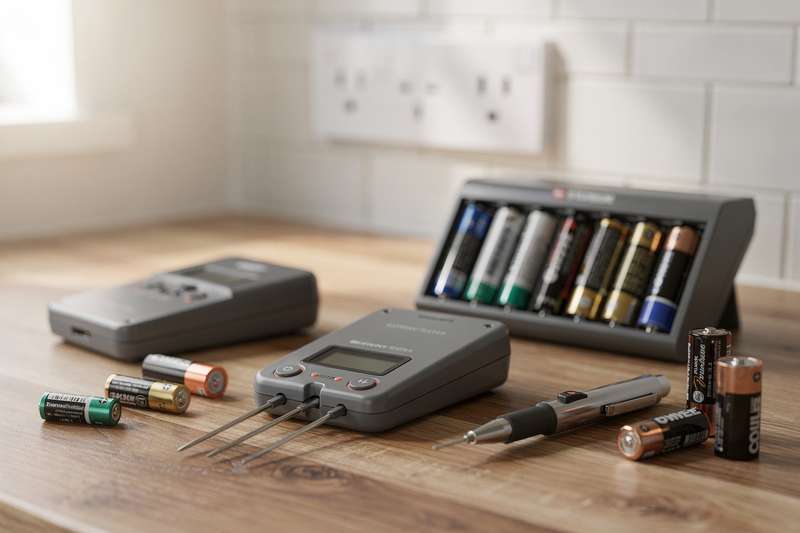
You wake up on a cold January morning, turn the key, and get that sickening slow-crank. Or you’ve just binned a drawer full of TV remotes, smoke alarm batteries and kids’ toy cells because you had absolutely no idea whether they were flat or just slightly depleted. Both situations are equally annoying, and both are entirely avoidable with the right battery tester to hand.
The problem is that “battery tester” covers an enormous range of tools. There’s the simple household battery checker that tells you whether your AA is good to go, and then there’s the 12V/24V car battery analyser that can assess cranking amps, check your alternator, and diagnose exactly why your van struggles every winter. Buy the wrong type and you’ll either under-solve your problem or end up with a professional tool that confuses rather than clarifies.
This guide cuts through the noise. Whether you’re a home user trying to sort through a box of mystery cells, a weekend DIYer who wants to check the car battery before a long drive, or someone who needs a reliable voltmeter for their workshop, there’s a pick here that will genuinely help you. None of these products have been paid for by manufacturers — this is a straightforward assessment based on real specifications, buyer feedback patterns, and category knowledge.
How We Evaluated These Picks
Choosing a battery tester sounds simple, but the category spans wildly different use cases. For household battery checkers, the key criteria were ease of use (no calibration required, self-powered operation), compatibility across common cell sizes (AA, AAA, C, D, 9V, and button cells), and clear readout — whether analogue or digital. For automotive battery and alternator testers, the criteria shifted: accuracy of CCA (cold cranking amps) measurement, voltage range (12V only vs 12V and 24V), charging system checks, display quality, and build durability for garage environments.
Alongside specification comparison, buyer review patterns were examined where review counts were sufficient. Products with zero reviews were included only where no reviewed alternative covered the same use case, and this is flagged honestly where relevant. Pricing tiers were assessed without naming specific figures — some tools are clearly budget, others mid-range, and one sits firmly at the professional end.
Best Household Battery Tester for Everyday Use
The AKIELO+ Digital Battery Tester is the pick for anyone who wants a clean, modern way to check the household cells scattered around their home. Its LCD display gives you a proper numerical voltage reading rather than a vague needle or a single LED, which means you can actually tell whether a battery has 70% of its charge left or is genuinely on its last legs. That distinction matters when you’re deciding whether to put a cell back in a remote control or relegate it to powering a low-drain torch.
One of the most practically useful features is that this tester requires no battery to operate — it draws the power it needs directly from the cell being tested. That sounds like a small detail, but it eliminates the frustrating irony of a battery tester that needs its own battery replaced. It covers AA, AAA, C, D, 9V, and 1.5V button cells, which accounts for the vast majority of what you’ll find in a typical UK household. The LCD is easy to read at a glance, and the build is compact enough to keep in a kitchen drawer without taking up the space of a proper tool.
The honest tradeoff here is that this is a household checker, not a load tester. It measures open-circuit voltage, which gives a reliable picture for alkaline cells but is less definitive for rechargeable NiMH cells, which tend to have a flatter discharge curve. If you’re regularly testing NiMH rechargeables, you’ll want to be aware that a reading of “good” doesn’t always mean the cell will last a full cycle under load. For disposable alkaline cells — which is what most people are checking — it’s accurate and dependable. Note that at the time of writing this product had no verified buyer reviews on Amazon, so early adopter caution is warranted, but the specifications are solid and the use case is well defined.
If you’re someone who constantly wonders whether that 9V in the smoke alarm is still good, or you want to sort a box of mixed used batteries before a camping trip, this is the tidiest solution available at a budget price. It won’t test your car battery, and it’s not designed to — but for what it does, it does it cleanly.
Best Analogue Household Battery Checker
The Analogue Battery Tester Multi Size Battery Checker takes the opposite approach to the AKIELO+ above: instead of an LCD, it uses a classic needle gauge with colour-coded zones to show battery condition. Good, low, and replace — you can read it without squinting at numbers, and in a bright garage or kitchen that readability is a genuine advantage.
Like the AKIELO+, this tester requires no battery to operate, drawing its test current directly from the cell under examination. It covers AA, AAA, C, D, 9V, 1.5V, and button cells, so you’re not going to be left fumbling with an incompatible socket. The analogue meter approach means there are no electronics to fail, no display to crack, and no software to confuse. It’s the kind of thing that will still work reliably in ten years.
Where analogue checkers fall short is precision. The needle zones are broad, so you get “good” or “replace” rather than a numerical percentage or voltage figure. For most household battery-checking tasks, that’s perfectly sufficient — you’re not running a lab, you just want to know if the AA in the TV remote has life left. But if you like specific data, or you’re checking cells for a more demanding application like a camera or a power tool, the digital AKIELO+ above gives you more information to work with.
This product also carried no verified buyer reviews at the time of writing. The analogue battery tester format itself is well established and reliable as a category, and the multi-size socket design mirrors products that have been sold for decades. It’s included here because it fills a distinct use case — some people genuinely prefer analogue readouts, and the no-battery-required convenience applies equally here. At a budget price, it’s a low-risk addition to any tool drawer.
Best Budget Car Battery and Alternator Tester
The Amtech 12 V Battery and Alternator Tester is the most practically tested product in this guide, backed by nearly 700 buyer reviews and a solid 4.4-star rating — which, for a budget-tier tool, is reassuring evidence that it does what it claims. It uses six LED indicators rather than a numerical display, which keeps the interface simple but limits how much detail you get.
For a first-time buyer who just wants to know whether their car battery is healthy or whether the alternator is charging properly, the LED system is actually a strength. You connect the clamps to your battery terminals, and within seconds the lights tell you whether you’re looking at a healthy battery, one that needs charging, or one that needs replacing. The alternator check similarly tells you whether your charging system is functioning — which is critically useful when you’re not sure whether to blame the battery or the alternator for a slow start.
The limitation is clear: six LEDs cannot tell you the precise voltage or the CCA (cold cranking amps) your battery is currently delivering. You know it’s in the green, amber, or red zone — but not by how much. For the home user who services their own car occasionally, that level of information is usually enough to make a sensible decision about whether to charge, replace, or carry on. For anyone who needs to diagnose more nuanced battery health issues — like a battery that cranks fine in summer but struggles in winter — a more capable tester is worth the additional investment.
The Amtech’s compact, lightweight design and simple clamp-and-read operation make it easy to store in the boot or glove compartment. It covers 12V batteries, which covers the vast majority of standard UK passenger cars, motorcycles, and boats. If you want a no-fuss entry point into car battery testing with real-world buyer validation behind it, this is the safest choice at the lower end of the price spectrum.
Best Mid-Range Car Battery Tester with LED Indication
The Car Battery Tester 6 LED Indicators Digital 12V Multi Functions Alternator Tester occupies a similar niche to the Amtech above but brings multi-function alternator testing more explicitly to the fore, and has accumulated over 680 buyer reviews at a 4.0-star rating. That rating drop versus the Amtech is worth acknowledging: a subset of buyers report some inconsistency in readings, particularly at the margins between LED indicator thresholds. This is a known limitation of LED-based (rather than numerical) battery testers — the boundaries between zones are not always precise.
That said, the majority of buyers find it useful and reliable for its primary purpose: quick go/no-go battery health checks and alternator charging verification on 12V systems. If you’re a home mechanic who does occasional battery maintenance, or you’ve recently bought a used car and want a quick sense of the battery health before a long trip, this tester gets the job done without requiring any technical knowledge to interpret.
The 12V limitation means it’s not suitable for lorries, larger vans on 24V systems, or some commercial vehicles. But for standard cars, motorbikes, and recreational boats, 12V coverage is entirely adequate. The LED display means no backlight battery concerns in low-light conditions — the LEDs themselves are visible whether you’re in a bright workshop or a dim underground car park.
Where this pick falls slightly behind the Amtech in overall buyer sentiment, it compensates with a slightly wider feature set on alternator diagnostics — the labelling on the unit makes the alternator test mode clearer, which some buyers appreciate when they’re unfamiliar with the process. If the Amtech is out of stock or you’re comparing the two side by side, either would serve a casual home user well. The Amtech has a marginally stronger review average, so that’s the default recommendation for most, but this is a reasonable alternative.
Best Digital LCD Car Battery Tester for Home Garages
The MOTOPOWER 12V Digital Battery Tester Voltmeter and Alternator Charging System Analyzer — in its black rubber-coated version — steps up meaningfully from LED-only testers by giving you an actual LCD numerical display. Rather than a band of lights telling you “somewhere in the amber zone”, you get a specific voltage reading. That numerical precision makes a real difference when you’re trying to track battery health over time, or when you need to communicate a reading to a mechanic.
The rubber-coated housing is a practical choice for garage environments where tools get knocked around. It makes the unit easier to grip in cold weather and provides some protection against minor drops. The LCD is clear and readable, and the tester covers both battery voltage measurement and alternator charging system analysis — meaning you can check whether your car is charging at the correct voltage while the engine is running, not just whether the battery holds charge at rest.
The honest limitation is that this is a 12V voltmeter rather than a full battery analyser. It measures voltage accurately, but it doesn’t give you a CCA (cold cranking amps) reading, which is the most revealing indicator of how a battery will perform in cold weather or under high load. For most home users checking whether their battery is adequately charged and their alternator is working, voltage measurement is sufficient. But if you’re preparing a vehicle for a long winter journey or want to know how much reserve capacity your battery has, a more advanced analyser — like the TOPDON BT200-A covered below — gives you a fuller picture.
At a mid-range price point and with a well-regarded brand behind it (MOTOPOWER has a long track record in the automotive accessories space), this is a solid, honest tool for the home garage. Note that Amazon UK listings for this product showed zero verified reviews at the time of research, which means the brand reputation and specification are the primary basis for inclusion — if you want a reviewed alternative in this tier, the Amtech covers basic needs at lower cost.
Best Advanced Car Battery Analyser for DIY Enthusiasts
If you want to properly understand your car battery rather than just get a pass/fail reading, the TOPDON Car Battery Tester BT200-A is in a different league from the other automotive picks in this guide. It covers both 12V and 24V systems, has a testing range of 100 to 2,000 CCA, and conducts dedicated battery health, cranking, and charging tests — giving you the kind of granular data that professional workshops use to decide whether to recommend a battery replacement.
CCA testing is the key feature that separates this class of tool from basic voltmeters. A battery might hold 12.5V at rest and appear fine on a simple voltage check, but if its cold cranking amps have degraded significantly, it will struggle on a cold morning even though nothing looks obviously wrong. The TOPDON’s ability to measure CCA means you can catch this degradation before it leaves you stranded — which is particularly valuable in the UK’s unpredictable winters.
The 12V and 24V compatibility opens the door to testing commercial vehicles, larger vans, motorhomes, and trucks — something none of the budget LED testers in this guide can do. If you maintain a fleet of two or three vehicles with different voltage systems, this tester handles all of them without requiring a separate tool for the bigger vehicle.
The tradeoff is straightforward: this is a premium-tier investment and sits well above the budget tools. For someone who services one family car occasionally, it’s probably more tester than they need. But for the enthusiastic DIYer who does their own servicing, runs a small fleet, or regularly buys used vehicles and wants to assess battery condition before purchase, the BT200-A pays for itself quickly in avoided unnecessary battery replacements and mechanic call-out fees. No verified buyer reviews were present on the Amazon UK listing at time of research, so the inclusion is based on TOPDON’s well-established reputation in the battery testing category and the specification set, which is genuinely comprehensive.
What to Look for When Buying a Battery Tester
- Household vs automotive use: These are fundamentally different tools. Household battery checkers test 1.5V and 9V cells (AA, AAA, C, D, button cells). Automotive testers work with 12V or 24V lead-acid, AGM, gel, and EFB batteries. Make sure you’re buying for your actual use case before looking at any other features.
- Display type — LED vs LCD: LED indicator testers (multiple coloured lights) give quick go/no-go readings but lack numerical precision. LCD testers show actual voltage figures, which let you track change over time and communicate readings clearly. If you want specific data, insist on an LCD display.
- CCA testing capability: For automotive users, the most revealing test is cold cranking amps — how much current the battery can deliver at low temperatures. Basic voltage testers don’t measure this. If winter reliability is a concern, prioritise a tester that includes CCA analysis rather than just voltage measurement.
- Alternator / charging system testing: A battery that keeps going flat isn’t always a faulty battery — it could be a failing alternator that isn’t charging the battery properly. Testers that cover the charging system as well as battery health save you from replacing a good battery unnecessarily.
- Voltage range — 12V vs 12V/24V: Standard passenger cars use 12V systems. Larger commercial vehicles, some vans, and agricultural equipment use 24V. If you need to test both, confirm the tester explicitly covers 24V before buying.
- Self-powered operation (for household testers): A household battery checker that requires its own power source to operate adds a layer of inconvenience. Opt for one that draws test current from the cell being measured — it’s simpler and more reliable in practice.
- Build quality and connection leads: For automotive testers, the quality of the clamp leads matters. Poorly made clamps with thin cables give inconsistent readings and degrade quickly in a garage environment. If the unit arrives with obviously flimsy leads, consider replacing them with heavier-gauge aftermarket cables for more reliable contact.
Verdict
For most UK readers, the best single recommendation depends entirely on what you’re actually testing. If your problem is a drawer full of mystery household batteries — AAs, 9Vs, button cells — the AKIELO+ Digital Battery Tester gives you the clearest, most informative reading at a budget price with no battery required to operate it.
If your primary concern is your car, the Amtech 12 V Battery and Alternator Tester is the safest entry-level pick — it has nearly 700 real buyer reviews, covers battery and alternator checks on 12V systems, and keeps things simple enough that you won’t need to read a manual to use it.
For the reader who services their own vehicle, buys used cars, or wants a genuine CCA measurement to catch battery degradation before it causes a problem, the TOPDON Car Battery Tester BT200-A is the step up worth making. It’s a premium outlay, but it gives you genuinely diagnostic information rather than a rough indication. For most home garages, it’s the ceiling of what you actually need — and it handles both 12V and 24V systems, so it grows with your needs.
We were not paid to feature any specific product in this guide. All opinions are independent and based on publicly available specifications, verified buyer feedback patterns, and category research.
Quick Comparison Table


FAQ
What’s the difference between a battery tester and a voltmeter?
A voltmeter measures the electrical potential difference (voltage) at a battery’s terminals — it tells you the voltage but nothing about the battery’s ability to deliver current under load. A battery tester, particularly one with CCA measurement, assesses how the battery performs when it’s actually being asked to do work, which is a much more meaningful indicator of real-world health. For basic checks, a voltmeter is useful; for genuine battery diagnosis, a dedicated tester with load or CCA analysis is more informative.
Can I use a car battery tester on motorbike batteries?
Most 12V car battery testers will work on motorbike batteries, provided the clamps can make a secure connection to the terminals — which can be trickier on smaller bike batteries. Check that the tester’s CCA range extends down to the lower CCA values typical of motorbike batteries (often 100–200 CCA), as some automotive testers are calibrated primarily for higher CCA car batteries and may give less accurate readings at the lower end.
How do I know when my car battery actually needs replacing?
A healthy 12V car battery should read around 12.6V at rest (fully charged) and above 12.4V after sitting overnight. If your tester shows consistently low resting voltage or a CCA reading significantly below the battery’s rated spec, it’s a strong indicator the battery is ageing. A battery that cranks the engine slowly in cold weather, or one that’s more than four to five years old and showing reduced capacity, is typically worth replacing proactively rather than waiting for a failure.
Do household battery testers work on rechargeable batteries?
They will give a reading, but interpret it carefully. NiMH rechargeable cells (the most common rechargeable AA/AAA type) have a different discharge curve than alkaline cells — they hold a relatively flat voltage for most of their discharge and then drop sharply near the end. A voltage reading may show “good” when the cell is nearly depleted. For a more reliable check of rechargeable cells, test them immediately after a recent charge cycle and compare against fresh readings to spot degradation over time.
What does CCA mean on a battery tester, and why does it matter in winter?
CCA stands for Cold Cranking Amps — the number of amps a 12V battery can deliver at −18°C for 30 seconds while maintaining a voltage of at least 7.2V. In cold weather, engine oil thickens and the battery’s chemical reactions slow down, so more current is needed to turn the starter motor. A battery with degraded CCA may test fine on a warm day but fail to crank the engine on a cold morning — which is exactly the scenario a CCA-capable tester helps you anticipate and avoid.
Is it safe to test a car battery yourself?
Yes, with basic precautions. Make sure the car is off before connecting the clamps. Connect red (positive) first, then black (negative), and disconnect in reverse order. Avoid sparks near the battery — car batteries can emit hydrogen gas, particularly if damaged or overcharged. Check the battery casing for cracks or corrosion before testing, and if the battery is visibly damaged or leaking, don’t attempt to test it yourself — take it to a workshop.