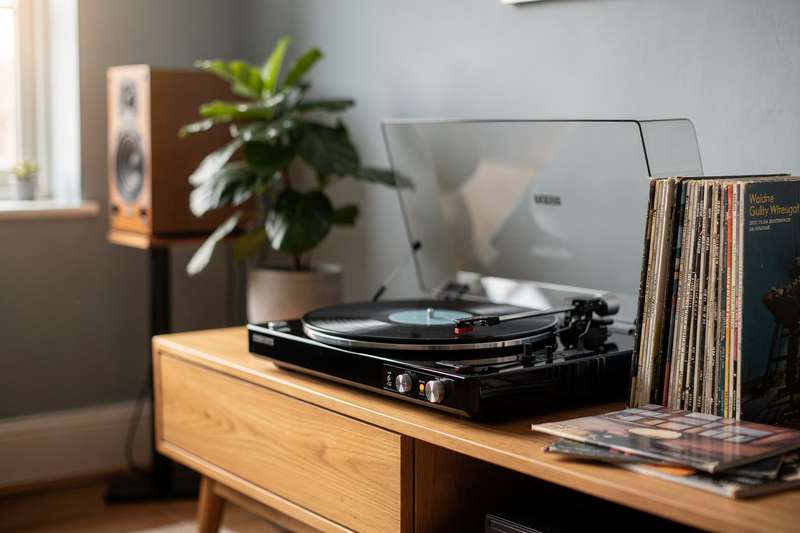
You’ve been meaning to dig out those vinyl records stacked in the loft for years. Maybe it started with a charity shop haul that left you with thirty classic LPs and absolutely nothing to play them on. Or perhaps you inherited a parent’s collection and want to actually hear what all the fuss was about. You’ve done a quick search online, immediately hit a wall of jargon — belt-drive, phono preamp, magnetic cartridge, 33⅓ RPM — and quietly closed the tab. This guide is for you.
The record player market in 2026 is surprisingly crowded. For every genuinely well-made turntable, there are half a dozen cheap suitcase players with flimsy styli that will chew through your records in six months. Picking the wrong one doesn’t just mean bad sound — it can permanently damage records you can’t replace. On the other end, it’s easy to spend serious money on audiophile kit that’s complete overkill if you just want to spin some Beatles albums on a Sunday morning. The right turntable depends on how you listen, where you listen, and what you already own.
This guide cuts through the noise. You’ll find concrete picks for different situations — beginners, Bluetooth users, Hi-Fi enthusiasts, and people who want everything in one box — all based on products actually available on Amazon UK right now.
How These Picks Were Chosen
Every product featured here was evaluated against a set of criteria that matter to real listeners: sound quality relative to price, build quality (platter material, tonearm stability, cartridge type), ease of setup, connectivity options (RCA, Bluetooth, built-in speakers), and verified buyer feedback patterns from Amazon UK reviewers. Where review counts were large enough to be meaningful, common complaints — stylus skipping, Bluetooth dropout, flimsy dust covers — were weighted alongside praise.
Products were also assessed on practical UK considerations: compatibility with standard phono preamps, availability of replacement styli, and whether the unit will sit sensibly in a typical British living room. Picks with zero verified reviews were included only where the product came from an established brand or filled a category gap that better-reviewed alternatives couldn’t cover. The range spans entry-level all-in-ones right through to Bluetooth-capable Hi-Fi separates, so there’s a realistic option at every level.
Best for Beginners: Audio-Technica LP60XBK
If you’re new to vinyl and want something that simply works the first time you plug it in, the Audio-Technica LP60XBK Fully Automatic Belt-drive Stereo Turntable is the closest thing to a guaranteed safe bet in this category. It holds a 4.5-star rating from nearly a thousand Amazon UK reviewers — that’s a meaningful sample size, and the consensus is consistently positive.
The LP60XBK is fully automatic, which means the tonearm lifts, drops onto the record, and returns to rest entirely on its own. There’s no fiddling with cueing levers, no nerve-wracking moments lowering a stylus you’re afraid of scratching. For anyone who hasn’t touched a record player since childhood, that automation removes a significant barrier. The belt-drive system isolates motor vibration from the platter, which directly benefits sound quality — you’re not hearing a faint mechanical hum underneath your music.
The cartridge Audio-Technica fit here is a real strength. It’s a purpose-built magnetic cartridge with a replaceable diamond stylus, which matters more than most beginners realise. A good cartridge tracks the groove accurately and causes far less wear on your records than the generic ceramic cartridges used in cheaper all-in-ones. When the stylus eventually wears out — typically after several hundred hours of play — you can simply swap it for a fresh one without buying a whole new deck.
The tradeoff is that the LP60XBK has no built-in speakers. You’ll need either an amplifier and passive speakers, a powered speaker with a phono input (or line input if you use the built-in preamp), or a Bluetooth-capable speaker if you opt for the Bluetooth variant. For beginners who don’t already own audio kit, that’s an extra purchase to budget for. The platter is also aluminium rather than acrylic, which is perfectly adequate at this level but worth knowing if you later compare it to pricier decks. For most people starting out, though, this is the benchmark everything else gets measured against.
Best Bluetooth Turntable: Audio-Technica LP60XBTBK
The Audio-Technica LP60XBTBK Full Automatic Wireless Belt-Drive Turntable is the Bluetooth-enabled sibling of the LP60XBK above, and it deserves its own section because the wireless capability genuinely changes how the deck fits into your home.
Being able to pair the turntable directly with a Bluetooth speaker — whether that’s a portable unit in the kitchen or a smart speaker in the living room — means you don’t need any speaker wire running across your floor, no amplifier to find a home for, and no phono preamp to worry about. The deck handles the preamp stage internally, so the signal leaving via Bluetooth (or the RCA outputs, if you prefer wired) is already line-level. That simplicity is genuinely valuable when you’re renting a flat or don’t want a rack of equipment.
The fully automatic operation is identical to the standard LP60XBK — the tonearm raises and lowers itself, which is particularly useful when you’re pairing wirelessly and walking away from the turntable. You don’t need to stay close to catch the tonearm at the end of a side. The belt-drive mechanism and the same quality cartridge carry over from the base model, so the fundamental sound character is the same.
Bear in mind that Bluetooth does introduce a small amount of latency, and if you’re watching a video whilst listening through the turntable (an unusual use case, admittedly), you may notice lip-sync issues. The Bluetooth range is standard for this type of device — adequate for a typical room, but not something to rely on through multiple walls. The platter is the same aluminium unit as the LP60XBK, and the manual speed switching (belt repositioning for 45 RPM on some versions) is a minor inconvenience. As a Bluetooth turntable in this category, though, it’s well above the alternatives in terms of reliability.
Best Hi-Fi System Package: 1 BY ONE Bluetooth Turntable with Bookshelf Speakers
The 1 BY ONE Bluetooth Turntable Hi-Fi System with 36 Watt Bookshelf Speakers takes a different approach from standalone turntables: it comes bundled with a pair of bookshelf speakers, giving you a complete vinyl playback system in one box. With a 4.6-star rating from 679 Amazon UK reviewers, it’s one of the best-reviewed products in this guide.
The headline feature is the included speaker pair. These are active (powered) bookshelf speakers rated at 36 watts total, which is enough output for a normal-sized room without needing to push the volume uncomfortably high. For someone who doesn’t want to research amplifiers and speaker matching separately, getting a matched system from one brand removes a lot of guesswork. The speakers connect directly to the turntable, and the magnetic cartridge means you’re getting decent tracking from the off.
Bluetooth connectivity adds flexibility — you can stream music from your phone through the speakers even when you’re not playing vinyl. This makes the whole unit function as a general-purpose Hi-Fi rather than just a turntable, which is good value if you’re replacing an older stereo system. The RCA outputs also let you hook up alternative speakers if you upgrade later.
The tradeoffs here are practical. A bundled system like this is a very good starting point, but the speakers — while decent for the price — won’t match a dedicated pair of bookshelf speakers at a similar combined spend. If you’re an audiophile comparing this to separates, you’ll hear the difference. But if you’re a casual listener who wants to spin records and occasionally stream a playlist without wiring together four separate components, this is a genuinely sensible package. The footprint is also larger than a standalone turntable, so measure your shelf space before ordering.
Best All-in-One Vintage Style: Udreamer Vintage Turntable
The Udreamer Record Player with 2 Dual Stereo Speakers, Vintage Turntable Bluetooth 5.3 is pitched squarely at people who want that retro wooden cabinet aesthetic without spending a fortune. It has a 4.0-star rating from 552 Amazon UK reviewers — a meaningful base that reveals both genuine strengths and a few consistent limitations.
The Udreamer handles three speeds (33⅓, 45, and 78 RPM), which means you can play modern 12-inch albums, 7-inch singles, and older shellac 78s if you happen to have them. The built-in dual stereo speakers mean you can play records straight out of the box without any additional hardware. Bluetooth 5.3 is a more recent standard than many rivals at this level, offering slightly more stable connections and better range. The AUX-in port, RCA line output, and USB encoding options add further flexibility — you can record your vinyl digitally if you want to archive a collection.
The vintage cabinet design genuinely does look the part in a living room. If aesthetics matter as much as audio performance — and for many people, they do — the Udreamer’s warm wood-effect finish fits a certain style of interior that a plain black turntable won’t match.
Where it falls short is on speaker quality. The built-in speakers at this size and price point lack low-end response — bass is thin, and at higher volumes there’s some distortion. Reviewers consistently note this, and the honest recommendation is to treat the built-in speakers as a convenience feature for background listening rather than serious playback. For anything more critical, connect it to external speakers via RCA. The cartridge is also more basic than what you’d find on the Audio-Technica models above, so it’s worth replacing the stylus with a quality aftermarket option after a few months if you want to protect your records long-term. As a versatile, good-looking starter turntable, it earns its positive reviews.
Best Premium Wireless: Sony PS-LX3BT Wireless Bluetooth Turntable
The Sony PS-LX3BT Wireless Bluetooth Turntable with Full Auto Playback sits at the top of this guide’s price range, and it earns its position by delivering features you genuinely can’t get elsewhere at this level. Its 4.9-star rating from 19 Amazon UK reviewers is encouraging, though the sample size is small — the product is relatively new to the UK market.
The standout specification is Hi-Res Audio Wireless (LDAC support), which allows the turntable to transmit audio over Bluetooth at up to three times the data rate of standard Bluetooth codecs. In practical terms, if you pair it with a speaker or headphones that also support LDAC, you hear noticeably more detail and dynamic range than a standard Bluetooth connection delivers. For vinyl enthusiasts who previously resisted wireless because it compressed the sound, LDAC is the feature that changes the conversation.
Full automatic playback means the tonearm operates without any manual intervention — the same benefit as the Audio-Technica automatics, but at a higher quality tier. The built-in phono preamp handles the signal conditioning internally, so you can connect to any line-level input directly. The belt-drive system is Sony’s own design, built to the tolerances you’d expect from a manufacturer with decades of audio engineering history.
The realistic tradeoffs: this is a premium purchase that makes most sense if you already own LDAC-compatible speakers or headphones, or plan to buy them alongside. Without LDAC on both ends, you’re paying a premium for wireless capability that a less expensive Bluetooth turntable could match. It also has no built-in speakers, so it’s a pure Hi-Fi component, not an all-in-one solution. If your listening setup is already sorted and you want the best wireless vinyl experience available on Amazon UK right now, this is the one to choose.
Best Budget All-in-One: Mersoco Bluetooth Record Player
The Mersoco Bluetooth Record Player Belt-Driven 3-Speed Turntable is the most affordable option in this guide, and it’s genuinely useful for a specific type of buyer: someone who wants to dip a toe into vinyl without committing serious money, or who needs a secondary player for a bedroom or office rather than a main listening room.
It covers three speeds, includes built-in stereo speakers, has a headphone jack and AUX input, and offers Bluetooth for wireless connection to external speakers or headphones. Belt-driven operation is a positive at any price — it inherently reduces motor noise compared to direct drive units at this level. For someone who finds a box of old 45s at a car boot sale and wants to hear what they sound like this weekend, it does the job.
The honest limitations are significant and worth naming plainly. Built-in speakers on budget all-in-ones consistently underperform, and this one is no exception — they handle voice-led folk or acoustic music tolerably but struggle with anything with real bass or dynamic range. The cartridge and stylus on entry-level players like this are the area where corners get cut most aggressively, and while this isn’t necessarily record-destroying in the short term, it’s worth replacing the stylus after a few months of use. There are no verified Amazon UK reviews on this listing at time of writing, which means the advice is to keep expectations calibrated accordingly.
Where the Mersoco makes sense is as a genuine budget entry point — not as a long-term solution, but as a way to test whether vinyl listening is something you’ll stick with before spending more. If six months in you’re still reaching for records regularly, upgrade to the Udreamer or the Audio-Technica. If the records go back in the loft, you haven’t lost a significant sum.
Best Full Hi-Fi Belt-Drive: 1 BY ONE High Fidelity Belt Drive Turntable
The 1 BY ONE High Fidelity Belt Drive Bluetooth Turntable with Built-in Speakers occupies the upper-mid tier of the 1 BY ONE range and offers a step up from the bookshelf-speaker bundle in terms of focused audio engineering. It combines belt-drive mechanics, a magnetic cartridge, Bluetooth output, and built-in speakers in a single unit positioned for listeners who want more than entry-level but aren’t ready to invest in full separates.
The magnetic cartridge is the detail that separates this from cheaper ceramic-cartridge all-in-ones. Magnetic cartridges track record grooves more accurately, produce less distortion, and are significantly gentler on your vinyl over time — an important consideration if your records have any sentimental or financial value. The belt-drive system keeps the motor mechanically isolated from the platter, which translates to a cleaner audio signal without motor interference.
Bluetooth output means you can bypass the built-in speakers entirely and wirelessly drive a better external speaker when the occasion calls for it — a useful flexibility that cheaper turntables at this size don’t offer. The RCA outputs are there for conventional wired connections if you prefer. The built-in speakers are more capable than those on budget all-in-ones, but as with any integrated speaker system, they reach their limits at higher volumes.
There are no verified Amazon UK reviews on this listing at the time of writing, so treat the product as a considered choice based on brand track record (1 BY ONE’s 36W bookshelf bundle rates 4.6 stars from nearly 700 reviewers) and specification rather than community consensus. It’s best suited to buyers who want the clean internal design of a belt-drive mechanism with the convenience of built-in audio and wireless connectivity, without the full commitment of a separates setup. If you’d rather have confirmed peer review behind your purchase, the bundled bookshelf system is the safer call within this brand.
What to Look For When Buying a Record Player
- Drive type (belt vs direct): Belt-drive turntables isolate the motor from the platter with an elastic belt, reducing vibration and motor noise in the playback signal. Direct-drive turntables connect the motor directly to the platter and are preferred by DJs for their torque and speed stability, but for home listening, belt-drive is generally the better starting point. Most picks in this guide are belt-drive.
- Cartridge and stylus quality: This is the single most important component for both sound quality and record longevity. Magnetic (MM) cartridges are vastly preferable to the ceramic cartridges used in the cheapest all-in-ones. A diamond stylus — even a basic conical diamond — tracks grooves cleanly and wears slowly. Check whether a replacement stylus is available and affordable before you buy; orphaned stylus designs are a real problem with obscure brands.
- Built-in preamp vs external: A phono signal is much weaker than a standard line-level signal and needs a phono preamp before it can be connected to a normal amplifier or powered speaker. Many modern turntables include a built-in preamp (sometimes switchable), which simplifies the setup considerably. If yours doesn’t have one, you’ll need either an amplifier with a phono input or a separate phono stage.
- Automatic vs manual operation: Automatic turntables raise and lower the tonearm without you touching it. Manual decks require you to place and lift the stylus yourself. Automatic is more convenient and reduces the risk of accidentally damaging a record; manual is more common in mid-range and audiophile turntables. Neither is inherently better — it’s a lifestyle preference.
- Speed options: Most modern records are 33⅓ RPM (albums) or 45 RPM (singles). 78 RPM is only relevant if you have shellac records from the 78 era, which require a specialist stylus anyway. If you’re buying purely for modern vinyl, a two-speed deck is fine. Check that speed switching is straightforward — some decks require manually repositioning the belt, which is fiddly.
- Connectivity: Consider what you’re connecting to. RCA outputs into a phono preamp or amplifier give the best quality. Bluetooth is convenient but adds minor latency and can compress audio unless the deck and speaker both support a high-quality codec like LDAC. Built-in speakers are useful for casual listening but rarely match external speakers at equivalent cost.
- Platter material: Aluminium platters are standard at entry and mid level. Acrylic platters are preferred by audiophiles because acrylic has a similar density to vinyl, reducing resonance at the stylus contact point. If platter material is highlighted in the specs, it’s usually a sign the manufacturer has paid attention to vibration control throughout the unit.
Verdict
For the majority of UK buyers — people returning to vinyl after years away, or picking up their first proper turntable — the Audio-Technica LP60XBK is the clearest recommendation. It’s fully automatic, uses a proper magnetic cartridge with a replaceable diamond stylus, and has nearly a thousand verified Amazon UK reviews backing up its reliability. The belt-drive mechanism handles the basics properly, and it won’t damage your records. The only gap to plan for is speakers — you’ll need a powered speaker or amplifier to get sound out of it.
If you want everything in one box without any additional purchases, the 1 BY ONE Hi-Fi System with Bookshelf Speakers is the pick — it’s a complete setup, and 679 reviewers rate it at 4.6 stars. For those with an existing LDAC-capable speaker system who want the best wireless vinyl experience available, the Sony PS-LX3BT is in a class of its own for wireless fidelity. Match the pick to your actual setup, not to a specification on paper.
We were not paid to feature any specific product in this guide. All opinions are independent and based on publicly available specifications, verified buyer feedback patterns, and category research.
Quick Comparison Table


FAQ
Do I need a separate amplifier to use a record player?
It depends on the turntable. Many modern record players include a built-in phono preamp and can connect directly to powered (active) speakers via RCA or a 3.5mm cable. If your turntable has no built-in preamp and your speakers or amplifier have no phono input, you’ll need a separate phono stage between the two. Check the turntable’s spec sheet for “built-in phono preamp” or a switchable “phono/line” output before buying.
Will a cheap record player damage my vinyl records?
It can, but the main risk factor is stylus quality rather than price alone. Ceramic cartridges (common in very cheap suitcase players) track grooves with more force and less accuracy than magnetic cartridges, causing accelerated groove wear over time. A budget turntable with a magnetic cartridge and a proper diamond stylus — like the Audio-Technica LP60XBK — is far safer for your records than a more expensive-looking unit with a poor cartridge.
What’s the difference between 33, 45, and 78 RPM?
These are the three standard rotation speeds for vinyl records. Most 12-inch albums (LPs) play at 33⅓ RPM; 7-inch singles and some 12-inch club records play at 45 RPM. 78 RPM was standard on older shellac records from before the 1950s and is now very niche — those records also require a different stylus shape, so if you have a 78 collection, check the turntable supports it properly before buying.
Is Bluetooth vinyl playback good enough quality?
For casual listening, standard Bluetooth is perfectly acceptable — most people can’t hear a meaningful difference in a normal room environment. Where Bluetooth falls short is at the higher end of the frequency range and in very dynamic passages, where compression artefacts can occasionally be audible. If audio quality is your priority, a wired RCA connection to a good amplifier or powered speakers will always outperform Bluetooth. The Sony PS-LX3BT with LDAC narrows this gap significantly if you have matching LDAC speakers.
How often should I replace the stylus on my record player?
A general guideline for a standard conical diamond stylus is replacement every 500 to 1,000 hours of play. Heavy use — say, two hours per day — means replacing annually; lighter listening could stretch to two or three years. A worn stylus sounds dull and muffled, and more importantly, it can damage record grooves. Replacement styli for common models like the Audio-Technica LP60 series are inexpensive and widely available on Amazon UK.
Can I record my vinyl to digital using these turntables?
Some of the turntables in this guide — including the Udreamer — include a USB output and encoding function that lets you connect to a computer and record directly using free software like Audacity. Not all turntables include this feature, so if digitising your collection is a priority, check the spec before purchasing. Alternatively, a separate USB audio interface between any turntable’s RCA output and your computer achieves the same result with more control over recording quality.