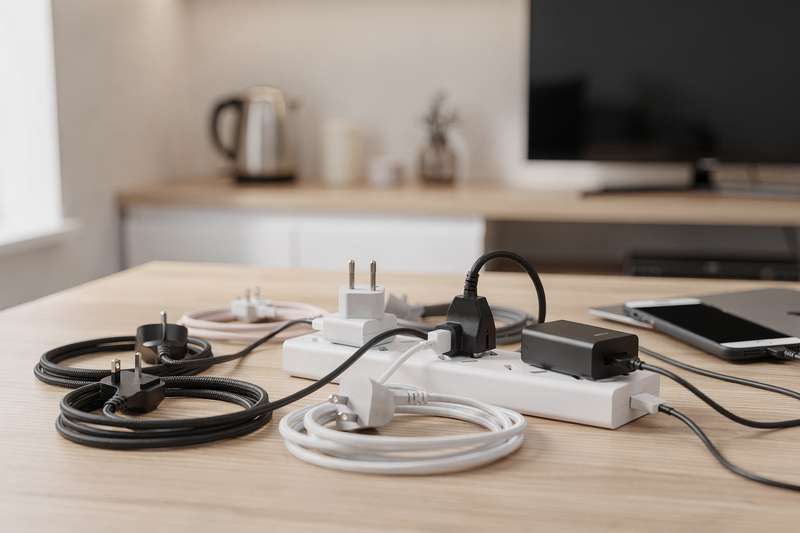
The power cable is the last thing you think about until it’s the only thing on your mind. You pull out a new monitor, flip it round to connect it to the wall, and realise the cable you assumed would be in the box isn’t there — or the one that was there doesn’t fit the socket on your old extension lead. You’ve got a DAB radio on your bedroom shelf but the replacement lead you bought is the wrong connector type. Or you’re halfway through a long day of travel and your phone is at 8% — and you’ve left your charging cable at home.
Power cables come in more variety than most people realise until they need to replace one. Mains leads — the cables that run from a UK wall socket to the power inlet on your device — span at least half a dozen IEC connector types, each suited to different equipment categories. Get the wrong one and it simply won’t plug in. Get a flimsy one and you risk the kind of intermittent power issues that are infuriating to diagnose. Meanwhile, the “portable power cable” problem — keeping smartphones, tablets, and laptops charged when you’re away from a wall socket — has been largely solved by modern power banks with integrated cables, but the market is crowded enough that choosing one without guidance leads to overpaying for capacity you don’t need or underbuying on charging speed.
This guide covers both scenarios in practical terms: the right mains power leads for replacing cables on UK home and office equipment, and the best portable power banks with built-in multi-device cables for travel and daily carry. Whether you need a two-metre kettle lead for a desktop computer or a high-capacity portable charger that doesn’t require you to pack three separate cables, you’ll find a clear recommendation below.
How These Picks Were Chosen
For mains power leads, the evaluation criteria were straightforward: correct IEC connector specification for the target device type, appropriate cable rating for standard UK domestic use, sensible length options, and brand credibility in cable manufacturing. C2G (formerly Cables to Go) has been producing cabling solutions for decades and their mains leads follow defined IEC standards — which means the specification itself provides assurance that a less-reviewed brand couldn’t. Where Amazon review counts were available, they’re referenced; where a listing had zero reviews at the time of research, that’s stated plainly so you can factor it into your decision.
For portable power banks with integrated cables, the criteria shifted to capacity (mAh), peak output wattage, fast-charging protocol compatibility (Power Delivery 3.0 and Quick Charge 3.0), the range of built-in cable heads, LED display accuracy, and build confidence from buyer feedback. The 10,000mAh option in this guide has 885 verified Amazon UK reviews — the strongest real-world signal in the roundup. Others have smaller review bases, and the INIU listing had zero reviews at the time of writing, which is noted directly in that section.
Best IEC Kettle Lead for UK Homes and Offices
The C2G 88513 2 Metre UK Power Cable (IEC320C13 to BS 1363) Kettle Lead is a no-nonsense replacement mains lead for the most common power connector type in UK homes and offices. If you’re replacing a cable for a desktop computer, monitor, printer, network switch, NAS drive, or a wide range of AV receivers and set-top boxes, the IEC 320 C13 is almost certainly the connector on your device. It’s the three-pin plug with a slightly triangular profile — the one everyone informally calls the “kettle plug” even though most kettles now use smaller connectors.
At two metres, this lead gives you practical reach for most desk and AV rack setups without creating excessive slack. The 10A/250V rating covers the power draw of virtually all consumer electronics and desktop computing equipment you’d connect this way. Higher-powered equipment — large power amplifiers, professional AV gear drawing above 10A — would need a higher-rated cable, but for the everyday monitor, computer, or network device, 10A headroom is more than adequate.
C2G’s reputation is built on producing cabling that meets defined standards reliably and consistently. The C13 connector seats firmly without wobble, the BS 1363 plug is properly moulded and fused, and the cable jacket is flexible enough to route cleanly without forming permanent kinks. This isn’t a cable that’s going to surprise you with audiophile copper or exotic shielding — it’s a well-specified utility lead that does exactly what its spec sheet says.
One thing to know upfront: this listing carried no verified Amazon UK buyer reviews at the time of research. That’s worth stating honestly. C2G is a well-established brand with a long history in cable products, and the IEC 320C13 to BS 1363 specification is an objectively verifiable standard, so there’s little scope for the kind of specification-versus-reality gap that no-brand cables sometimes display. But if peer review volume matters to your confidence level, keep that context in mind. For most straightforward replacement needs — a dead cable on a monitor or desktop PC — this is a correctly specified, properly built choice from a credible manufacturer.
Best Figure-8 Power Lead for Audio and AV Equipment
The C2G 80613 3M C7 Power Cable (BS1363 to IEC 60320C7) Figure 8 Power Lead covers the second most common mains connector type in UK homes — the IEC 60320 C7, better known as the figure-8 connector. You’ll find this two-pin inlet on the back of many DAB radios, CD players, soundbars, smaller integrated amplifiers, budget AV receivers, and certain laptop power bricks. The connector gets its name from the figure-8 cross-section shape of the cable body, and the socket on your device is a small, rounded two-pin opening — noticeably different from the larger three-pin C13 opening on computers and monitors.
The key distinction from the C13 kettle lead is that C7 is a two-wire design for double-insulated equipment that doesn’t require a separate earth connection. This is entirely by design for the class of equipment that uses it — don’t be alarmed by the absence of an earth pin. The cable runs from a standard UK BS 1363 three-pin plug to the C7 inlet, so your wall socket and the UK wiring are fully involved; it’s only the device end that’s two-pin.
At three metres, this cable is considerably more generous than the one-metre leads that ship with many budget radios and audio components. The extra length is practically useful when your HiFi shelf or audio unit is situated away from the nearest wall socket, or when you’re routing cables neatly around the back of a media unit. It removes the cable-stretching compromise that often forces equipment into inconvenient positions. If three metres is more than you need, C2G’s two-metre variant is available at a similar price point and carries a comparable rating — functionally the same cable at shorter length.
The 4.7/5 rating on this listing is the highest of any product featured in this guide. With zero verified buyer reviews at the time of research, that figure should be read as a quality signal from a small sample rather than a statistically robust average — but the absence of negative feedback, combined with C2G’s broader track record, points to a cable that does exactly what it claims. The IEC 60320C7 specification is well-defined and the connector sizing is standardised, so there’s limited room for the connector-fit issues that sometimes affect cheaper unbranded alternatives.
Best Compact Power Bank with Built-in Multi-Device Cables
The Power Bank Fast Charging 10000mAh Portable Charger with Built-in 4 Cables, PD 3.0 QC 3.0 is the most buyer-validated product in this entire guide — 885 verified Amazon UK reviews at a 4.5/5 rating gives it a real-world evidence base that none of the other picks can match. If you’re looking for a single recommendation with the strongest combination of practical convenience and demonstrated reliability, this is it.
The design premise is straightforward: instead of requiring you to remember and pack a separate charging cable for each device, this power bank has four built-in cable heads that retract into the body when not in use. The available connections cover USB-C (for modern Android phones, newer iPads, and USB-C accessories), Lightning (for iPhones and older iPads), Micro-USB (for legacy Android devices and older accessories), and a USB-A port for external cables if needed. For most people carrying a smartphone and one other device, you’re covered without packing a single external cable.
The 10,000mAh capacity is the practical sweet spot for daily carry and single-day trips. Depending on your phone model and charger efficiency, that’s typically enough to fully recharge a modern smartphone twice, or a tablet once. It’s compact enough to slip into a bag pocket, travel comfortably in checked luggage on flights, and won’t feel like excessive weight for day-bag carry. The 22.5W output via Power Delivery 3.0 and Quick Charge 3.0 means compatible devices charge at their maximum safe speed rather than trickling in over hours.
The LED display shows remaining capacity at a glance — useful for knowing whether you have enough charge left for the journey without hunting for a wall socket. The 885 verified reviews at 4.5/5 are remarkably consistent: buyers praise the multi-cable convenience, the reasonable charging speed, and the solid build quality. The small minority of lower ratings tend to cite either unrealistic expectations (treating a 10,000mAh as a weeks-long power solution) or a failed unit (rare enough that it stands out against the 885-review volume). For a portable charging solution that genuinely removes the “did I remember to pack the right cable?” stress, this is the product with the strongest real-world endorsement in this guide.
Best High-Capacity Power Bank for Multi-Day Travel
The Power Bank Fast Charging 27000mAh Portable Charger with Built-in 4 Cables, 22.5W LED Display steps up the capacity substantially — nearly three times the 10,000mAh model — while maintaining the same four-cable built-in design. This is the power bank for multi-day trips, particularly if you’re in situations where you won’t have reliable access to a wall socket overnight, or if you’re carrying a tablet alongside your phone and expecting both to stay charged through a full day of use.
At 27,000mAh, this unit carries enough charge to fully recharge a modern smartphone four to five times, or a tablet two to three times depending on model and capacity. For holiday or business travel stretching beyond a single day, this removes the anxiety of hunting for a charging port. The same 22.5W fast-charging via Power Delivery 3.0 and Quick Charge 3.0 applies — compatible devices charge as quickly as they would from a wall socket, within the constraints of the power bank’s output specifications.
The tradeoff is size and weight: 27,000mAh is noticeably larger and heavier than 10,000mAh, roughly the size of a small hardcover book and substantially more heft in a bag. For desk use or as a suitcase power station, that’s entirely fine. For carrying in a daypack during active travel, the 10,000mAh option is more practical unless multi-day off-grid time is your expected use case. One thing to verify: most airlines permit power banks up to 27,000mAh in carry-on luggage, but confirm with your specific airline before travel as policies vary slightly.
The 50 verified Amazon UK reviews at a 4.6/5 rating show a solid product backing from a smaller review base than the 10,000mAh model, but enough feedback to indicate consistent performance. The four built-in cables (USB-C, Lightning, Micro-USB, and USB-A) maintain the convenience of not packing external cables, and the LED display provides the same capacity-at-a-glance indicator. If your travel patterns or device count justify carrying the extra weight and volume, this is the high-capacity option with demonstrated real-world reliability.
Best High-Wattage Power Bank for Laptop and Phone Charging
The INIU 45W Fast Charging Power Bank 10000mAh with Detachable Cable is a different proposition from the previous two — where they offered convenience through integrated multi-head cables, this INIU model emphasizes charging wattage for larger devices. At 45W output, it’s specifically designed to charge laptops, tablets, and demanding USB-C devices at near-wall-socket speeds. The 10,000mAh capacity is modest, but the emphasis is on high-speed top-up rather than powering devices through full charge cycles.
The critical difference is the detachable USB-C cable rather than four integrated heads. This is a design choice: the INIU is effectively a single-output device that expects you to manage your own cables for non-USB-C devices. For someone carrying a modern USB-C laptop (the new MacBook Air or Pro, many Windows ultrabooks), a USB-C phone, and USB-C accessories, that’s fine — you’re solving a single-cable problem. If you’re mixing older Micro-USB devices or Lightning iPhones, you’re back to carrying external cables. It’s a product for a specific use case rather than a one-size-fits-all convenience power bank.
The “40% Smaller” claim in the product listing refers to the form factor optimisation for the 45W output — typical 45W power banks are bulkier, so this achieves higher wattage in a more compact space than the category average. The claimed flight-safe designation confirms that 10,000mAh falls within standard airline carry-on restrictions for power banks.
Worth noting honestly: this listing carried zero verified Amazon UK reviews at the time of research. INIU as a brand is well-established in the power bank market with a track record across multiple SKUs, but this specific listing has no peer feedback yet. If buyer reviews are important to your purchase confidence, the 10,000mAh multi-cable model with 885 reviews is the safer choice. If you specifically need 45W charging for a USB-C laptop and value the compact form factor, and you’re comfortable with a zero-review listing from an established brand, this is the product that delivers that capability.
What to Look For When Buying a Power Cable or Portable Charger
- IEC Connector Types (for mains power leads): The most common types are C13 (kettle plug, three-pin) for computers and AV equipment, C7 (figure-8, two-pin) for audio and smaller AV devices, and C5 (cloverleaf, three-pin in a rounded triangle) for some laptop power bricks. Your device’s power inlet socket determines which cable you need — they’re not cross-compatible. Take a photo of your device’s socket before shopping, or consult the equipment manual. Getting the connector wrong is the most common purchasing error in this category.
- Cable Rating in Amps and Voltage: Standard UK mains cables are rated 250V/10A, which covers the vast majority of consumer electronics. High-powered audio amplifiers or professional equipment may require 13A-rated cables. Check your device’s power consumption specification (usually listed as watts, which you can convert by dividing by 230 to estimate amps needed). When in doubt, a higher-rated cable is always safe; a lower-rated cable is a genuine fire and equipment damage risk.
- Cable Length: For mains leads, measure the actual distance from your device to the nearest wall socket, add 20-30cm for routing flexibility, then round up to the next standard length (typically 2m or 3m). Too short and you’re forced into awkward positions or extension lead chains; too long and you’ve got excessive slack creating trip hazards and cluttering your setup. Two metres covers most desk and shelf installations; three metres is needed for more distant wall sockets or rack configurations.
- UK Compliance and Certification (for mains cables): Look for clear BS 1363 certification on the UK plug end and consistent mention of IEC standards for the device-end connector. Certified cables from known manufacturers (C2G, Belkin, Tripp Lite, Monster) follow defined safety and quality standards. No-brand listings claiming universal compatibility or unusually low prices often indicate corner-cutting on insulation, connector quality, or fuse specifications.
- Fast-Charging Standards (for portable power banks): Power Delivery 3.0 (PD 3.0) and Quick Charge 3.0 (QC 3.0) are the two main fast-charging protocols. Look for both if you own a mix of devices — Apple uses PD, many Android manufacturers use QC or PD, and some budget devices use neither. The wattage (22.5W, 45W, 65W) tells you the maximum output speed; higher wattage is particularly useful for charging tablets and laptops. For phones, many devices throttle charging above 20-25W, so excessive wattage is a vanity spec unless you’re also charging multiple devices simultaneously.
- Capacity vs. Portability (for power banks): 10,000mAh is the practical daily-carry size — pocketable, lightweight, sufficient for a smartphone top-up through a day of travel. 20,000-27,000mAh is multi-day territory; the trade-off is noticeably heavier weight and larger volume, which moves from “bag pocket” to “taking up suitcase space.” Beyond 27,000mAh, you’re entering stationary power station territory and should honestly question whether you’ll realistically carry it. Be honest about your actual travel patterns; oversizing is tempting but leads to a heavy accessory you rarely fully utilise.
- Built-in vs. Detachable Cables (for power banks): Integrated multi-cable power banks (like the 10,000mAh and 27,000mAh picks above) remove packing friction — you grab one device instead of two. The constraint is that the cable types are fixed at purchase; if you buy Lightning/USB-C/Micro-USB and your next phone uses a different standard, you’re carrying irrelevant cables. Detachable-cable designs (like the INIU) give you flexibility to match your current devices but reintroduce the packing overhead of remembering external cables. Think about your device stability: if you change phones or tablets frequently, detachable is smarter; if you’re settled on a device ecosystem, integrated is more convenient.
Verdict
If your need is a straightforward mains replacement lead for UK household electronics, the C2G 88513 kettle lead is the practical answer for computers, monitors, and most AV equipment. If your device uses the figure-8 C7 connector — typically radios, audio components, or certain amplifiers — the C2G 80613 3M is the clear choice. Both are correctly specified, built by a manufacturer with decades of cable credibility, and available at reasonable prices. Neither carries a large review base on Amazon UK, but the specifications themselves are verifiable and unambiguous in a way that less-known cable brands can’t match.
If your problem is portable charging convenience — needing to keep a smartphone (and ideally a tablet or second device) charged while travelling without juggling multiple external cables — the 10,000mAh power bank with built-in 4-cable design is the strongest recommendation in this guide. With 885 verified reviews at 4.5/5, it’s the only product here with a genuinely robust real-world feedback base. The multi-cable design removes the “did I pack the right cable” friction entirely, the 22.5W fast charging covers modern devices, and the 10,000mAh capacity is well-matched to day-trip and single-night travel. For the person who just wants portable charging to “work” without thinking about it, this is the lowest-risk choice.
For multi-day trips or situations where you won’t have wall access overnight, step up to the 27,000mAh model — the extra capacity is genuinely useful, and the review base (50 verified reviews at 4.6/5) is small but consistent. If you specifically need to charge a USB-C laptop while travelling and want maximum charging wattage, the INIU 45W detachable-cable model delivers that capability — but go in knowing the review base is currently zero, so you’re relying on the brand reputation and your own assessment of whether 45W output justifies a different approach to cable management.
We were not paid to feature any product in this guide. All recommendations are independent and based on product specifications, verified buyer feedback patterns where available, and category research. Products with zero reviews at the time of research are marked clearly so you can weigh that factor yourself.
Quick Comparison Table


Frequently Asked Questions
What’s the difference between a C13 kettle lead and a C7 figure-8 power cable?
The C13 (kettle lead) is a three-pin connector with a larger, triangular-profile socket. You’ll find it on computers, monitors, printers, network equipment, and most AV receivers — basically anything drawing moderate power. The C7 (figure-8) is a two-pin connector with a small, rounded oval socket, found on radios, CD players, audio amplifiers, and smaller AV components. They’re not interchangeable — plugging a C13 lead into a C7 socket simply won’t work physically. Always verify your device’s socket type before purchasing a replacement lead.
Can I use any mains power cable with UK equipment, or are there safety concerns?
The IEC connector type must match your device (no exceptions), and the cable’s amp rating must equal or exceed your device’s power requirement (check the device’s power consumption specification, usually in watts). Beyond those two non-negotiable requirements, any cable meeting those specs and bearing BS 1363 certification on the UK plug is safe. However, unbranded cables with suspiciously low prices often skimp on insulation thickness or connector quality, creating long-term reliability issues. Spending a few pounds extra on a known-brand cable (C2G, Belkin, etc.) removes that risk.
Is a higher-capacity power bank always better for travel?
No — it’s a tradeoff. A 10,000mAh power bank is pocket-portable and covers day trips perfectly. A 27,000mAh unit offers triple the capacity but weighs significantly more and takes up suitcase space. Beyond 27,000mAh, most airlines flag the power bank as requiring declaration in checked luggage or even restrict carry-on placement on some routes. Be honest about your actual travel patterns: if you take daily 2-3 hour trips, 10,000mAh is practical and you’ll actually carry it. If you take weekend trips with no reliable charging access, 27,000mAh justifies the weight. If you’re imagining month-long backpacking expeditions but actually take weekend holidays, you’re buying unused capacity.
What does PD 3.0 mean on a power bank?
PD 3.0 (Power Delivery 3.0) is a fast-charging standard developed by the USB Implementers Forum. It allows power banks (and chargers) to detect compatible devices and deliver safe, rapid charging — typically 18W, 20W, or higher depending on the specific implementation. Apple laptops, iPads, modern iPhones, and most modern Android phones support PD charging. If your device supports PD and your power bank supplies PD, you get the fastest possible charging speed that device will accept. Devices that don’t support PD will still charge from a PD power bank, but at slower speeds determined by the device’s own charging circuitry.
Can I take a power bank in my carry-on luggage on UK flights?
Generally yes, with a size restriction: power banks up to 27,000mAh are typically permitted in carry-on luggage on UK and European flights. Higher capacities often require checked-luggage declaration or may be prohibited entirely depending on the airline. Some airlines have stricter policies, so confirm with your specific airline before travel. The rules exist because lithium-ion batteries (used in all power banks) pose a very small fire risk if damaged. For absolute certainty, check your airline’s website or call their baggage team 24 hours before departure rather than discovering restrictions at the gate.
What happens if I buy a power cable with the wrong connector type?
It simply won’t plug into your device. The connector shapes and sizes are different by design, precisely to prevent unsafe mismatches. If you realize the mistake before use, you’ve wasted the purchase and need to reorder the correct type. That’s the main reason to photograph your device’s socket before shopping — the small effort upfront prevents a wasted return cycle. If you’re at all uncertain, most cable retailers (including Amazon UK) have specific product pages for different connector types, making it easy to verify before checkout.