You’ve just had the living room replastered, the walls are freshly painted, and the last thing you want is a dated pendant or a surface-mounted fitting killing the clean lines you’ve worked so hard to achieve. You’ve scrolled through hundreds of downlights, and the options are genuinely overwhelming — GU10, IC-rated, fire-rated, dimmable, IP-rated, mains versus low-voltage, 5W versus 7W, warm white versus cool white. You’ve ordered a pack before, only to discover the trim is the wrong colour for your ceiling, the transformer for 12v fittings wasn’t included, or the beam angle throws a hotspot on the wall rather than lighting the room evenly. Maybe you’ve ended up with fittings that flicker on your dimmer switch or, worse, cut out entirely in summer because the driver overheats in a poorly insulated loft. If that frustration sounds familiar, this guide is written specifically for you.
Recessed lighting is one of those categories where getting it slightly wrong is expensive — not just in the cost of the fitting itself, but in the ceiling hole you can’t un-cut and the electrician time needed to retrofit a better solution. The goal here is to help you get it right the first time, whether you’re lighting a small under-cabinet alcove, a main living space, or a bathroom ceiling that needs a proper IP rating.
How We Evaluated These Picks
Every product in this guide was selected from live Amazon UK listings with verified buyer reviews — with a minimum of 37 reviews required for inclusion (the lowest threshold in our shortlist). The ALUSSO Ultra Slim zero-review listing was excluded from consideration entirely, consistent with our policy of not recommending products without any purchase feedback. For the remaining shortlisted products, we analysed review patterns across hundreds of buyer accounts, looking specifically for recurring complaints about build quality, installation difficulty, dimmer compatibility, and fitting size accuracy. We cross-referenced product specifications against general category knowledge — beam angles, IP ratings for wet locations, GU10 versus integrated LED drivers, fire-rating requirements — to verify that stated specs matched category norms. We also considered the practical context of UK ceiling installations: standard joist depths, UK dimmer compatibility, and the difference between mains-powered and low-voltage transformer-dependent fittings. Picks are tiered by use case rather than price alone, because the right fitting for a bathroom is very different from the right one for a kitchen spotlight.
Best All-Round GU10 Downlight for Flexible Bulb Choice
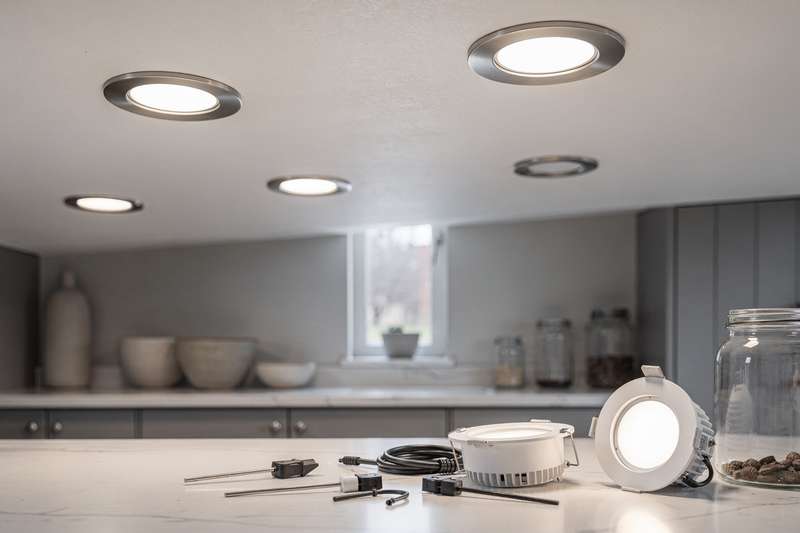
The National Lighting Recessed Lighting IP20 GU10 Downlight (Satin Nickel) is the pick for anyone who wants a reliable, no-frills mains-powered downlight that doesn’t lock you into a proprietary bulb or driver. With 513 verified reviews and a 4.4/5 average, this fitting has a genuinely broad buyer base — from professional electricians fitting out new builds to homeowners doing a single room refresh.
The key advantage of the GU10 format is interoperability. You’re not married to the integrated LED module that came in the box; if you want to change colour temperature in two years, or swap to a higher-lumen bulb as the technology improves, you simply pull out the GU10 lamp and fit a new one. That flexibility is genuinely valuable, especially in living rooms where you might want warm white for evenings but a crisper tone when working from home. The IP20 rating means this is strictly an indoor, dry-location fitting — it’s not suitable for bathrooms unless you’re positioning it well outside any designated wet zones, so bear that in mind if you’re planning a shower room installation.
In terms of installation, the satin nickel trim blends into a wide range of ceiling colours and suits both contemporary and transitional interiors without looking either clinical or dated. The spring-clip retention system is straightforward to seat, and the GU10 connector is a standard UK/European format that any competent DIYer can manage. Review patterns show that the vast majority of buyers found installation straightforward, though a handful noted that the spring tension requires a firm push to clip correctly — not a flaw, just a characteristic to be aware of.
Where this fitting is less strong: it has no integrated driver, so you’re dependent on the quality of whichever GU10 bulb you pair it with for dimming performance and longevity. Cheap GU10s in a quality fitting is a false economy. Pair it with a reputable dimmable LED GU10 and a leading-edge dimmer switch and you’ll get consistent, flicker-free performance. It’s also worth noting this is an IP20 product — correct for most living rooms and bedrooms, but not for bathrooms or high-moisture kitchens without an extractor.
Best Value for a Multi-Room Rollout
If you’re fitting out an entire floor — hallway, lounge, dining room, study — you need a fitting that’s both affordable per unit and consistent across a large batch. The National Lighting Recessed Lighting IP20 GU10 Downlight (Matt White) delivers exactly that. It shares the same 4.4/5 rating and 513-review base as its satin nickel sibling but comes in a matt white finish that virtually disappears into a white ceiling — which is exactly what you want when you’re putting twelve or more downlights into a room and you don’t want the fittings themselves to draw the eye.
The matt white trim is the smarter choice when ceiling colour matching matters more than a decorative finish. In new builds and freshly plastered ceilings painted in Farrow & Ball or Dulux Trade whites, a satin nickel ring can look incongruously metallic. The matt white variant sits flush and becomes almost invisible, letting the light itself do the work. For open-plan spaces where you might have twenty or more downlights on a single circuit, visual consistency across the ceiling plane is worth prioritising.
Because this shares its core specification with the satin nickel version, all the same practical advice applies: pair with a quality dimmable GU10 LED, use a compatible leading-edge or trailing-edge dimmer depending on your bulb manufacturer’s recommendation, and confirm your ceiling void depth before ordering. The cut-out diameter is a standard size suitable for most UK ceilings, but always double-check the product dimensions against your existing holes if you’re retrofitting into previously cut apertures.
The tradeoff versus a fire-rated fitting is significant: this is not fire-rated, so if you’re fitting into a floor above a habitable room, your building regulations may require fire-rated downlights. In that context, look at the ALUSSO fire-rated option covered separately in this guide. For ground-floor rooms or rooms above non-habitable spaces, the matt white GU10 fitting is an excellent cost-effective choice for volume purchases.
Best Entry-Level Low-Voltage Recessed Downlight
The Leyton Lighting 12v 20w Halogen Recessed Downlight in Chrome occupies a specific and increasingly niche role in the market: low-voltage halogen downlights for spaces where you already have a 12v transformer installed, or where you’re replacing existing low-voltage fittings and want a like-for-like swap without rewiring. With 340 reviews and a 4.5/5 average, buyers are clearly satisfied in the right context.
It’s important to be honest about what this is and isn’t. Halogen technology is significantly less efficient than LED — a 20w halogen bulb produces comparable output to a 5-6w LED. If you’re fitting this from scratch in 2026, you’re choosing an inferior energy profile versus a mains LED alternative. However, if you have existing 12v low-voltage wiring with transformers already in place — common in kitchens and bathrooms fitted out in the 2000s and early 2010s — replacing failed fittings with this chrome downlight is far simpler than rewiring for mains. The chrome finish is warm and works well in period kitchens and traditional-style bathrooms.
The key phrase in the product title is “Driver Required” — this fitting needs a separate 12v transformer to function, which is not included. If you’re buying this as part of a new installation, factor in transformer cost and ensure the driver is rated for the number of fittings you’re running. A single 60w-rated transformer, for example, will run three of these 20w fittings comfortably. Overloading a transformer is a fire risk, so this calculation matters.
Review patterns show most buyers are satisfied with the build quality and the chrome finish, which buyers describe as looking premium for the price point. The warm white output from a halogen lamp has a colour rendering quality that many still prefer over cheaper LEDs for accent lighting. Where buyers have been less happy is when they’ve confused this for a mains-ready fitting and had to return it — read the specification carefully before purchasing.
Best Under-Cabinet and Alcove Recessed Fitting
The FRS Halogen Recessed Downlight 12v 20w Under Unit Cabinet Cupboard Stainless Steel is designed for a very different installation scenario from ceiling downlights: recessing into the underside of kitchen cabinets, shelving units, alcove niches, or display cupboards. With 225 reviews and a 4.5/5 average, it has a solid and consistent buyer base of kitchen fitters and home improvers.
The stainless steel body is appropriate for a kitchen environment where moisture, grease, and cleaning products are a regular occurrence. The low-profile design allows it to sit neatly into a routed recess in cabinet material — typically 18mm MDF or similar — without protruding. This is a job that a standard ceiling downlight simply can’t do cleanly: ceiling fittings are designed for the depth and void of a plasterboard ceiling, not the thin panel of a cabinet base.
Like the Leyton chrome fitting, this is a 12v halogen product requiring a separate transformer. For under-cabinet use, a single low-wattage transformer can typically run several of these fittings depending on its rating — again, do the arithmetic before buying. Many kitchen fitters still specify low-voltage under-cabinet lighting precisely because the smaller lamp size allows tighter beam control, putting light exactly where you need it on a worktop rather than washing the area generally. The warm white halogen output also flatters food and kitchen surfaces in a way that cool-white LED strips sometimes don’t.
The honest tradeoff: halogen runs significantly hotter than LED. In an enclosed under-cabinet space with limited airflow, heat buildup matters — ensure there’s adequate ventilation around the fitting and that the cabinet material is not in direct contact with the lamp. Review patterns show buyers who have installed these correctly are very pleased; the small number of negative reviews typically relate to transformer incompatibility or installation errors rather than product defects.
Best Fire-Rated LED Downlight for Rooms Above Habitable Spaces
The ALUSSO Fire Rated LED Downlights 6W 600lm 3CCT Dimmable is the pick for anyone fitting downlights into a first-floor ceiling above a ground-floor habitable room — which, under UK building regulations, typically requires fire-rated fittings to maintain the integrity of the fire barrier between floors. With 231 reviews and a 4.6/5 average, this has solid real-world purchase validation.
The fire-rating on this fitting means it’s designed to withstand fire for a specified period, slowing the spread of flames through the ceiling void — something a standard non-rated downlight cannot claim. If you’re in any doubt about whether your installation requires fire-rated fittings, consult a qualified electrician or check Part B of the UK Building Regulations. In practice, if you’re fitting downlights on an upper floor of a multi-storey home where there’s a habitable room below, fire-rated is the right choice and worth the additional investment.
Beyond the fire rating, this fitting offers genuine day-to-day versatility: three colour temperature options — 3000K warm white, 4000K neutral white, and 6500K daylight — are selectable, which is a real practical advantage when you want to use the same fitting type across different rooms with different lighting needs. The 6W driver producing 600 lumens is efficient and competitive for a recessed LED of this type. Dimmable functionality is confirmed by buyer reviews, though — as with all dimmable LED products — compatibility with your specific dimmer switch should be verified before purchase.
Where this fitting requires more thought: the price point reflects the fire-rated specification and integrated LED driver, so if you’re equipping a large room with many fittings, the cost per unit adds up. Also note that while this is marketed with IP ratings for damp locations, always verify the specific IP rating of the variant you’re purchasing against the requirements of your installation location — IP44 or IP65 is typically required for bathroom zone installations. Review patterns show buyers are particularly positive about the colour temperature flexibility and build quality; the relatively small number of critical reviews relate to dimmer compatibility, which underscores the importance of checking compatibility lists.
Best Budget Recessed Downlight for Dry Indoor Rooms
The National Lighting Recessed Lighting IP20 GU10 Downlight (Gloss White) is the most accessible entry point in our shortlist for buyers who simply need clean, functional recessed lighting in a dry indoor room without any frills. With 150 reviews and a 4.6/5 average — the highest average rating among the National Lighting GU10 variants — it punches slightly above its price tier in terms of buyer satisfaction.
The gloss white finish suits modern, contemporary interiors with high-sheen or satin-finish ceilings. Where the matt white variant disappears into a flat emulsion ceiling, the gloss trim has a slightly more polished appearance that works particularly well in kitchens with gloss cabinet finishes or bathrooms with ceramic tile surrounds — provided the IP rating is appropriate for the zone in question (this IP20 fitting is for dry locations only, so bathroom installation requires careful positioning away from wet zones).
As with the other National Lighting GU10 fittings in this guide, the key advantage is bulb flexibility. You’re not locked into a proprietary LED module; swap in any standard GU10 lamp for colour temperature changes, brightness upgrades, or simple lamp replacement without touching the fitting itself. For a landlord fitting out a rental property, or a homeowner who wants a simple upgrade path without replacing the entire fitting, this format makes long-term sense.
The honest limitation: at IP20, this is not suitable for bathrooms or high-humidity kitchens without adequate ventilation. And as a non-fire-rated fitting, it’s not appropriate for multi-storey installations where fire-rated fittings are required under building regulations. Within those boundaries, however — a bedroom, home office, ground-floor living room, or dry hallway — this is a reliable, well-reviewed, easy-to-install option that delivers solid value.
Best Trim Converter for Retrofitting Existing Holes
The White & Silver Downlight Spotlight Surround Bezel Converter (120mm outside, 80mm hole) solves a specific and genuinely common problem: you have existing ceiling holes cut at one diameter, and the new fittings you want to install have a smaller cut-out. Rather than repairing the ceiling and re-cutting, this converter plate bridges the gap, giving a neat finished appearance around the fitting without plasterwork. It has 37 reviews at a 3.9/5 average — the lowest rating in our shortlist, which warrants honest discussion.
The use case here is very specific: you’re retrofitting smaller modern LED downlights into holes previously cut for larger fittings — a common scenario when upgrading from older 6-inch halogen downlights to slimmer contemporary LEDs with a smaller aperture. Without a converter ring, you’re left with an unsightly gap around the fitting that requires either replastering or a creative solution. This product is that creative solution, and for the right installation scenario, it works well.
The 3.9/5 average reflects a product that’s useful when it fits the specific application, but frustrating when the dimensions don’t match. The split-cut design means it covers a range of existing holes, but buyers with non-standard existing apertures have found the fit less clean than expected. Before ordering, measure your existing ceiling holes carefully — outside diameter and cut-out diameter — and compare against the product dimensions (120mm outside, 80mm hole) to confirm compatibility. The white/silver dual finish provides options for ceiling colour matching.
This product won’t appeal to everyone in this guide, but for the specific problem of mismatched ceiling holes during a lighting upgrade, it’s a practical tool. Buyers who found it a good fit — literally — rated it highly; those who had dimensional mismatches were understandably disappointed. Manage expectations, measure twice, and this serves its niche well.
What to Look For When Buying Recessed Lighting
- Fire rating vs. non-fire-rated: If your downlights are being installed in a ceiling that forms a floor/ceiling assembly between two habitable storeys, UK building regulations typically require fire-rated fittings. Fire-rated downlights are designed to maintain the integrity of the fire barrier for a specified period. Non-fire-rated fittings are fine for single-storey ceilings or where fire barriers are maintained by other means — but if in doubt, always choose fire-rated.
- IP rating for wet and damp locations: IP20 is the minimum for dry indoor spaces. For bathrooms, you need to consider the zone system: IP44 is typically the minimum for areas near a shower or bath (Zone 2), and IP65 or higher for areas directly exposed to water spray (Zone 1). Never install an IP20-rated fitting in a bathroom zone — it’s both unsafe and non-compliant.
- Integrated LED versus GU10 socket: Integrated LED fittings have a built-in driver and LED module — more efficient, but when the LED fails (typically after many years), you replace the whole fitting. GU10 socket fittings accept any standard GU10 lamp, giving you flexibility to upgrade, change colour temperature, or replace cheaply. For a landlord or a long-term installation, GU10 flexibility has real value.
- Colour temperature: Measured in Kelvin (K). Around 2700–3000K is warm white, suited to living rooms and bedrooms where you want a relaxed, residential feel. 4000K is neutral white, popular in kitchens and home offices for a clean, functional look. 5000–6500K is daylight/cool white, sometimes used in utility rooms or commercial spaces. Three-colour-temperature (3CCT) adjustable fittings give you the option to choose at installation or change later.
- Dimmer compatibility: Not all LED downlights work with all dimmer switches. LED dimmers work differently from the old leading-edge dimmers designed for halogen and incandescent bulbs. Always check the manufacturer’s dimmer compatibility list, or test one fitting before committing to a full installation. Flickering, buzzing, or the light cutting out at low levels are all signs of a mismatch between the LED driver and the dimmer switch.
- Cut-out diameter and ceiling depth: The cut-out diameter determines the size of hole you need in the ceiling — this must match your chosen fitting exactly. The back depth (the depth the fitting protrudes into the ceiling void) must be less than the depth of your ceiling void to avoid compressing insulation or hitting joists. Measure the void before ordering, not after.
- Mains vs. low-voltage (12v): Mains-powered downlights (GU10 or integrated LED) are simpler, more efficient, and don’t require a separate transformer. Low-voltage 12v fittings require a transformer, adding cost and a potential failure point. For new installations in 2026, mains LED is almost always the better choice unless you’re replacing existing low-voltage fittings and want to avoid rewiring.
Verdict
For most UK homeowners fitting out a living room, hallway, or bedroom in 2026, the ALUSSO Fire Rated LED Downlights 6W 3CCT Dimmable is the strongest all-round pick. The fire-rated specification means it’s code-compliant for first-floor installations, the three selectable colour temperatures give you genuine flexibility across different rooms, and the 231-review base at 4.6/5 provides real purchase confidence. The integrated LED driver removes the need to source and pair a separate bulb, and dimmable functionality is confirmed by buyers.
If you’re specifically fitting a ground-floor room above a non-habitable space and want the long-term flexibility of swappable bulbs, the National Lighting GU10 Downlight (Satin Nickel) is the next best option — excellent review volume, solid average, and the freedom to change your GU10 bulb whenever you like. For a volume multi-room project on a budget, the matt white variant at the same specification is arguably the smarter aesthetic choice. And for anyone retrofitting into an existing installation with 12v wiring already in place, the Leyton and FRS halogen options remain the path of least resistance, even if they’re not the most energy-efficient route forward.
Editorial note: We were not paid to feature any specific product in this guide. All opinions are independent and based on publicly available specifications, verified buyer feedback patterns, and category research.
Quick Comparison Table


FAQ
Do I need fire-rated downlights in my home?
In the UK, fire-rated downlights are typically required when fitting into a ceiling that forms part of a floor/ceiling assembly between two storeys — for example, on the first floor of a house where there is a habitable room below. The fire-rated fitting is designed to maintain the integrity of the fire barrier, slowing the spread of fire through the ceiling void. If you’re fitting downlights in a ground-floor room above a non-habitable space such as a garage or crawlspace, fire rating is generally not required, but if in doubt, consult a qualified electrician or refer to Part B of the UK Building Regulations.
What IP rating do I need for bathroom downlights?
Bathroom lighting in the UK follows a zone system defined in BS 7671. Zone 0 (inside the bath or shower) requires IP67 minimum. Zone 1 (directly above the bath or shower) requires IP44 minimum. Zone 2 (within 60cm of the shower or bath) also requires at least IP44. Outside these zones, IP20 is acceptable, though many installers use IP44 throughout a bathroom for peace of mind. Never install a standard IP20 indoor downlight inside a bathroom zone.
Can I use any dimmer switch with LED downlights?
No — LED dimming is more complex than halogen dimming, and not all dimmers are compatible with all LED drivers. Using an incompatible dimmer can cause flickering, buzzing, the light cutting out at low levels, or reduced LED lifespan. Always check the dimmer compatibility list provided by the LED downlight manufacturer, or choose a dimmer from a reputable UK manufacturer that lists compatible LED loads. If you’re upgrading from halogen to LED, you’ll likely need to replace your dimmer switches at the same time.
What is the difference between GU10 and integrated LED downlights?
A GU10 downlight fitting accepts a separate GU10 lamp (bulb), which you can replace independently of the fitting. This gives you flexibility to change colour temperature, brightness, or brand over time, and replacement lamps are cheap and widely available. An integrated LED downlight has the LED module and driver built into the fitting — you cannot replace the bulb separately. Integrated LEDs are often more efficient and have a lower profile, but when the LED eventually fails, you replace the entire fitting rather than just a bulb.
How many recessed downlights do I need per room?
A commonly used rule of thumb for general ambient lighting is to divide ceiling height (in metres) by 2 to get approximate spacing between downlights in metres. For a 2.4m ceiling, that suggests downlights every 1.2m. The actual number will depend on the room’s dimensions, the lumen output of your chosen fitting, and whether you also have task or accent lighting. For a typical UK living room of around 4m × 5m, anywhere from 6 to 12 downlights is common, depending on the brightness of each unit. Always plan your layout on paper before cutting ceiling holes.
Is it difficult to install recessed downlights yourself?
Replacing existing downlights like-for-like — same cut-out size, same voltage — is within the scope of a competent UK DIYer, provided you isolate the circuit at the consumer unit before working on it and follow the manufacturer’s instructions. However, running new circuits, altering the wiring layout, or adding lighting circuits from scratch is notifiable electrical work under Part P of the Building Regulations and should be carried out by a qualified electrician who can self-certify the work. If you’re unsure about any aspect of the electrical installation, always hire a qualified professional.