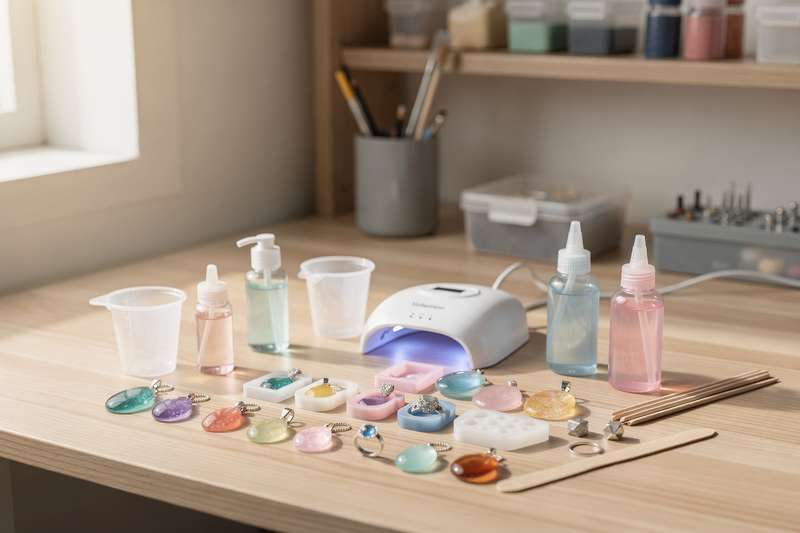
You bought a few silicone moulds at a craft fair, watched a handful of YouTube tutorials, and ordered what looked like a decent UV resin kit. Three evenings later you have a tray of sticky, yellowed, half-cured pendants and a UV lamp that takes four minutes to cure a piece that should set in sixty seconds. The resin is tacky on the surface no matter how long you leave it under the light. One of the moulds already tore on the second pour. Sound familiar?
Starting out with UV resin jewellery is genuinely exciting — the workflow is faster than two-part epoxy, you don’t have to mix ratios, and small pieces can be ready to wear the same afternoon. But the entry-level market is flooded with kits where individual components are mediocre: low-wattage lamps that cannot fully cure even a 3 mm layer, resin that clouds after a day in natural light, and moulds so thin that detailed relief patterns distort when you demould. Getting the right combination of resin, lamp, and moulds from the start saves hours of frustration and wasted material.
This guide is written specifically for UK crafters working with small jewellery moulds — earring blanks, pendant shapes, ring forms, and small cabochons. Every pick below is available on amazon.co.uk right now, chosen because the complete kit gives a beginner everything they genuinely need without forcing expensive upgrades after the first week.
How We Evaluated These Kits
Eight kits currently listed on amazon.co.uk were assessed against five criteria that matter most to beginner jewellery makers working with small moulds. First: resin clarity — does the cured piece stay water-clear or does it yellow within days of UV exposure? Second: lamp wattage and coverage — can the included light fully cure a filled 5 mm mould cavity in a reasonable time? Third: mould quality — are silicone moulds food-grade thickness, do detail lines hold their shape, and can you demould cleanly without tearing? Fourth: kit completeness — does a total beginner need to order anything extra before their first pour? Fifth: verified buyer feedback patterns — across public review data, what recurring complaints appear and how significant are they? Kits with fewer than 15 verified reviews were noted as limited-data picks and treated accordingly. The result is eight honest picks, each covering a different use case.
Best Overall Starter Kit: HeyClear UV Resin Moulds Jewelry Making Kit
The HeyClear UV Resin Moulds Jewelry Making Kit with UV Light is the pick that does the most things right for someone opening their first resin kit. It holds a 4.7-star rating from 415 verified reviewers — the largest verified review pool in this selection — which gives you far more confidence than a handful of early reviews on a new listing.
The headline feature here is the 250g of super-clear, hard, premixed UV resin. “Premixed” matters for beginners: you are not combining Part A and Part B and hoping your ratio is correct. You open the bottle and pour. The formula is described as fast-curing, which in practice means small jewellery-scale fills of 2–4 mm depth cure fully under a decent UV lamp in roughly 1–2 minutes rather than the 4–5 minutes some budget resins require. Buyers consistently note that cured pieces release from silicone moulds cleanly and have a glass-like finish without requiring sanding.
The UV lamp included is functional for jewellery-scale work. It is not a professional nail-lamp wattage unit, but for small mould cavities — earring studs, teardrop pendants, small cabochon shapes — it delivers enough UV output to cure through the depth of the piece. Where it does struggle is with thicker pours above 6 mm. If you intend to make chunky resin rings or deep dome paperweights, you will outgrow the included lamp fairly quickly. For flat earring blanks and small pendant fills, though, it performs consistently.
The kit includes silicone moulds alongside the resin and lamp, which means you are genuinely ready to start on day one. Mould quality is adequate for beginner work — fine detail lines are reasonable rather than exceptional, and experienced buyers note the moulds are serviceable but thinner than premium standalone silicone sets. Still, for learning pouring technique, bubble management, and demoulding without tears, they are perfectly suited.
The main tradeoff is that HeyClear is a relatively new brand compared to LET’S RESIN, so long-term yellowing data is less established. Early buyers report no yellowing at 3–6 months, which is encouraging. If you want the largest community of fellow beginners using the same kit and the most verified real-world feedback, this is your strongest starting point.
Best Budget Entry Point: Suzzam UV Resin Kit with Lamp (200g)
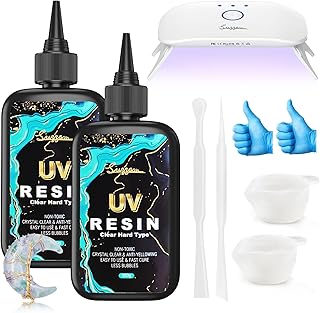
The Suzzam UV Resin Kit with Lamp, Upgraded 200g Crystal Clear UV Resin Hard with UV Light is the pick for crafters who want to test the hobby before committing to a larger kit. It sits in the budget tier and delivers a solid baseline experience for small jewellery work.
Suzzam’s resin formula is described as crystal clear and hard-curing. At 200g you get enough material to fill a substantial number of small earring and pendant moulds before needing to reorder — roughly 80–120 small fills depending on mould size, which is more than enough to decide whether resin jewellery is for you. The formula shares the same 4.5-star rating as Suzzam’s larger kit (below), drawn from the same 598-reviewer pool, which suggests buyers who start here are broadly happy with results.
The UV lamp is basic but sufficient for flat jewellery pieces. Buyers note it cures thin layers well, but thick pours above 4 mm may need a second exposure pass. For earring blanks, small flower pendants, and cabochon fills — the typical beginner project — this is rarely a limiting factor. You’re pouring thin, small, and shallow at this stage.
Where this kit makes its compromise clearest is in accessories. The tool set is minimal: you will likely need to source a few extra items yourself — a small silicone mixing cup, extra transfer pipettes, or additional glitter and pigments if you want to add colour. The kit gets you curing; it does not fully kit you out for elaborate decorative work. That is actually fine if you prefer to build your own accessory collection rather than inherit a box of items you won’t use.
One honest caution: because the lamp wattage is on the lower end, curing times are longer than the packaging suggests for certain mould depths. Test with a small pour first and check for full surface hardness before demoulding. A sticky surface after two curing cycles usually means either insufficient wattage or the lamp is held too far from the piece — keep the lamp within 3–5 cm of the surface for best results.
Best Large Resin Volume Kit: Suzzam UV Resin Set with UV Lamp (300g)
If you know you’re going to make resin jewellery regularly and want to stock up from the outset, the Suzzam UV Resin Set with UV Lamp – 300g Crystal Clear UV Resin Jewelry Crafting Kit with Molds, 30W UV Lamp, and Tools is a meaningful step up from the 200g version.
The headline difference is the 30W UV lamp — this is the most capable lamp wattage in the budget-to-mid range kits reviewed here. A 30W output lamp cures small jewellery fills significantly faster than 6W or 9W units, and critically, it can cure deeper mould cavities more reliably. If you’re making small ring blanks (which have more depth than flat earring pieces), this wattage advantage shows up in practice. Buyers with 4.5 stars from 598 reviews note faster cure times and fewer sticky-surface issues than with low-wattage alternatives.
The 300g resin quantity is ideal if you plan to work consistently through a term of craft sessions, run a small batch for a market stall, or share the kit with a teenager learning the craft. You won’t be rationing pours or hesitating to experiment with colour layers. The formula is described as non-toxic and odourless, which matters if you’re working at a kitchen table or in a room without dedicated ventilation — though good ventilation practice is still recommended regardless of what any formula claims.
The included moulds and tools round out the kit well for a beginner. You get enough variety in mould shapes to explore different jewellery types — earrings, pendants, keychains — without needing to purchase extra sets immediately. The silicone moulds are functional rather than premium, so if you develop a strong preference for a particular shape, upgrading to a dedicated professional silicone mould set later is a natural next step.
The main tradeoff versus the HeyClear kit is that the Suzzam brand has less detailed public breakdown of individual reviewer complaints. Aggregate ratings are strong, but if you like reading detailed reviews before buying, HeyClear’s 415 detailed reviews give you more information to parse. That said, 598 ratings at 4.5 stars is a statistically solid result for a craft kit in this category.
Best Comprehensive Accessory Kit: LET’S RESIN UV Resin Kit (153-Piece)
For beginners who feel overwhelmed by shopping for accessories separately, the LET’S RESIN UV Resin Kit with Lamp, 153Pcs Resin Jewelry Making Kit with 250g Crystal Clear Low Odor UV Resin is the most complete out-of-box experience in this selection.
LET’S RESIN is one of the most established brands in the entry-level resin craft space, and this 153-piece kit reflects that experience. At 250g of low-odour crystal-clear UV resin, you have generous material volume. But the real value proposition here is breadth: 153 pieces means you’re getting tweezers, silicone moulds in multiple shapes, pigment powders, glitter, jump rings, eye pins, chain segments, and a range of small tools that would otherwise require four or five separate Amazon orders. For a complete beginner who does not know what they need, this eliminates the guesswork.
The resin itself is a LET’S RESIN formula that buyers consistently praise for clarity. Low odour is meaningful — not zero odour, but substantially less sharp than some budget resins that genuinely require outdoor use. The cured finish is hard and glossy, and pieces hold their transparency well with normal indoor light exposure.
The included UV lamp performs adequately for jewellery-scale work, though it falls into the same category as most kit lamps — functional for 2–4 mm fills, requiring extended exposure for anything deeper. At this kit’s scope, that is acceptable: you’re learning technique across a wide range of mould types rather than pushing depth limits.
Where this kit can feel overwhelming is that 153 pieces generate a lot to organise on a first session. Some buyers find they use perhaps 60–70 of the pieces regularly and the rest sit in the box. If you prefer a leaner setup and like building your own supply collection, you may find the HeyClear or Suzzam kits a cleaner starting point. But if you want one box that has an answer to every “what do I do next?” question in the first month of learning, this is that box. Note this listing shows no review count in the current data, so exercise normal caution — check current reviews before purchasing.
Best Compact Upgrade Kit: LET’S RESIN UV Resin Kit with Lamp (200g Upgraded)
The LET’S RESIN UV Resin Kit with Lamp, Upgraded 200g Crystal Clear & Low Odor UV Resin, UV Light, Silicone Mat is the refined, more focused version of LET’S RESIN’s beginner offering — fewer accessories than the 153-piece kit, but with a silicone mat included, which is a genuinely useful addition that often gets overlooked.
The silicone mat deserves special mention for jewellery makers working on small moulds. Resin drips and spills are inevitable while learning, and a dedicated silicone work mat protects your surface and — importantly — allows you to cure any drips flat and peel them off cleanly without waste or mess. Beginners who try to work on paper towels or cardboard quickly discover these materials stick to partially cured resin and ruin pieces. The mat is a practical inclusion that signals this kit was designed by someone who has actually used resin.
The 200g formula is the same low-odour, hard-curing LET’S RESIN resin as the larger kit. At 200g you have enough for solid early experimentation across earring and pendant moulds. The UV lamp performs consistently with the brand’s other kits — fine for jewellery scale, limited for deep pours. Pairing it with the silicone mat means your work surface is under control from the first session.
At a 4.4-star rating with no currently visible review count, this listing requires a similar caveat to the 153-piece version — check live reviews before purchasing. The formula and brand reputation are solid based on the wider LET’S RESIN product family, but individual listing verification is always worth doing on Amazon. If the review count has built since this guide was written, it may well reflect the same strong buyer satisfaction patterns the brand shows elsewhere.
This kit works well as a “compact and clean” setup: you’re getting the essentials without the full 153-piece spread, and the silicone mat makes the workflow tidier. A good choice if you have limited workspace and want to keep your resin station orderly.
Best Large Accessory Collection: Resiners UV Resin Kit (190-Piece)
The Resiners UV Resin Kit, 190PCS UV Resin Jewelry Making Kit, Resin Accessories for Keychains, Earrings, Necklaces, Adult DIY Crafts is the most accessory-rich option in this selection, with 190 pieces covering keychains, earring findings, necklace components, and resin tools alongside the UV resin itself.
Resiners as a brand sits in a similar space to LET’S RESIN — established craft brand with a full range of resin accessories. At 190 pieces, this kit goes further than the 153-piece LET’S RESIN set in terms of finished jewellery components: you are getting more of the hardware needed to turn a cured resin piece into a wearable item without additional shopping. Jump rings, lobster clasps, ear hooks, and keychain rings are the kind of small items beginners discover they need on the second or third session, and having them in the box saves both time and small-order delivery waits.
The 4.8-star rating is the highest in this selection, which is genuinely impressive. However, it is based on only 7 verified reviews at the time of writing — a critically small sample for any purchasing decision. A new product can accumulate early reviews from enthusiastic buyers and settle lower as more general buyers weigh in. Treat the 4.8 stars as promising rather than definitive; the rating may well hold as reviews grow, but it is not yet statistically reliable in the way that HeyClear’s 415-review dataset is.
The kit explicitly notes it is “not a toy,” which is a reminder that UV resin — even low-odour formulas — is a chemical craft material requiring adult supervision and basic safety precautions: nitrile gloves, ventilation, UV eye protection. This is true of all UV resin kits, but it is good practice to note before purchasing as a gift for a younger crafter.
If the review count builds strongly and maintains the 4.8-star average, this may become the standout kit in the 190-piece category. Right now it is a promising pick for crafters who want the maximum accessory count, approached with the understanding that it is early in its review lifecycle.
Best Kit for Keychain & Mixed Jewellery Projects: UPDOKIT UV Resin Kit with Lamp
The UPDOKIT UV Resin Kit with Lamp and 2 Resin Moulds Silicone and More Resin Accessories, Jewelry Making Kit with 250g Crystal Clear UV Resin is a solid mid-range pick that specifically includes two silicone mould sets alongside the 250g resin, making it one of the better-value options for buyers who want more mould variety out of the box.
Having two distinct silicone mould sets included is a meaningful differentiator. Most kits include one mould sheet; UPDOKIT’s inclusion of two means you immediately have more shape variety — typically a combination of earring shapes and pendant or keychain forms — which lets you explore different jewellery types in your first sessions rather than making the same shape repeatedly. For crafters who want to experiment broadly before settling on a niche, this variety matters.
The 250g resin is crystal clear and described as hard-curing. At this volume you have enough material for extensive early experimentation. The UV lamp included follows the same pattern as most kit lamps — functional for jewellery scale, best kept within 3–5 cm of the piece surface for consistent results.
At 4.2 stars from 85 reviews, UPDOKIT sits slightly lower in aggregate rating than HeyClear or Suzzam, and the review patterns suggest the occasional complaint about lamp performance and mould thickness. The lamp is adequate but not outstanding; buyers who have tried higher-wattage alternatives note the difference. The moulds are functional for learning but thinner than dedicated professional silicone mould sets. Both of these are typical constraints at this price tier — they are not unique problems with UPDOKIT, but it is honest to name them.
Where UPDOKIT earns its place on this list is the combination of 250g resin plus two mould sets plus accessories in one order. If your primary frustration with other kits is that you end up with only one mould sheet and burn through your mould shapes in the first session, this kit solves that specific problem.
Best for Flower & Keychain Specialisms: LET’S RESIN All-Inclusive Keychain Making Kit
The LET’S RESIN All-Inclusive Keychain Making Kit, 12-Color UV Resin with Keychain Molds Silicone, UV Light, 6 Styles Flower and Heart Open Bezel is the only kit in this selection built specifically around a colour resin system — 12 pre-coloured UV resins — rather than a single clear formula plus separate pigments.
This is a fundamentally different creative experience from the clear resin kits. Instead of adding pigment powder or alcohol ink to clear resin and hoping for even colour distribution (a technique that takes some practice to master), you are working with pre-coloured resins ready to pour directly. The 12 colours cover a range from pastels to brighter tones, and combining them in layered or marbled pours in open bezel settings is a natural workflow for this kit’s included components.
The 6 styles of flower and heart open bezel frames are worth highlighting: open bezels are thin metal frames (typically silver or gold toned) that you fill with resin to create pendant and charm pieces without needing a separate silicone mould for the shape. The frame itself becomes the finished jewellery component. This is a different technique from mould-based resin work and produces a distinct aesthetic — more delicate and lightweight than solid mould-cast pieces.
At 4.1 stars from 15 reviews, this is another limited-data pick. The lower star rating combined with a small review pool means you should read individual reviews carefully before purchasing. Buyers who disliked it tend to mention limited quantity per colour tube and the UV lamp being less powerful than expected. Buyers who loved it consistently mention the coloured resin formula being easy to use and the bezel results looking professional for beginner work.
This kit is best for a crafter who already knows they want coloured flower and heart jewellery rather than exploring clear resin with embedded inclusions. If that is your aesthetic direction, the pre-coloured system removes a significant learning barrier. If you want full control over colour mixing and a clear base resin for embedding dried flowers, foils, or glitter, one of the clear resin kits above will serve you better.
What to Look For When Buying a UV Resin Kit for Small Jewellery Moulds
- UV lamp wattage and coverage area: This is the single most important hardware specification. A lamp below 9W will struggle to fully cure even shallow jewellery fills, leaving tacky surfaces that ruin finished pieces. Look for at least 9W for basic work; 30W lamps (as in the Suzzam 300g kit) give you the flexibility to cure deeper fills and speed up your workflow significantly. Equally important is the coverage area — a lamp that only illuminates a 3 cm circle will require repositioning for every piece. Nail lamp-style UV units with broader reflective interiors are worth considering as standalone upgrades once you outgrow a kit lamp.
- Resin clarity and anti-yellowing formula: All UV resins will yellow eventually with UV exposure, but the rate varies enormously between formulas. Look for kits explicitly describing anti-yellowing or UV-resistant chemistry. For jewellery you intend to wear outdoors or display in bright rooms, this matters far more than it does for decorative pieces kept indoors. Crystal-clear formulas should stay glassy for 6–12 months minimum under normal indoor conditions.
- Mould silicone thickness and detail resolution: Thin silicone moulds are cheaper to produce but tear more easily on demoulding and distort fine detail lines. For small jewellery moulds — particularly those with engraved text, fine floral patterns, or sharp geometric edges — look for food-grade silicone at 3 mm+ thickness. Tearability is the most common complaint in beginner mould reviews; it is almost always a silicone quality issue rather than a technique problem.
- Viscosity for small cavities: UV resin viscosity varies from thin (water-like) to thick (honey-like). For small, detailed jewellery moulds with fine cavities — tiny flower petals, thin ring bands, narrow earring shapes — a medium-to-thin viscosity fills detail recesses without trapping air bubbles at the base. Thick resins are better for flat fills and open bezels. Most kit resins are medium viscosity, which is a reasonable starting point.
- Kit completeness versus modularity: Decide before you buy whether you want a complete out-of-box experience (153-piece or 190-piece kits) or a lean core kit you can customise. Complete kits reduce initial friction but can feel cluttered. Lean kits (200g resin + lamp + basic tools) give you a cleaner workspace and let you choose your own moulds, pigments, and findings independently — which is often better value if you have specific creative preferences.
- Safety and ventilation requirements: Even “low odour” and “non-toxic” UV resins are chemical materials that should not be used without nitrile gloves and ventilation. Uncured UV resin is a skin sensitiser — meaning repeated skin contact without gloves can cause an allergic reaction that, once developed, may prevent you from working with resin at all. This is not scare-mongering; it is standard material handling for any polymer chemistry. A kit that does not include gloves is missing a basic safety item worth adding to your order.
- Verified review volume and recency: In a product category with many white-label or newly launched products, the difference between 7 reviews and 415 reviews is not just confidence — it is statistical significance. A kit with 400+ reviews at 4.5 stars has survived enough varied buyer experiences to be genuinely reliable data. A kit with 7 reviews at 4.8 stars may be excellent or may be a statistical anomaly. Weight review volume heavily alongside rating score when making your final decision.
Verdict
For the majority of UK crafters picking up UV resin jewellery making for the first time, the HeyClear UV Resin Moulds Jewelry Making Kit with UV Light is the pick we’d choose. It combines the largest verified review pool of any kit in this selection (415 reviewers at 4.7 stars), a fast-curing 250g clear resin formula, an adequate UV lamp for jewellery-scale work, and included moulds — everything you need to start today without supplement orders.
If your priority is maximum lamp wattage for faster, more reliable curing — particularly if you plan to move quickly into slightly deeper ring and dome forms — the Suzzam UV Resin Set with UV Lamp (300g) is the upgrade to consider, with its 30W lamp making a practical difference in curing consistency. And if you know you will want every accessory under one roof from session one, the LET’S RESIN 153-piece kit removes the need to build your supplies incrementally.
Whichever kit you choose, prioritise the lamp quality and resin clarity above accessory count — those two elements determine whether your finished pieces look professional or end up in the bin. Get those right and the rest follows naturally as your technique develops.
We were not paid to feature any specific product in this guide. All opinions are independent and based on publicly available specifications, verified buyer feedback patterns, and category research.
Quick Comparison Table




FAQ
How long does UV resin take to cure in small jewellery moulds?
For small jewellery moulds with fills up to 4 mm deep, most UV resins cure fully in 1–3 minutes under a 9W+ UV lamp held 3–5 cm from the surface. Thicker fills and lower-wattage lamps significantly extend this time — sometimes to 5–8 minutes per layer. If your surface is still tacky after a full curing cycle, either the lamp is too far away, the wattage is insufficient, or the pour depth exceeds what that lamp can cure in one pass. Try a closer lamp position or split thick fills into two thinner layers.
Can I use UV resin without a UV lamp — will sunlight work?
Sunlight does contain UV radiation and will technically cure UV resin, but the process is slow and unpredictable — expect 10–30 minutes depending on cloud cover and season, and results are often uneven compared to a dedicated UV lamp. For small jewellery moulds where a perfectly cured, hard surface matters for demoulding without distortion, sunlight curing is not reliable enough for consistent results. A UV lamp is a worthwhile investment even if you are only making occasional pieces.
Why do my resin pieces come out with bubbles?
Bubbles in UV resin pieces are almost always caused by one of three things: pouring too quickly and trapping air, using a resin that is too thick for fine mould cavities, or working in a cold room (resin viscosity increases in cold temperatures, making bubbles harder to escape). To reduce bubbles, warm the resin bottle briefly in warm water before use, pour slowly from a low height, and use a short burst from a lighter or a heat gun held at distance to pop surface bubbles before curing. Avoid blowing on the surface — moisture from breath causes cloudiness.
Is UV resin safe to use indoors?
UV resin is significantly safer to use indoors than two-part epoxy resin, but “low odour” does not mean zero risk. Uncured UV resin is a skin sensitiser — wear nitrile gloves every time you handle it, as repeated skin exposure without protection can cause a permanent sensitisation reaction. Work in a ventilated room, avoid touching your face, and cure all resin waste before disposal. Once fully cured, UV resin is inert and safe to wear. The key rule is: gloves on for any contact with uncured resin, no exceptions.
What is the difference between UV resin and two-part epoxy resin?
UV resin is a single-component material that cures when exposed to ultraviolet light — no mixing required, and cure time is minutes rather than hours. Two-part epoxy requires you to combine a resin and a hardener at a precise ratio, then wait 12–48 hours for a full cure. For small jewellery making, UV resin is usually the better choice because of its speed, cleaner workflow, and lower waste. Two-part epoxy is better suited to large castings, deep pours, or work that needs to be repositioned over a long open time before curing.
How do I stop my UV resin jewellery from yellowing?
All UV resins yellow over time, but you can slow the process significantly by choosing a kit that specifies anti-yellowing or UV-resistant chemistry in the formula. Finished pieces should be stored away from direct sunlight when not being worn, as prolonged UV exposure accelerates yellowing. Adding a UV-resistant varnish coat as a topcoat after curing provides an additional barrier. Cheap, unbranded resins typically yellow fastest — this is one area where spending slightly more on a reputable brand like LET’S RESIN, HeyClear, or Suzzam is justified.