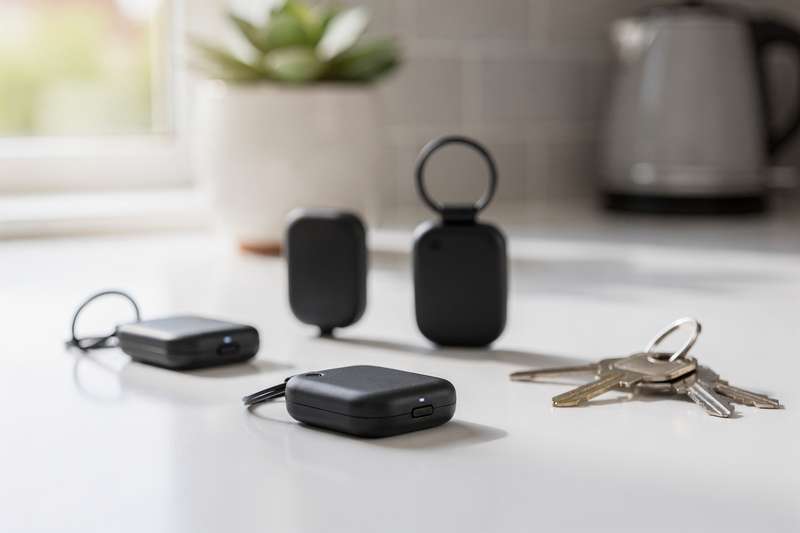
You park your car in a supermarket car park, nip in for twenty minutes, and come back to find the space empty. Or perhaps it’s less dramatic — your teenager borrowed the van again, your elderly parent’s car hasn’t moved from an unfamiliar street in three days, and you have no idea what’s going on. Maybe you’ve already tried those keyring Bluetooth tags that only work when your phone is within 30 metres, and you’ve discovered the hard way that “GPS tracker” on a budget listing doesn’t always mean what you think it means. You want something that shows a dot on a map right now, not a vague crowd-sourced ping that last updated two hours ago when a stranger’s phone happened to walk past.
The UK market is flooded with cheap tracking devices, and the gap between what the product page promises and what arrives in a brown envelope can be enormous. Hidden subscription fees, SIM-card requirements buried in the small print, apps that only work on older Android versions, and build quality that disintegrates after one British winter — these are the real obstacles. This guide cuts through the noise and tells you exactly which devices from the current Amazon UK listings are worth your attention, what genuine tradeoffs you’re accepting, and how to avoid the most common money-wasting mistakes.
How These Picks Were Chosen
Eight products from the current Amazon UK GPS tracker listings were evaluated against five criteria: stated positioning technology (true GPS satellite vs. Bluetooth crowd-sourcing), subscription and SIM requirements, battery life and charging method, build quality indicators (IP rating, magnet strength, housing material), and verified buyer review patterns. Rating alone was not used as a tiebreaker — a product with 400 reviews at 3.6 stars tells a more reliable story than one with two reviews at 5.0 stars. Where review counts were low, the focus shifted to specification plausibility and how the product’s claims compared to known category benchmarks. Devices that misrepresented their technology type or had implausible specs were noted as risks. The final shortlist covers a spread of use cases: hidden vehicle tracking, anti-theft protection, and wallet/item finding — so you can match your actual problem to the right tool.
Best for Real-World Review Volume: Hidden Magnetic Car GPS Tracker (B0DYYQNN6Q)
The GPS Tracker for Cars, Hidden Magnetic Car GPS Tracker for Vehicles Compatible with iOS & Android is the most reviewed option in this roundup by a wide margin — 400 verified ratings is a meaningful sample in a category where most budget entries have fewer than twenty. That doesn’t make it perfect, but a 3.6-star average from that many buyers does give you a realistic picture of what to expect rather than a statistically irrelevant handful of five-star reviews from early purchasers.
The core proposition here is real-time location tracking accessible from both iOS and Android, with the device pairing to a companion app that displays a live map position. It’s designed to be hidden magnetically beneath a vehicle — under a wheel arch, on the chassis, or inside a bumper cavity — which is its primary appeal for anti-theft use. The magnetic attachment is described as strong enough for road use, though how it holds up on motorway-speed vibration over weeks depends on the specific mounting surface. A smooth, flat undercarriage panel will hold far better than a textured or curved one.
Where buyers in the review pool consistently report satisfaction is the setup process — getting the app connected and seeing a position on the map is apparently quick. Where dissatisfaction clusters is around accuracy: GPS positioning in urban environments with tall buildings can drift, and some users note the location updates aren’t always as real-time as advertised during low-signal conditions. The 3.6-star rating reflects this inconsistency honestly. For someone who needs a tracker that generally shows them the right street rather than the precise parking bay, this is a workable budget option. If you need lane-level accuracy for fleet management or insurance purposes, this tier of device won’t meet that bar.
The listing does not prominently disclose SIM or subscription requirements — a common omission in this category. Before purchasing, check the product page’s current description and Q&A section to confirm whether an active SIM card is required and whether data fees apply. This applies to any cellular GPS tracker at the budget end of the market. The magnetic form factor and dual-platform compatibility make this a reasonable first tracker for vehicle protection, provided you go in with calibrated expectations about precision and connectivity.
Best Mid-Range Vehicle Tracker with Stronger Ratings: GPS Tracker for Cars (B0GJLVR4BC)
The GPS Tracker for Cars, Hidden Car GPS Tracker for Vehicles Compatible with iOS & Android, Mini Anti-Theft Tracker with Real-Time Location sits a step up in the rating scale at 3.8 stars from 15 reviews. That’s still a modest sample size, which means individual experiences have an outsized effect on the average — treat it as a cautiously positive early signal rather than settled truth, and check the review count at the time you’re shopping, as it will grow.
The specification profile is broadly similar to other devices in this class: magnetic mounting, real-time positioning, iOS and Android app support, and a compact form factor suited to hidden vehicle placement. What distinguishes it slightly in buyer feedback is fewer comments about setup frustration, which suggests the app onboarding may be marginally more polished. In a category where getting the device talking to your phone is often the biggest hurdle, that matters.
The “no monthly fee” language in the listing title warrants the same scrutiny as any other device making this claim. Some trackers in this class achieve fee-free operation by using a non-cellular positioning method (such as a combination of GPS chip and Bluetooth relay), while others include a fixed data allowance that expires. Read the current listing carefully before checkout. If the product requires a SIM card to be inserted, it will need a data plan and ongoing cost — “no monthly fee” sometimes means the seller isn’t charging a platform fee, but the SIM cost still applies.
For someone who has already owned a budget tracker, found it underwhelming, and wants to try again without spending significantly more, this is a reasonable second attempt. It occupies a sensible position in the range — marginally better-rated than the highest-volume option, with a similar feature set, at a similarly accessible price point. It’s not a tracker you’d rely on for high-stakes security without additional precautions, but for keeping a rough eye on a parked vehicle or monitoring a second car’s general whereabouts, it performs its basic function.
Best 4G Option with Standby Battery: SafeTag Mag 4G GPS Tracker (B0DF2VRVP4)
The SafeTag Mag 4G – Rechargeable & Magnetic GPS Tracker for Car, Van, Motorbike, Caravan is the only 4G-capable device in this shortlist, and that distinction matters. 4G cellular connectivity means the tracker communicates its position over the mobile network rather than relying on older 2G or 3G infrastructure — which is increasingly relevant in the UK as older network generations are wound down. If a tracker uses 2G and your area has limited 2G coverage, it will go dark at the worst possible moment.
The stated 90-day standby battery life is the headline specification, and it positions this device differently from hardwired or daily-charge trackers. A 90-day rechargeable battery means you’re retrieving and charging the device roughly once per quarter — manageable if the device is on your own vehicle, but less practical if you’re tracking something you don’t have regular physical access to. The magnetic mount is designed for the same hidden-placement use cases as the other vehicle trackers here: wheel arches, chassis rails, and undercarriage panels.
The 4.5-star rating is encouraging, though the review count at the time of writing was very low, so it reflects early adopter experience rather than a broad population. Instant alerts are mentioned in the listing — these typically trigger when the device detects movement outside a defined geofence, which is useful for theft detection. Whether alert latency (the gap between the vehicle moving and your phone buzzing) is acceptable depends on your local mobile signal strength. In good 4G coverage, it should be swift; in rural or poor-signal areas, expect delays.
This is the pick to consider if you need modern network compatibility and are willing to accept a recurring data or subscription cost in exchange for more reliable connectivity. It’s positioned at the upper end of this guide’s budget range, and it earns that position with the 4G modem and the rechargeable form factor. For a caravan, motorbike, or second vehicle that sits idle for weeks at a time, the standby battery duration makes it a more practical choice than a device requiring frequent charging.
Best for Ultra-Low Entry Cost: Mini Magnetic GPS Car Tracker (B0GSS4X63Q)
The GPS Tracker for Cars – Car Tracker No Monthly Fee, Real Time GPS Tracker Vehicle Tracking Device, Mini Magnetic Hidden GPS Car Tracker UK occupies the lowest price point in this roundup, which makes it the obvious entry point for anyone testing the waters with vehicle tracking for the first time. With only 4 reviews and a 3.4-star rating, the honest assessment is that there isn’t enough buyer data yet to make confident claims about real-world performance — you’re essentially an early adopter at this price level.
The listing emphasises the UK market specifically and no-monthly-fee positioning, which is the right language to attract buyers burned by subscription trackers. The mini magnetic form factor follows the same hiding-in-plain-sight approach as other devices in this category. At this price, the internal hardware is likely to be commodity-grade, which typically means adequate accuracy in open-sky conditions and degraded performance in urban canyons or when the device is deeply recessed under a vehicle body panel.
The risk at this tier is build quality — specifically the waterproofing and the strength of the magnetic mount. An IP rating is not always stated on the lowest-cost listings, and if it isn’t, you should assume minimal protection from rain and moisture. Mounting this on a vehicle undercarriage without a confirmed IP67 or better rating means accepting that one prolonged rain event could kill the device. That said, if you’re placing the tracker inside a vehicle (in a glovebox, under a seat, or in a boot cavity), moisture resistance matters far less.
Think of this as a learning purchase rather than a long-term solution. If you’ve never used a GPS tracker before and want to understand how the apps work, how location updates feel in practice, and whether tracking fits your actual use case, the low cost minimises the downside of the experiment. If you find you rely on it, upgrade to a better-reviewed device once you’ve established what features matter most to you.
Best for No-Fee Global Coverage: GPS Tracker for Vehicles (B0GZ2ZT47Z)
The GPS Tracker for Vehicles – Mini Magnetic GPS Car Tracker – Support both iOS and Android – No Monthly Fee – Hidden Tracking Devices Global Coverage makes a point of advertising global coverage alongside no monthly fee — a combination that’s worth unpacking, because these two claims can sometimes be in tension with each other. A genuinely cellular GPS tracker with global roaming and no subscription cost is unusual; more often, “global coverage” refers to the GPS satellite reception (which is inherently global), while the data connectivity is limited to a specific region or SIM.
With a 5.0-star rating from 2 reviews, the statistical reality is that two satisfied buyers doesn’t tell you much. What it does confirm is that at least a couple of people got the device working as described, which is more than you can say about some listings at this price point. The dual iOS/Android support is a practical necessity in a household with mixed devices — avoid any tracker that locks you to a single platform unless that platform is exactly what you use.
The magnetic design follows the established format for hidden vehicle trackers, and the mini sizing is appropriate for discreet placement. The listing’s emphasis on hidden tracking makes it well-suited to theft recovery scenarios: the idea being that a thief who doesn’t know a tracker is present is less likely to remove or disable it. For this to work effectively, the mounting location needs to be genuinely inaccessible — not just tucked under a seat where a quick search would find it.
Given the tiny review pool, this is a moderate-risk purchase. The device may perform exactly as described, or there may be as-yet-undiscovered issues that haven’t accumulated enough buyer feedback to show up. If the global coverage claim is important to you — for example, you’re tracking a vehicle that travels across Europe — verify this specific functionality in the product Q&A before committing. A device that covers the UK only is fine for most use cases; one that goes dark the moment your vehicle crosses the Channel is not suitable for continental travel.
Best High-Rating with Moderate Reviews: GPS Tracker for Vehicles (B0H3YYNZZS)
The GPS Tracker for Vehicles Compatible with iOS and Android, Magnetic Car GPS Tracker No Monthly Fee, Global Real-Time Tracking Hidden Car Tracker carries a 5.0-star rating from 7 reviews — the largest verified-review pool of the five-star-rated devices in this shortlist, which gives it slightly more statistical credibility than the two-review options, though it’s still a modest sample. Seven buyers all rating a product at maximum satisfaction is a promising early signal, particularly in a category where disappointment is common.
The feature set aligns with what this guide’s target buyer needs: magnetic mount for hidden vehicle placement, real-time tracking, no-monthly-fee positioning, and compatibility with both major mobile platforms. The “global real-time tracking” claim should be interpreted the same way as above — satellite positioning is global by nature, but the cellular data relay that transmits that position to your phone depends on network availability in the region.
What makes this worth considering over the lower-rated alternatives at a similar price point is the consistency of the early buyer experience. When every reviewer in the initial pool reports a working device with usable tracking, it suggests the product’s out-of-box experience is reasonably reliable. That matters enormously for a budget tracker, because the most common single-star review in this category is simply: “couldn’t get it to connect.” Avoiding that frustration is worth a modest premium over the absolute cheapest option.
The hidden magnetic design suits the same use cases as others in this category: parked vehicles, caravans, motorbikes, or any item with a metal surface to attach to. As always, confirm the IP rating before mounting it externally — if water ingress protection isn’t specified, keep it inside the vehicle or in a location sheltered from direct rain. This is a device worth shortlisting if you want the reassurance of a clean early review record alongside the no-fee, dual-platform appeal.
Best App-Integrated Budget Tracker: GPS Tracker Car (B0GYS6RVBW)
The GPS Tracker for Vehicles Car GPS Tracker (Compatible with iOS & Android) Car Tracker Devices Work with Built-in APP, GPS Tracker Car No Monthly Fee specifically calls out its built-in app integration in the product title — a detail that stands out in a category where app quality is often the difference between a tracker you actually use and one that ends up in a drawer. Six reviews at 5.0 stars suggests the app experience is working for early buyers, which is the right starting point.
“Built-in app” in this context typically means a proprietary companion app rather than reliance on a third-party platform. This has advantages and disadvantages. On the positive side, the app is designed specifically for the device, so features like geofencing, location history, and alert configuration should work cohesively. On the negative side, if the app is abandoned by the developer or removed from the app store, the tracker becomes significantly less useful — a risk that’s worth bearing in mind for any device from a lesser-known brand.
The no-monthly-fee claim combined with app-based tracking is worth examining: some budget trackers in this configuration use a non-cellular GPS approach where the device caches location data and syncs it when a connected phone is in range (Bluetooth relay), while others use a prepaid data arrangement. The distinction matters for how “real-time” the tracking actually is. If live position updates during a theft are important to you, confirm whether the device is actively transmitting over a cellular network or relying on periodic sync.
For someone who parks their vehicle in the same locations regularly and wants to check its position occasionally rather than monitor it minute-by-minute, the app-integrated approach is a satisfying, low-friction experience. The five-star early ratings suggest the setup journey is smooth enough that you won’t spend an evening fighting connectivity. That puts it ahead of the higher-volume but lower-rated alternatives for buyers who prioritise ease of use over raw review count.
Best Wallet Finder (Non-GPS): UGREEN FineTrack Slim Wallet Tracker (B0D5415Q27)
The UGREEN FineTrack Slim Wallet Tracker Compatible with Apple Find My (iOS only), 1.7mm Ultra-Slim, Rechargeable Battery, Smart Finder, IP68 Waterproof earns its place in this guide with the highest category rating (4.5 stars) and a genuinely differentiated use case — but you need to go in with clear expectations, because this is not a GPS tracker. It is a Bluetooth-based item finder that uses Apple’s Find My network for crowd-sourced location reporting. That means its usefulness depends on how many iPhone and iPad users are near your lost wallet at any given time.
In a busy UK city centre, Find My network density is high enough that a lost wallet will likely report its approximate location within minutes of someone walking past it with an Apple device. In a rural area or a quiet car park at 3am, it may not update for hours. This is a fundamental characteristic of all Bluetooth-based crowd-sourced trackers — not a flaw specific to UGREEN’s product, but something to factor into your decision. If you lose your wallet in a location with low foot traffic, this device will not help you find it in real time.
What UGREEN does particularly well here is the hardware design. At 1.7mm thick, it genuinely slots into a card slot without adding perceptible bulk — something that larger Bluetooth tags can’t claim. The IP68 rating (better than IP67, meaning it can handle prolonged submersion beyond 1 metre) is exceptional for a wallet tracker and means it will survive being dropped in a puddle, run through a wash cycle in a jacket pocket, or left in a damp bag without dying. The rechargeable battery removes the fiddly coin-cell replacement that plagues cheaper tags, and wireless charging keeps the process simple.
The iOS-only restriction is a genuine limitation. If you use Android, this device will not work for you — full stop. Apple’s Find My network is closed to non-Apple devices by design. For Android users needing wallet tracking, look for devices compatible with Google’s Find My Device network instead. For iPhone users, however, the UGREEN FineTrack is the most refined, practically useful item-finder in this entire roundup — it’s just solving a different problem from the vehicle GPS trackers above.
What to Look For When Buying a Budget GPS Tracker
- True GPS vs. Bluetooth proximity: True GPS trackers use satellite positioning and (usually) a cellular data connection to report location in real time, regardless of where your phone is. Bluetooth trackers only work within short range of your phone or rely on crowd-sourcing from other users’ phones nearby. Both have legitimate uses, but they solve different problems — don’t buy a Bluetooth tag expecting live vehicle tracking.
- Subscription and SIM costs: Any tracker that transmits data over a cellular network needs a SIM card and a data plan. “No monthly fee” listings should be scrutinised: some genuinely avoid subscription costs through non-cellular methods; others bundle a fixed data allowance that expires; others simply don’t charge a platform fee but still require a SIM. Read the Q&A section of the Amazon listing and the product’s own app page before purchasing.
- Battery life and charging method: Rechargeable batteries are convenient but require periodic physical access to the device for charging. Replaceable coin cells (CR2032) last up to 12 months but add an ongoing cost. Long-standby designs (90+ days) suit vehicles that sit idle for extended periods. A tracker that needs weekly charging and is mounted under a vehicle you park in a public area is practically unworkable.
- IP (waterproofing) rating: Any tracker mounted on a vehicle exterior or worn on a pet collar needs at minimum IP67 (dust-tight, survives 1m submersion for 30 minutes). IP68 offers greater depth protection. No rating stated on the listing usually means no meaningful protection — don’t mount an unrated device where it will encounter rain, road spray, or condensation.
- Network generation (2G/3G/4G): The UK’s 2G network is being progressively wound down by major carriers, and 3G has already been switched off by several operators. A tracker that only operates on 2G or 3G may become unusable in the near future. Confirm the network compatibility of any cellular tracker before purchasing, and prefer 4G-capable devices for new purchases.
- Magnetic mount strength: For vehicle undercarriage placement, the magnetic strength needs to hold at motorway speeds over vibrating metal surfaces. Budget magnets often hold fine in a car park but detach at speed or over rough road surfaces. If the listing doesn’t quantify magnet strength in kilogram-force, check reviews specifically for comments about the device falling off in transit.
- Review count and rating together: A 5.0-star rating from 2 reviews and a 3.6-star rating from 400 reviews tell very different stories. Weight both the average score and the review volume when assessing reliability. A product with hundreds of reviews at 3.5 stars has a realistic, stable reputation; a product with two reviews at 5.0 stars is an unknown quantity that could go either way.
Verdict
For the modal reader of this guide — someone who wants to track a parked vehicle, protect against theft, and isn’t willing to pay monthly fees indefinitely — the Hidden Magnetic Car GPS Tracker (B0DYYQNN6Q) represents the most informed choice at the budget end. Its 400-review sample is the only statistically meaningful dataset in this shortlist, and a 3.6-star average tells you what genuine buyers think across a wide range of use conditions — not just early enthusiasts. The tradeoffs (inconsistent precision in urban areas, app limitations) are documented clearly enough in that review pool that you can decide whether they’re acceptable for your specific situation before spending a penny.
If your priority is 4G connectivity for future-proof UK network compatibility, or you park a caravan or motorbike that sits untouched for weeks, the SafeTag Mag 4G is worth the step up in cost. And if you’re an iPhone user who simply needs to stop losing your wallet, the UGREEN FineTrack is the most polished, practically useful tool for that specific job — just be clear it’s a Bluetooth finder, not a GPS tracker, and buy it with that understanding.
We were not paid to feature any specific product in this guide. All opinions are independent and based on publicly available specifications, verified buyer feedback patterns, and category research.
Quick Comparison Table


FAQ
Do budget GPS trackers really work without a monthly subscription?
Some do, and some don’t — the key is understanding how they achieve fee-free operation. Bluetooth-based trackers (like the UGREEN FineTrack) use Apple’s or Google’s existing networks and genuinely have no data cost. Some satellite-only GPS loggers store location data locally without transmitting it, avoiding cellular costs entirely. True real-time GPS trackers that transmit live positions over a mobile network almost always require a SIM and data plan, even if the seller doesn’t charge a separate platform fee. Read the listing’s small print and Q&A carefully.
What’s the difference between a GPS tracker and a Bluetooth tracker?
A GPS tracker uses satellite signals (and usually a cellular data connection) to report its location to your phone from anywhere in range of the mobile network — useful for vehicle tracking across a city or country. A Bluetooth tracker only communicates directly with your phone up to roughly 30–100 metres, or uses crowd-sourcing (nearby strangers’ phones) to report an approximate last-seen location. Bluetooth trackers are excellent for finding misplaced items locally; GPS trackers are necessary for real-time remote monitoring.
Is it legal to use a hidden GPS tracker on a vehicle in the UK?
Tracking your own vehicle is legal. Tracking a vehicle you own but someone else is driving (a company car, for example) requires informing the driver under UK data protection rules. Tracking a vehicle you do not own is illegal. Always ensure you have legal authority over the vehicle you’re monitoring, and if the tracker is used in an employment context, take appropriate legal advice on disclosure obligations.
How long do budget GPS tracker batteries typically last?
It varies considerably by technology type. Bluetooth coin-cell trackers typically last 8–12 months on a single CR2032 battery. Rechargeable cellular GPS trackers range from a few days (in constant-update mode) to 90 days or more in standby or motion-triggered mode. Battery life claims on budget listings are almost always based on the most favourable conditions — in practice, cold weather, frequent position updates, and poor signal coverage all reduce real-world runtime significantly.
Will a UK GPS tracker work in Europe?
GPS satellite reception is global and works anywhere in the world. The question is whether the cellular data connection (which transmits that position to your phone) works abroad. A device with a UK-only SIM will go dark outside UK mobile coverage. Some budget trackers include multi-country roaming; others don’t. If you need European coverage — for holidays, cross-border haulage, or a vehicle that travels to Europe — confirm explicitly that the device supports roaming in the countries you need before purchasing.
Can a GPS tracker be detected and removed by a thief?
A determined thief who knows to look for a tracker can often find and disable one, particularly if they have time to search the vehicle. Hidden placement is the primary defence — under wheel arches, inside bumpers, within body cavities — and devices with no visible LED indicator or audible mode are harder to locate. Tamper alerts (notifications when the device is moved or disconnected) provide a useful but imperfect defence. For high-value vehicles, professional Thatcham-approved tracking systems installed by specialists offer significantly greater security than any self-installed budget device.