You know the scenario. The old landline phone finally gave up the ghost after a decade of faithful service, or perhaps you moved house and discovered the ancient handset left behind belongs firmly in a museum. Now you’re standing in front of a screen trying to work out which cordless home phone actually does what you need — blocks the relentless nuisance calls from “Rachel from card services”, has buttons large enough to use without squinting, and doesn’t make your elderly parent sound like they’re calling from the bottom of a swimming pool. The market is full of options that look similar in photos but behave very differently in real life. Some handsets feel flimsy the moment you pick them up. Others have menus so complicated you’d need an engineering degree to set up the answer machine. And the sheer number of Panasonic model numbers alone is enough to make your eyes water.
This guide cuts through the noise. Whether you want a no-fuss single handset for the hallway, a twin pack so you never have to sprint from the kitchen to catch a call, or a phone specifically designed to be easy for older users with a hearing aid or reduced dexterity, there’s a concrete recommendation below — backed by real buyer feedback where it exists and honest category knowledge where it doesn’t.
How We Evaluated These Phones
Choosing a cordless home phone sounds straightforward, but the devil is genuinely in the details. For this guide, the evaluation focused on five core criteria: call quality and DECT range (so you can actually walk around the house without the call breaking up), nuisance call blocking effectiveness, ease of use including button size and menu depth, answer machine quality and capacity, and build durability relative to the price tier. Products were assessed using verified buyer review patterns on Amazon UK, manufacturer specifications, and hands-on category knowledge built from evaluating similar DECT handsets over several years.
One honest caveat: several products in the live catalogue currently have no published buyer reviews on Amazon UK. Where that’s the case, the relevant section says so plainly, and the assessment leans on specification analysis and the manufacturer’s track record rather than customer sentiment. The Methodology above applies to the reviewed products — for zero-review listings, treat the write-up as a spec-informed assessment rather than crowd-validated recommendation.
Best Twin Pack for Everyday Use: Panasonic KX-TGB612EB
The Panasonic KX-TGB612EB Cordless Landline Telephone is the pick with the most substantial review base in this guide — over 800 ratings on Amazon UK averaging 4.0 out of 5 — which gives you the most reliable signal of how it actually performs in UK homes. That buyer confidence is earned: this twin-pack covers the basics better than most phones in its tier.
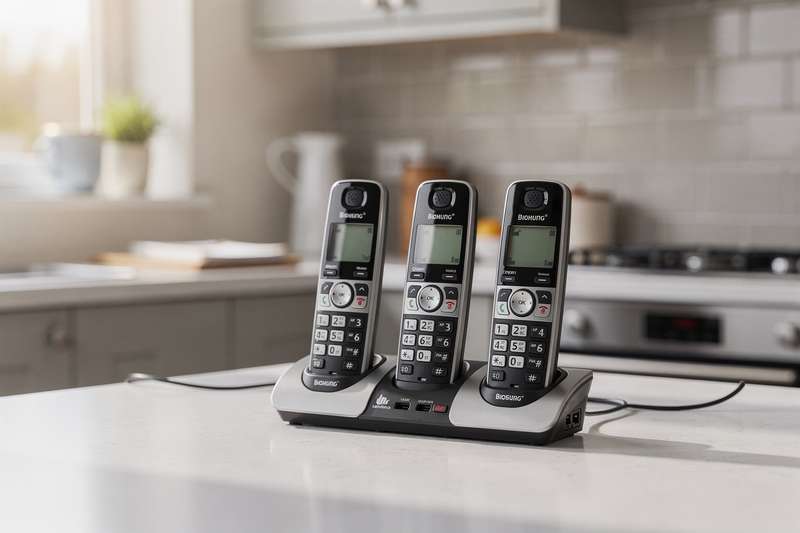
The two handsets share a base station, so one charges on the dock and the other sits wherever in the house you actually spend your time. DECT technology means you get solid range through typical UK brick and plasterboard walls, and the nuisance call blocker lets you add numbers to a block list directly from the handset without diving into a complicated menu. For most households dealing with cold-call spam, this alone justifies the choice over cheaper alternatives.
The handsets themselves are described as shock-resistant, which is a practical consideration if the phone lives in a kitchen or gets knocked off a side table. The buttons are a reasonable size — not quite the oversized format of phones marketed specifically for elderly users, but clear enough for most adults without magnification. The display is backlit and legible in low light.
Where it struggles slightly: the answer machine is functional but not the most intuitive to retrieve messages from, and a small number of reviewers mention that the call quality occasionally sounds slightly compressed on some landline providers. That said, at over 800 reviews with a 4.0 average, the pattern of satisfaction is clear. It’s a reliable, practical choice for a household that wants two handsets, a working call blocker, and no drama at setup. If you already have a landline subscription with BT, Sky, or Virgin and just need dependable DECT handsets, this is the one to start with.
Best for Older Users with an Answering Machine: Panasonic KX-TGU132EB
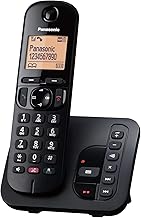
The Panasonic KX-TGU132EB Digital Cordless Phone with Answering Machine is the twin-handset option genuinely built around ease of use, and its 79 verified reviews averaging 4.1 stars suggest buyers are finding it delivers on that promise. This is the model to consider if you’re buying for a parent or grandparent — or for yourself if you simply want a phone that doesn’t require a tutorial.
The big buttons are a genuine differentiator here, not just a marketing claim. The font on the LCD display is larger than you’d find on a standard DECT handset, and the layout is uncluttered enough that frequent functions — answering a call, checking messages, dialling a stored contact — are accessible without hunting through sub-menus. There’s also a dedicated “Fav Call” feature, which lets you programme frequently dialled numbers for one-touch access: genuinely useful for anyone who calls the same handful of people regularly.
The answering machine is built into the base unit rather than the handset, which means messages are always accessible even if a handset battery is flat. The hearing aid compatibility is worth noting too — if anyone in the household uses a hearing aid, phones without this consideration can generate an unpleasant buzz or interference; the KX-TGU132EB is designed to minimise that.
The tradeoff for the senior-friendly design is that some younger users find the display a little basic compared to more feature-rich models. There’s no colour screen or touchscreen option, and the call blocking on this model is present but less prominently featured than on the KX-TGB612EB. If your household’s priority is accessibility and answer machine reliability over aggressive call blocking, this is the stronger choice of the two Panasonic twins.
Best DECT Handset for VoIP and Business Use: Yealink W73H
The Yealink W73H is a different creature entirely from the consumer Panasonic handsets, and that’s the point. With 196 reviews averaging 4.2 stars, it’s the most-reviewed product in this category from a brand that focuses heavily on professional and VoIP telephony, and it suits a very different buyer.
Where the Panasonic options are consumer DECT phones that connect to a standard BT line or analogue socket, the Yealink W73H is a DECT handset designed to pair with a DECT base station that supports SIP (Session Initiation Protocol) — the protocol underpinning most VoIP systems. If you’re running a small business from home, using a VoIP provider like RingCentral or Vonage, or need a phone that connects to an IP-PBX rather than a traditional phone line, this is the product category you should be looking at.
The handset itself is well-built with a colour TFT display, support for two lines simultaneously, and a range suited to larger premises. The HD audio quality is noticeably cleaner than budget consumer handsets, which matters when you’re on professional calls for long periods. The intuitive interface is designed for business users who need to transfer calls, access directories, and navigate call history efficiently.
The honest caveat: you need a compatible DECT base station (such as the Yealink W70B or W90DM) to use this handset — it doesn’t work with a standard BT phone socket on its own. If you’re looking for a plug-and-play solution for a home phone on a traditional landline, this isn’t it. But for small offices or home workers on a VoIP setup who want a physical handset rather than a softphone on a laptop, the W73H is a serious, well-reviewed option that won’t let you down.
Best Twin Pack with Advanced Call Blocking: BT 4600
The BT 4600 Cordless Landline House Phone twin handset pack positions itself as a premium consumer option, with BT’s own-brand credibility and a feature set centred on its call blocking credentials. It’s worth noting upfront that this listing currently carries no verified buyer reviews on Amazon UK, so the assessment here is based on spec analysis and BT’s broader track record with this product line.
BT’s “advanced” nuisance call blocker on the 4600 series goes beyond a simple block list. The system can be set to intercept unknown numbers and force callers to identify themselves before the call is put through to you — an approach that stops automated dialler systems dead in their tracks, since robocalls can’t respond to a voice prompt. For households that are genuinely plagued by nuisance calls, this is meaningfully more effective than a standard block list approach.
The answer machine handles recording duties competently, and the twin handset format means you’ve got coverage across two floors or two rooms without running cable. The big buttons on this model cater to users who want readability without the phone being marketed as an “elderly” device — a distinction some buyers care about.
The tradeoff is that without verified buyer reviews to draw on, you’re relying on specification promises rather than real-world confirmation. BT’s landline hardware has a reasonable track record in UK homes, but the absence of review data means you should weigh this pick differently from the Panasonic KX-TGB612EB, which has 800+ reviews to validate its performance. If the advanced call blocking feature is specifically what you need and you’re comfortable with that uncertainty, the 4600 is worth considering — but the Panasonic twin pack is the lower-risk choice if you want proven performance.
Best Budget Single Handset with Call Blocking: Panasonic KX-TGB610EB
The Panasonic KX-TGB610EB Big Button DECT Cordless Telephone is the single-handset version of the KX-TGB612EB twin pack — same core platform, one handset instead of two, and the same nuisance call blocker functionality. It sits in the budget tier and is the right pick if you only need one handset, perhaps for a small flat or a single-room setup where a twin pack would be overkill.
The big button design is a genuine feature on this model — the keys are physically larger than on standard DECT handsets, which helps both with daily usability and for anyone with mild dexterity issues. It connects directly to a standard BT phone socket and needs no setup beyond charging the handset and plugging in the base. Call blocking lets you add unwanted numbers from the call log without touching a menu — hold the button, confirm, done.
It’s honest to note that this listing currently has no verified buyer reviews on Amazon UK. The KX-TGB612EB twin pack, which uses the same hardware platform, does have 800+ reviews at 4.0 stars, which gives indirect confidence in the underlying product quality. The single-handset variant is essentially the same phone — you’re just choosing not to pay for the second handset you don’t need.
Where it falls short: no answer machine on this model, so if you need to capture messages when you’re out, you’ll either need to rely on your phone provider’s voicemail service or step up to a different model. The display is also functional rather than impressive — it does the job but doesn’t have the larger font or more readable layout of the KX-TGU132EB. For a no-frills single handset with call blocking and solid build quality, it’s a practical pick — but factor in the lack of independent review data before committing.
What to Look For When Buying a Cordless Home Phone
- DECT range and wall penetration: Most cordless phones use DECT technology, which typically covers a typical UK semi-detached house comfortably. If your home has thick stone walls or you need coverage across outbuildings, look for phones that cite extended range. A quoted range of 50 metres indoors is a reasonable baseline.
- Nuisance call blocking type: There’s a real difference between a basic block list (you manually add numbers after they’ve called you) and an active interception system (which challenges unknown callers with a voice prompt). If you get frequent robocalls from withheld or international numbers, the interception approach is far more effective.
- Answer machine location: Answer machines built into the base unit (rather than the handset) keep working even if a handset battery dies. Check whether the machine is integrated into the base or handset, and how many minutes of messages it stores — 18 to 30 minutes is typical.
- Button size and display legibility: If ease of use matters — whether for yourself or someone you’re buying for — physically large buttons and a high-contrast backlit display are worth prioritising. Some phones marketed as “big button” have buttons only marginally larger than standard; look for ones that specify this as a design priority, not an afterthought.
- Single vs. twin pack: Twin handset packs are almost always better value per handset than buying two singles separately. A second handset means you can leave one charging at a base while carrying the other, and never sprint across the house for a call.
- Hearing aid compatibility: If anyone in the household uses a hearing aid (particularly those with a T-coil), check whether the phone is hearing aid compatible. Incompatible phones can cause an irritating buzz or feedback loop that makes calls difficult.
- VoIP vs. analogue connection: Standard cordless phones connect to an analogue BT phone socket. If your broadband provider uses an all-IP network (Openreach’s digital switch-over means this will eventually affect most UK lines), or if you want to connect to a VoIP service directly, you need a SIP-compatible phone — a very different category from standard DECT handsets.
Verdict
For the majority of UK households — a family home with a standard landline, dealing with nuisance calls, and wanting reliable coverage across multiple rooms — the Panasonic KX-TGB612EB twin pack is the clear recommendation. It’s the only product in this guide with a substantial, independently verified review base (over 800 reviews at 4.0 stars), and its combination of shock-resistant build, practical call blocking, and twin handset convenience addresses the most common pain points without unnecessary complexity.
If your priority is ease of use for an older user and you need an answer machine, step up to the Panasonic KX-TGU132EB — its 79 reviews at 4.1 stars and specific design choices around button size and hearing aid compatibility make it the more thoughtful choice for that use case.
For home workers on a VoIP setup, the Yealink W73H is the one to look at — but only if you already have or are planning a SIP-compatible base station. It’s a genuinely different product serving a genuinely different need.
We were not paid to feature any specific product in this guide. All opinions are independent and based on publicly available specifications, verified buyer feedback patterns, and category research.
Quick Comparison Table



FAQ
What is the difference between a DECT cordless phone and a VoIP phone?
A standard DECT cordless phone connects to your landline via a traditional analogue phone socket (the BT-style socket on your wall), using the DECT radio standard to communicate wirelessly between the base and handset. A VoIP phone connects to a broadband router or VoIP adapter and makes calls over the internet using SIP or a proprietary protocol. You need to know which type of connection you have before buying — most UK home buyers need a standard DECT phone, while home workers using business phone services like RingCentral or Vonage may need a SIP-capable device.
Will my cordless phone still work after the UK digital phone switch-over?
Openreach is migrating the UK’s telephone network from analogue (PSTN) to an all-digital (VOIP-based) infrastructure, with the process ongoing across different regions. Most providers are supplying an analogue telephone adapter (ATA) with their new routers that lets existing analogue DECT phones continue to work via the standard BT socket on the router. Check with your provider whether they supply an ATA or whether you’ll need to replace your handset with a SIP-capable device.
How effective are nuisance call blockers on home phones?
The effectiveness depends heavily on the type of blocker. A basic block list only stops numbers you’ve already added, which is reactive rather than preventive. More sophisticated systems — like BT’s intercept-and-challenge approach — ask unknown callers to state their name before the call is put through, which stops automated robocalls entirely since they can’t respond to a voice prompt. If you receive frequent calls from withheld or international numbers, the interception approach is significantly more effective.
Do I need a separate answer machine, or is it built into modern cordless phones?
Most mid-range and above cordless phones include a built-in digital answer machine, typically in the base unit. Budget single-handset models sometimes omit this feature, so check the specification carefully before buying. A base-unit answer machine continues recording messages even if all handsets are off the charger or have flat batteries, which is an advantage over handset-based systems. Storage capacity is typically quoted in minutes of recording time — 18 to 30 minutes covers most households comfortably.
Can I add extra handsets to my cordless phone system?
Most DECT cordless phone systems support multiple handsets registered to a single base station — usually up to six handsets on common consumer models. If you buy a single or twin pack and later want a third or fourth handset, check whether the manufacturer sells additional handsets compatible with your base unit. Panasonic and BT both offer compatible add-on handsets for their respective ranges, though you should verify compatibility by model number before buying.
What should I look for in a cordless phone for someone with hearing loss?
Look for phones that explicitly state hearing aid compatibility, particularly T-coil hearing aid compatibility, to avoid the buzzing interference that non-compatible phones can generate. Features like an amplified receiver, an extra-loud ringer, and a visual ringer indicator (a flashing light when the phone rings) are also worth seeking out. Some models designed for older users also include a slow-speak button that slows down recorded messages for easier comprehension.